


September 25, 2026
|
5 min read


Published: September 25, 2026
.webp)
Blazingly fast way to build, track and deploy your models!
An MCP Gateway sits between AI agents and MCP servers. It controls which tools an agent can see, enforces authentication, routes requests, and logs every invocation. Instead of agents connecting directly to GitHub, databases, or internal APIs, they connect to the gateway, which acts as a centralized control layer for all tool traffic.
AI systems are no longer limited to answering questions. Increasingly, they act. They read support tickets, query internal databases, update CRMs, open Jira issues, and sometimes trigger production workflows. The shift from conversational assistants to operational agents changes the architecture underneath.
Most teams begin with direct connections. An LLM calls a Slack API. Another agent queries Postgres. A third talks to GitHub. It works, at first. But as the number of agents and tools grows, the pattern becomes brittle. Credentials are scattered. Access rules live inside prompts. There is little centralized visibility into what any given agent is actually doing.
The Model Context Protocol (MCP) introduces a standard way for models to discover and invoke external tools. It removes the need to build custom glue code for every model–tool pairing. That alone is meaningful.
But MCP by itself does not solve governance. It does not enforce access control. It does not provide centralized auditing or cost boundaries. In enterprise environments, those gaps matter.
This is where the idea of an MCP Gateway emerges. It is not an optional add-on but rather a control layer that makes MCP usable at scale.
The first generation of LLM systems was largely passive. You sent a prompt. You received a text. If the answer was wrong, it was inconvenient, not catastrophic. That model no longer holds.
Modern AI agents query databases, modify tickets, send emails, and trigger downstream automation. They do not just generate language. They execute intent. And once execution enters the picture, architecture matters more than prompt engineering.
Most teams begin with direct integrations. An agent is given a GitHub API key. Another gets Slack credentials. A third connects to the CRM. Each integration is built independently, often inside application code or wrapper scripts. It feels fast. It is fast. But it does not scale.
Every agent manages its own credentials. Access rules are scattered. Observability becomes fragmented across systems. Adding a new tool requires wiring yet another direct connection. Soon, no one has a clear picture of which agent can touch which system.
The pattern looks something like this:
.webp)
There is no control layer. No central audit trail. No unified policy enforcement.
As agent counts increase, this topology turns fragile. What begins as flexibility gradually becomes operational risk. A standardized integration layer is not about elegance. It is about containment.
The Model Context Protocol, or MCP, is an open protocol that defines how AI models discover and interact with external tools. Instead of every model integrating with every API differently, MCP introduces a shared language between agents and systems. It builds on concepts similar to the language server protocol, applying the same idea of standardized capability negotiation to AI tool use.
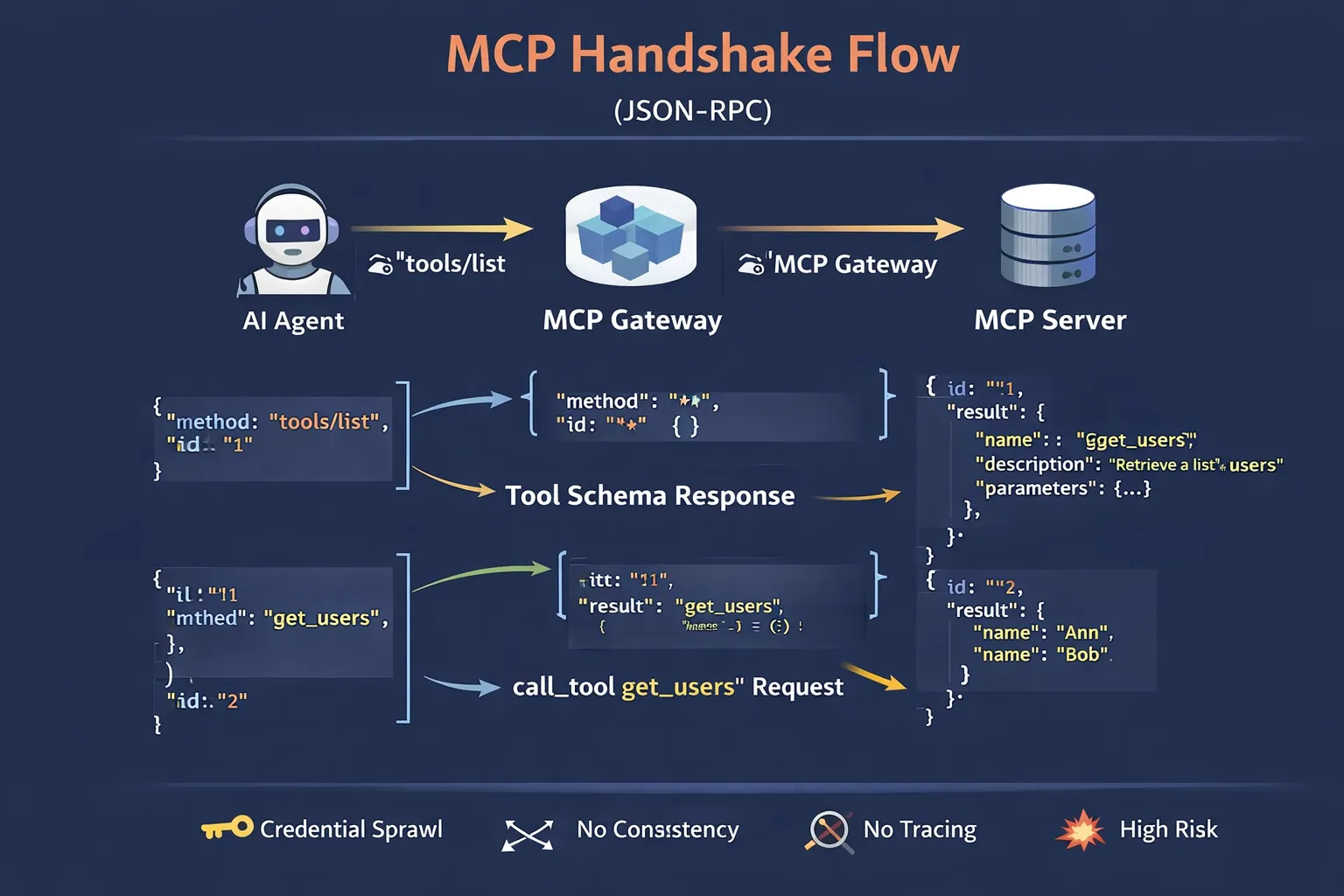
At its core, MCP uses JSON-RPC over HTTP. When an MCP client connects to an MCP server, it performs a discovery step. The model sends a tools/list request to understand what available tools are exposed.
{
"method": "tools/list"
}
The server responds with a structured list of MCP tools, including their names, input schemas, and expected outputs. From there, the agent can invoke a specific tool using a call_tool method, passing arguments that conform to the declared schema.
This handshake matters. It standardizes capability discovery and invocation across providers and systems. A GitHub connector and a Postgres connector expose tools differently at the backend, but through MCP they present a unified interface to the model.
In effect, MCP removes the combinatorial explosion of custom integrations. Instead of writing bespoke glue code for every model–tool pairing, teams implement MCP servers once and allow models to interact through a uniform protocol. This has become the MCP standard for how AI models communicate with backend services and data sources across the MCP ecosystem.
But protocol standardization is not the same as governance. That distinction becomes important.
If MCP defines how models talk to tools, an MCP Gateway defines who is allowed to speak, and under what conditions.
An MCP Gateway sits between AI agents and one or more MCP servers. Instead of agents making direct connections to GitHub servers, database connectors, or workflow engines, they connect to the gateway. The gateway becomes the single endpoint: a central point of ingress for tool discovery and invocation. It functions as a centralized proxy for all MCP traffic.
From the agent's perspective, nothing changes structurally. It still performs a tools/list handshake. It still issues call_tool requests. But those requests are intercepted, evaluated, and routed by the gateway before any backend system executes them.
At a minimum, the MCP Gateway performs four roles.
First, discovery control. It filters which tools are visible to which agents.
Second, routing. It forwards requests to the appropriate MCP server.
Third, authentication. It validates identity and may propagate credentials on a user's behalf.
Fourth, policy enforcement. It can apply rate limits, scope restrictions, or execution constraints before forwarding traffic.
Architecturally, the difference is simple but profound:
.webp)
The MCP Gateway centralizes control without modifying individual servers. MCP remains the protocol. The gateway becomes the management layer that makes protocol use safe in production.
MCP standardizes interaction. It does not standardize control.
Out of the box, MCP does not define role-based access control. If an agent can connect to a server, it can discover every tool that server exposes. There is no native concept of scoping visibility per team, per workload, or per user. Access becomes an infrastructure concern outside the protocol itself.
There is also no centralized audit layer. Each MCP server may log its own activity, but there is no inherent aggregation point showing which agent invoked which tool, on whose behalf, and in what sequence. Reconstructing intent across different MCP servers becomes a manual exercise.
Cost governance presents a similar gap. MCP does not track token consumption or enforce usage boundaries. An agent can invoke tools repeatedly, triggering model calls or database queries, without any built-in budget constraints.
Then there is the tool explosion problem. As organizations add connectors — GitHub, Slack, internal services, observability systems — the list of discoverable tools grows. Without visibility controls, agents are exposed to capabilities they may not need, which complicates reasoning and increases blast radius. In real time, the absence of security policies turns a governance gap into an active liability.
MCP is necessary. It is not sufficient. Enterprise deployment demands an additional control layer.
In production environments, what is an MCP Gateway best understood as? Not just a routing proxy, it behaves more like a control plane layered above multiple execution planes.
The execution plane consists of MCP servers. They connect to GitHub, Postgres, Slack, internal APIs, and legacy systems. They perform actions. They return results.
The control plane lives at the gateway. It decides which agent can see which tools, under which identity, and with what constraints. That separation is subtle, but it changes how risk is managed. An MCP Gateway is a reverse proxy purpose-built for MCP traffic, with security features that standard proxies do not offer.
One critical capability is identity propagation. In many real systems, an AI agent acts on behalf of a human user. Without propagation, the agent often runs with a shared service account. With a gateway, the authenticated user's identity can be injected downstream via OAuth or OIDC tokens.
The flow looks something like this:
.webp)
The gateway validates the JWT, maps it to Alice's permissions, and forwards the request using her scoped credentials. If Alice cannot delete a repository, neither can the agent acting for her. Authorization is enforced at the protocol layer, not assumed in prompts.
Tool slicing is another core function. The gateway filters tools/list responses, exposing only a subset relevant to a particular team or workload. Dangerous capabilities simply never appear in the agent's context. Sensitive data and high-privilege endpoints remain invisible to agents that have no business accessing them.
Finally, policy enforcement happens at the protocol layer. Before a call_tool request reaches a server, the gateway can inspect arguments, apply quotas, or block operations entirely.
In production AI systems, that mediation layer becomes the difference between experimentation and governable infrastructure.
Direct model-to-tool connections look efficient until you examine the failure modes.
The first issue is credential sprawl. Each agent often carries its own API keys or service accounts. Those keys live in environment variables, config files, or secret stores scattered across services. Rotating credentials becomes tedious. Revoking direct access for a compromised workflow is worse. There is no single choke point.
Then comes excessive tool exposure. When agents are given broad direct access to all available MCP servers, the tools/list response can become crowded. Models perform better when the action space is constrained. Exposing dozens of loosely related external tools increases reasoning complexity and raises the probability of incorrect tool selection. In other words, security posture and model performance degrade together.
Observability suffers too. Without a gateway aggregating MCP traffic, tracing an agent's behavior requires combing through logs across multiple MCP servers. There is no unified execution timeline. Debugging becomes guesswork.
Finally, there is a blast radius. If an agent connects directly to production systems with high-privilege credentials, mistakes propagate immediately. A misinterpreted instruction can trigger irreversible operations.
The absence of a control layer does not merely reduce elegance. It increases operational risk in ways that compound quietly over time.
The terminology can be confusing, especially since both components speak MCP.
An MCP server is an executor. It connects to a specific system, GitHub, Slack, Postgres, an internal API, and exposes tools that perform concrete actions. It knows how to translate a call_tool request into a database query or an API call. It does the work.
An MCP Gateway, by contrast, is an orchestrator. It does not execute business logic. It governs access control to backend servers. It filters discovery responses, enforces authentication, propagates identity, applies security policies, and routes requests to the correct execution endpoint.
The distinction is structural:
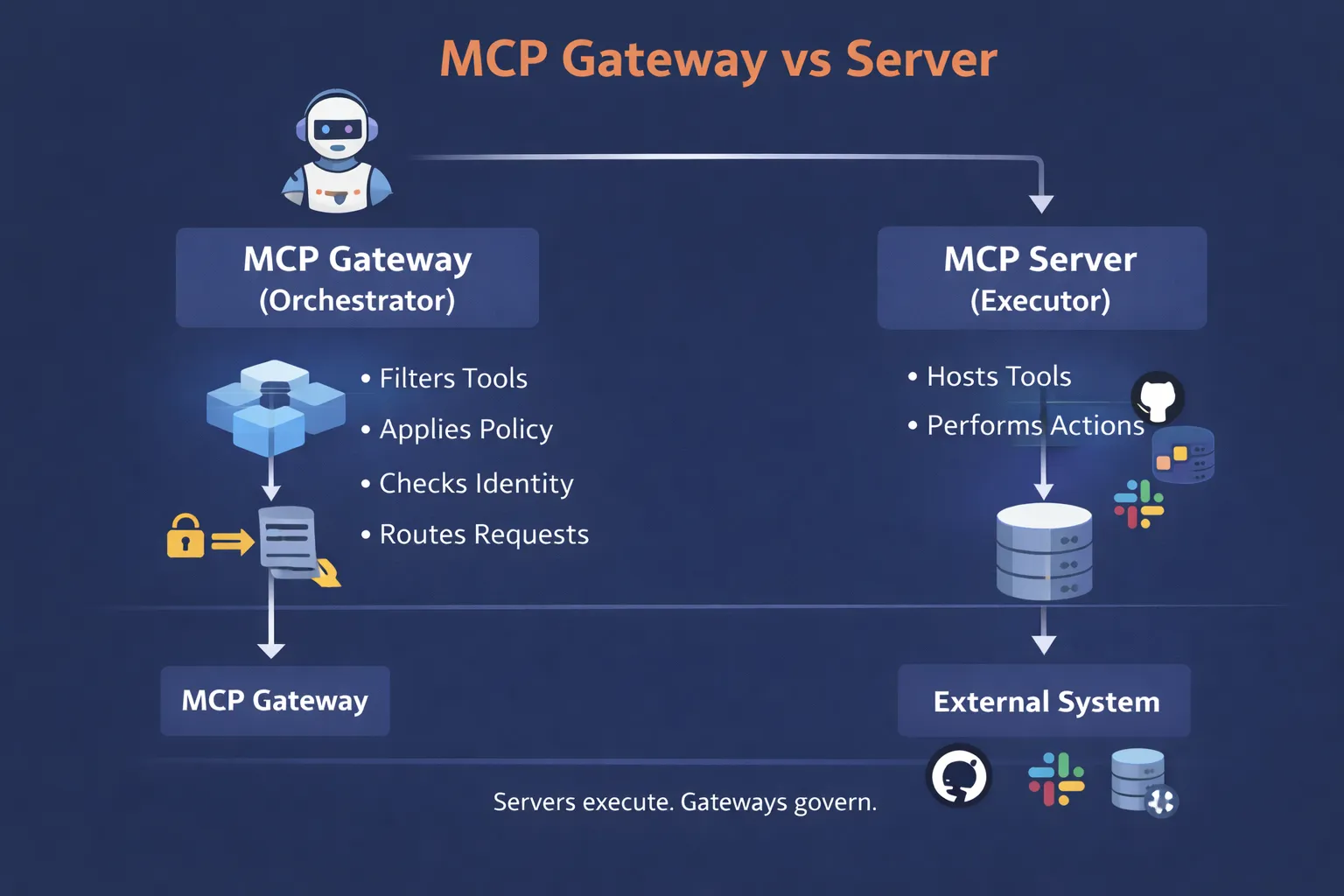
Without servers, there are no tools. Without gateways, there is no centralized control. In production architectures, both roles typically coexist, each operating at a different layer of responsibility. Adding new MCP servers is straightforward when they register through a gateway; new servers are onboarded once, and their tools become available selectively rather than universally.
MCP is not a replacement for APIs, and it is not a substitute for an API gateway.
APIs remain the foundational interface between systems. They define contracts, enforce schemas, and expose business capabilities in a structured way. API gateways sit in front of those interfaces, handling authentication, rate limiting, traffic management, and sometimes transformation.
MCP operates at a different layer. It does not replace REST endpoints or GraphQL. Instead, it makes those APIs usable by AI models. Through standardized tool discovery and invocation, MCP translates structured API capabilities into a format models can reason about. The distinction matters especially for system integration involving both traditional services and AI-driven workflows.
In modern enterprise architectures, the two often coexist. APIs serve app services and integrations. API gateways govern traditional HTTP traffic. MCP servers expose selected capabilities to agents. An MCP Gateway then governs agent access control.
The relationship is complementary, not competitive. Removing APIs would collapse system integration. Removing MCP would make those APIs invisible to models. Production AI systems typically require both layers working together.
Not every gateway that forwards JSON-RPC traffic qualifies as enterprise-ready. Production environments demand more than routing. They require identity, visibility, and deliberate scoping across use cases ranging from customer support to complex multi-step workflows.
.webp)
In serious deployments, agents rarely act alone. They act for someone. An enterprise MCP gateway validates the incoming user context, typically via JWT or OIDC, and propagates that identity downstream. Instead of a shared service key, requests execute on behalf of a specific user.
This prevents the “generic agent” problem. If a user cannot access a production repository, the agent cannot either. Identity becomes enforced at the protocol layer, not assumed in prompts.
An enterprise MCP Gateway maintains a registry of available MCP servers and MCP tools. Instead of each agent discovering everything by default, visibility is managed centrally. New capabilities from new servers are registered once and exposed selectively. This configuration eliminates the documentation gap that typically emerges when teams lose track of what tools exist and who can use them.
Every tools/list and call_tool invocation can be logged with metadata: agent identity, user context, arguments, and response status. This creates a coherent audit trail across systems. Debugging and compliance reviews become tractable rather than forensic.
Production systems often require scoped exposure. A support agent does not need database administration tools. A finance workflow does not need deployment controls. This kind of scoping directly improves user experience; agents behave more predictably when their action space is intentionally limited.
A simple configuration might look like:
virtual_server:
name: support-scope
allow_tools:
- github.list_issues
- github.get_comments
- crm.update_ticket
ゲートウェイはそれに応じて検出応答をフィルタリングします。エージェントは、見るべきものだけを見ることができます。
エンタープライズ機能とは、ツールを増やすことではありません。それは、制御されていない攻撃対象領域を減らすことです。
TrueFoundryのMCPゲートウェイは、企業のワークロードが実際に存在する場所、つまり顧客のクラウド環境内で動作するように設計されています。Dockerコンテナを使用して専用VPC内にデプロイできるため、ツールトラフィック、認証情報、モデルのやり取りが外部の共有インフラストラクチャを経由する必要がありません。規制対象業界にとって、このデプロイモデルだけでも摩擦を軽減します。
アクセス制御は、エージェント、MCPツール、チーム全体にわたるきめ細かなRBACで処理されます。認証情報をエージェントのランタイムにハードコーディングする代わりに、ゲートウェイは一元化されたIDプロバイダーと統合し、ロールをスコープ化されたツールの可視性にマッピングします。セキュリティポリシーは宣言型であり、承認は実行前に行われます。
認証情報の保管もまた実用的な懸念事項です。APIキーとサービスキーは、コードや環境ファイルに埋め込むのではなく、一元的に保存および管理されます。ローテーションポリシーは、何十ものエージェントにわたってではなく、MCPゲートウェイレベルで一度適用できます。
安全なテスト環境も同様に重要です。チームはステージングエージェント用に隔離されたツールスコープを定義し、本番システムへの偶発的な直接アクセスを防ぐことができます。この分離は、慣例だけでなく構造的に強制されます。
可観測性がシステム全体を結びつけます。ツール呼び出し、ID伝播、テレメトリ、ポリシー決定は完全に追跡可能です。使用パターン、レイテンシ、MCPトラフィックに関するメトリクスは単一のダッシュボードに表示されます。何か問題が発生した場合でも、複数のシステムにわたるイベントを再構築することなく、実行チェーンを検査できます。
目標は、それ自体が目的の抽象化ではありません。それは、封じ込め、明確さ、そして制御された実行を MCP自動化プラットフォーム あなたがすでに管理しているインフラストラクチャ内で。
チームがMCPゲートウェイを評価する際、本当の比較対象は他のゲートウェイだけではありません。それは、彼らがすでに使用している代替手段との比較です。
TrueFoundryの立ち位置を確認するための詳細な比較。
直接アクセス制御は速度を最大化しますが、制御は分散され脆弱になります。APIゲートウェイは境界セキュリティを向上させますが、エージェントの意図やツールスコープを理解しません。 最高のMCPゲートウェイ モデル駆動型実行とMCPトラフィックを特に意識した管理レイヤーを導入します。
この違いは微妙ですが、AIシステムが実験段階に留まるか、それともインフラになるかを決定します。
デモを予約する TrueFoundry MCP Gatewayがエンタープライズ環境でどのように機能するか、詳細をご確認ください。
MCPはモデルとツールの間で共通言語を提供します。それだけでも、大きな進歩です。これにより、統合の無秩序な拡大が減り、エージェントが外部システムを検出・呼び出す方法が標準化されます。しかし、標準化はガバナンスではありません。
AIエージェントが運用システムに近づくにつれて、それらを取り巻くアーキテクチャが決定的なものとなります。誰がどのツールを見ることができるのか?誰のIDでアクションが実行されるのか。監査証跡はどこに保存されるのか。リスクはどのように封じ込められるのか。これらの疑問はプロトコル層の上に存在します。
MCPゲートウェイは、相互運用性を損なうことなく制御を導入することで、それらの疑問に答えます。
エンタープライズチームにとって、本当の変化は意識の面です。エージェントはもはやAPIに接続された実験的なものではありません。彼らは本番インフラストラクチャ内のアクターです。それを一度受け入れれば、コントロールプレーンの必要性は、オプションではなく構造的なものになります。
MCPゲートウェイはAIエージェントとMCPサーバーの間に位置します。エージェントがどのツールを見ることができるかを制御し、認証を強制し、リクエストをルーティングし、アクティビティをログに記録します。エージェントがGitHubやデータベースなどのシステムに直接接続する代わりに、ゲートウェイに接続し、ゲートウェイが制御レイヤーとして機能します。TrueFoundryは、AIエコシステム全体でこれらの接続を管理する統合インターフェースを提供することで、これを実用化します。
MCPゲートウェイは、それらのサーバーへのアクセスを管理します。ツールが呼び出される前に、ID、可視性、ポリシーの適用を処理します。MCPサーバーはアクションを実行します。特定のツールまたはデータソースに接続し、操作を実行します。TrueFoundry MCP Registryを使用すると、これらのサーバーを管理対象グループに編成して、管理制御を向上させることができます。
MCPゲートウェイは、エージェント駆動型ワークフロー向けに設計されています。MCPプロトコル内でMCPツールの検出と実行を管理し、APIゲートウェイが提供しない認証と可観測性を追加します。APIゲートウェイは、従来のアプリケーションのトラフィックを管理します。HTTPルート、認証、レート制限を理解します。TrueFoundryは、LLMとツールの相互作用という独自のコンテキストを理解する専門のAIコントロールプレーンを提供することで、このギャップを埋めます。
いいえ、MCPとAPIは異なる目的を果たします。APIはシステムインターフェースとRESTエンドポイントを定義し、MCPはそれらのインターフェースをAIモデルが利用可能かつ検出可能にします。ほとんどのエンタープライズシステムでは、シームレスな統合を確保するために両方のレイヤーが連携して機能する必要があります。TrueFoundryプラットフォームは、既存のツールにSDKの変更を必要としない標準コネクタインターフェースを提供することで、この共存をサポートします。
TrueFoundryは、お客様のクラウドで動作するマネージドMCPゲートウェイを提供します。これにより、認証情報管理が一元化され、きめ細かなアクセス制御が強制され、エージェントワークフロー全体で可観測性が提供されます。
TrueFoundry AI Gateway delivers ~3–4 ms latency, handles 350+ RPS on 1 vCPU, scales horizontally with ease, and is production-ready, while LiteLLM suffers from high latency, struggles beyond moderate RPS, lacks built-in scaling, and is best for light or prototype workloads.





.webp)
.webp)
.webp)
.webp)
.webp)
.webp)
.png)
.png)
.png)
.png)
.png)
.png)
.png)





