


September 22, 2026
|
5 min read


Published: September 22, 2026
.png)
Blazingly fast way to build, track and deploy your models!
Jane, a support engineer, types one sentence into a support copilot: prepare a refund summary for ticket #4521. The copilot hands it to a planner agent, which calls a research agent (Zendesk ticket, linked Jira bug) and a billing agent (Stripe payment record). One human request, six machine-to-machine calls, most made by software that decided on its own to call more software.
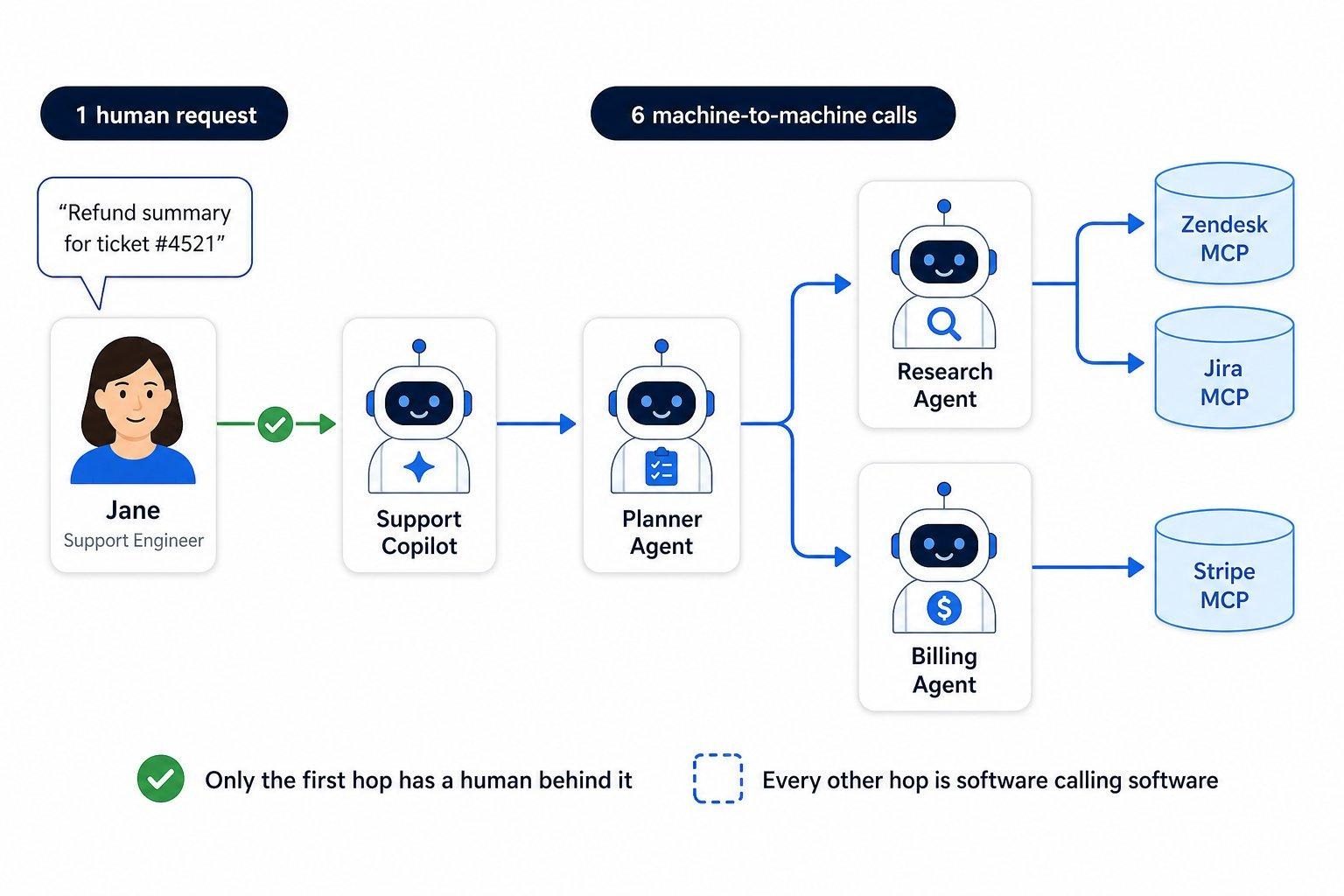
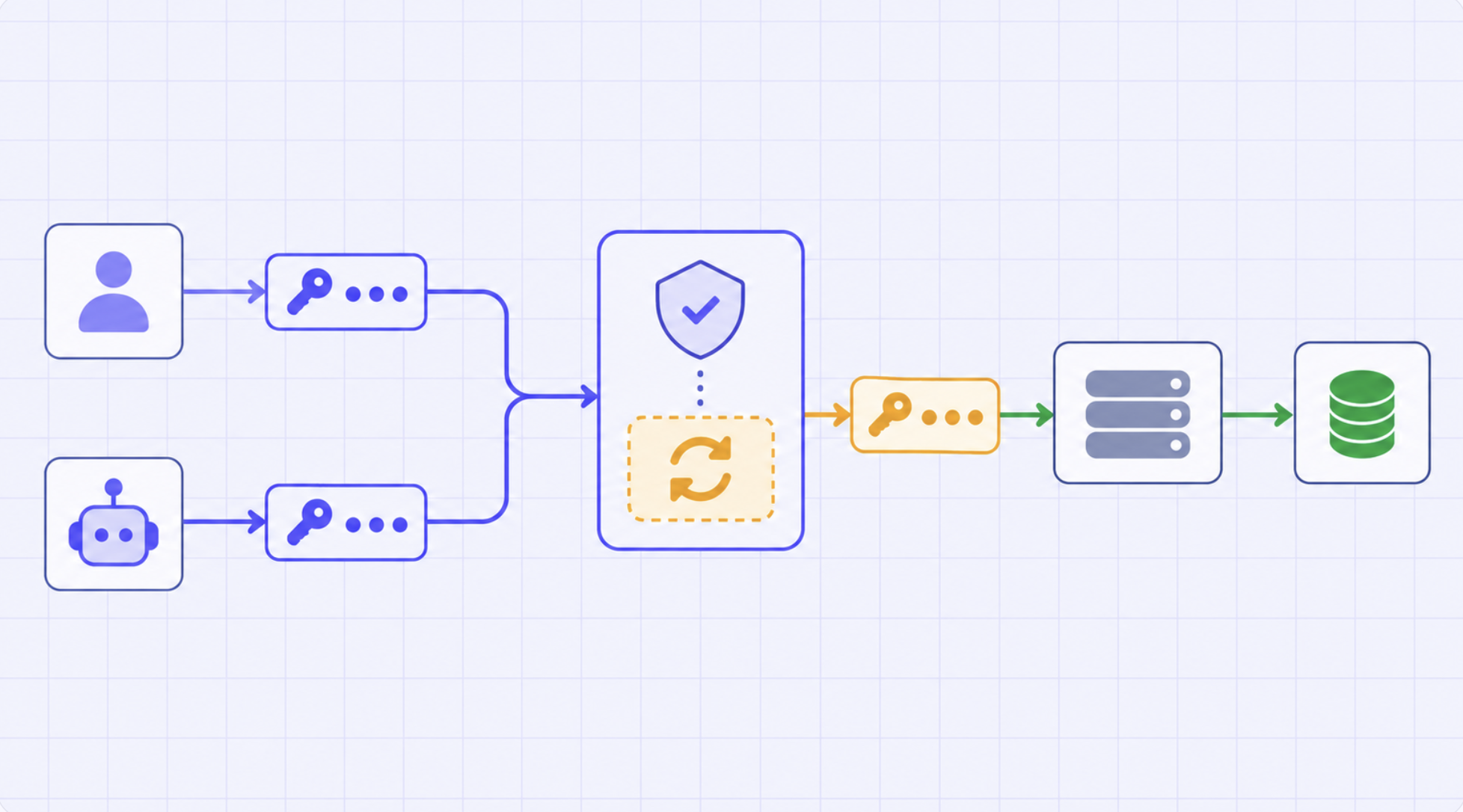
That chain — user → application → agent → sub-agent → MCP tool — is the agentic call path, and it is what agent governance has to control. Every enterprise access model rests on three assumptions: a user sits at the front of the request, the thing making the call is that user, and the scope is what the user consented to. By the third hop all three are false, so three questions stop having answers:
Answering all three at every hop, with evidence, is what agentic AI governance means — five systems, not a paragraph on responsible use.
Most teams reach for one of two shortcuts: let the agent forward the user’s token, or give it a shared service account. Both are wrong, because an agent is neither.
Giving each agent its own verifiable identity is the decision everything else hangs off. It buys attribution, because the receiver can tell which agent called; per-agent policy, because Jane’s copilot reading Jira and her engineering agent writing to it are different principals even though both act for Jane; and no anonymous agents, because a tool reachable only by a registered identity makes registration the enforcement point.
The urgency is unglamorous: machine identities already outnumber human users in most enterprises by more than 40 to 1, and agents multiply faster than service accounts ever did — anyone with a framework and an API key can make one.
Complete governance is five capabilities in a loop. The first two run before an agent makes a single call, the middle two on every call, the last continuously — feeding back into the second.
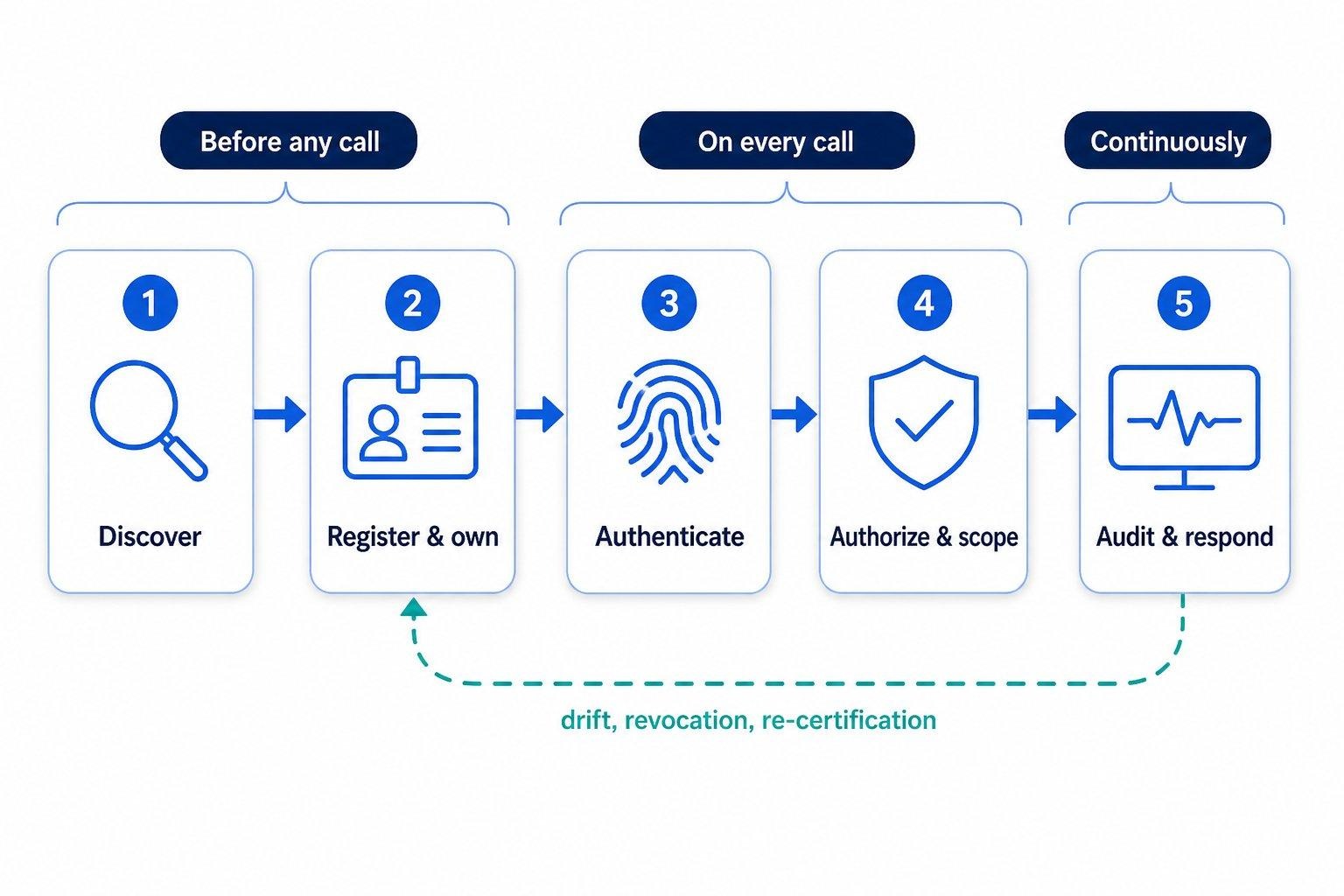
Five-pillar governance pipeline: discover and register before any call, authenticate and authorize on every call, audit continuously, with a feedback arrow back to registration
TrueFoundry AI Gateway delivers ~3–4 ms latency, handles 350+ RPS on 1 vCPU, scales horizontally with ease, and is production-ready, while LiteLLM suffers from high latency, struggles beyond moderate RPS, lacks built-in scaling, and is best for light or prototype workloads.




The set of controls that make five questions answerable for every agent at any moment: what agents exist, who is accountable, what each can reach, on whose behalf it acts, and what it actually did. In practice: a registry, an identity per agent, least-privilege grants per target, delegation that carries the user across hops, and a per-hop audit trail with a kill switch.
A service account does what its configuration says and is reviewed on a schedule. An agent interprets an objective, picks its own tools and chains calls, so its behaviour drifts from its defined authority between reviews. Agent governance adds delegation rules, per-hop attribution of the actor chain, and continuous comparison of behaviour with declared scope.
Yes, if your agents cross platforms. Entra governs Entra agents, Okta governs Okta apps, Bedrock governs Bedrock agents, and none governs an agent that starts in one and calls into another. A registry plus a gateway gives one inventory and one enforcement point across all of them.
Yes. TrueFoundry runs in your VPC, on-prem, air-gapped, or hybrid, so prompts and responses never leave your domain even as you route across many providers.
Yes. It includes an MCP Gateway, an Agent Gateway, and an MCP & Agents Registry with tool-level access control. Agents on LangGraph, CrewAI, AutoGen, or a custom framework can all be governed centrally.
はい。ゲートウェイはOpenTelemetryに準拠しており、Grafana、Datadog、Prometheus、またはお好みのスタックに接続できます。プロンプトからツール、モデルの実行まで、すべてのリクエストを追跡するため、既存のシステムを大幅に変更することなく、統合されたロギングを実現できます。



.png)
.png)
.png)
.png)
.png)
.png)
.png)
.png)
.png)
.png)





