


September 24, 2026
|
Lesedauer: 5 Minuten


Erhalten Sie sofortigen Zugriff auf eine TrueFoundry-Live-Umgebung. Stellen Sie Modelle bereit, leiten Sie den LLM-Verkehr weiter und erkunden Sie die gesamte Plattform — Ihre Sandbox ist in Sekundenschnelle einsatzbereit, ohne dass eine Kreditkarte erforderlich ist.



Published: September 24, 2026
.webp)
Unglaublich schnelle Methode zum Erstellen, Verfolgen und Bereitstellen Ihrer Modelle!
The Requesty AI vs. Obot AI comparison begins by recognizing that their primary roles differ. Obot sits at the intersection of agents, models, and tools. Requesty primarily sits between applications and LLM providers.
Obot AI centers its platform on the Obot MCP Gateway. It can host or proxy MCP servers, manage credentials, enforce access policies, and record requests. Its control plane also includes an LLM Gateway, model policies, registries, and agent services.
Requesty focuses more heavily on model access. Applications change the base URL to Requesty and access 600+ models through an OpenAI-compatible endpoint. Routing policies support fallback, load balancing, cost-aware selection, and latency-based routing across providers.
The practical distinction remains useful. Obot helps IT teams govern which identities reach which tools and models. Requesty helps applications select a model provider reliably while controlling cost and availability.
Teams examining model-gateway architecture can also review TrueFoundry’s LLM Gateway analysis for the role of centralized provider access.
Feature tables can hide architectural differences, so the notes beneath this table matter. Obot owns more of the MCP infrastructure and can run inside customer-controlled environments. Requesty operates as a managed cloud service, removing most gateway operations from the customer.
Obot’s core capabilities now extend beyond MCP. Its LLM Gateway supports OpenAI, Anthropic, Amazon Bedrock, Azure, and compatible endpoints. Administrators define model access policies, while Obot stores upstream credentials instead of exposing them to users.
The Obot Gateway also handles MCP hosting on Docker or Kubernetes. It supports remote servers when organizations already operate their own MCP servers. Filters can accept, reject, or modify traffic before forwarding an approved tool call.
Requesty solves a different routing problem. Its intelligent routing can distribute traffic based on cost, latency, quality, or a defined fallback order. This makes it stronger for multi-provider reliability and cost optimization when applications use several commercial models.
.webp)
Agent management creates another clear difference. Obot treats an AI agent as a governed platform identity with access to models and tools. Requesty primarily governs the model-routing policies that an agent uses.
Obot Agent supports conversations and scheduled workflows, while Agent Authorization Scopes provide machine credentials. An administrator can restrict an API key to selected MCP servers, LLM proxy access, or other capabilities. This enables secure access without using a person’s interactive login.
Instead of developers wiring credentials into local AI tools, Obot provides centralized credential management and server access. Filters enforce policy enforcement before approved requests reach downstream systems. The gateway also handles upstream OAuth flows and refreshes the necessary OAuth token on the user’s behalf.
Device Management extends visibility to supported developer clients such as Claude Code, Codex, and Cursor. Tool-call enforcement remains experimental, while local activity can still be audited. This gives engineering teams visibility into AI activity outside centrally hosted agent workloads.
Requesty does not provide the same hosted-agent execution model. Instead, it lets organizations apply a routing policy and a spend ceiling to specific agents. That is useful when the main requirement remains model reliability rather than complete workflow execution.
Teams evaluating alternatives around agent and MCP governance can also review Obot AI alternatives.
Both platforms provide observability, although they answer different operational questions. Obot focuses on agent, model, and tool activity. Requesty focuses more strongly on provider behavior, cost, routing, and gateway performance.
Obot records MCP requests, users, timestamps, outcomes, model information, and token usage. Its LLM audit records also include provider, requested model, client details, and duration. Sensitive request or response data requires the Auditor role.
Audit exports can go to Amazon S3, Google Cloud Storage, Azure Blob Storage, or compatible object storage. Organizations therefore retain full control over long-term evidence and can align storage with their data privacy requirements.
Requesty emphasizes request latency, cache performance, model cost, failures, and provider routing. Its dashboard provides real-time cost and usage visibility across keys, teams, and models. The gateway also supports policy-based regional routing and zero-data-retention endpoints.
This distinction matters for compliance requirements. Obot provides a detailed audit trail around agent and MCP actions. Requesty gives teams stronger visibility into model routing outcomes, policy application, and costs across production model traffic.
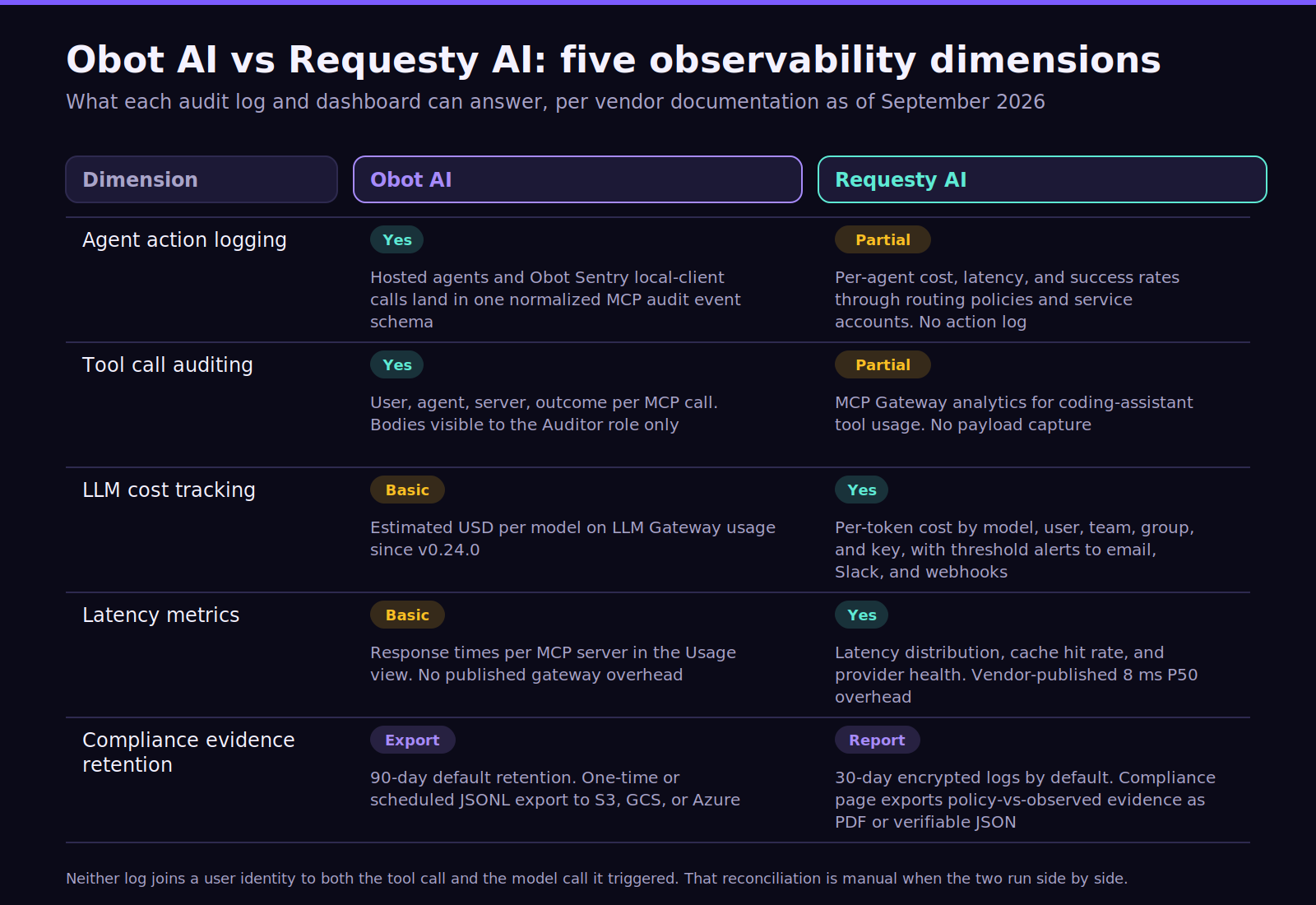
Alt Text: Obot AI Versus Requesty AI Observability Comparison Across Five Enterprise Monitoring Dimensions
The pricing and deployment models reflect different ownership philosophies. Obot gives customers more infrastructure control. Requesty charges for a fully managed gateway and removes most operational work.
Obot currently offers three editions from the same container image. The default edition supports up to 100 users and 100 devices. Community remains free and adds Entra, Okta, JumpCloud, and Auth0. Enterprise removes those limits and adds enterprise support.
A Kubernetes or Docker deployment keeps Obot within the customer's infrastructure. Hosted MCP workloads run in separate containers or Kubernetes workloads. This structure can fit organizations with strict requirements for a private cloud, internal credentials, or local audit storage.
Requesty offers a free entry point and pay-as-you-go pricing. Current pricing adds 5% to upstream model costs, while customer-owned provider keys carry 0% markup. The free plan supports 200 daily requests against available free models.
Requesty’s enterprise pricing is custom. Enterprise adds SSO, RBAC, compliance support, custom SLAs, and deeper organizational controls. Its SOC 2 Type II observation period remains in progress, while EU residency is available in Frankfurt.
For large-scale workloads, teams should compare licensing with operational ownership. Self-hosting means patching, scaling, storage, and support remain internal responsibilities. SaaS removes much of that work, while the customer accepts the vendor’s deployment options and security boundary.
Also Read: AI gateway cost guide
Obot AI fits teams that need a dedicated MCP governance layer. It is useful when internal agents, coding assistants, and AI clients need approved access to local, remote, or hosted MCP servers. It also supports organizations that prefer open-source infrastructure and self-hosted control.
One caveat belongs here. The 100-user and 100-device ceiling below Obot Enterprise arrived in v0.25.0 and now applies to GitHub and Google auth deployments that were previously unlimited. Existing users keep working past the cap, but you cannot add new ones. Size the pilot with that number in mind.
Requesty AI fits teams that need fast access to many models through a managed gateway. Its strongest value comes from reliable LLM providers, routing policies, caching, analytics, and spending controls without self-hosted infrastructure.
The platform also works well for prototype workloads where teams want fast model experimentation. Once usage reaches moderate RPS or higher peaks, teams should test provider reliability and high-latency scenarios using realistic production traffic rather than isolated requests.
Requesty’s gateway can route around degraded providers and centrally apply model restrictions. That can improve the developer experience when teams would otherwise maintain separate credentials and integrations. Its OpenAI-compatible interface also minimizes application changes.
Choosing Obot AI or Requesty AI based on a demo alone can still lead to the wrong conclusion. One platform may demonstrate blocked tool access, while the other demonstrates successful failover. Both scenarios matter, although each measures a different layer of production.
The Obot AI and Requesty AI comparison reveals a shared limitation when one workflow crosses both layers. Obot governs models, agents, and MCP access within its platform. Requesty offers deeper cross-provider routing. Neither combines every enterprise control at the same depth.
A support workflow may call one model, query a CRM through MCP, update a case, and trigger another agent. This creates a potential data exposure when identity, permissions, budgets, and logs are distributed across independent systems.
Requesty has also expanded its own MCP integrations. Its MCP Gateway supports centralized authentication, tool whitelisting, usage analytics, and shared or per-user credentials for remote MCP servers. It does not replace full MCP hosting or complete agent execution governance.
The missing pieces become more visible when teams want one policy across models and tools:
A dedicated agent layer becomes relevant when these actions turn into multi-step workflows. TrueFoundry’s Agent Gateway provides retries, timeouts, policy controls, traceability, and governed tool execution across those workflows.
CRO Banner:
Title: Move Beyond Gateway Pricing to Governed Agentic AI Execution Across Teams
Subtext: Get started with TrueFoundry to enforce identity, budgets, MCP policies, and audit trails before execution
CTA: Get Started
Alt Text: TrueFoundry enables governed agentic AI execution across teams
Link: https://www.truefoundry.com/book-demo?ref=obot_ai_vs_requesty_ai
TrueFoundry fits when enterprises want a single platform connecting model, tool, and agent governance. Its AI control plane brings model routing, identity, policies, budgets, guardrails, and observability into the same production architecture.
The model layer supports multi-provider routing and model serving across hosted and self-hosted endpoints. Budget policies can apply to users, teams, models, or metadata before additional requests execute.
A budget rule is a versioned YAML object, so it lives in Git next to the rest of the platform config:
name: budget-limiting-config
type: gateway-budget-config
rules:
- id: 'support-rag-monthly'
when:
subjects: ['team:support']
metadata:
environment: 'production'
limit_to: 5000
unit: cost_per_month
budget_applies_per: ['user']
alerts:
thresholds: [75, 90, 100]
notification_target:
- type: slack-bot
notification_channel: 'budget-alerts-channel'
channels: ['#ai-spend']
When the support team's RAG pipeline crosses $5,000 in a month, the gateway returns a 429 with `error_origin_level: rate_limit_budget` in the body and the violated rule ID in the `x-tfy-applied-rules` header, not a surprise on the invoice. That covers the multi-provider access and cost governance use case that Requesty AI serves, with the added architectural benefit of VPC-native deployment.
The TrueFoundry MCP gateway provides per-server RBAC, Virtual MCP Server abstractions, OAuth 2.0 token management with automatic refresh, and audit trails tied to user identity for every tool invocation.
A Virtual MCP Server takes a subset of tools from several registered servers (say, GitHub without `delete_pr` and Slack without `delete_message`) and exposes them as a single endpoint that requires no deployment. Guardrails attach at the same policy layer, and one YAML file governs LLM calls and MCP tool calls:
name: guardrails-control
type: gateway-guardrails-config
rules:
- id: kubernetes-tools-pii
when:
target:
operator: or
conditions:
mcpServers:
values:
- kubernetes-mcp
condition: in
subjects:
operator: and
conditions:
in:
- team:platform
llm_input_guardrails: []
llm_output_guardrails: []
mcp_tool_pre_invoke_guardrails:
- pii/pii-detection
mcp_tool_post_invoke_guardrails: []
This architecture is useful when separate gateway products would create overlapping policies. It can also simplify governance when several teams share models, agents, and MCP tools across environments.
Choose TrueFoundry when:
TrueFoundry currently offers Developer at $0, Pro at $499 monthly, Pro Plus at $2,999, and custom Enterprise pricing. Enterprise supports VPC and air-gapped control and gateway planes.
For teams comparing broader production architectures, TrueFoundry provides one control layer for models, tools, agents, and governed enterprise execution.
Book a Demo with TrueFoundry to see how a single enterprise control plane can securely govern models, MCP tools, agents, budgets, policies, and audit evidence across your production AI environment today.
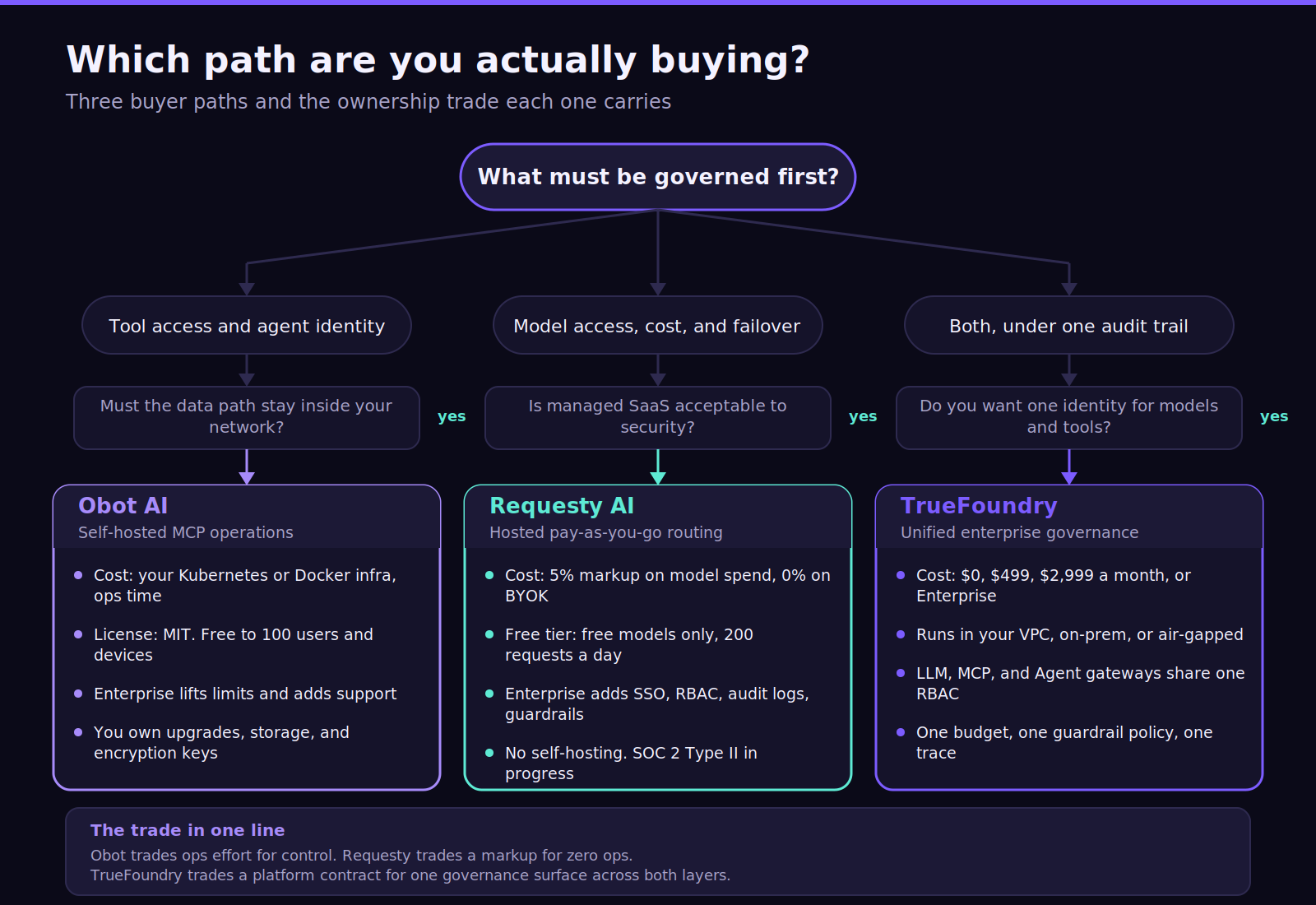
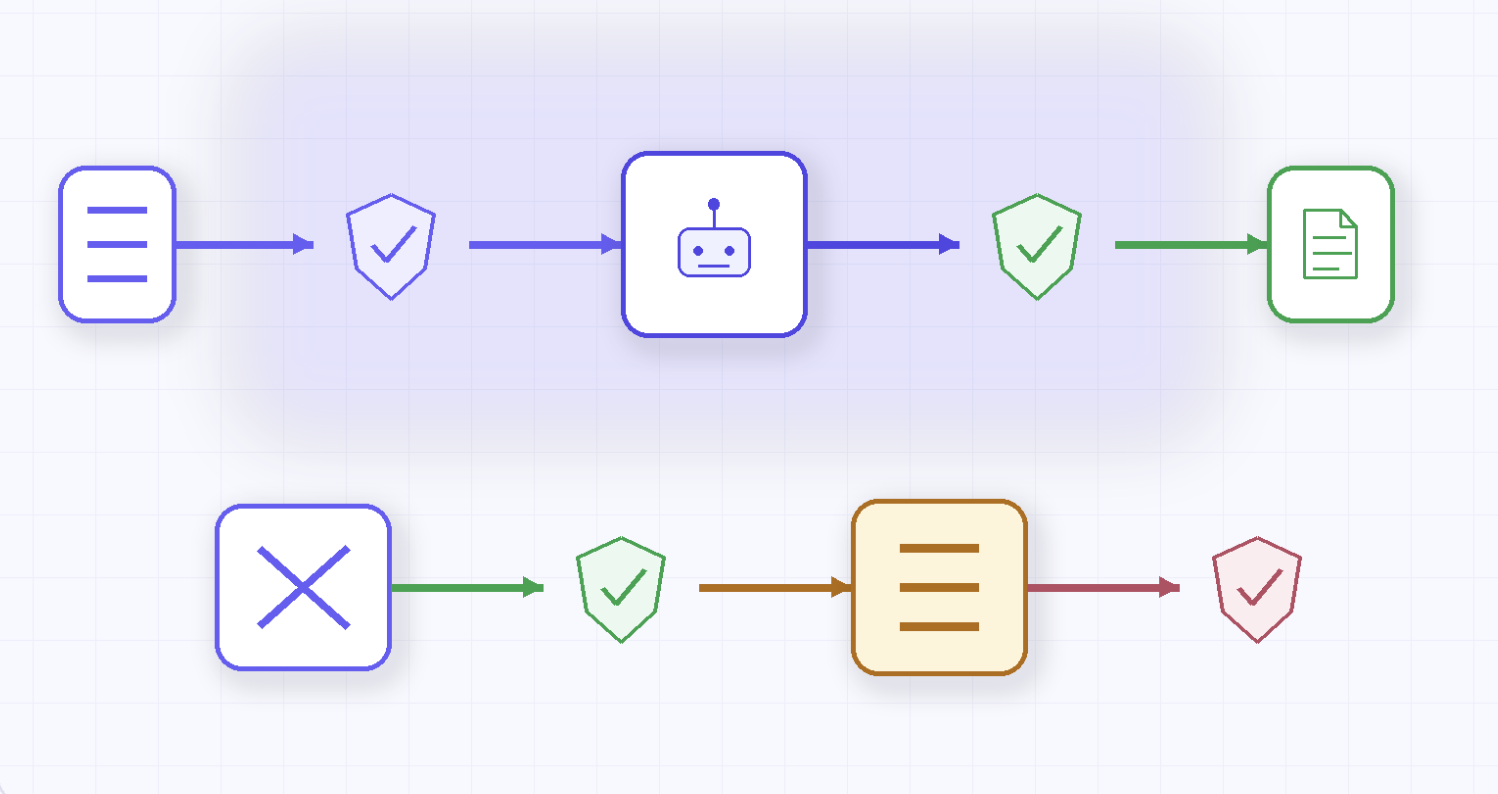
Alt text: Pricing decision flow showing open-source operations, pay-as-you-go gateway use, and enterprise governance ownership tradeoffs
TrueFoundry AI Gateway bietet eine Latenz von ~3—4 ms, verarbeitet mehr als 350 RPS auf einer vCPU, skaliert problemlos horizontal und ist produktionsbereit, während LiteLM unter einer hohen Latenz leidet, mit moderaten RPS zu kämpfen hat, keine integrierte Skalierung hat und sich am besten für leichte Workloads oder Prototyp-Workloads eignet.





Die neuesten Nachrichten, Artikel und Ressourcen werden in Ihren Posteingang gesendet
.webp)
.webp)
.png)
.png)
.png)
.png)
.png)
.png)
.png)
.png)
.png)
.png)


