


September 19, 2026
|
5 min read


Published: March 31, 2026
Blazingly fast way to build, track and deploy your models!
Today building AIs is more than simply determining which Model you would like to use.
There are several pieces to building AI agents i.e. connecting to the various tools, managing access, tracking usage, and preventing things from breaking once in production; this is where teams leverage services like MCP, and more recent examples would be Obot AI.
Obot AI provides a structured, Open Source framework to help teams manage their Model Context Protocol (MCP) infrastructure; this is effective for tool Governance.
However, as teams move into Production, many times their requirements grow such as further observability, the ability to work with multiple models, or control over the deployment and security of the Model.
That’s usually when teams start exploring Obot AI alternatives. In this guide, we’ll walk through the top options in 2026—so you can find the one that actually fits your technology stack.
Obot AI, previously known as Acorn Labs, provides an open-source platform for companies to manage their Model Context Protocol (MCP) based systems.
The core functionalities of Obot AI include:
The MCP gateway acts as the centralized control point where IT teams can onboard, manage, and monitor MCP servers using either a modern administrative user interface (UI) or via GitOps-based workflow, including maintaining a full audit trail of every action taken in relation to an MCP server.
Obot AI can be deployed to self-host on either Docker or Kubernetes, allowing users the ability to maintain full control and sovereignty over their data and infrastructure.
While Obot AI is a strong MCP Server Management Foundation, there are limitations for teams looking for more extensive use of their AI infrastructure.
- Narrow focus on MCP — Designed strictly for governance of MCP. If an organization wants to perform model serving/buffering, tuning or prompting management functions, or full LLMOps, a separate provider must be sought out.
- No built-in model serving or inference layer — Tool connections are managed by Obot; however, the models themselves are managed by a separate stack that has yet to be built which will manage where LLM instances are hosted, how inference is routed, and how GPU compute is managed.
- Kubernetes Deployment — The ideal deployment option for teams that have a cloud-native infrastructure however; this could be a significant hurdle for organizations who do not possess the required resources or platform engineering expertise.
- Limited visibility & cost management Capabilities — While audit logging exists, there is no token-based (1) [Cost Attribution] (2) [Latency Dashboard] or (3) proper-level [Monitoring of Production], which are present in dedicated AI Gateways.
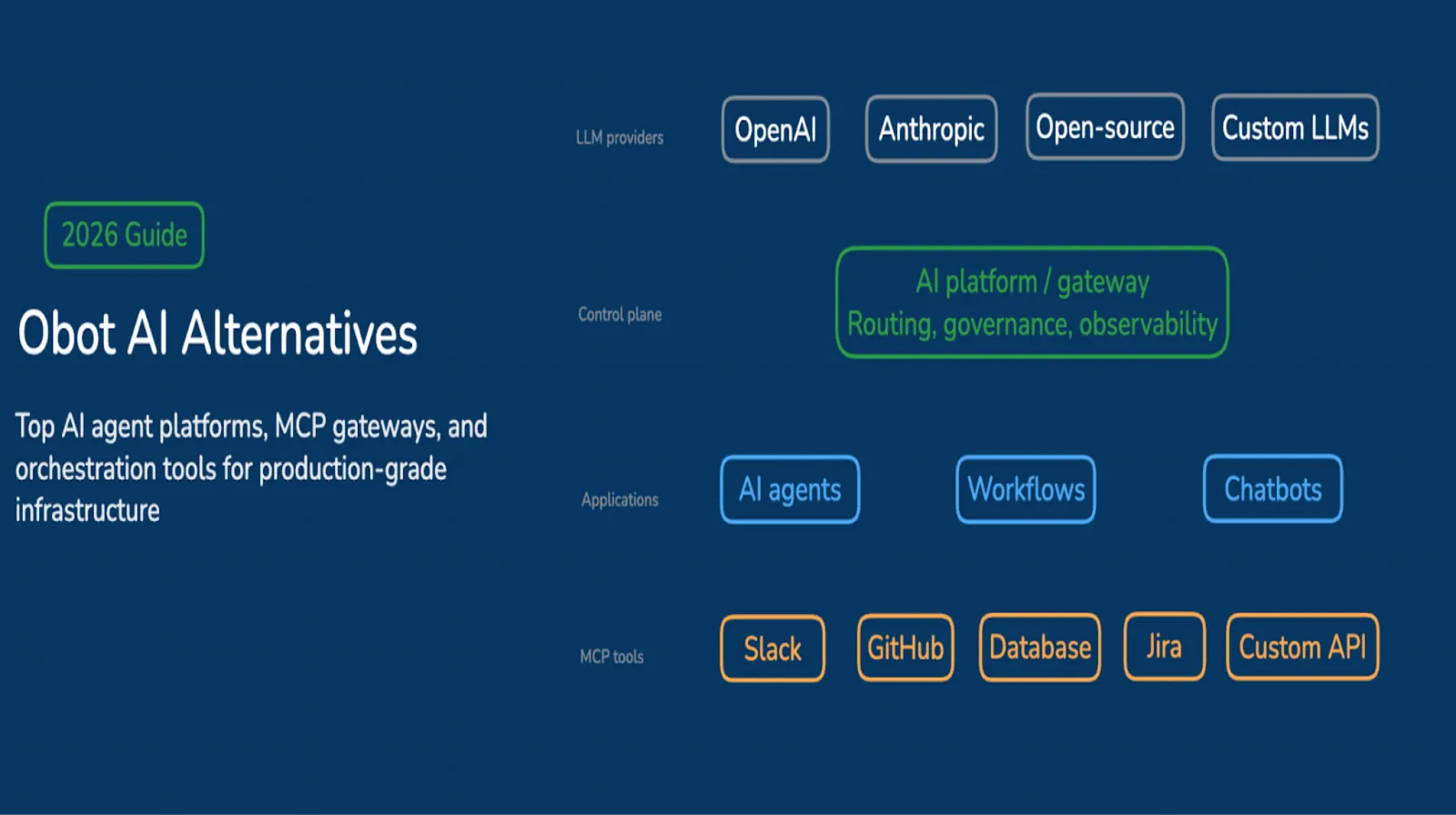
Not all alternatives to Obot AI are trying to solve the same issue; for example, some may be focused only on MCP while others are looking at AI infrastructure in a more comprehensive sense.
We evaluated each of the alternative solutions based on several practical aspects:
No one alternative solution is a clear winner when evaluated across all of these areas, and that is the overall purpose of the evaluation.
TrueFoundry is an AI platform delivered as Kubernetes-managed workloads on-premises or as cloud services within your VPC on all three major cloud platforms (AWS/Azure/GCP).
TrueFoundry addresses all aspects of managing and controlling the lifecycle of AI such as deploying models, routing inferences to them, orchestrating agents, governing MultiCloud deployments, via a single control plane.
Recognized for its completeness by Gartner in their 2025 Market Guide for AI Gateways and recent Board of Directors in North Carolina, TrueFoundry provides governance over models, agents, tools, and compute resources, whereas Obot provides only governance over hosted agents/passed-through requests.
The platform has been adopted by enterprises including Siemens Healthineers, Resmed, Automation Anywhere, and NVIDIA.
Key Features:
Best For:
Platform engineering organizations, enterprises seeking a cloud-neutral (not simply an MCP gateway) governed AI platform with total model, agent, tool & infrastructure control (best suited for those transforming 1 or 2 LLM use cases).
Organizations transitioning from limited LLM use cases to broad LLM implementations typically have trouble getting a solid understanding of the size of their current environment, what the future will look like, and how to plan for scalability over the long term.
LangGraph is a framework that offers an open-source way to create directed graphs of stateful multi-step agent workflows. LangGraph builds on LangChain by adding features including explicit state management, cycles, and human-in-the-loop patterns.
Key Features:
Pros:
Cons:
Best for:
Engineering teams creating complex stateful agent workflows that are ready to manage their infrastructure.
CrewAI is a Python framework designed for collaborating with teams of AI agents by allowing them to complete tasks by their assigned roles within specified goals and delegation methods.
Key features:
Pros:
Cons:
Best for:
CrewAI is a great mult-agents collaboration tool for teams interested in rapid development of multi-agents workflows through no-code methods.
Composio, as a managed MCP gateway and tools integration platform, has over 500 pre-built tools to connect to your AI agents (and is enterprise-approved). The company's Universal MCP Gateway was launched in August of 2025 to support over 100,000 developers and eliminate the need for numerous separate MCP servers by allowing for one installation instead.
Key Features:
Pros:
Cons:
Best For:
Development teams creating agents who need quick access to a large number of MCP tools without the time lag associated with developing custom integrations — when speed of integration is key.
Portkey is a reliable and observable platform can help to manage costs related to the use of large scale Learning Management System (Edition) and therefore its primary focus is to provide a 'gateway to 1,600+ laws, across 40+ different companies, each with less than one millisecond' delay when generating new content for large-scale enterprise resources.
Key Features:
Pros:
Cons:
Best for:
Portkey is more useful to engineers that have already built their organizational structure, processes and have an extensive network used to route documents, monitor usage, and develop costing models.
n8n is an open source (OS) workflow automation tool with integrated native AI agent capabilities and bidirectional MCP support, connecting both traditional methods of automation: webhooks, API’s and databases to LLM-powered agent workflows via visual builder.
Key Features:
Pros:
Cons:
Best for:
If your team is in an Operations or Automation-related area and is looking to augment their existing automation solutions with AI agent powered capabilities without a full-fledged ML-based solution.
Choosing the Best Obot AI alternative Requires Consideration to Match Your Team's Needs
Your team will not benefit from the same Obot AI replacement due to differences in the size of your team along with what amount of infrastructure you want to manage and what task/function you want to complete first.
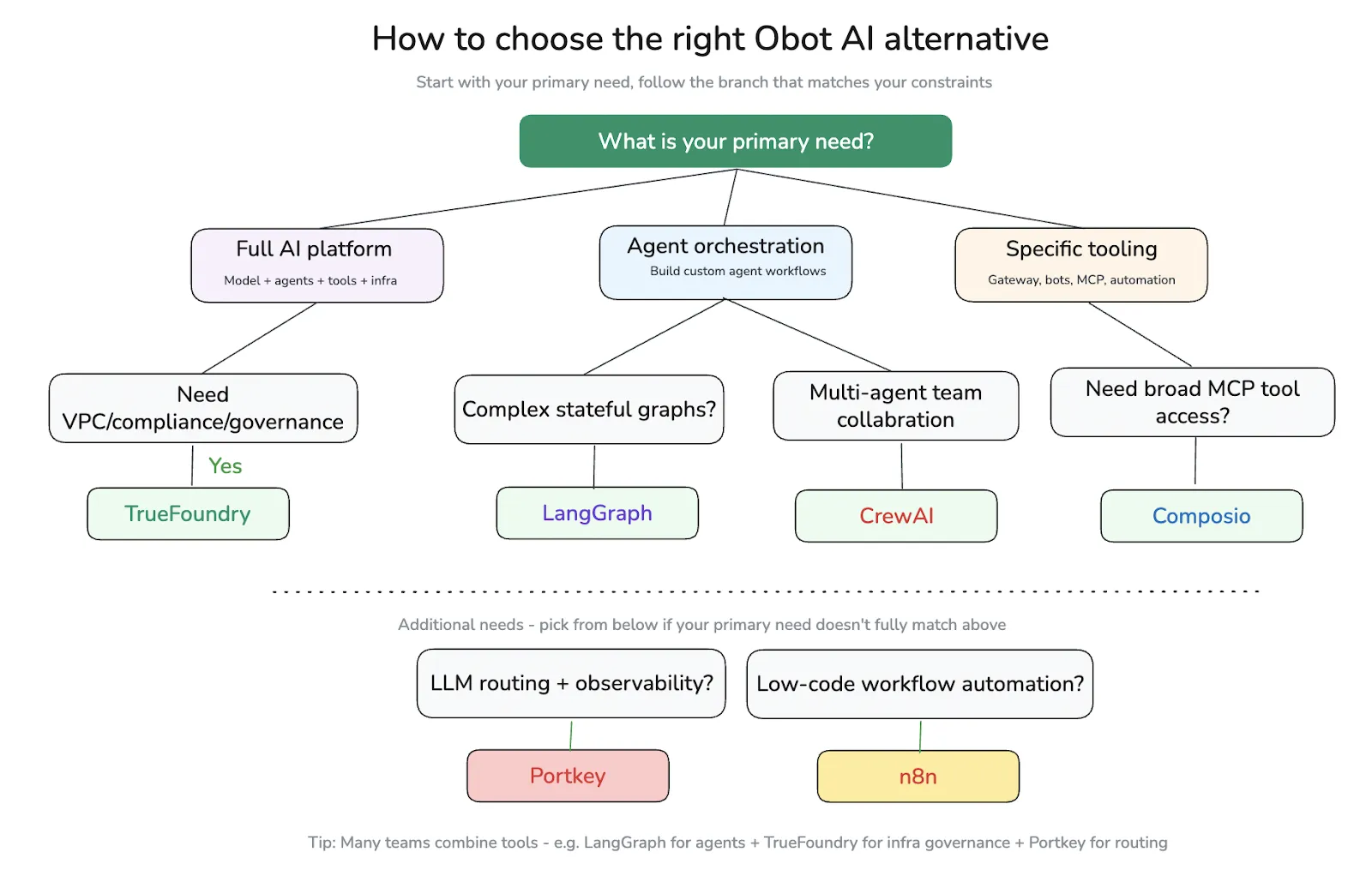
Scenario-Based Recommendations:
Question: What Is Obot AI Used For?
Question: Why Do Teams Look for Obot AI Alternatives?
Question: What are the best AI agent platforms in 2026?
The best artificial intelligence (AI) agent platform for your needs in 2026 will depend on which portion(s) you will require to own:
TrueFoundry - This is the preferred platform for large organizations to control the end-to-end model governance. TrueFoundry offers all the components of the end-to-end model governance stack including: Model serving, agent orchestration, management of MCP tools, and control of the infrastructure for model serving.
If you need a platform that provides production-level-compliance, cost attribution of models by department or team, and governance at the scalable level across many departments or teams, then TrueFoundry would be the best platform.
LangGraph - This is the framework of choice for engineering teams that are building complex, stateful agent-based applications with custom branching, cycles, and/or human-in-the-loop workflows.
CrewAI - This is the best platform for designing systems for collaboration between multiple agents with role-based delegation and task coordination.
Composio - This is the best platform when fast access to 500+ managed cross-platform (MCP) tool integrations is more important than owning the infrastructure.
If you are looking for a platform that has the largest surface area throughout to provide you with a governance, cost-control, and compliance solution across multiple departments or teams, then TrueFoundry would be by far the best option.
Question: How do AI agent tools compare to traditional automation tools?
An AI agent differs greatly from traditional/legacy automation applications (e.g., n8n/Zapier) in that these applications run on a very deterministic basis (i.e. the same code structure produces the same outcome every time).
They are usually appropriate for very well-defined (i.e. guaranteed) tasks, such as: synchronizing data, sending notifications and executing scheduled work.
On the other hand, AI agents use (LLM)-driven decision making, dynamically selecting tools based on the immediate environment’s requirements and performing multi-step reasoning which gives the AI agent some discretion in determining its next task.
Question:What should you look for in an AI orchestration platform?
Model Management: The ability to use a variety of large language models (LLMs) offered by third-party cloud vendors (OpenAI, Anthropic, open-source) and to host self-hosted (non-cloud) models.
Deployment Options: Options for executing AI workloads in a virtual private cloud (VPC), on-premise or in an air-gapped environment to ensure data privacy.
Observability: The ability to monitor latency, assign a token cost for each LLM, and provide per-team usage analytics.
Management of Tools and Agents: The ability to centrally manage the registration and auditing of data connections between models, tools and agents.
RBAC Compliance: The ability to create role-based access and apply standards for SOC 2 compliance and enterprise audit trails to everyone with access to the toolset.
Developer Experience: The speed in which developers can write, test and deploy their code to production, quality of the SDK and the frameworks the SDK supports
The main difference is whether you are developing an application or supporting an infrastructure layer. Platforms such as TrueFoundry are mainly for use by platform teams to manage models, agents and tools across multiple business units when transitioning AI from experimentation to production.
If you are looking for an open-source solution for your team’s hosting and governing of MCP servers, then Obot should still be one of the top contenders. But as the enterprise moves from trials of AI to producing and deploying AI-powered solutions at scale, you will find that most teams require additional functionality beyond hosting and governance of their models
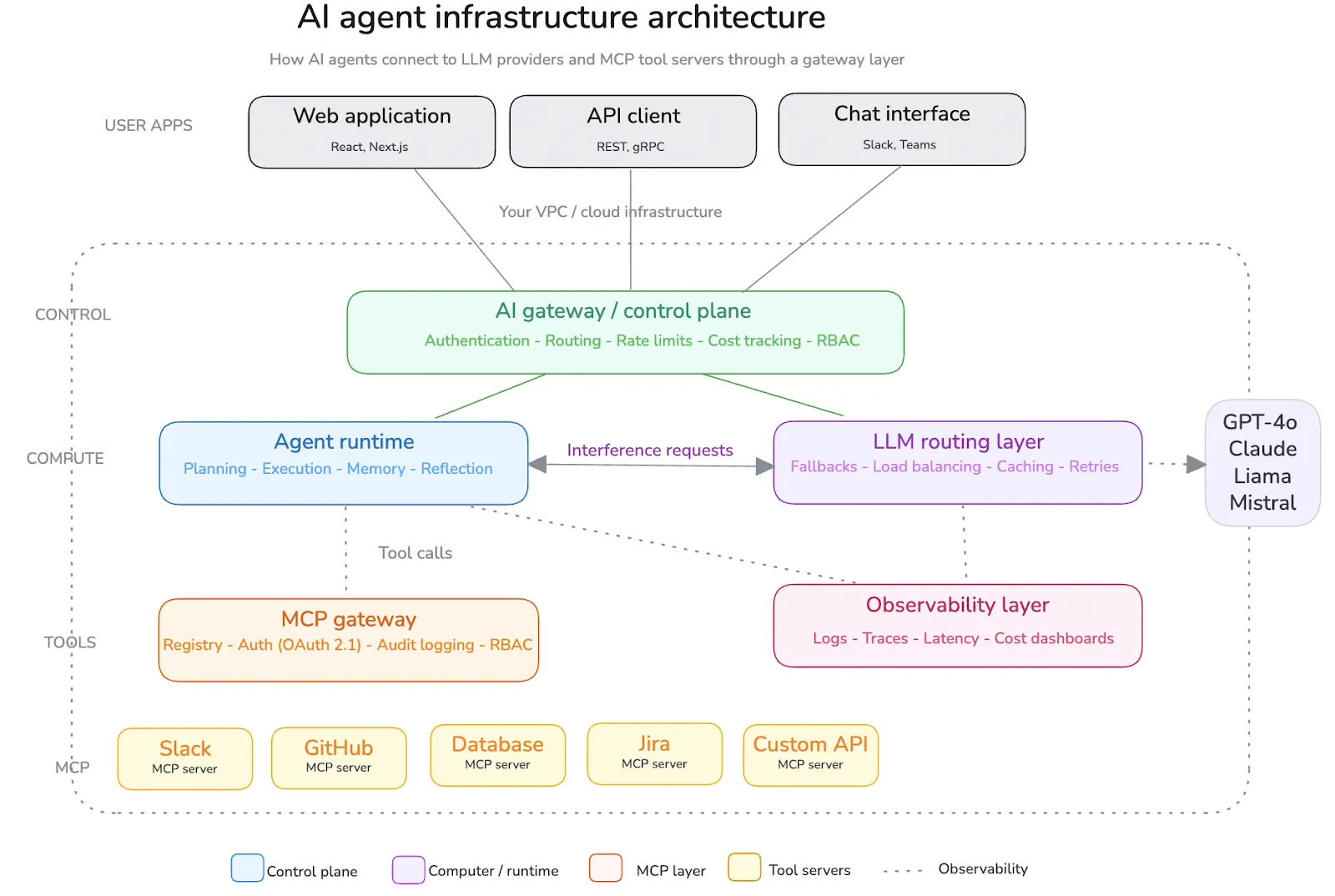
This is where TrueFoundry is uniquely positioned as it is the only vendor on this list that has successfully merged the governance of the MCP with the equivalent of managing the entire AI life cycle from deploying models, having a connected AI Gateway providing intelligent routing , storing agent registries , providing observability dashboards and providing VPC-native execution — all without tying you to a single cloud provider.
If your team is considering using Obot AI alternatives and needs a platform to grow its use of AI across multiple teams and user communities, we recommend requesting a demo of TrueFoundry’s products and an overview of how they support your technology stack.
1. What is the difference between an MCP gateway and an AI gateway?
An MCP gateway is intended for managing how AI agents interact with tools outside their system through the Model Context Protocol. The AI gateway is at a higher level, where requests are managed for multiple models. The gateway is responsible for enforcing policies, as well as monitoring latency, usage, and costs. In a production environment, both gateways will need to work together. This is where TrueFoundry is useful, as it brings both MCP and AI gateways together in a single platform.
2. Do I need both MCP infrastructure and LLM infrastructure to run AI agents in production?
Yes, a production environment for AI agents will require both MCP infrastructure and LLM infrastructure. MCP will manage how AI agents interact with tools outside their system. LLM will manage how AI agents are hosted. Obot AI is a tool designed for MCP, but a production environment will require both MCP and LLM. TrueFoundry brings both MCP and LLM together in a single platform, making it much simpler to manage production environments for AI agents.
3. When should a team move beyond Obot AI?
A team will need to move away from Obot AI when their needs go beyond MCP. This is when they need to move to a production environment. This is when they need to work with multiple models, have their costs tracked, and have a better view of their AI agents. The need for a production environment will come up when AI is used by many teams. At this point, it is complicated to manage different tools for different levels. At this point, a team will need a platform like TrueFoundry, where both MCP and AI can be managed in a single platform.
4. What are the key features that you would want in an Obot AI alternative?
When you want to choose Obot AI alternatives, you want to make sure you choose those that have the features required for production readiness. This means you want them to support multiple models, both hosted and self-hosted. Also, you want them to have good observability with features such as latency and token usage. Moreover, you want them to have good security features such as RBAC and audit trails. Finally, you want them to support deployment in VPC or on-premise environments. Another important feature is the developer experience, especially with regards to how quickly you want to go from prototype to production. TrueFoundry is often a consideration in this regard as it supports these features at both the MCP and model levels.
5. Can MCP tools such as Obot AI support production-level monitoring and cost control?
MCP tools such as Obot AI were designed primarily with the purpose of managing the tools themselves. They were not designed with the purpose of supporting production-level monitoring. Although they support features such as audit trails, they lack features such as token-level cost control or the ability to monitor the performance of the models and agents. This is the reason why you would want to use TrueFoundry as it supports production-level monitoring.
6. What is the best way to start with AI agent infrastructure in 2026?
The simplest way to get started varies based on the level of development. For instance, teams who are still experimenting with agents might want to use a framework or a workflow tool to build initial use cases. However, as the complexity level increases, teams might want to add MCP systems to help manage access to the tools, followed by infrastructure to handle routing and monitoring. However, it might eventually become hard to manage these layers separately, and this is where the need to use a more unified system arises. TrueFoundry makes it easy to achieve this by supporting both experimentation and infrastructure in the same environment.
TrueFoundry AI Gateway delivers ~3–4 ms latency, handles 350+ RPS on 1 vCPU, scales horizontally with ease, and is production-ready, while LiteLLM suffers from high latency, struggles beyond moderate RPS, lacks built-in scaling, and is best for light or prototype workloads.






The latest news, articles, and resources sent to your inbox
.png)
.png)
.png)
.png)
.png)
.png)
.png)
.png)
.png)
.png)
.png)


