Blank white background with no objects or features visible.

TrueFoundryはSeldon AIの買収を発表し、エンタープライズAI向けコントロールプレーンを拡張します。プレスリリース全文はこちら→

Mid-2026: The Agentic Convergence — Six Signals, and the Turn to Control

By Boyu Wang

Published: July 14, 2026

That AI systems are becoming more agentic has been forecast for years. What mid-2026 added is an unusual concentration of dated, checkable signals in a short window:

  • June 1 — NVIDIA prices the agentic buildout: gigawatt-class AI factories at up to $100B per gigawatt, agentic AI named the defining workload (siliconangle.com).
  • June 2 — NVIDIA declares AI-factory infrastructure a need of every company and every country (blogs.nvidia.com).
  • Early June — Cloudflare CEO Matthew Prince announces that bot-classified traffic has passed human traffic for HTML content on Cloudflare's network — ≈57.5% of such requests, visible on the live public Radar chart (the chart).
  • June 15 — CNET explains it to the mainstream: bot-classified HTML requests at 57.4% versus 42.6% human, "a milestone that arrived well ahead of even the most aggressive projections" (cnet.com).
  • June 17 — Matthew Prince, on X: "Welp, that happened faster than I predicted." Same report: Microsoft's AI-driven sessions tripled, and ~80% of websites now gate agents (tech.yahoo.com).
  • June 25 — IBM calls time on tokenmaxxing: "Token consumption is a cost signal, not a value metric" (ibm.com).
  • June 29–July 2 — the AI Engineer World's Fair convenes 6,000+ attendees (per the organizers); the final day carries Harness Engineering keynote programming; Greptile's April data — evidence of end-to-end AI generation in 27.6% of merged PRs, in its dataset — circulates through the program (ai.engineer; greptile.com).

Traffic, code, capital, institutions, practitioners, discourse — independent instruments, one direction, one mid-year window. Think of it as halftime in GenAI: the first phase emphasized demonstrating capability; the second — the enterprise half — emphasizes reliable, accountable operation: governed, measured, at what cost, under whose control. This post reads the record trend by trend, names the moment, and describes the control-plane requirements that follow, including where TrueFoundry's platform fits.

Key Takeaways

Key Takeaways

  • Mid-2026 concentrated six independently scoped, dated signals — traffic, code, practitioners, capital, institutions, and the discourse itself — which this post reads together and names the Agentic Convergence: an editorial synthesis, offered with sources.
  • On Cloudflare's network, bot-classified requests for HTML content passed human requests for the first time in the company's measurements — driven by agentic traffic, arriving well ahead of projections, and corroborated directionally by Microsoft and HUMAN Security data.
  • Software production shifted measurably: one large pull-request dataset shows evidence of end-to-end AI generation in over a quarter of merged PRs, while a separate developer survey finds only about half of developers say they always verify AI-assisted code before committing — verification demand is rising toward machinery, not vigilance.
  • Money and institutions began formalizing the plumbing: infrastructure received explicit token-economics framing, payment networks supported agent-payment protocols, and platforms introduced new controls and services for machine visitors.
  • The conversation matured on schedule: volume metrics (tokenmaxxing) gave way to value metrics (valuemaxxing) — the discussion visibly expanding from adoption to operational quality: how reliably agents perform, at what cost, and under whose control.
  • The landscape that follows runs on conditional admission: machine actors that carry identity, respect budgets, and leave audit trails get admitted; anonymous, unbounded ones get blocked, throttled, and repriced — governance is the ticket, not the brake.
  • That ticket is a shipping product category, and it is TrueFoundry's: an enterprise-grade control plane — brokered agent identity, in-path guardrails, budgets and quotas with warn-only or hard enforcement, per-step traces and auditable records, deployable inside your own boundary — introduced in Section 7 and mapped to what comes next in Section 8.

1. Trend One — Traffic: Bot-Classified HTML Requests Crossed 50% on Cloudflare's Network

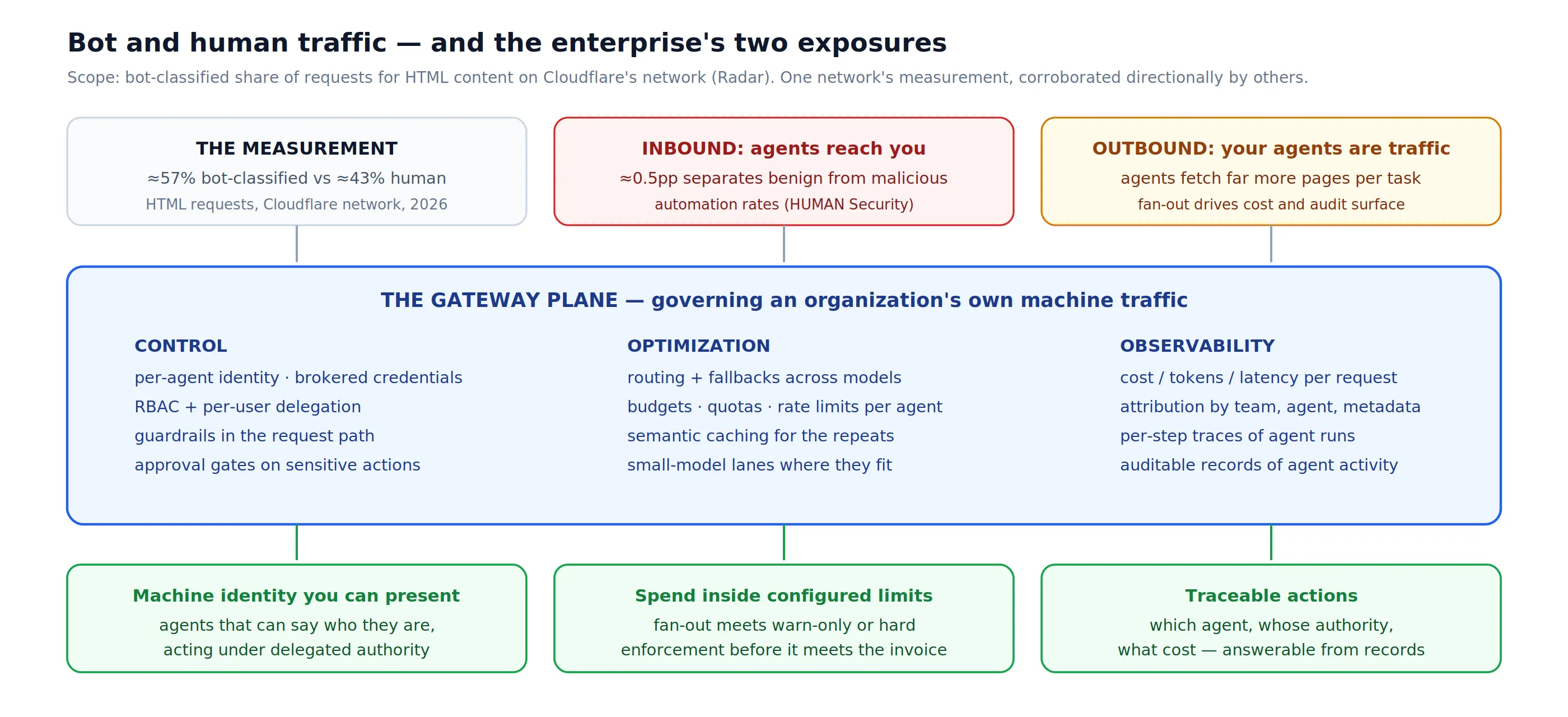
The anchor measurement is Cloudflare's, and its dating is precise: the crossover registered in early June 2026, with Matthew Prince announcing that bot-classified traffic had passed human traffic for the first time in Cloudflare's measurements — 57.5% of the network's HTTP requests for HTML content versus 42.5%, verifiable on the live public chart (radar.cloudflare.com) — roughly eighteen months ahead of his own end-2027 forecast, with agentic AI supplying the acceleration (CNET's June 15 explainer read the same live chart at 57.4% versus 42.6% and framed the milestone as arriving well ahead of the most aggressive projections — cnet.com). The corroboration bracketed the same window. HUMAN Security's benchmark report, published March 26, 2026 on more than a quadrillion analyzed interactions, had already measured automated traffic growing eight times faster than human and agentic traffic up 7,851% year over year (humansecurity.com; CNBC coverage March 26: cnbc.com); the June 17 MediaPost report added Microsoft's own telemetry: the company separately reported that the AI-driven sessions it monitored tripled across 2025, and that automated and AI traffic was growing eight times faster than human traffic — echoing the ratio HUMAN Security measured independently — plus Matthew Prince's wry mid-June admission on X that it had happened faster than he predicted (tech.yahoo.com). For an enterprise this trend has two faces. Inbound, agents are hitting your properties, and discrimination is genuinely hard — across HUMAN's dataset, only half a percentage point separates benign from malicious automation rates, which kills "bot or not" as a posture; the live question is whether a machine interaction is trustworthy: identity and behavior, not species. Outbound, your agents are the traffic — and the fan-out is the point CNET's explainer makes plainly: humans still engage more deeply, but agents visit far more pages, far more often, on the same errand — which makes that fan-out your egress, your API bills, your token spend, and your audit surface, compounding at machine speed.

Bot and human traffic and the enterprise's two exposures: the scoped Cloudflare measurement, inbound and outbound faces, the gateway plane, and three governed outcomes
Figure 1: Trend One's two enterprise faces, and the plane between an organization's machines and the world. Traffic scope: bot-classified requests for HTML content on Cloudflare's network, per Radar; the benign/malicious gap per HUMAN Security's March 2026 report. Original graphic.

2. Trend Two — Production: Evidence of End-to-End AI Generation Is Rising, and Verification Demand With It

The second instrument measures what ships — with a methodology note stated up front, because the two relevant datasets measure different things. Greptile's longitudinal data over pull requests reviewed on its platform found evidence of end-to-end AI generation — bot authorship, co-author footers, agent-specific branch prefixes — in 27.6% of merged PRs as of April 2026, up from 0.86% in February 2025: a within-dataset trend (greptile.com) that circulated widely at the late-June conference. Separately, Sonar's January 2026 survey of more than 1,100 professional developers found that only 48% say they always verify AI-generated or assisted code before committing it — a respondent-level practice measure, from a survey in which developers also reported that 42% of the code they commit is AI-generated or assisted (sonarsource.com). Different populations, different methods — so the two figures cannot be combined into a single production-to-verification ratio. But each independently points the same direction: in these observed and surveyed populations, AI-generated or assisted contributions are becoming a substantial part of software production, and verification demand is rising with them — which converts quality from a staffing question into an infrastructure question. At machine production rates, review has to be machinery first and attention second: evaluation pipelines in the output path, per-step traces on every run, repeated-trial reliability (pass^k) rather than best-of-k demos as the bar for delegation. This trend, more than any other, is why the practitioner agenda (Trend Three) reorganized around the system rather than the model.

3. Trend Three — The Practitioners: Harness Engineering Reached the Keynote Stage

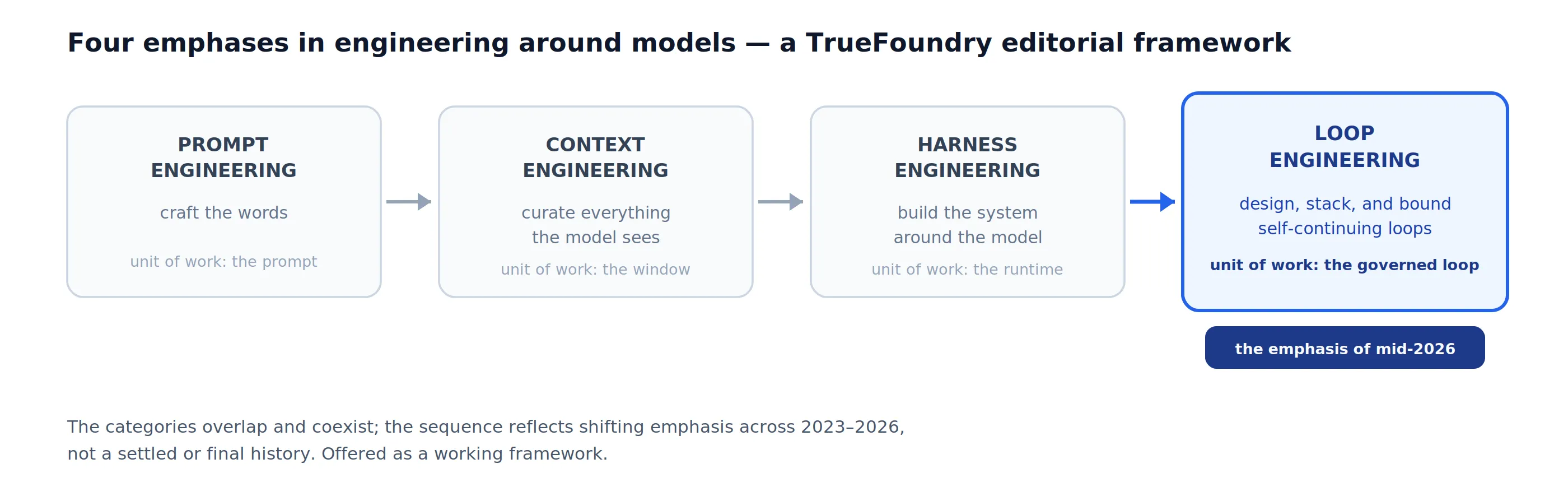
In the last week of June, the field measured itself. The AI Engineer World's Fair convened 6,000+ attendees (per the organizers), June 29–July 2 (ai.engineer); it opened on swyx's "Loopcraft: The Art of Stacking Loops," with his own publication's daily dispatch recording that "Loops, loops and more loops" dominated the first full day (latent.space); and its final day carried Harness Engineering keynote programming, with Anthropic's Mike Krieger among the keynote speakers, per the schedule and conference coverage. A line highlighted in swyx's three-year retrospective in the conference daily: "the model alone is no longer the product," with prompt engineering having given way to rigorous evals and harness engineering (dev.to). A conference program is a leading indicator of a specific, limited kind: it shows what organizers and speakers chose to prioritize, months in advance — and the program gave sustained space to running agents, to verification, and to the system around the model. A related argument comes from practice: OpenAI's harness-engineering write-up — a five-month build in which agents authored roughly a million lines of code under human-designed constraints, tooling, and feedback loops — argues that useful agent performance depends on the environment around the model (openai.com). Step back and the period reads — in this post's editorial framing — as the latest rung on a ladder the craft has been climbing: prompt engineering (craft the words) gave way to context engineering (curate everything the model sees), which gave way to harness engineering (build the system around the model — a discipline named in early 2026, with OpenAI's write-up its canonical text), and mid-2026 brought loop engineering to the fore — the craft of designing, stacking, and bounding the self-continuing loops that harnesses run, the theme the week literally opened on. The categories overlap and coexist, and the sequence reflects shifting emphasis rather than strict succession; we offer it as a working framework, not a settled history.

A TrueFoundry editorial framework: four overlapping emphases in engineering around models — prompt, context, harness, and loop engineering, with loops the emphasis of mid-2026
Figure 2: A TrueFoundry editorial framework: four overlapping emphases in how teams engineer around models. The sequence reflects shifting emphasis across 2023–2026, not a settled or final history. Original graphic.

We have covered the rung in depth — loop engineering at enterprise grade (from laptop loops to governed runtimes) and the week the loops got their keynote — and the point for this post is the timing: the practitioners' stated priorities shifted in the same weeks the traffic and production numbers landed.

4. Trend Four — Capital: Intelligence Production Got Industrial Pricing

Capital has been flowing into AI since 2023; that is not the news. What mid-2026 added is an explicit economic framing, stated from the top and priced in public. The founding axiom came from NVIDIA's March GTC keynote: "Tokens are the new commodity" (datacenterfrontier.com) — data centers recast as AI factories whose output is tokens, whose raw input is electricity, and whose efficiency is measured in tokens per watt, with token throughput framed as directly revenue-determining. By the first days of June the theory had industrial pricing and a universal claim: gigawatt-class sites at "$50 billion to $60 billion, and soon... $80 billion to $100 billion per gigawatt" — sites Huang described as the largest infrastructure buildout in human history — with agentic AI named as the defining workload (June 1 coverage: siliconangle.com); on June 2, the ecosystem framing that every company and country needs AI-factory infrastructure (blogs.nvidia.com). Commodity, unit cost, efficiency metric: NVIDIA articulated each of these elements publicly across the first half of 2026. Vendors talk their book — this vendor is also investing heavily in the very category it is describing — but once intelligence has a unit economics, every enterprise inherits the accounting whether it bought the machines or rents the tokens.

5. Trend Five — Institutions: The Plumbing Turned Agent-Native

The quietest trend is the most durable: institutions began formalizing agent-specific access, identity, and payment plumbing — at varying maturity, and with several steps dated to the same mid-year window. The clearest mid-2026 marker is Microsoft's: per the June 17 MediaPost report, the company is shipping agent-native search infrastructure, AI-citation reporting for brands, and updates to its MCP server for custom AI workflows — infrastructure decisions, not experiments — while its search lead, James Murray, offered an executive estimate of the web's defensive posture the same week — roughly 80% of websites blocking agents (the published account does not disclose the methodology behind the figure) (tech.yahoo.com). That pair is the whole institutional story in miniature: gates going up on one side, agent-native plumbing going in on the other — the web converting from open access to conditional admission. The payment rails have both a run-up and a mid-year step. On April 2, 2026, the Linux Foundation launched the x402 Foundation — the agent-payments standard's governing body, formed by Coinbase, Cloudflare, and Stripe, with Google, Visa, Microsoft, and some twenty other technology and payments organizations expressing initial support (linuxfoundation.org). Then, on July 1, 2026 — squarely in this post's window — Cloudflare, whose Pay Per Crawl program had launched a year earlier as a private-beta experiment in charging AI crawlers (blog.cloudflare.com), opened the waitlist for its broader Monetization Gateway: charging agents for any page, dataset, API, or MCP tool behind its network, settling over x402 (announcement). These developments vary in maturity — foundations, private betas, waitlists — but they point one way: platforms, payment networks, and publishers writing agents terms of service, with identity, payment, and conduct as the terms.

6. Trend Six — The Discourse: Value Replaced Volume

The final instrument is the conversation itself, and its correction is precisely datable. Through late 2025 and into 2026 the fashionable position was tokenmaxxing — maximize AI usage on the conviction that consumption leads to outcomes; usage leaderboards bloomed and got gamed (IBM Consulting SVP Neil Dhar, quoted June 25: "usage soon became a proxy for value"), and the term still headlined leadership programming at the late-June conference. Cost pressure sharpened the discussion — one example was a May 2026 Forbes report, linked by IBM, whose headline said Uber had exhausted its annual AI budget in four months — and on June 25, IBM gave the emerging cost-versus-value debate its most concise formulation to date in "Tokenmaxxing is dead, long live valuemaxxing," crediting Nebius CRO Marc Boroditsky with the successor term and drawing the line that matters: token spend measures cost, not value (ibm.com). The piece warns equally against overcorrecting into token minimization (starved context reappears as retries and rework) and lands on an infrastructure conclusion: with models becoming interchangeable, advantage shifts to the systems around them — IDC, as cited there, projects 70% of leading AI enterprises on dynamic multi-model routing by 2028. Valuemaxxing, operationalized, is a control-plane workload — cost attribution joined to outcomes, budgets and quotas enforced before the ceiling (warn-only or hard modes), routing and caching that cut cost per completed task rather than starving the task — machinery this post returns to once the layer is properly introduced below. IBM's framing is one prominent example of a broader shift toward measuring completed work, quality, and outcomes rather than usage alone — and a discourse expanding from adoption to operational quality in the same weeks the traffic crossed its threshold is a signal in its own right: the questions of how reliably, at what cost, and under whose control took the floor.

7. Naming the Moment — and What the Signals Imply for Enterprise Control

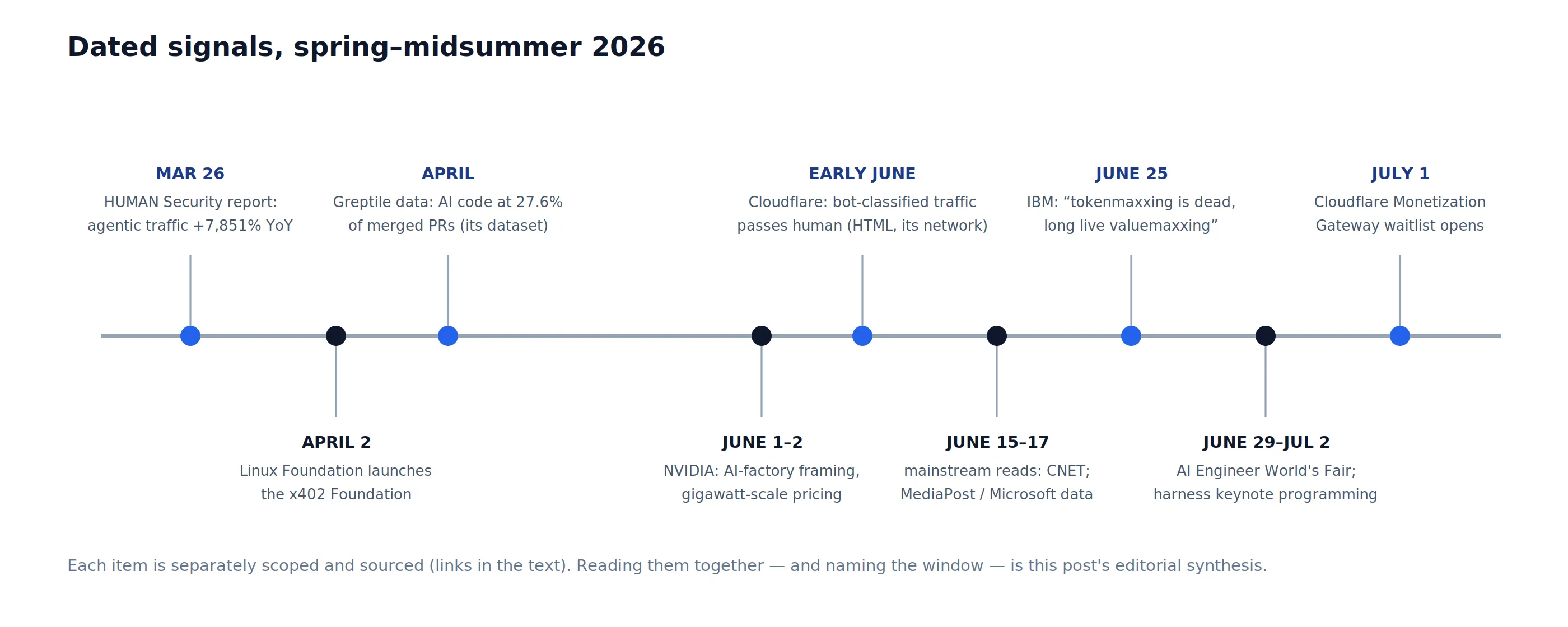
Moments like this are usually named years later, by historians with hindsight. We will be bolder and put a stake in the ground now: call it the Agentic Convergence — mid-2026: six separately scoped, dated signals, which this post reads together as the window in which operational questions moved to the center of the agentic conversation. Naming a moment is a claim history gets to grade, and we are comfortable being graded: every trend is independently sourced and linked. The bolder half of the claim stands on precedent rather than hope: past platform shifts have often elevated security, reliability, governance, and cost questions after initial adoption — the web era produced security and reliability engineering as disciplines; the cloud era produced FinOps and zero trust. The agentic turn pushes the conversation toward governance, control, and observability, because when bot-classified HTML requests cross 50% on a major network, one large pull-request dataset shows rapid growth in evidence of end-to-end AI generation, and token use is a metered operating cost, capability is no longer the only question that matters: reliability, economics, identity, accountability, and deployment boundaries become equally consequential. That is what "the second half of GenAI" means concretely — same game, wider questions — and the second half is the enterprise half, because enterprises are where those questions have teeth.

Dated signals from spring to midsummer 2026: the HUMAN Security report, x402 Foundation launch, Greptile data, the Cloudflare crossover, NVIDIA's framing, mainstream coverage, IBM's valuemaxxing essay, the AI Engineer World's Fair, and the Monetization Gateway waitlist on one timeline
Figure 3: The window, as dated items: each signal separately scoped and sourced in the text; reading them together — and naming the window — is this post's editorial synthesis. Original graphic.

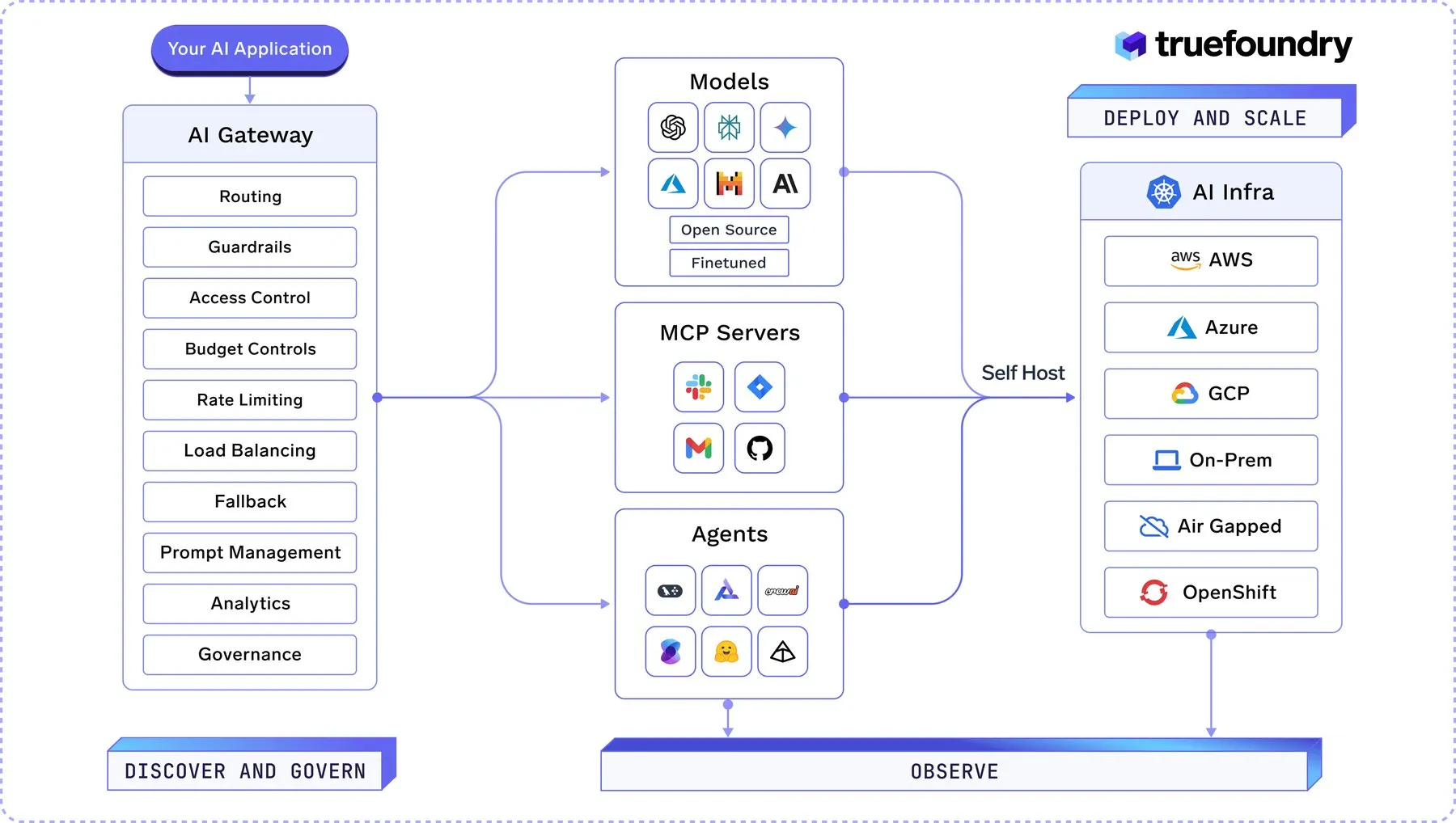
That is where TrueFoundry enters this story: the operating problem the six trends describe maps closely to the control-plane category TrueFoundry is building. Concretely, TrueFoundry ships an enterprise AI gateway and agent runtime: one governed plane through which an organization's models, tools, and agents operate. Control: per-agent identity with brokered credentials — no keys in agent definitions — RBAC and per-user delegation against the enterprise IdP, guardrails (PII, prompt-injection screening, moderation) enforced in the request path, and human approval gates that pause sensitive actions (Agent Harness docs; MCP Gateway security). Optimization: policy-based routing, retries, and fallbacks across 1000+ models behind one interface, budgets, quotas, and rate limits per team, agent, application, and environment, with warn-only and hard-enforcement modes and budget milestone alerts (budget docs) — plus caching and small-model lanes for the errand traffic (gateway docs). Observability: per-request cost, token, and latency attribution; per-step traces of every agent run with first-class OpenTelemetry export feeding whatever evaluation stack you run; and auditable records of agent and tool activity at the Agent Gateway. And because the convergence includes sovereign pressure, the plane deploys where the enterprise requires — VPC, on-premises, or fully air-gapped, with the documented commitment that "no data leaves your domain" (truefoundry.com/ai-gateway). Every claim in this paragraph resolves to a documentation page; the fastest due diligence available is reading them.

TrueFoundry platform architecture: your AI application enters the AI Gateway (routing, guardrails, access control, budget controls, rate limiting, load balancing, fallback, prompt management, analytics, governance), reaching models, MCP servers, and agents, deployed on AWS, Azure, GCP, on-prem, air-gapped, or OpenShift — with discover-and-govern, observe, and deploy-and-scale planes
Figure 4: The platform, whole: one governed plane between your AI applications and everything they touch — models, MCP servers, and agents on one side; AWS, Azure, GCP, on-prem, air-gapped, and OpenShift infrastructure on the other; governance, observability, and scale as the connective tissue. Source: TrueFoundry.
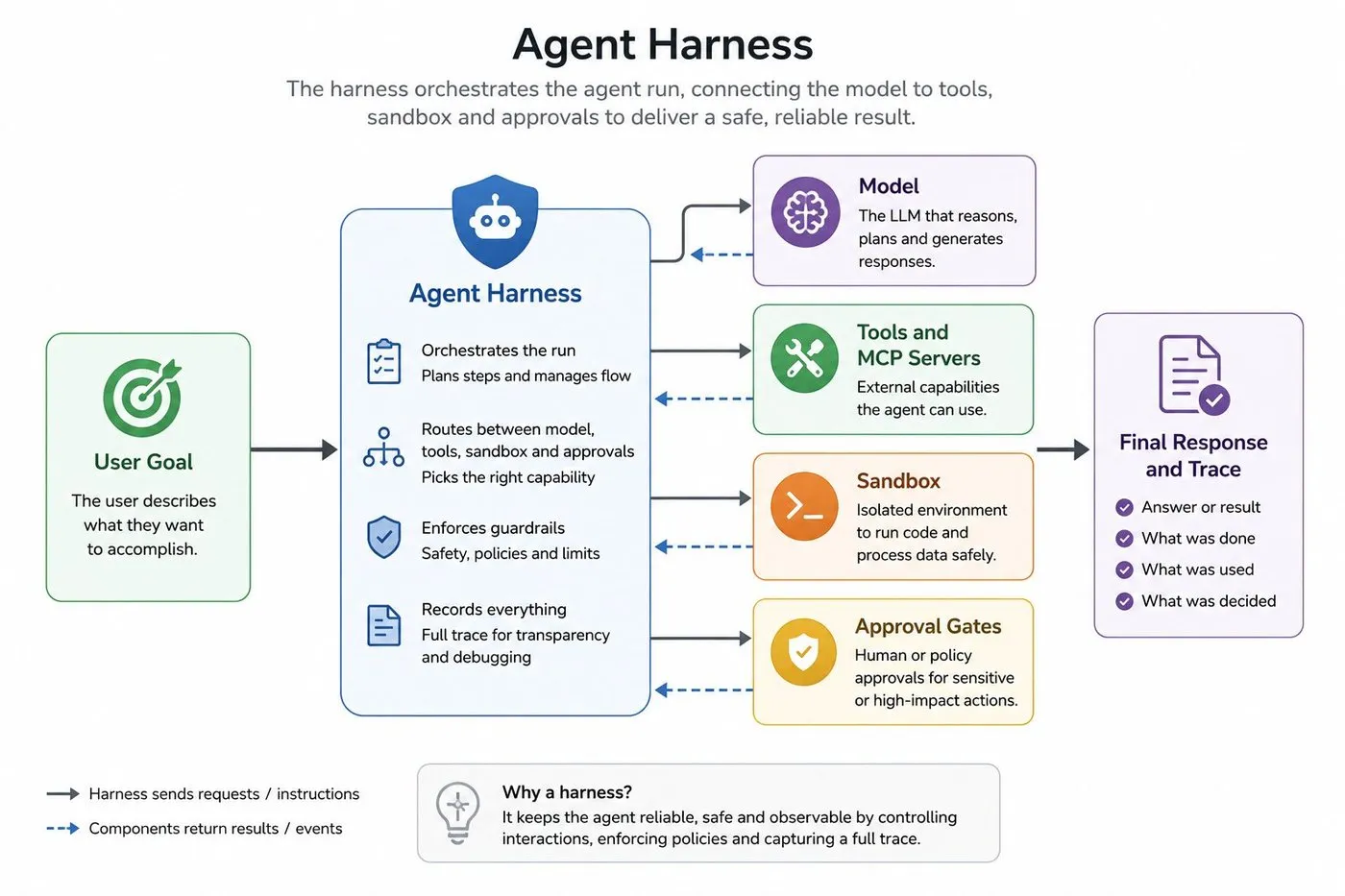
TrueFoundry overview: a user goal enters the Agent Harness, which orchestrates across model, tools and MCP servers, sandbox, and approval gates, producing a final response with a full trace
Figure 5: Zooming in on the runtime: the Agent Harness orchestrating each run across model, tools/MCP, sandbox, and approval gates, with guardrails enforced and a full trace recorded. Source: Agent Harness documentation.
AI Gateway dashboard showing aggregate input and output tokens, inference cost, request count, error rate, and latency
Figure 6: An AI Gateway metrics surface: aggregate token consumption, inference cost, request volume, error rate, and latency. TrueFoundry's broader documentation describes metadata-based grouping, cost controls, and agent metrics separately (analytics docs). Source: TrueFoundry.

8. Looking Forward: Enterprise Readiness Becomes the Theme

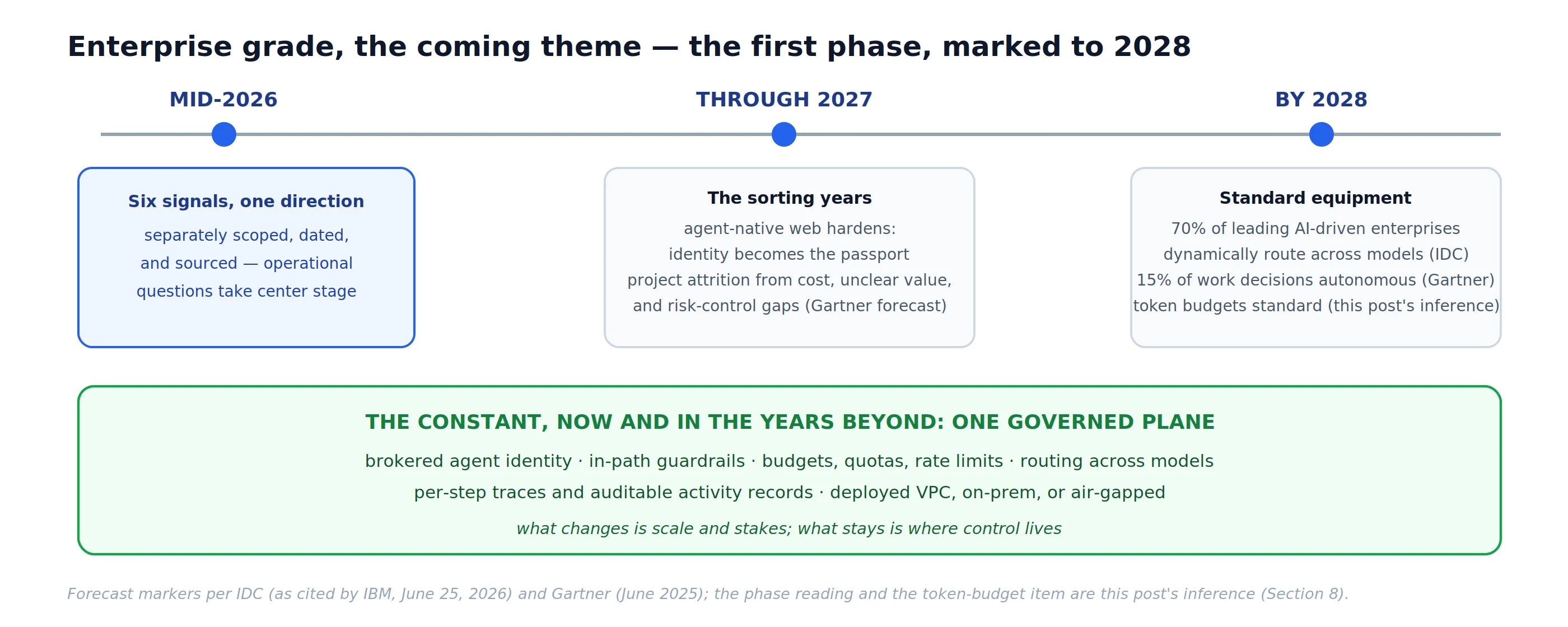
Forecasting a decade would outrun the evidence, so this section stays within the next two to three years. The six signals suggest growing demand for multi-model routing, cost controls, machine identity, auditability, and private deployment — requirements that overlap substantially with TrueFoundry's current platform. One broader observation, held at appropriate humility: if the years beyond follow this direction, enterprise readiness will be among their defining themes. Routing becomes standard architecture. IDC's projection — 70% of leading AI enterprises on dynamic multi-model routing by 2028 — describes the gateway pattern becoming default; the category-level implication is demand for this class of control plane: many models behind one interface, policy routing, cost-per-task attribution. Token budgets become standard equipment. This post's inference is that, as autonomous workloads grow more expensive, token budgets — ceilings enforced in-path, with attribution — will increasingly resemble a standard engineering control, the way cloud budgets became one. Budgets, quotas, and rate limits with warn-only and hard-enforcement modes are already documented capabilities in this category. The agent-native web hardens. Conditional admission (the 80% wall, Pay Per Crawl, agent-native endpoints, MCP-based access) will keep formalizing, which makes presentable machine identity — brokered credentials, per-user delegation, auditable conduct — the passport enterprises will need their fleets to carry; identity and MCP governance are where this category's requirements deepen. Agentic commerce arrives with mandates. As AP2 and x402 move from foundations to transactions, per-agent financial identity, hard ceilings, and reconcilable audit are likely to become increasingly important — an extension of the same budget-and-audit plane. And sovereignty grows more visible. Sovereign and private AI infrastructure are an increasingly visible part of the broader AI-factory buildout; enterprise-grade may increasingly include the option to run entirely inside the buyer's boundary, which is the deployment posture TrueFoundry has documented from the start. These are category-level implications, not statements about TrueFoundry's future roadmap; roadmap commitments belong in the company's own channels. One forecast keeps the outlook sober: Gartner's standing prediction (June 2025) that over 40% of agentic projects will be canceled by end-2027 for costs, unclear value, and inadequate risk controls sits inside the same research projecting 15% of daily work decisions autonomous by 2028 — TrueFoundry's interpretation is that growth and attrition may occur simultaneously — sorted, in significant part, by the controls this section describes.

Timeline: mid-2026's six signals, the sorting years through 2027, and 2028 forecast markers, over the constant of one governed plane
Figure 7: The first phase, marked to 2028: six dated signals, the sorting years, and 2028's forecast markers — with the governed plane as the constant. Forecasts are forecasts; the phase reading is Section 8's. Markers per IDC (as cited by IBM) and Gartner. Original graphic.

9. Limits

Four, so the argument stays disciplined. Measurement scope: the traffic figures are precise about their windows and methods — Cloudflare's 57.5% covers HTTP requests to HTML content across its network; HUMAN's ratios cover its quadrillion-interaction platform; researchers quoted in the March CNBC coverage caution that agent-string estimates are noisy. Several independently collected datasets point in a similar direction, but their magnitudes are not directly comparable; each percentage should be read within its own population and methodology. Convergence is not maturity: the same window that strengthened the case for the direction left the casualty forecast standing — which makes governance more decisive, not less. The coinage is ours: the underlying observations are sourced; grouping them as six signals and naming their conjunction the Agentic Convergence is TrueFoundry's editorial synthesis — offered with every link so you can weigh and grade it yourself, on the understanding that precedent is an argument, not a law. And a scope note on the vendor sections: TrueFoundry capabilities are paraphrased from public documentation current at writing; verify against the live docs, and read forward-looking statements in Section 8 as direction inferred from shipped surface, not announced commitments.

Closing Remarks

Every so often a stretch of the calendar compresses a transition that was always coming into a window you can point at. Mid-2026 was that stretch: across a handful of mid-year weeks, a major network's HTML-request mix, software-production measurements, capital's pricing, institutional plumbing, the practitioners' agenda, and the discourse's own vocabulary all registered the same direction — on the record, with dates. What the window strengthened, more than anything, is the case that agent operations are becoming a central enterprise engineering concern: for organizations deploying agents, the questions increasingly include how reliably those agents perform, what they cost, what authority they carry, and where their data and execution reside. That is a governance, control, and observability agenda — the agenda of GenAI's second half — and it maps closely to the platform TrueFoundry is building. The chart is public; the documentation is public; and history gets to grade the name this post has given the moment.

References

  • Traffic — Cloudflare Radar (live bot-vs-human chart): radar.cloudflare.com; CNET, June 15, 2026 — "Bots Now Outnumber Humans on the Internet. Here's What That Actually Means" (the mainstream explainer: 57.4%/42.6% live-chart reading, the ahead-of-projections framing, the agent fan-out point): cnet.com; HUMAN Security report, March 26, 2026: humansecurity.com, with CNBC coverage: cnbc.com; MediaPost via Yahoo Tech, June 17, 2026 (Microsoft telemetry, Prince reaction, ~80% blocking, agent-native product updates): tech.yahoo.com, canonical: mediapost.com.
  • Production and practitioners — Greptile, "Rise of the Overnight Agents" (the 27.6% merged-PR figure, its dataset): greptile.com; Sonar, "State of Code Developer Survey report" (1,100+ professional developers; the 48% always-verify and 42% self-reported committed-code figures): sonarsource.com; conference coverage (Krieger keynote programming, secondary): chatforest.com; the late-June program and scale: ai.engineer; swyx retrospective: dev.to; daily dispatch: latent.space; OpenAI, "Harness engineering: leveraging Codex in an agent-first world" (February 2026): openai.com.
  • Capital and institutions — GTC 2026 (March) keynote coverage: datacenterfrontier.com; GTC Taipei coverage, June 1, 2026: siliconangle.com; NVIDIA AI clouds, June 2, 2026: blogs.nvidia.com; x402 Foundation launch, April 2, 2026 (Google, Visa, Microsoft among 20+ expressing initial support): linuxfoundation.org; Cloudflare — Pay Per Crawl private beta: blog.cloudflare.com and Monetization Gateway waitlist, July 1, 2026: blog.cloudflare.com. The ~80% blocking figure is an attributed executive estimate (James Murray, Microsoft), per the MediaPost report.
  • Discourse and outlook — IBM Think, June 25, 2026 (Dhar and Boroditsky attributions, the linked May 2026 Uber budget-burn report, IDC 2028 routing projection, as reported and linked there): ibm.com; Gartner press release, June 25, 2025 (cancellation and autonomy forecasts): gartner.com; AP2, the Agent Payments Protocol (Google announcement): cloud.google.com.
  • TrueFoundry documentation — AI Gateway, MCP Gateway auth & security, Agent Harness, Agent Gateway, deployment posture. Series: AI FinOps, AI factory, agentic commerce, the keynote week.

All statistics and quotations are as reported by the linked sources on the dates given, with quoted fragments under fifteen words and attributed; internet-scale traffic measurement carries inherent noise per the caveats cited in the text. "The Agentic Convergence" is this post's coinage; the synthesis is the author's. TrueFoundry capabilities are paraphrased from public documentation — verify against current docs; Section 8's outlook is direction inferred from shipped capability, not a statement of announced roadmap. TrueFoundry is not affiliated with Cloudflare, HUMAN Security, Microsoft, NVIDIA, IBM, Gartner, or the cited publications.

The fastest way to build, govern and scale your AI

Sign Up
Table of Contents

One Gateway for Every LLM, Agent and MCP Server

Book a 30-min with our AI expert

Book a Demo

The fastest way to build, govern and scale your AI

Book Demo
Summarize with
ChatGPT logo by OpenAI
Perplexity AI logo
Blurry red snowflake on white background, symmetrical frosty design with soft edges and abstract shape.

Discover More

No items found.
July 14, 2026
|
5 min read

Mid-2026: The Agentic Convergence — Six Signals, and the Turn to Control

No items found.
July 14, 2026
|
5 min read

Lasso Security vs TrueFoundry: AI Security Comparison for 2026

No items found.
July 14, 2026
|
5 min read

Lasso Security Pricing: A Complete Breakdown for 2026

No items found.
July 14, 2026
|
5 min read

Runlayerの価格:2026年版 完全な内訳

No items found.
No items found.

Recent Blogs

Black left pointing arrow symbol on white background, directional indicator.
Take a quick product tour
Start Product Tour
Product Tour