Blank white background with no objects or features visible.

TrueFoundryはSeldon AIの買収を発表し、エンタープライズAI向けコントロールプレーンを拡張します。プレスリリース全文はこちら→

Enterprise-Grade Was the Subtext of the World's Fair

By Boyu Wang

Published: July 9, 2026

Read AI Engineer World's Fair 2026 the way a CIO would and a second conference appears inside the first. Yes, the headlines were loops, harnesses, and coding agents. But look at the program's structure: the AI-Native Enterprises leadership track ran on every main day — alongside a standing CTO Circle and leadership sessions titled "Tokenmaxxing" and "AI Factories" (official program) — a theme we’ve treated at book length in our Tokenmaxxing trilogy on AI cost governance, the architecture of governed usage, and building AI leverage. Look at who attended: the conference's own attendee breakdown reads like a Fortune 500 roster — Walmart, Capital One, Fidelity, Uber, Netflix, CVS Health, Toyota's Woven — alongside the labs and startups (ai.engineer). And look at the tracks that quietly earned prominent slots across the week: Security (Day 2), Evals (Day 3), Agentic Commerce (Day 4). The buyers were in the building, and the program they came for was not "can agents do it" but "can we run it" — governed, measured, inside our boundary. The sober analyst literature explains why. The frontier's demos and the analysts' warnings point at the same missing middle: an enterprise-grade execution layer. This short post is about what that layer concretely requires — and the documented TrueFoundry surface that ships it.

Key Takeaways

Key Takeaways

  • The enterprise thread ran through all of AIEWF 2026: AI-Native Enterprises was programmed on every main session day, alongside recurring leadership programming such as CTO Circle and token-economics sessions, plus prominent Security, Evals, and Agentic Commerce track slots across the program.
  • Enterprise-grade decomposes into five checkable properties: sovereignty of deployment, security in the request path, identity-based access, cost control with attribution, and audit — each a documentation page, not an adjective.
  • TrueFoundry's documented surface covers all five: VPC/on-prem/air-gapped deployment with "no data leaves your domain," in-path guardrails, RBAC and per-user delegation against the enterprise IdP, budgets and per-request cost attribution across 1600+ models, and logged, auditable agent activity.

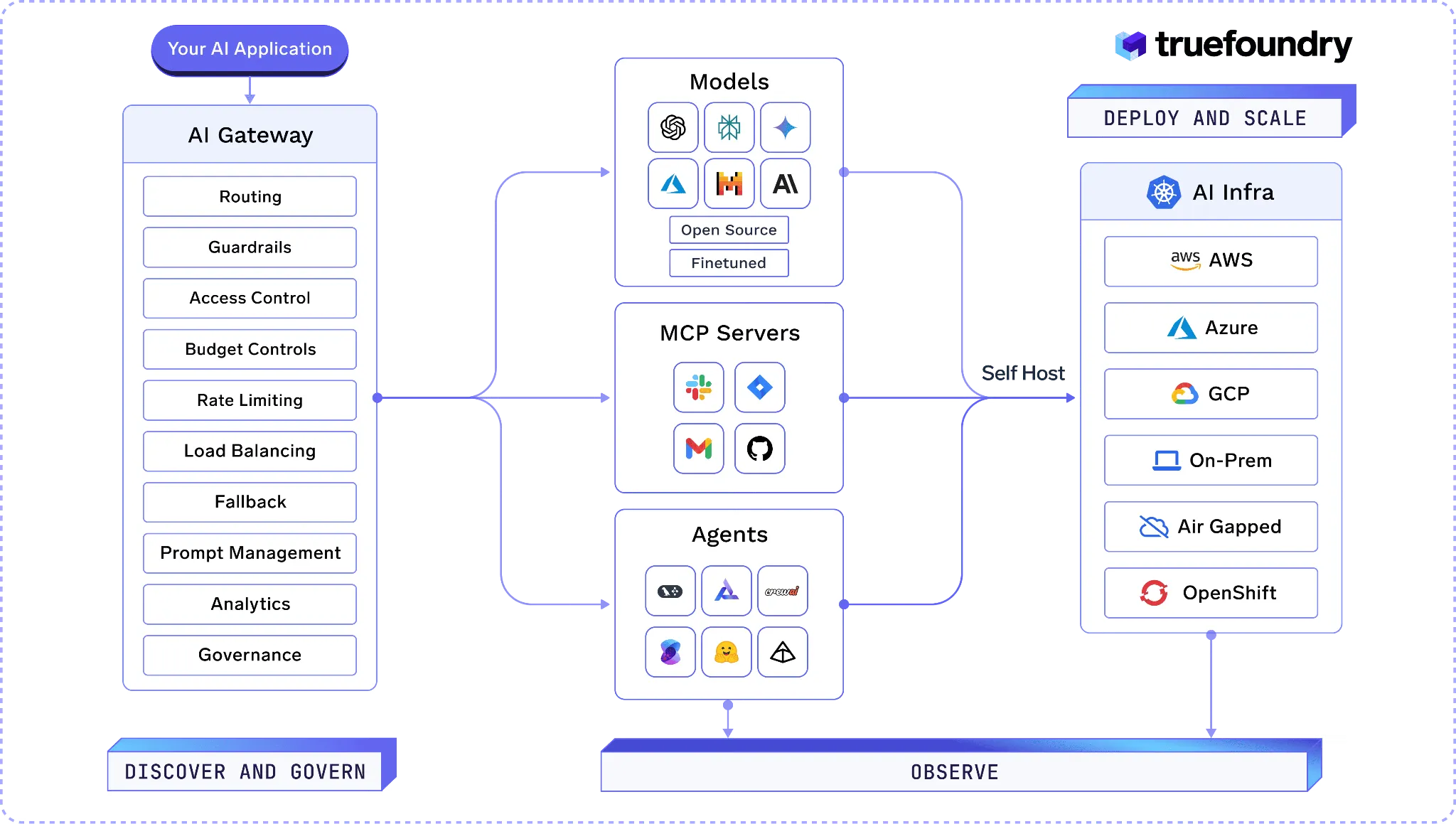
Figure 1: The platform this post keeps pointing back to, in one picture — TrueFoundry’s own flagship overview from its homepage.

1. The Conference the Buyers Attended

The engineering tracks made the noise; the leadership programming made the point. Every main day of the fair, while ten parallel engineering tracks ran, the AI-Native Enterprises track ran beside them, alongside recurring leadership programming — a CTO Circle in the leadership lounge and architect sessions on token economics ("Tokenmaxxing") and industrialized AI operations ("AI Factories") (llms.md). Security, Evals, and Agentic Commerce each held prominent slots across the main program: Security on Day 2, Evals on Day 3, and Agentic Commerce on Day 4. And the registration data the conference published tells you who was in those rooms: alongside the labs and dev-tool builders, the attendee roster spans finance (Vanguard, Fidelity, Capital One), consumer (Walmart, Uber, DoorDash), healthcare (CVS Health, Intuitive Surgical), and industrials (Rockwell, Woven by Toyota) (ai.engineer). That mix is the tell. The frontier's practitioners came to trade loop techniques; the enterprises came to answer a procurement question — what does it take to run this inside our walls, under our controls, at our scale? — and the program's structure says the organizers knew it.

Independent observers read the grid the same way. A widely shared DEV Community write-up of the program noted that there's no track called simply "AI Agents" anymore — the striking shift was that "infrastructure for managing agents — not just building them" had become its own category of talks. That's the enterprise-grade thesis stated from outside any vendor's mouth: the field's own agenda now separates making agents from governing them, and the second half is where a buyer's questions live. It's also, not coincidentally, the half a governed AI Gateway and managed Agent Harness exist to answer. And the seniority of the stage underlined that this was no side conversation: the announced keynote wave included OpenAI president Greg Brockman alongside the builders of the tools half the room uses daily.

2. Enterprise-Grade, as Five Documentation Pages

"Enterprise-grade" is an adjective until it decomposes into checkable properties; here are the five, each with its page. Sovereignty: the platform deploys in your VPC, on-premises, or fully air-gapped, with the documented posture that "no data leaves your domain" (truefoundry.com/ai-gateway) — the property that makes the local-AI and regulated-industry conversations at the fair actionable rather than aspirational, with self-hosted models behind the same API as cloud ones. Security in the path: guardrails — PII handling, prompt-injection screening, content moderation — run on requests and responses at the gateway; agents hold no credentials, with brokered injection, token refresh, and per-user delegation per the harness docs and MCP security docs. Identity-based access: per-server and per-tool RBAC integrated with the enterprise IdP, approval workflows, and curated Virtual MCP tool subsets at the MCP Gateway. Cost control with attribution: budgets, rate limits, and metadata-filtered quotas per team, user, model, application, and environment, with per-request cost, token, and latency metrics — across 1600+ models behind one interface (gateway docs). And audit: agent actions routed through the gateway — model and tool calls alike — logged and auditable at the Agent Gateway, with per-step traces for governed Agent Harness runs. Notice the mapping back to the analysts's triad: costs → budgets and attribution; unclear value → the evaluation layer and per-workflow measurement; risk controls → the governed runtime end to end. The cancellation causes are, read constructively, a requirements document — and every requirement resolves to a link.

Per-team, per-model AI cost attribution dashboard — the escalating-costs cancellation cause answered as a control surface
Figure 2: The first cancellation cause, answered: spend attributed per team, model, user, and workload, with budgets and quotas enforced on the same plane — costs as a dashboard, not a discovery. Source: TrueFoundry.
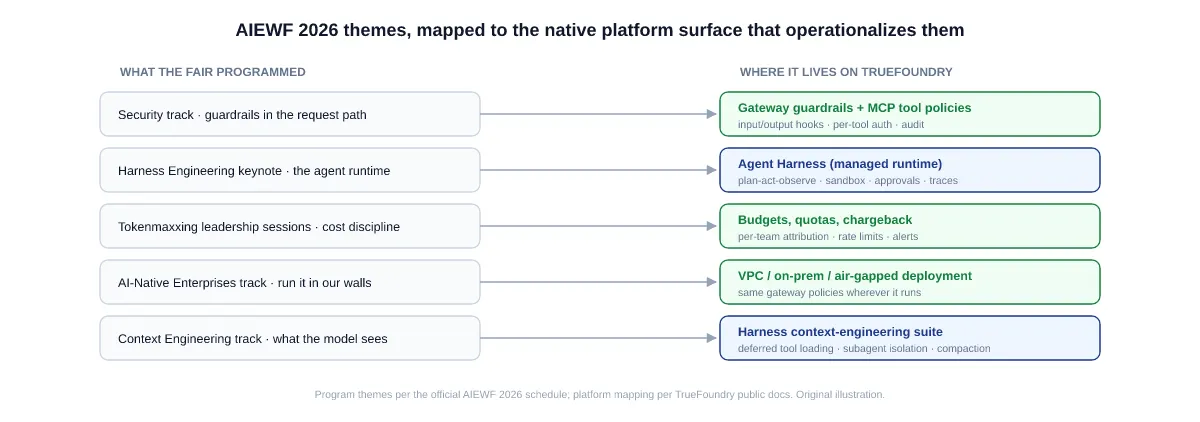
AIEWF 2026 program themes on the left mapped by arrows to the TrueFoundry feature that operationalizes each: Security to guardrails and MCP policies, Harness Engineering to Agent Harness, Tokenmaxxing to budgets and chargeback, AI-Native Enterprises to VPC/on-prem deployment, Context Engineering to the harness context suite.
Figure 3: The fair’s themes and the platform surface, one arrow each. Original illustration; program per the official schedule, mapping per TrueFoundry docs.

Careful readers will notice two of the fair's loudest themes have no arrow in that figure — and that's the map being honest rather than incomplete: they aren't native platform features, they're disciplines you build on the platform. Evaluation is one: TrueFoundry doesn't ship a native eval product, but the gateway's vantage point — every request, response, cost, and trace flowing through one place — is precisely the foundation an online-evaluation practice needs, which is the argument of our online LLM evaluation post: quality monitoring built where the traffic already is. Loop engineering is the other: designing the systems that prompt your agents is your craft, not a checkbox, but as our loop engineering at enterprise grade post puts it, that craft meets the runtime it assumes — approvals, budgets, traces, governed credentials — and its fleet-scale sequel extends the same point to running many loops at once: orchestration, routing and resilience, the unattended attack surface, and the loop lifecycle on a governed runtime. Foundation, then discipline — in that order. To be explicit about the line: the platform’s native, first-class surface is the gateway family (AI, MCP, and Agent Gateways), the Agent Harness runtime, Prompt Management, the Skills Registry, deployment and fine-tuning, and the governance controls around them — budgets, quotas, RBAC, guardrails, traces. Evaluation practices and loop engineering are not native features; they are capabilities you build on that surface.

Who Should Care — Beyond the AI Engineers

The conference is named for AI engineers, but the badge mix told the truer story: good enterprise AI is an organizational sport. The common layer everyone benefits from knowing is small — one gateway endpoint, a unified API across models, budgets and traces, and the shared agent vocabulary so meetings stop relitigating words. From there, each role has its own reason to care. InfoSec owns the request path once agents can act, so guardrail hooks, MCP tool-call policies, sandboxing, and credential isolation are their surface. Compliance and legal answer where data goes and under what terms — deployment posture (VPC, on-prem, air-gapped) and vendor-stated certifications are theirs. Audit inherits the question "what did the agent do" — request/response logs, per-step traces for governed runs, and cost attribution turn that from forensics into a query. FinOps and engineering leadership own the bill and the run-rate their board asks about — budgets, quotas, and chargeback are the levers, and the Tokenmaxxing series is the long-form playbook. Platform and SRE teams run the thing — routing, failover, autoscaling self-hosted models. Even product managers and procurement have a stake: PMs because agent quality gates decide what ships, procurement because "is this vendor real" is now a standard diligence question. None of these people need to become AI engineers; they need the shared layer plus their shelf. For a guided path through both, TrueFoundry Academy packages the same material as structured learning.

This post’s companion, Loops, Harnesses, and 6,000 Engineers, walks the same week from the engineer’s side — the loops-to-verification-to-harness arc — where this one walks it from the buyer’s.

3. The Honest Note, and the Week's Real Lesson

Two calibrations. The layer is necessary, not sufficient: the analysts's leaders also chose No platform makes those choices; what the platform guarantees is that whatever you choose runs inside your boundary, under your identities, within your budgets, and onto your audit trail. TrueFoundry's position in that convergence is simply stated and deliberately verifiable: the enterprise-grade AI gateway and agent runtime the week's two audiences both described is a set of public documentation pages, linked throughout this post, shipping today. The fastest due diligence available is reading them.

4. Frequently Asked Questions

How do we avoid the "agent washing" trap the analysts describes when buying? Test behavior, not branding: initiative, adaptation to failure, real tool use, durable memory — the community battery our Agent Harness explainer details — then run the governance battery on whatever passes: show me the agent's identity and scope, its budget hitting a cap, the approval queue, yesterday's run as a trace. Vendors that pass the first and fumble the second are selling the exciting half of an agent.

What's the minimum first step toward the layer described here? Put your AI calls on the gateway path — one integration that immediately yields attribution (the costs cause), a place for evaluation (the value cause), and guardrails plus identity (the risk cause). Everything else in this post — harness, skills, approvals, air-gapped deployment — composes onto that path incrementally; the gateway docs are the starting page.

References

TrueFoundry capabilities are paraphrased from the linked public documentation — verify against current docs. TrueFoundry is not affiliated with the conference or the cited analyst firms; the synthesis here is the author's.

Disclaimer. This is an independent commentary published by TrueFoundry for general informational purposes; it is not legal, financial, or professional advice. Conference names, company names, and speaker names are used solely for identification and good-faith commentary on public events and published coverage; no affiliation, sponsorship, or endorsement by the AI Engineer World's Fair, OpenAI, Anthropic, or any named individual or publication is implied, and none of them has reviewed or endorsed this article. Quoted fragments are short excerpts from the linked published sources, used with attribution for commentary. If you believe anything here is inaccurate, contact us and we will review corrections promptly.

The fastest way to build, govern and scale your AI

Sign Up
Table of Contents

One Gateway for Every LLM, Agent and MCP Server

Book a 30-min with our AI expert

Book a Demo

The fastest way to build, govern and scale your AI

Book Demo
Summarize with
ChatGPT logo by OpenAI
Perplexity AI logo
Blurry red snowflake on white background, symmetrical frosty design with soft edges and abstract shape.

Discover More

No items found.
July 9, 2026
|
5 min read

Enterprise-Grade Was the Subtext of the World's Fair

No items found.
July 8, 2026
|
5 min read

LLM向けOpenTelemetry: マルチプロバイダーAIゲートウェイをどのように計測するか

No items found.
July 8, 2026
|
5 min read

TrueFoundryによるマルチクラウドGPUオーケストレーション:ハイパースケーラーと専門クラウドのためのリファレンスアーキテクチャ

No items found.
TrueFoundry AI gateway is an enterprise alternative to OpenRouter and Portkey
July 7, 2026
|
5 min read

OpenRouter vs Portkey: Pricing, Gateway Features, and Enterprise Fit Compared

No items found.
No items found.

Recent Blogs

Black left pointing arrow symbol on white background, directional indicator.
Take a quick product tour
Start Product Tour
Product Tour