Blank white background with no objects or features visible.

TrueFoundryはSeldon AIの買収を発表し、エンタープライズAI向けコントロールプレーンを拡張します。プレスリリース全文はこちら→

Loops, Harnesses, and 6,000 Engineers: What the World's Fair Confirmed — and What Ships Today

By Boyu Wang

Published: July 10, 2026

AI Engineer World's Fair (AIEWF) 2026 — 6,000+ engineers, 300 speakers, 29 tracks, and 100+ expo partners across four days (ai.engineer/worldsfair/2026) — is one of the field's clearest annual snapshots of itself. This year's measurement had a shape. The week opened on loops: swyx (AIEWF cofounder) titled his opening talk "Loopcraft: The Art of Stacking Loops," and his own publication's daily dispatch led with the verdict — "Loops, loops and more loops" dominated the first full day, from cron-job automations to Geoffrey Huntley's now-canonical claim that "everything is a ralph loop" (latent.space). It pivoted mid-week to verification, as Greptile's dataset showed AI-generated code at 27.6% of merged PRs — up from under 1% fourteen months earlier — and Sonar pressed the uncomfortable companion number: roughly 48% of that code gets explicitly reviewed before merge (as reported in the conference coverage at chatforest.com). And it closed on the harness: the final day's keynote slot belonged to Harness Engineering itself, with Anthropic Labs co-lead Mike Krieger headlining. Loops, verification, harness — that arc is not a conference schedule. It is an architecture. And it is the architecture TrueFoundry documents and ships today.

Key Takeaways

Key Takeaways

  • AIEWF 2026's arc ran loops → verification → harness: swyx opened on "Loopcraft," Greptile and Sonar quantified the verification gap mid-week, and the closing keynote belonged to Harness Engineering with Anthropic's Mike Krieger.
  • swyx's three-year retrospective named the shift outright: "the model alone is no longer the product," and prompt engineering "gave way to rigorous evals," RL environments, and context/harness engineering (dev.to).
  • The reported numbers point in the same direction: with AI writing a reported 27.6% of merged PRs and only ~48% of AI-generated code explicitly reviewed, generation has outrun verification — the gap is closed by harness infrastructure, not vigilance.
  • TrueFoundry's Agent Harness ships the keynote discipline as documentation: managed plan-act-observe loop, sandboxed execution, human-in-the-loop approval gates, memory for long-running tasks, and no credentials in agent definitions.
  • The loop discourse lands on the same surface: budgets, step ceilings, retries, and stall safeguards for governed runs — the cost half of which our Tokenmaxxing series treats end to end at the Agent Gateway are what make a stacked loop a production system instead of a token bonfire.
  • Verification ships as the continuous evaluation layer plus per-step traces — the quality gate the 48% figure says most pipelines are missing.
  • Honest note: a harness governs and bounds; it doesn't make a weak model strong or a bad task decomposition good — the frontier keynoted the layer because it changes failure economics, not because it abolishes failure.

1. The Week in Three Quotes

Start with the retrospective, because it frames everything else. In his welcome to the conference's official daily, swyx marked three years since "The Rise of the AI Engineer" and summarized what the thesis became: everyone from top startups to the frontier labs is now saying "the model alone is no longer the product," and prompt engineering "gave way to rigorous evals," RL environments for post-training, and context and harness engineering (dev.to/dailycontext). Then the opening day's obsession: the Latent.Space dispatch reported that the word loop "dominated conversations" — swyx's own "Loopcraft" keynote framed the field's evolution "from chat, to tools, to goals" to automations, and the Software Factories track built the day around persistent agent loops run against specs (latent.space). And the close: the final day's keynote was Harness Engineering — the coverage framing the whole four-day debt as something "paid... through infrastructure, governance," with Krieger's builder philosophy summarized as build "frontier-far" (chatforest.com). One community observer put the structural point best: three years ago "AI Agents" was one track — this year the same scope needed nine (dev.to/hanzla). The field didn't get louder. It got specific — and the specifics are infrastructure.

2. Why the Arc Is an Architecture

Loops, verification, harness are not three topics; they are one dependency chain. A loop is an agent that keeps going — the cron-job automations and ralph-loop workers the opening day celebrated — and a loop that keeps going multiplies output past what humans can inspect, which is what the reported mid-week numbers pointed to: 27.6% of merged PRs AI-generated, a ~28× increase in fourteen months, against an explicit-review rate near 48%. Generation compounding, verification flat — that divergence is the field's core operational problem, and the closing keynote pointed at the layer where that problem gets operationalized: the harness, the layer where loops get bounded, verified, and recorded by construction. Bounded: budgets, step ceilings, stall detection, so a stacked loop has a worst case measured in dollars and pages rather than invoices. Verified: evaluation gates in the output path, because at 27.6% and climbing, review has to be machinery first and attention second. Recorded: per-step traces, so the question "what did the loop actually do" is a query — the log-is-the-agent principle several of the week's most-shared talks circled. This is precisely the stack this blog has been documenting for a year across loop engineering, quality gates at the gateway, and the harness vocabulary made concrete — and the pleasant surprise of the week was watching the frontier's own program converge on the same order of operations.

The convergence wasn't only in the program grid; it was in what the frontier labs said about their own practice. Interviewed on stage by swyx, Anthropic's Head of Labs Mike Krieger described how his team actually uses its internal agent: "Most usage is actually much more delegated," he said — the instruction pattern isn't "fix this bug" but closer to giving the agent standing ownership of a part of the codebase, a feedback channel to monitor, and license to take on tasks proactively (as reported in Latent.Space's closing dispatch). Read that as an operations requirement and it's a harness spec: a standing, delegated agent is precisely the thing that needs budgets before it runs, approval gates on the actions that matter, and a per-step trace after — which is the shape of a governed Agent Harness run, not a chat window.

OpenAI has been making the same argument in method form. Its published "Harness Engineering" approach — covered by InfoQ earlier this year — has Codex agents generating, testing, and deploying a million-line production system under observability, architectural constraints, and structured documentation. Strip the scale and the lesson is the one this post keeps landing on: when the frontier trusts agents with real systems, it does so by strengthening the layer around the model, not by trusting the model more. That layer is exactly what an enterprise adopts when it runs agents through a managed harness behind a governed gateway rather than hand-rolling the loop per team.

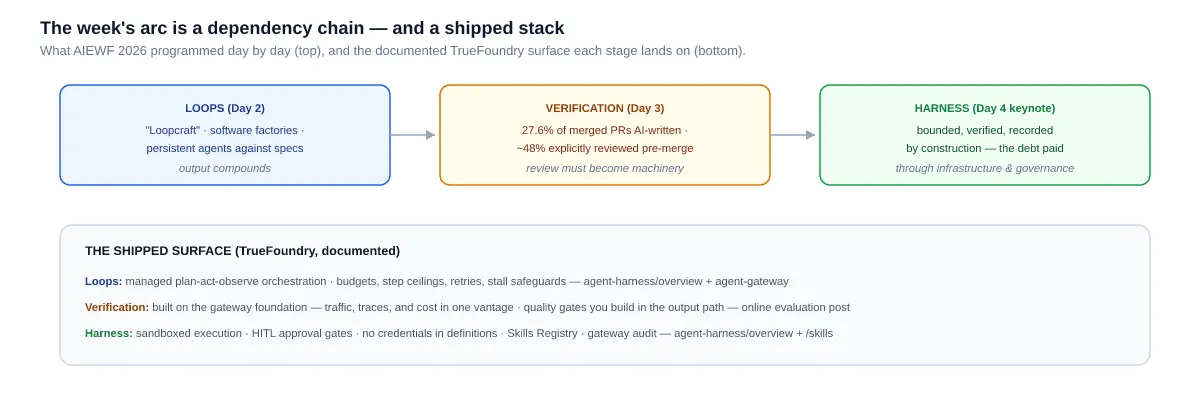
Diagram: the week's arc from loops to verification to harness, mapped to the governed runtime stack.
Figure 1: The conference arc as a dependency chain. Figures per the cited conference coverage; the bottom band's claims are checkable against the linked TrueFoundry documentation.

A precision note on that bottom panel: the loops and harness rows are native platform surface; the verification row is deliberately framed as a foundation, because TrueFoundry doesn't ship a native eval product. What it ships is the vantage point evaluation needs — every request, response, cost, and per-step trace in one place — which is the argument of our online LLM evaluation post: quality monitoring built where the traffic already is. The same foundation-then-discipline order holds for the loops themselves: Loop Engineering at Enterprise Grade makes the case that designing the systems that prompt your agents is your craft, but that craft meets the runtime it assumes — approvals, budgets, traces, governed credentials — and its fleet-scale sequel extends it to many loops at once: orchestration, routing and resilience, the unattended attack surface, and the loop lifecycle on a governed runtime. The line to keep crisp: TrueFoundry’s native, first-class features are the gateways (AI, MCP, Agent), the Agent Harness, Prompt Management, the Skills Registry, deployment and fine-tuning, and the governance controls — budgets, quotas, RBAC, guardrails, traces. Online evaluation and loop engineering are disciplines built on that surface, not features of it.

3. What Ships, With the Links

The Harness Engineering keynote's discipline is TrueFoundry's Agent Harness, documented and generally available: agents defined declaratively and executed by a managed plan-act-observe loop; sandboxed execution per run; memory and context management for long-running tasks; human-in-the-loop gates that pause sensitive actions until explicit approval; and the security pillar stated categorically in the docs — no API keys or credentials in agent definitions, with the gateways brokering scoped credentials, token refresh, and per-user delegation (mcp-gateway-auth-security). The loop discourse lands on the Agent Gateway's documented controls — per-agent quotas and rate limits, retries, fallbacks, and timeout safeguards against stalled or looping agents, with all agent actions logged and auditable. The verification gap lands on the platform's native telemetry — per-step traces with cost, tokens, and latency per step, exported first-class over OpenTelemetry — feeding the evaluation loop you run on top of it: TrueFoundry documents integrations with evaluation platforms such as Braintrust and Langfuse, and our online-evaluation post details the architecture. To be precise about what's native and what's built: the traces, export, and guardrails ship in the platform; the scoring pipeline is yours or a partner's, attached to that substrate — and it's that combination that turns the 48% review problem from a staffing plea into an output-path gate. And the week's skills conversation (the "missing manual" thread from the community's most-shared online programming) lands on the Skills Registry: versioned, access-controlled procedure packages mounted at runtime, covered at depth in our skills post. That is the entire pitch, and it is deliberately boring: the stack the frontier keynoted is a set of documentation pages that already exist. Read them against the keynote notes and check.

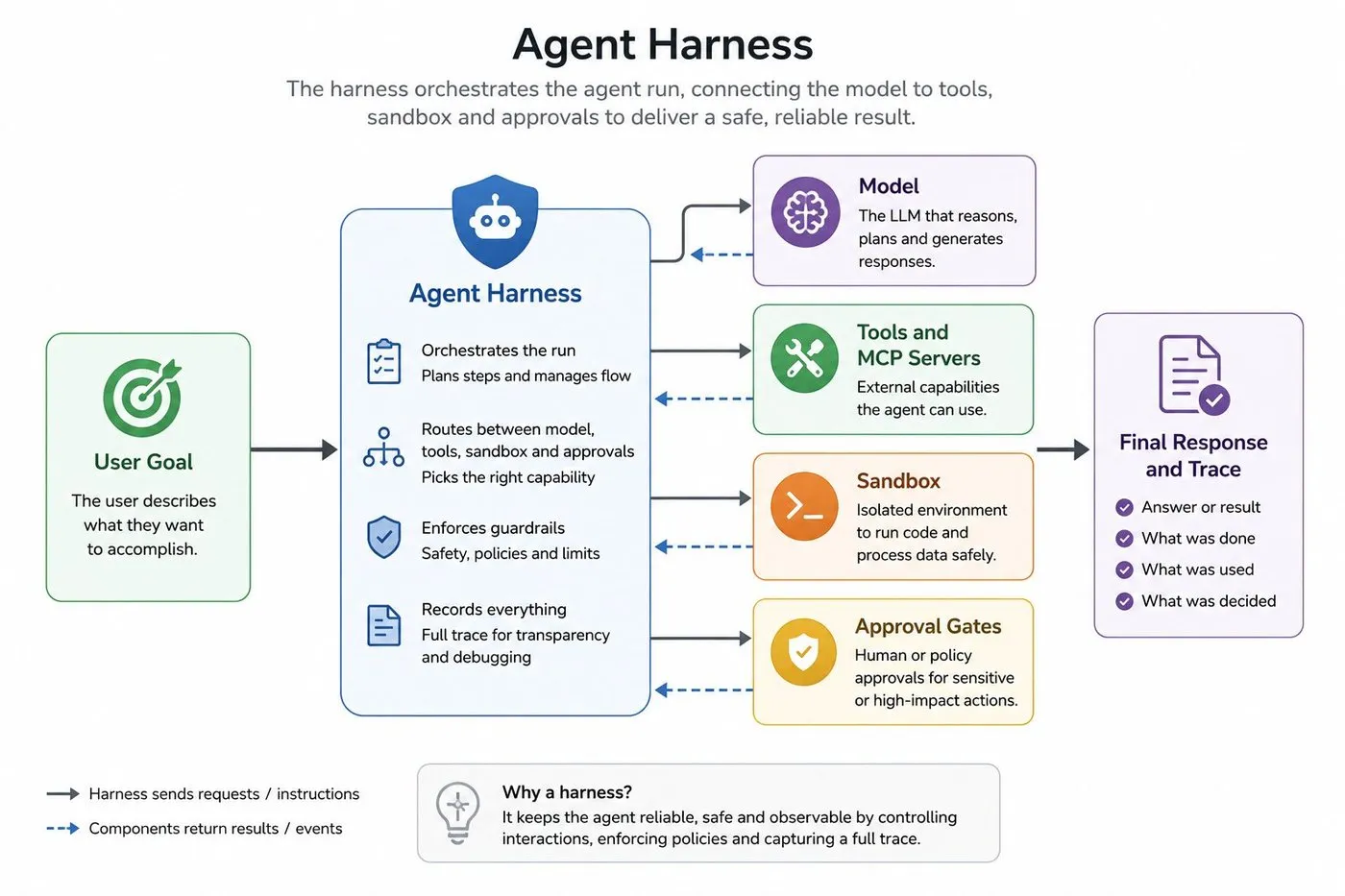
TrueFoundry Agent Harness: the managed loop, sandbox, approvals, and traces the harness engineering keynote described — as shipped documentation
Figure 2: The keynote discipline as a documentation page: managed loop, sandboxed runs, brokered credentials, approval gates, and per-step traces on one governed runtime. Source: TrueFoundry Agent Harness documentation.

Who Should Care — Beyond the AI Engineers

Loops, verification, and harness sound like engineers' problems, and the conference is named accordingly — but each stage of the arc lands on someone else's desk too. Platform and SRE teams inherit the fleet problem the moment a second loop ships: orchestration, routing, resilience, scale-down. InfoSec inherits what the fleet post calls the unattended attack surface — agents acting at 3 a.m. with standing credentials are a security posture, not a demo. QA and quality leadership inherit the 27.6% question: when a growing share of merged code is machine-written, review has to become machinery, and someone owns that machinery. Audit gets the trace: "what did the loop actually do" should be a query. And engineering leadership owns the trade the whole week debated — output that compounds versus risk that compounds — which is a budgets-ceilings-and-gates decision, not a vibe. None of them need to write agent code; they need the shared layer — one gateway, budgets, traces, the common vocabulary — plus their shelf. TrueFoundry Academy is the guided path through both.

The companion post, Enterprise-Grade Was the Subtext, reads the same fair from the buyer’s seat — the leadership programming, the analyst backdrop, and the persona map — where this one reads it from the builder’s.

4. The Honest Note

Two calibrations keep this credible. First, the harness changes failure economics, not failure existence: bounded, gated, traced loops fail cheaply and diagnosably, which is what lets teams iterate to strong agents — but no harness makes a weak model reason well or a misconceived automation worthwhile, and the week's own verification numbers are a reminder that the gap between generation and assurance is closed by sustained engineering, not by any single layer. Second, conference coverage is coverage: the quotes and figures above are drawn from the cited dispatches and the conference's own materials, and readers should treat the statistics (Greptile's 27.6%, the 48% review average) as reported by those sources — links provided precisely so the claims can be traced. What needs no caveat is the direction: one of the largest technical AI conferences in the field just spent four days arguing that the system around the model is the product. On that point, the documentation linked throughout this post has been making the argument in shipping form all along.

5. Frequently Asked Questions

Where can I watch the talks referenced here? The conference publishes recordings to its YouTube channel (youtube.com/@aiDotEngineer), with keynotes streamed live and session recordings landing within days; the program and structured session data live at ai.engineer/worldsfair/2026. The Latent.Space daily dispatches (latent.space) are the deepest practitioner coverage.

Is "harness engineering" different from what agent frameworks already do? Yes, in scope and guarantees: a framework is a library your team runs; the harness discipline the keynote track described — and the Agent Harness implements — is a managed runtime on governed rails, where the loop, sandbox, credentials, gates, and traces are platform properties. Frameworks compose with it rather than compete.

What's the one thing to adopt first, given the week's arc? Follow the arc backwards: if your agents already loop, add the verification gate (evals in the output path, traces on governed runs) before adding more loops — the reported Greptile/Sonar figures are the warning sign. On the linked platform that's configuration on the path your calls already take, not a rebuild.

References

Quotes and figures are drawn from the linked conference materials and coverage, with quoted fragments under fifteen words and attributed; statistics are as reported by the cited sources. TrueFoundry capabilities are paraphrased from the linked public documentation — verify against current docs. TrueFoundry is not affiliated with the conference; the reading here is the author's.

Disclaimer. This is an independent commentary published by TrueFoundry for general informational purposes; it is not legal, financial, or professional advice. Conference names, company names, and speaker names are used solely for identification and good-faith commentary on public events and published coverage; no affiliation, sponsorship, or endorsement by the AI Engineer World's Fair, OpenAI, Anthropic, or any named individual or publication is implied, and none of them has reviewed or endorsed this article. Quoted fragments are short excerpts from the linked published sources, used with attribution for commentary. Reported statistics are as published by the cited coverage and may be revised. If you believe anything here is inaccurate, contact us and we will review corrections promptly.

The fastest way to build, govern and scale your AI

Sign Up
Table of Contents

One Gateway for Every LLM, Agent and MCP Server

Book a 30-min with our AI expert

Book a Demo

The fastest way to build, govern and scale your AI

Book Demo
Summarize with
ChatGPT logo by OpenAI
Perplexity AI logo
Blurry red snowflake on white background, symmetrical frosty design with soft edges and abstract shape.

Discover More

No items found.
TrueFoundry AI gateway is an enterprise alternative to OpenRouter and Portkey
July 10, 2026
|
5 min read

OpenRouter vs Portkey: Pricing, Gateway Features, and Enterprise Fit Compared

No items found.
TrueFoundry AI gateway is an enterprise alternative to OpenRouter and AWS Bedrock
July 10, 2026
|
5 min read

OpenRouter vs AWS Bedrock: Pricing, Governance, and Enterprise Fit Compared

No items found.
TrueFoundry AI gateway is an enterprise alternative to OpenRouter and Bifrost
July 10, 2026
|
5 min read

Bifrost vs OpenRouter: A Practical Comparison for Engineering Teams in 2026

No items found.
TrueFoundry AI gateway is an enterprise alternative to OpenRouter and Helicone
July 10, 2026
|
5 min read

Helicone vs OpenRouter: Which Platform Fits Your Production Stack?

No items found.
No items found.

Recent Blogs

Black left pointing arrow symbol on white background, directional indicator.
Take a quick product tour
Start Product Tour
Product Tour