Blank white background with no objects or features visible.

TrueForgeのご紹介:オープンソースでベンダーフリーなエージェントハーネス。コストを50%削減します。今すぐ試す→

Agent Interoperability: One Control Plane for Any Framework

By アシシュ・ドゥベイ

Published: August 25, 2026

⚡ TL;DR

Agent interoperability is the ability to build agents on any framework and connect them to any model and tool, while governing all of them the same way. The alternative is a stack that fragments by vendor, where each framework has its own auth, its own tool wiring, and its own blind spots. On TrueFoundry, agents from LangGraph, CrewAI, AutoGen, Bedrock, Vertex, or a custom service register in one place, speak open standards like MCP and A2A, and inherit one identity, access, and guardrail model.

Pick an agent framework today and you are really picking a small ecosystem: a way to define agents, a way to wire tools, and a way to authenticate. Pick a second framework next quarter, which most teams do, and you now have two of everything, governed inconsistently. Add the models each one talks to and the tools each one calls, and the surface area no one can see grows fast. That fragmentation, not any single framework, is the real obstacle to running agents in production.

Agent interoperability is the answer to it: a vendor-neutral layer that lets teams choose the best framework for each job while the platform keeps one consistent view of every agent, model, and tool. This guide covers what interoperability means in practice, why open standards matter, and how TrueFoundry provides it without asking anyone to standardize on one framework.

What Is Agent Interoperability?

Agent interoperability is the property that the pieces of an agent stack, the framework, the model, and the tools, can be mixed and swapped without the governance around them breaking. An agent built on one framework can call the same tools as an agent built on another, both can reach the same models, and both are subject to the same identity, access, and audit rules.

It has two halves that are easy to conflate:

  • Build-time interoperability. You are not locked into one framework or one model provider. You can build one agent in LangGraph, another in CrewAI, and a third as a plain HTTP service, and adopt a new model without a rewrite.
  • Run-time interoperability. Those agents speak shared protocols to reach tools and each other, so a tool written once is usable by any of them, and governance applies uniformly no matter which framework made the call.

Without the second half, the first just spreads the fragmentation around. Interoperability that matters is the combination: freedom to choose, plus one consistent control plane underneath.

Why Open Standards Are the Foundation

Interoperability is only real if it rests on open standards rather than one vendor's proprietary connectors. Two standards carry most of the weight for agents today.

  • MCP (Model Context Protocol) standardizes how an agent reaches a tool. A tool exposed as an MCP server can be called by any MCP-aware agent, regardless of the framework it was built on. Instead of N frameworks times M bespoke integrations, you get one protocol.
  • A2A (Agent-to-Agent) standardizes how one agent calls another. An agent that implements A2A exposes a machine-readable agent card, and other agents can discover and call it without custom glue.

A platform that speaks these standards can sit in front of any agent and any tool and still understand what is happening. A platform that relies on proprietary wiring can only govern the parts built its way. That difference is why the MCP vs A2A distinction matters: one is how agents reach tools, the other is how agents reach each other, and a vendor-neutral control plane needs to handle both.

How TrueFoundry Delivers Vendor-Neutral Interop

TrueFoundry's role is to be the control plane that every framework, model, and tool passes through, so choice at the edges does not become chaos in the middle.

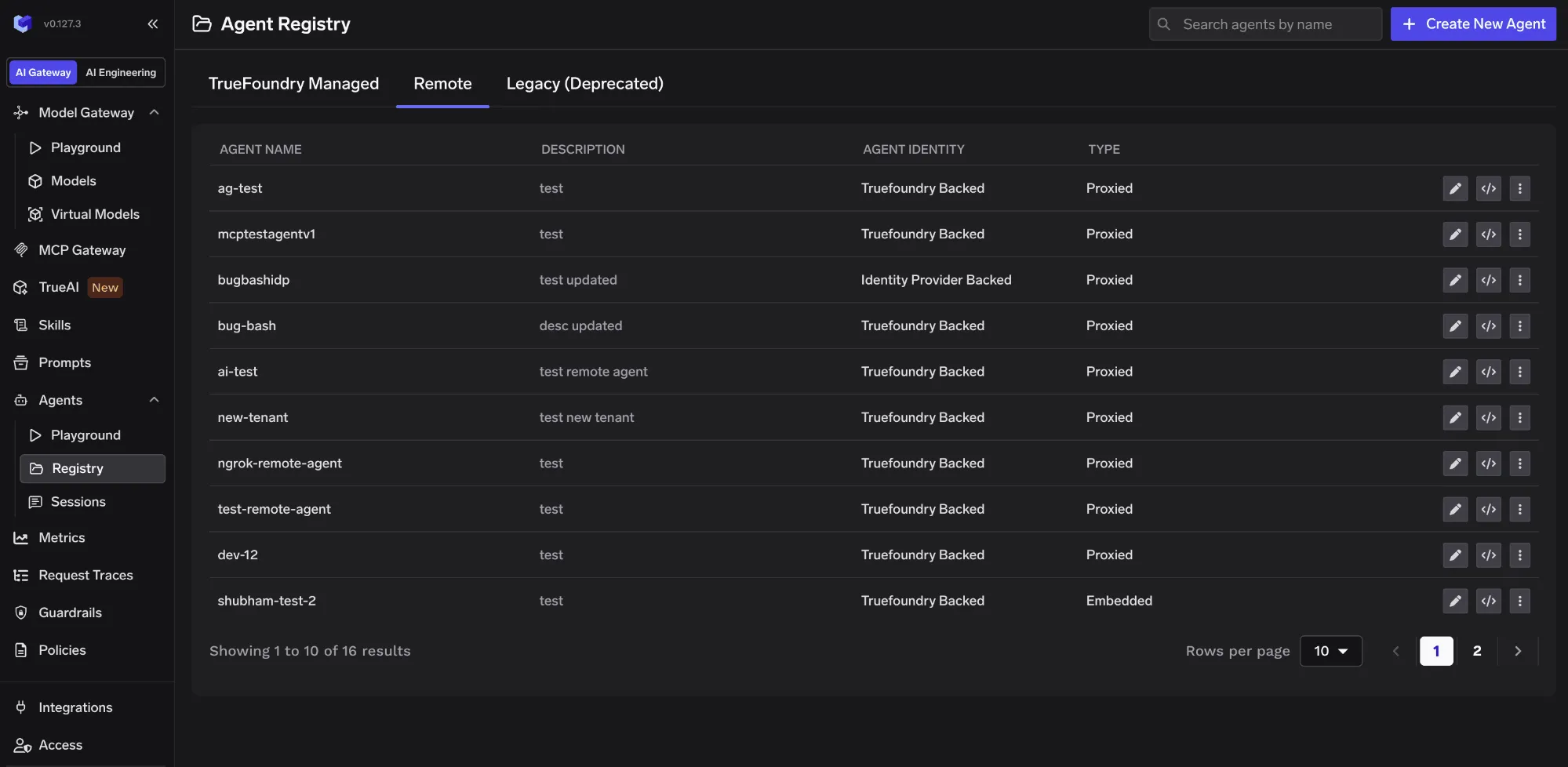
A framework-agnostic Agent Registry

Whatever an agent is built on, Bedrock, Vertex AI, LangGraph, a custom HTTP service, an A2A agent, or a copilot embedded in a SaaS product, it enters governance by being registered in the Agent Registry, with nothing to move or rewrite.

The framework-agnostic Agent Registry listing agents from any stack
Product screenshot, TrueFoundry docs: the Agent Registry.

For A2A agents specifically, the registry resolves the agent card at its well-known endpoint, proxies calls through the gateway, and records the JSON-RPC request and response in every trace. So an A2A agent and a LangGraph agent look different at build time but are governed identically at run time: same registry, same identity, same audit trail.

One unified interface for models and tools

On the model side, every provider sits behind a single OpenAI-compatible API, so any framework can reach any of 1,000+ models by pointing at the gateway and overriding its base URL. You do not adopt a TrueFoundry SDK to get this. You keep your framework and change one setting.

# Any OpenAI-compatible framework or app becomes portable by overriding the base URL.
from openai import OpenAI

client = OpenAI(
    api_key="your-truefoundry-api-key",   # a gateway token
    base_url="https://gateway.truefoundry.ai",
)
# LangChain, CrewAI, AutoGen, LlamaIndex, or a custom loop:
# set the same base_url and they all route through the one control plane.

On the tool side, the MCP Gateway fronts any MCP server and standardizes access to it, so a tool registered once is reachable by every governed agent. TrueFoundry's ecosystem spans 116+ integrations across categories like coding assistants, frameworks and apps, and guardrails, all reachable through the same gateway.

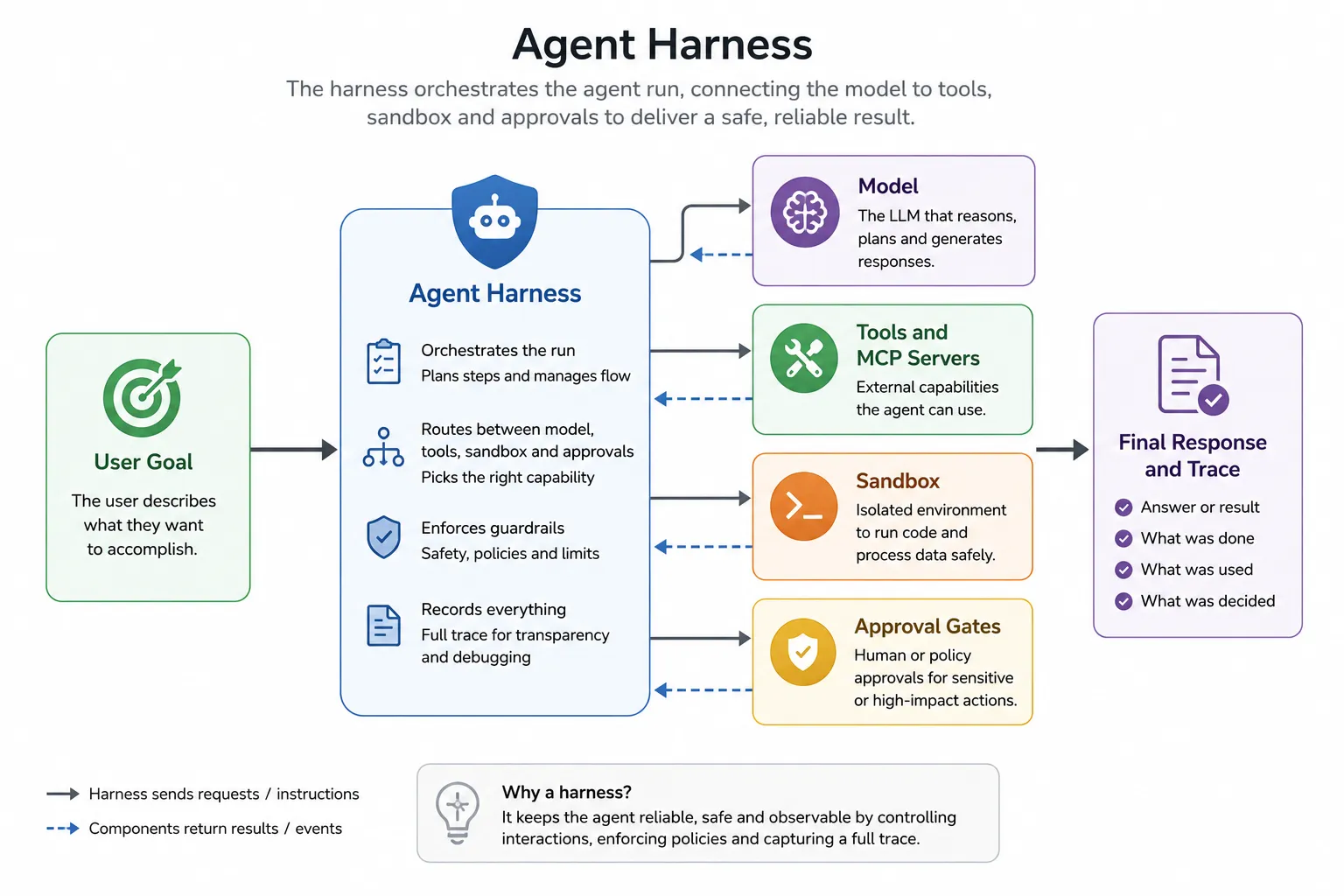
The Agent Harness connects any model, MCP tools, and sandbox under one governed runtime
Product screenshot, TrueFoundry docs: the Agent Harness runtime.

Pluggable extension points instead of a closed marketplace

Where some platforms ship a proprietary "agent plugins" catalog, TrueFoundry's extension model is open by design. Tools plug in as MCP servers. Safety and policy logic plugs in as custom guardrails, which are just HTTP services that follow a simple request and response contract, so you can add domain-specific validation or mutation without waiting on a vendor to build a connector. The result is the same benefit a plugin marketplace promises, extensibility, without the lock-in of a closed one.

Bring any framework. Govern it one way.

TrueFoundry registers agents from LangGraph, CrewAI, AutoGen, Bedrock, or a custom service and governs them from one control plane, inside your VPC.

One Governance Model Across Every Framework

The point of routing every framework through one control plane is that governance stops depending on which framework made a call. The same three controls apply everywhere:

  • Agent identity. Every registered agent carries its own verifiable identity, whether it was built in LangGraph or embedded in a SaaS app, so calls stay attributable per hop.
  • Access control. Which agents can reach which models and MCP tools is decided by role, not by framework, so a CrewAI agent and a custom one are scoped the same way.
  • Guardrails. Prompt-injection, PII, secrets, and unsafe-tool-call checks run at the gateway on every call, regardless of the framework that originated it.

That uniformity is what turns interoperability from a convenience into a governance property. You can let each team pick the framework that fits its problem, add a new model provider next quarter, and adopt a new tool standard as it matures, and the security and audit story does not fork. It stays one model, enforced in one place, inside your own cloud, at roughly 3 to 4 ms of overhead per call.

The strategic version of this is simple. Frameworks and standards will keep changing, and betting the whole stack on one of them is the risk. A vendor-neutral control plane lets you absorb that change at the edges while the center holds, which is the same instinct behind agent portability at the model layer.

Related reading

Conclusion

Agent interoperability is what lets a team pick the right framework for each job without ending up with a different governance story for each one. Built on open standards like MCP and A2A and a framework-agnostic registry, it keeps identity, access, and guardrails consistent no matter how an agent was made or which model it calls. That is the difference between a stack that fragments by vendor and one control plane that holds as the ecosystem keeps changing.

See how TrueFoundry governs agents from any framework through one vendor-neutral control plane. Book a demo or start free.

Try now.

One gateway for all your models, MCP servers, and agents.
No credit card needed.

Start free
Table of Contents

One Gateway for Every LLM, Agent and MCP Server

Book a 30-min with our AI expert

Book a Demo

The fastest way to build, govern and scale your AI

Book Demo
Summarize with
ChatGPT logo by OpenAI
Perplexity AI logo
Blurry red snowflake on white background, symmetrical frosty design with soft edges and abstract shape.

Discover More

No items found.
August 25, 2026
|
5 min read

AI Agent Guardrails: Inspecting Every Tool Call and Model Hop

No items found.
August 25, 2026
|
5 min read

Agent Interoperability: One Control Plane for Any Framework

No items found.
August 25, 2026
|
5 min read

Claude Skills: What They Are and How to Govern Them at Scale

No items found.
August 25, 2026
|
5 min read

AI Agent Identity: Giving Every Agent a Non-Human Identity

No items found.
No items found.

Recent Blogs

Black left pointing arrow symbol on white background, directional indicator.

Frequently asked questions

What is agent interoperability?

Agent interoperability is the ability to build agents on any framework and connect them to any model and tool while governing all of them consistently. It has a build-time half, freedom from lock-in to one framework or provider, and a run-time half, shared standards like MCP and A2A plus one control plane that applies the same identity, access, and audit rules to every agent.

Is TrueFoundry framework-agnostic?

Yes. Agents built on LangGraph, CrewAI, AutoGen, Bedrock, Vertex AI, a custom HTTP service, or a SaaS-embedded copilot all register in the Agent Registry without being moved or rewritten, and they are governed identically once registered.

Does TrueFoundry support both MCP and A2A?

Yes. Tools are reached over MCP through the MCP Gateway, and agent-to-agent calls use A2A, where the gateway resolves the agent card, proxies the call, and records the JSON-RPC exchange in traces. Supporting both is what lets one control plane govern how agents reach tools and each other.

What about agent plugins?

TrueFoundry favors open extension points over a closed plugin catalog. Tools plug in as MCP servers and policy logic plugs in as custom guardrails, which are HTTP services that follow a simple contract, so you get extensibility without depending on a single vendor's marketplace.

How many models and tools can agents reach?

1,000+ models through one OpenAI-compatible API, plus any MCP server through the MCP Gateway, across an ecosystem of 116+ integrations. Any framework reaches them by pointing at the gateway.

Take a quick product tour
Start Product Tour
Product Tour