October 13, 2026
|
5 minutos de lectura


Obtenga acceso instantáneo a un entorno TrueFoundry en vivo. Implemente modelos, dirija el tráfico de LLM y explore la plataforma completa: su sandbox estará listo en segundos, sin necesidad de tarjeta de crédito.


Published: October 7, 2026
¡Una forma increíblemente rápida de crear, rastrear e implementar sus modelos!
Part 1 read two BCG publications together — the AI at Work 2026 survey (June) and The Agentic Leadership Playbook: A Scaling Strategy for CTOs and CIOs (early July 2026; practitioners Mark Abraham and Neveen Awad) — and mapped selected survey and leadership findings to documented AI Gateway controls. This part takes both documents' agent findings — the survey's adoption-versus-governance statistics and the playbook's practitioner observations about what changes when agents act rather than recommend — and continues the same section-by-section pattern, receiving the hand-off Part 1 made explicit: build agents against a trusted core, inspect their observable execution and measured outcomes, expand as confidence grows. BCG reports agents mainstreaming quickly while governance lags: roughly 30% of respondents say their organizations have integrated AI agents into workflows, about 61% expect agents to do half their job within three years, yet roughly half of respondents say their companies lack clear governance for teams that include people and AI. This part applies the same editorial method to those agent findings, asking how governed tool access (the MCP Gateway) and a managed runtime (the Agent Harness) can address part of the operating-model gap. As in Part 1, BCG figures are paraphrased with primary-source citations, and capabilities are cited inline to TrueFoundry's documentation.
Part 1 established the method: BCG names a gap; a documented control maps to one technical portion of it; the operating decisions stay with the organization. Its findings concerned model traffic and aligned to the AI Gateway. BCG's agent findings are different in kind. An agent is not a single model call; it is a loop that plans, calls tools, observes results, and decides whether to continue — and those tool calls reach real systems and require real credentials. Governing an agent therefore means governing two things the AI Gateway alone does not fully cover: the tools the agent calls, and the runtime that drives the loop.
That is why this part introduces two further capabilities rather than reusing the first. The MCP Gateway governs tool access — the Model Context Protocol traffic between agents and the systems they act on. The Agent Harness is the runtime that runs the agent loop with governance built in. The sections below take them in turn: the deficit, tool governance, the runtime, then workflow redesign and deployment.
BCG's agent data carries opportunity and warning in one breath: roughly 30% of respondents say their organizations have integrated AI agents into workflows — up from 13% the prior year — and approximately 61% believe agents could perform at least half of their job responsibilities within three years (bcg.com/press/3june2026). Beside it sits the governance reading: roughly half of respondents say their companies lack clear governance for managing teams that include people and AI, and a majority report limited understanding of what agents are.
Adoption racing ahead of governance is worse for agents than for chat because an agent acts, chains actions across tools, and frequently holds credentials to do so. An ungoverned agent population is therefore a standing exposure — unregistered agents, embedded credentials, unaudited tool access. The playbook, published a month later from the opposite vantage point, reports the same shape: about 5% of companies agent-first, most others below 30% adoption, the difference attributed to leadership and change discipline rather than model choice (the playbook). It also names why the governance gap matters more for agents than for chat: agents act rather than recommend, so a bad input's cost moves from a misleading slide to a misfired action — the practitioners' example, a flawed "lapsed customer" definition sending a campaign awry. The gap BCG measures from the workforce is the same gap an infrastructure team sees from above, and the two sections that follow align it to two documented technical control surfaces that can address part of it: MCP-mediated tool access, then a governed agent runtime.
The first half of agent governance is the tools. Many agents reach external systems through tools, increasingly via the Model Context Protocol — and wherever they do, every security team asks the same question: with whose credentials, under what authorization, with what audit trail? This aligns to the MCP Gateway. Per TrueFoundry's documentation, agent tool authentication lives in the MCP Gateway rather than in the agent: agents call tools by name, and the gateway handles credential injection, token refresh, and per-user delegation (docs/agent-platform/agent-harness/overview). The product surface adds the controls that make this enterprise-grade: routing MCP tool calls through registered servers, applying OAuth2, RBAC, and metadata-based policies to gateway-mediated tool invocations, and tracing and attributing those calls for security and compliance review (MCP servers in the Agent Harness docs).
This addresses what makes ungoverned agents dangerous: centralized, gateway-managed authentication reduces the need to embed credentials in agent definitions — credentials become easier to rotate, scope, and revoke, held centrally rather than pasted into configs. Centralized identity, delegation, per-tool RBAC, and tool restrictions can help reduce confused-deputy and over-permission risk. And because gateway-mediated tool calls are traced and attributed, BCG's implied question — which agent did what, to which system, with what data — has an answer for the traffic the gateway carries. The MCP Gateway extends Part 1's guardrails from model calls to tool calls: the same govern-at-the-gateway principle, applied to the actions an agent takes rather than the text it generates. It is also the concrete form of the playbook's data doctrine. When the practitioners advise building agents against a trusted core of data and expanding the surface as confidence grows, the registry is one access-control mechanism around a trusted core: it constrains which approved servers and tools the agent may use, scoped by RBAC and per-user delegation, and expanding it is a deliberate, auditable registry change. The organization still has to establish the quality, provenance, and semantic correctness of the underlying data.
The second half of agent governance is the runtime — the loop itself and its controls. This aligns to the Agent Harness, which TrueFoundry describes as a managed harness built on the AI Gateway and MCP Gateway: you choose a model, connect MCP servers, add skills, and write instructions, while the platform manages orchestration, sandbox lifecycle, tool execution, approvals, governance, and observability (docs/agent-platform/agent-harness/overview). Its defining governance property: no API keys or credentials are ever pasted into agent definitions — models, MCP servers, and skills are referenced by name through a central control plane, with model credentials in the AI Gateway, tool authentication in the MCP Gateway, and skills in a versioned, RBAC-governed Skills Registry.
The harness addresses one technical portion of BCG's governance deficit. Per its documentation it runs an orchestration loop — plan, act, observe, continue or stop — with tool routing and execution, memory and context controls for long-running tasks, security boundaries including sandboxing and permissions, and human-in-the-loop approval gates that pause sensitive tool calls and require explicit approval before they execute (docs/agent-platform/agent-harness/overview). Because the harness runs in the same gateway plane as model and MCP traffic, governance and observability stay in one system rather than three. The result is one technical portion of "governance for human-and-AI teams," expressed as a runtime: agents acting with governed identities, drawing on sanctioned models and tools, and pausing configured sensitive or destructive tool calls for approval. It is also where the playbook's staged discipline becomes operational: build against the trusted core, then use run traces, evaluations, and business outcomes to decide when to expand an agent's data access or authority.
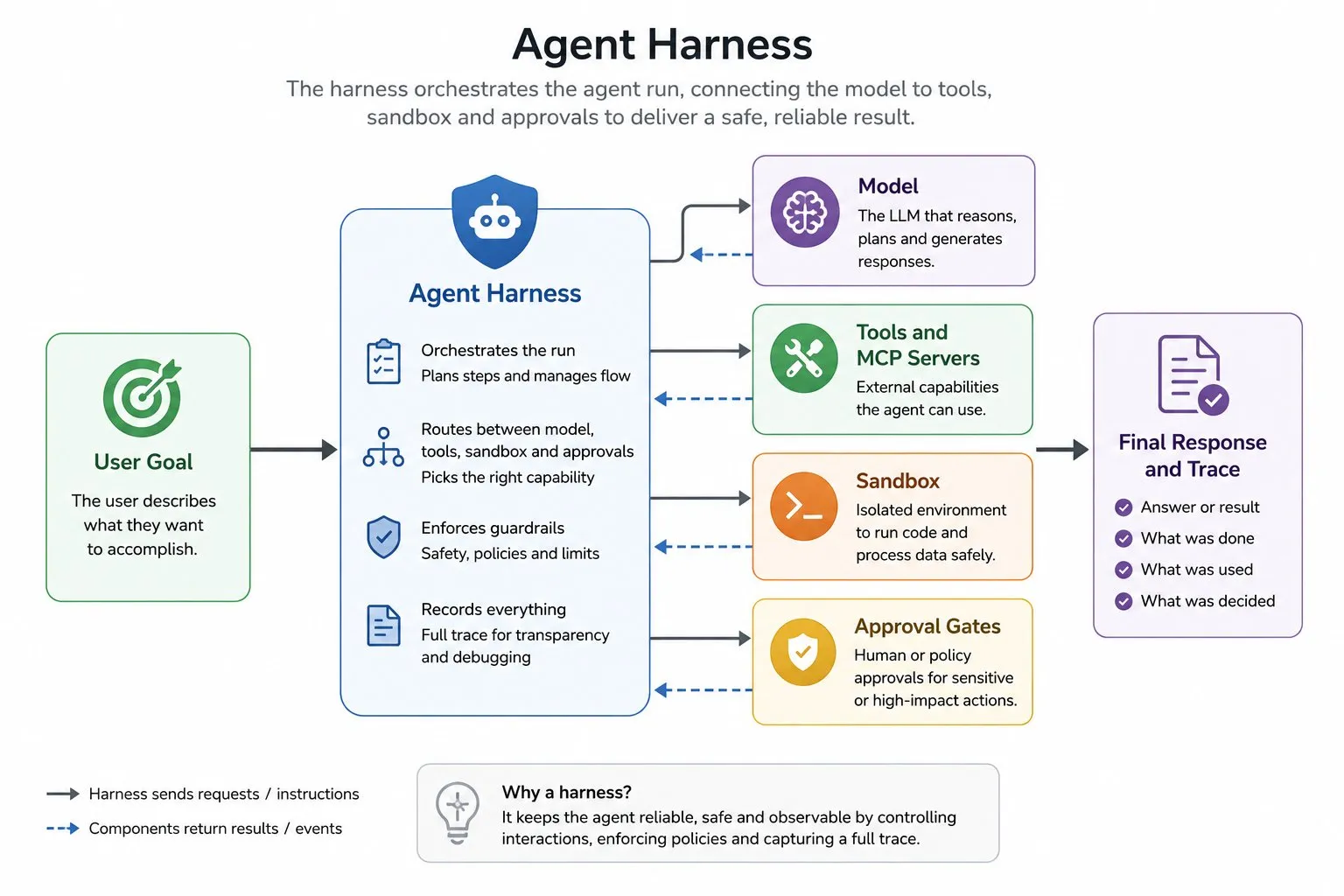
Agents raise Part 1's supervision question one level up — directing an agent is harder than directing a single call — and the harness answer is per-step tracing plus approval gates. Per TrueFoundry's writing, observability across model, tool, and agent traffic should be one pane — end-to-end traces per run, with cost, tokens, and latency per step (blog/agent-harness-managed-ai-agents). That per-step trace is what gives a supervisor a legible record of what an agent did, which tool it called, and what each step cost — the agent-scale version of the visibility BCG's managerial-revolution finding requires, and the practical implementation of the playbook's advice to watch how agents perform and make inferences before expanding their authority: run traces make the observable execution path legible — tools called, actions selected, explicit intermediate outputs, approvals, costs — though they do not expose a model's private internal reasoning.
The approval gate is the other half: selected sensitive or high-impact tool calls pause for explicit human authorization — supervision precisely placed, not constant watching. Approval gates and MCP access controls can reduce the blast radius of configured sensitive actions; they do not eliminate the broader governance and operating-model risks BCG's data shows most organizations have not yet addressed.
End-to-end workflow redesign needs an execution environment in which agentic workflows can be built, observed, and governed; the Agent Harness is one such managed runtime. It inherits model-access policy, budgets, rate limits, and guardrails from the AI Gateway, while runtime execution controls and approval gates help govern configured behavior (harness docs; on bounding loops generally, see our loop-engineering post) — the same budget-and-policy machinery from Part 1, scoped to the agent loop, which is why the harness is built on the AI Gateway rather than separate from it.
Deployment makes this usable for the regulated enterprises in BCG's 14-market sample: the platform runs as SaaS, self-hosted, or on-prem, with a split-plane architecture in which the compute plane — including the gateway — runs inside the customer's own cloud account, so prompts, completions, and data need not leave it (blog/field-notes-ai-cost-gateway-not-a-switch). For a bank or a hospital, "where does this run" is itself a strategy question, and deployment flexibility lets attribution, guardrails, and MCP governance remain in the gateway plane while the Harness runs in the same customer-controlled environment — including workloads that cannot use multi-tenant SaaS — deployment flexibility that can make governed agent operation feasible for sovereignty-sensitive or regulated workloads. The playbook adds the redesign's accelerant and its boundary: agents compress the slowest input — an eight-week data gathering-and-cleaning cycle into roughly a week, in the practitioners' account — while the intelligence layer — in Abraham's definition, mapping the company's actual business context onto its data so agents understand the drivers of the business — remains human work, the most underappreciated part of agentic deployment in their telling. Awad states the leaders' orientation in this post's one direct quotation from the playbook: "They ask, 'How do we work differently?'" — not how to deploy agents (the playbook). Agents accelerate the redesign; they do not author it.
It would misrepresent both BCG and TrueFoundry to claim the platform closes the value gap by itself; TrueFoundry states the boundary in its own writing: these primitives are what make the operating model possible — they are not the operating model by themselves; the platform gives you the dial and the data, and a capable team still has to set the thresholds and act on the alerts (blog/field-notes-ai-cost-gateway-not-a-switch). That is the same division BCG's strategy-versus-tools contrast implies (+25 points for strategic clarity versus +5 for tool access, in the survey's comparison) — and the playbook states it in its own numbers: success with agentic implementation is about 70% people and change management, with the furthest-along enterprises having trained more than half their workforce. Strategy sets the thresholds, decides what to measure, chooses what to retire, and determines what higher-value work should fill the hours AI returns. The four capabilities this series mapped — AI Gateway, guardrails, MCP Gateway, Agent Harness — can make selected technical policies enforceable and produce the telemetry that helps organizations review them. BCG does not prescribe this architecture; the mapping is TrueFoundry's interpretation of one way to operationalize part of the response.
The Part 1 sequence holds at the agent level: strategy first, then the execution layer that lets it act. A governed runtime without a strategy yields governed agents doing unclear work; an agent strategy without governed execution leaves open the technical portion of the operating-model gap BCG measures. Across both parts the claim has been constant and narrow: strategy remains the higher-leverage variable; a shared control plane can help translate parts of that strategy into governed technical behavior.
Taken together, the two parts align BCG's findings to four capabilities across gateway and runtime layers, each cited to documentation: cost attribution and observability (AI Gateway), guardrails and policy-as-configuration, tool governance (MCP Gateway), and the governed runtime (Agent Harness) — with approval gates, traces, and SaaS/self-hosted/on-prem deployment. The pattern never changed: a BCG finding on one side, a documented capability on the other, and the operating decisions held by the organization throughout.
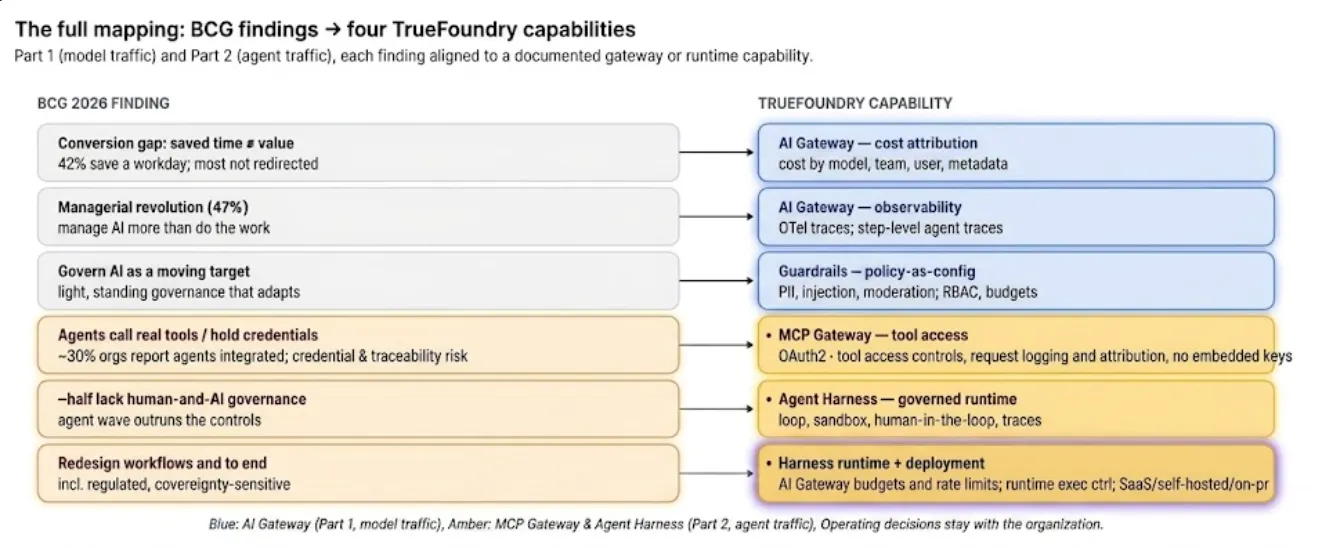
That consistency is the argument. BCG's contribution is the evidence that strategy, not tooling, is the high-leverage variable — relocating the contest from "which model wins" to execution. This series' only addition is a layer where selected technical policies can be enforced and operational telemetry collected, shown concretely enough to verify: the gateway and harness capabilities that let a clear strategy become governed technical behavior, measured where the gateway carries the traffic rather than a deck and a set of adoption charts. Strategy matters more than tools. It also runs on infrastructure — and the gap between a strategy declared and a strategy executed is the gap between AI adoption and AI advantage.
Why introduce the MCP Gateway and Agent Harness only in Part 2? Because the feature follows the finding. Part 1 mapped model-traffic concerns to documented AI Gateway controls. Part 2's findings are about agents, which add tool calls (governed by the MCP Gateway) and a runtime loop (governed by the Agent Harness). Introducing all four at once would have obscured which capability answers which gap; the section-by-section pairing is the point.
Does the Agent Harness eliminate the need for human oversight? No. Approval gates provide explicit checkpoints: configured sensitive or destructive tool calls pause for human authorization — and approval gates do not by themselves determine the organization's broader division of labor (docs/agent-platform/agent-harness/overview). Approval gates are one runtime control relevant to that governance gap; they are not a complete operating model. They provide checkpoints precisely placed, not constant watching.
What about the embedded-credential problem specifically? Embedded credentials are one failure mode the harness design addresses: per the documentation, credentials are not pasted into agent definitions — agents reference models, tools, and skills by name while credentials live centrally in the gateways (docs/agent-platform/agent-harness/overview). An agent's access is a governed configuration rather than a secret copied into its config, which is a common and significant source of agent-governance risk.
Is this analysis affiliated with BCG? No. It is independent commentary on BCG's published, public findings, paraphrased with attribution and source URLs. BCG figures are self-reported survey results and the strategy-versus-tools comparison is an association the report draws, not a controlled causal estimate; the +25-versus-+5-point contrast is best read as directional. TrueFoundry capabilities are cited inline to public documentation.
What does BCG's July 2026 playbook add to Part 2's mapping? The stakes (agents act, so data flaws become misfired actions), the method (a trusted core with the registry as one access-control mechanism around it, observable execution inspection, and staged expansion based on measured run outcomes), and the boundary (the intelligence layer remains human-built). The mapping is TrueFoundry's editorial synthesis.
Series: Part 2 of 2 · ← Part 1: From Strategic Clarity to Gateway Controls
Este es el segundo de un análisis de dos partes; la primera parte presenta la encuesta de BCG y alinea sus hallazgos sobre el modelo con la puerta de enlace de IA. Todas las capacidades de TrueFoundry se citan mediante enlaces a páginas públicas de productos o documentación y reflejan lo que dichas páginas indican al momento de redactar este texto; las capacidades evolucionan, por lo que se recomienda verificar la documentación actual. Las cifras de BCG son paráfrasis con atribución del informe "AI at Work" de 2026 y materiales de prensa, y corresponden a resultados de encuestas autoinformados; este es un comentario independiente, no afiliado ni respaldado por BCG. Una plataforma no sustituye a una estrategia, que es el punto central de ambas partes.
TrueFoundry AI Gateway ofrece una latencia de entre 3 y 4 ms, gestiona más de 350 RPS en una vCPU, se escala horizontalmente con facilidad y está listo para la producción, mientras que LitellM presenta una latencia alta, tiene dificultades para superar un RPS moderado, carece de escalado integrado y es ideal para cargas de trabajo ligeras o de prototipos.





Las últimas noticias, artículos y recursos enviados a tu bandeja de entrada

.webp)
.png)
.png)
.png)
.png)
.png)
.png)