



November 5, 2025
|
5 min read


Published: July 4, 2026

Blazingly fast way to build, track and deploy your models!
The Model Context Protocol (MCP) has revolutionized how AI applications connect to external data sources and tools. As organizations scale their AI implementations, they're discovering that direct server connections aren't always the optimal approach. Enter MCP Proxy, a powerful intermediary layer that enhances security, scalability, and manageability of MCP deployments. Let's explore how MCP Proxy transforms enterprise AI architectures and why it's becoming essential for production deployments.
An MCP Proxy serves as an intelligent intermediary layer that sits between MCP clients (AI applications) and MCP servers (data sources and tools). Rather than establishing direct connections, the proxy acts as a centralized gateway that manages, routes, and enhances communication between these components.
Think of MCP Proxy as the "API Gateway for AI"—similar to how traditional API gateways manage REST endpoints, MCP Proxy manages MCP server connections with enterprise-grade features like authentication, rate limiting, observability, and security controls. (For the model-traffic equivalent, see TrueFoundry's AI Gateway.) The proxy architecture follows the standard MCP protocol, appearing as a regular MCP server to clients while acting as an MCP client to backend servers. This transparency ensures seamless integration with existing MCP-enabled applications.
At its core, an MCP Proxy provides unified access control and authentication mechanisms, enables protocol translation between different transport types (stdio, SSE, HTTP), implements enterprise security policies and governance, and offers centralized monitoring and observability. Most importantly, it aggregates multiple MCP servers behind a single endpoint, dramatically simplifying enterprise deployments.
MCP Proxy operates on a straightforward yet powerful architecture that leverages the JSON-RPC foundation of the Model Context Protocol. The proxy functions as both an MCP server (facing clients) and an MCP client (facing backend servers), creating a transparent bridge that adds value without disrupting existing workflows.
Modern proxies support multiple transport protocols simultaneously. This includes stdio transport for local server connections and development environments, Server-Sent Events (SSE) for real-time streaming capabilities, streamable HTTP for stateless, scalable deployments, and WebSocket for persistent, low-latency connections. This transport flexibility allows organizations to deploy MCP servers using their preferred protocols while providing clients with a consistent interface.
When a client makes a request to the proxy, the system follows a well-defined workflow. First, the proxy receives the JSON-RPC request from the client, then security policies are evaluated during authentication and authorization. Next, route resolution determines which backend server(s) to query, followed by protocol-specific formatting during request translation. The proxy then forwards requests to appropriate servers, aggregates multiple server responses if needed, and returns a unified response to the client.
Enterprise MCP Proxy implementations maintain session state to optimize performance and enable advanced features including connection pooling where persistent connections to backend servers reduce latency, context preservation to maintain user context and conversation state, load balancing to distribute requests across multiple server instances, and circuit breaking to automatically bypass failed servers.
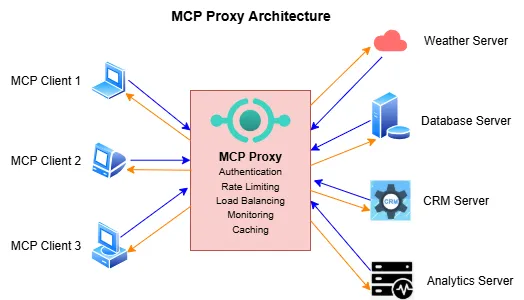
The foundation of any enterprise MCP deployment is a comprehensive registry that catalogs and manages available servers. A robust MCP registry provides a centralized catalog where administrators can register both public and privately hosted MCP servers, maintaining detailed metadata about each server's capabilities, authentication requirements, and access controls.
TrueFoundry's MCP Gateway exemplifies this approach with its centralized MCP registry that maintains a complete inventory of available servers and their authentication mechanisms. The registry handles user-specific OAuth2 flows, securely storing and refreshing access tokens while ensuring users can only access resources they're authorized for. This eliminates the chaos of distributed credential management and provides enterprise IT teams with the visibility and control they need.
The registry also enables dynamic tool discovery, allowing autonomous agents to discover and invoke tools at runtime rather than requiring hardcoded configurations. This flexibility is crucial for building adaptive AI systems that can respond to changing business requirements without manual intervention. For agent-to-agent traffic, the same pattern extends to the Agent Gateway.
Security is paramount in enterprise MCP deployments, and authentication represents the first line of defense. Traditional direct server connections require managing separate credentials for each MCP server, creating a complex web of authentication flows that becomes unwieldy at scale.
MCP Proxy centralizes authentication through several mechanisms. OAuth 2.0 integration supports both 2-legged and 3-legged OAuth flows for enterprise applications, while Personal Access Tokens (PATs) allow users to generate a single token for accessing all authorized MCP servers. For applications, Virtual Account Tokens (VATs) provide scoped access to specific server sets, and role-based access control (RBAC) ensures fine-grained permissions management.
The authentication layer also implements sophisticated token management, including automatic token refresh, secure credential storage, and session management across multiple server connections. This approach significantly reduces the security burden on individual developers while providing IT teams with comprehensive audit trails and access controls. For a deeper look at controlling and auditing MCP access at scale, see Enterprise MCP Governance.
The core value of MCP Proxy lies in its ability to orchestrate complex tool invocations across multiple servers. Unlike direct connections where each server operates in isolation, the proxy enables sophisticated workflows that span multiple data sources and capabilities.
Tool namespace management prevents naming conflicts by automatically prefixing tools with server identifiers. For example, a get_weather tool from a "weather-api" server becomes weather-api_get_weather, ensuring no collisions even when multiple servers expose similar functionality. This enables unified tool discovery where clients can discover all available tools through a single list_tools call rather than managing connections to multiple servers.
The proxy also enables cross-server workflows where complex AI agent behaviors can leverage tools from multiple servers seamlessly. This orchestration capability is what transforms simple tool calling into sophisticated enterprise automation, allowing organizations to build AI systems that integrate naturally with their existing technology stack.
Enterprise deployments demand comprehensive observability into MCP operations. Traditional direct connections scatter monitoring across multiple endpoints, making it difficult to gain holistic insights into system performance and usage patterns.
MCP Proxy consolidates observability through centralized monitoring that provides end-to-end visibility into request flows, comprehensive metrics collection including latency, throughput, and error rates, detailed audit logging for compliance and security analysis, and real-time health monitoring of backend server availability.
Advanced observability features include request tracing that follows individual requests through the entire system, performance analytics that identify bottlenecks and optimization opportunities, usage analytics that track tool utilization patterns, and security monitoring that detects anomalous access patterns or potential security threats. TrueFoundry's tracing provides this end-to-end visibility across both model and tool calls.
The observability layer also integrates with enterprise monitoring solutions like Grafana, Datadog, and custom dashboards, ensuring that MCP metrics flow seamlessly into existing operational workflows. This integration is crucial for maintaining enterprise-grade service level agreements and operational excellence.
The security benefits of MCP Proxy extend far beyond simple access control. By consolidating multiple server connections through a single, hardened gateway, organizations can implement consistent security policies across their entire MCP ecosystem. This approach dramatically reduces the attack surface compared to exposing multiple server endpoints directly to client applications.
Centralized authentication means clients authenticate once with the proxy rather than managing separate credentials for each server. The proxy handles backend authentication using service accounts or sophisticated token exchange mechanisms, ensuring that sensitive credentials never leave the secure gateway environment. Policy enforcement becomes consistent across all MCP interactions, with capabilities like sensitive data filtering, request sanitization, and response redaction implemented at the proxy layer rather than requiring individual server modifications.
Attack surface reduction is achieved by deploying backend servers in private networks, accessible only through the proxy. This network isolation significantly reduces exposure to external threats while maintaining the flexibility needed for complex enterprise integrations. For a complete architecture reference, see Secure AI Gateway with Centralized MCP for Enterprises.
MCP Proxy transforms operational complexity from a distributed challenge into a centralized management opportunity. Instead of configuring monitoring, scaling, and network policies for each individual server, operations teams can focus on a single, well-understood gateway component.
The unified deployment model allows proxies to be deployed using standard cloud-native patterns including containers, load balancers, and auto-scaling while backend servers focus purely on business logic. This separation of concerns enables different teams to optimize their components independently while maintaining overall system coherence.
Simplified client integration means applications need only integrate with a single proxy endpoint rather than managing connections to multiple servers. This dramatically reduces the complexity of client applications and makes it easier to add new MCP servers without requiring client-side changes.
The proxy architecture enables sophisticated scalability patterns that would be difficult to implement with direct connections. Horizontal scaling through multiple proxy instances deployed behind load balancers provides linear scalability as demand grows. Backend server pooling allows multiple instances of the same server to be pooled behind the proxy for load distribution, improving both performance and reliability.
Geographic distribution becomes possible with proxies deployed in multiple regions and intelligent routing to the nearest backend servers. This approach minimizes latency for global deployments while maintaining consistent functionality across all regions — a key enabler of data residency in the age of agentic AI.
Performance optimization features include intelligent caching where frequently requested data is cached with configurable time-to-live settings, request deduplication that collapses identical concurrent requests, connection pooling that maintains efficient connections to backend servers, and response compression that reduces network overhead.
MCP Proxy deployments often result in significant cost savings through several mechanisms. Resource consolidation reduces per-server operational overhead by sharing infrastructure components like monitoring, logging, and security systems. Efficient resource utilization through connection pooling and request batching improves overall system efficiency.
Reduced development overhead allows teams to focus on building MCP servers that implement business logic rather than solving repeated infrastructure challenges like authentication, monitoring, and scaling. This acceleration in development velocity often represents the largest cost savings for organizations adopting MCP Proxy architectures.
Implementing MCP Proxy introduces several technical challenges that require careful architectural consideration. State management represents a primary concern since, unlike stateless HTTP proxies, MCP Proxy often needs to maintain session state to provide optimal user experience. This includes conversation context, user preferences, and server connection state. Designing stateful proxies requires careful consideration of state persistence, replication, and recovery mechanisms.
Protocol compatibility presents another challenge as different MCP servers may implement slightly different protocol versions or extensions. The proxy must handle these variations gracefully while presenting a consistent interface to clients. Version negotiation and feature detection become critical components for ensuring seamless operation across diverse server implementations.
Error handling and circuit breaking require sophisticated logic when aggregating multiple servers. If one server in a multi-server request fails, the proxy needs intelligent decision-making to determine whether to return partial results, retry with alternative servers, or fail the entire request. This complexity multiplies when dealing with dependencies between different server responses.
Connection pool management requires balancing resource usage with performance characteristics. Too few connections create bottlenecks that limit throughput, while too many connections consume excessive system resources. The optimal configuration depends on usage patterns, server characteristics, and infrastructure constraints.
Caching strategy implementation requires deep understanding of MCP tool semantics. Some tools return dynamic data that shouldn't be cached, while others return relatively static information suitable for extended caching periods. Implementing effective caching policies requires careful analysis of each tool's behavior and data characteristics.
Request batching presents opportunities for efficiency improvements but must be implemented carefully to avoid introducing unacceptable latency for individual requests. The challenge lies in identifying optimal batching windows that balance efficiency gains with response time requirements.
Token management becomes complex when securely managing authentication tokens for backend servers while providing seamless authentication for clients. This requires sophisticated token exchange mechanisms, secure credential storage, and proper token lifecycle management.
Data privacy concerns arise because the proxy potentially has access to all data flowing between clients and servers. Implementing proper data handling, encryption at rest and in transit, and privacy controls becomes crucial for maintaining enterprise security standards.
Rate limiting implementation must balance protecting backend servers from overload while providing good user experience. This requires careful tuning based on server capabilities, user behavior patterns, and business requirements.
Monitoring and alerting complexity increases as the proxy becomes a critical component requiring comprehensive observability. Teams need to implement health checks, performance monitoring, and alerting for both the proxy itself and its connections to backend servers. This monitoring must integrate seamlessly with existing enterprise monitoring infrastructure.
Deployment coordination becomes necessary as updates to the proxy must be coordinated with backend server deployments to ensure compatibility and avoid service disruptions. This coordination requires sophisticated deployment pipelines and testing procedures.
Backup and recovery planning must account for the proxy's configuration and state. Critical system components need comprehensive backup strategies and tested recovery procedures to ensure business continuity during outages or disasters.
Successful MCP Proxy implementation begins with comprehensive architecture planning that addresses both immediate needs and future growth requirements. Server discovery strategy determines how the proxy will identify and connect to backend MCP servers. Options include static configuration files suitable for stable environments, service discovery mechanisms that automatically detect new servers, and dynamic registration APIs that allow servers to self-register with the proxy.
Deployment topology decisions involve choosing between single proxy instances for simple deployments or multiple instances for high availability and load distribution. Geographic distribution requirements must consider network latency, data residency requirements, and disaster recovery needs.
Integration planning identifies how the proxy will connect with existing enterprise infrastructure including load balancers for traffic distribution, API gateways for external access control, identity providers for authentication integration, and monitoring systems for comprehensive observability. These integration points are critical for ensuring the proxy fits seamlessly into existing operational workflows.
A fundamental MCP Proxy implementation requires several core components working in harmony. The proxy server itself handles client connections and implements the MCP protocol, while backend connection managers maintain connections to MCP servers and handle protocol translation. Authentication and authorization modules integrate with enterprise identity systems and enforce access policies.
Here's a simplified example demonstrating the basic structure of an MCP Proxy implementation using Node.js:
Implementing MCP Proxy introduces several technical challenges that require careful architectural consideration. State management represents a primary concern since, unlike stateless HTTP proxies, MCP Proxy often needs to maintain session state to provide optimal user experience. This includes conversation context, user preferences, and server connection state. Designing stateful proxies requires careful consideration of state persistence, replication, and recovery mechanisms.
Protocol compatibility presents another challenge as different MCP servers may implement slightly different protocol versions or extensions. The proxy must handle these variations gracefully while presenting a consistent interface to clients. Version negotiation and feature detection become critical components for ensuring seamless operation across diverse server implementations.
Error handling and circuit breaking require sophisticated logic when aggregating multiple servers. If one server in a multi-server request fails, the proxy needs intelligent decision-making to determine whether to return partial results, retry with alternative servers, or fail the entire request. This complexity multiplies when dealing with dependencies between different server responses.
Connection pool management requires balancing resource usage with performance characteristics. Too few connections create bottlenecks that limit throughput, while too many connections consume excessive system resources. The optimal configuration depends on usage patterns, server characteristics, and infrastructure constraints.
Caching strategy implementation requires deep understanding of MCP tool semantics. Some tools return dynamic data that shouldn't be cached, while others return relatively static information suitable for extended caching periods. Implementing effective caching policies requires careful analysis of each tool's behavior and data characteristics.
Request batching presents opportunities for efficiency improvements but must be implemented carefully to avoid introducing unacceptable latency for individual requests. The challenge lies in identifying optimal batching windows that balance efficiency gains with response time requirements.
バックエンドサーバーの認証トークンを安全に管理しつつ、クライアントにシームレスな認証を提供する際、トークン管理は複雑になります。これには、高度なトークン交換メカニズム、安全な認証情報ストレージ、適切なトークンライフサイクル管理が必要です。
プロキシがクライアントとサーバー間を流れるすべてのデータにアクセスする可能性があるため、データプライバシーに関する懸念が生じます。適切なデータ処理、保存時および転送時の暗号化、プライバシー管理の実装は、企業のセキュリティ基準を維持するために不可欠となります。
レート制限の実装は、バックエンドサーバーを過負荷から保護しつつ、良好なユーザーエクスペリエンスを提供することのバランスを取る必要があります。これには、サーバーの能力、ユーザーの行動パターン、ビジネス要件に基づいた慎重な調整が必要です。
プロキシが包括的な可観測性を必要とする重要なコンポーネントとなるため、監視とアラートの複雑さが増します。チームは、プロキシ自体とそのバックエンドサーバーへの接続の両方について、ヘルスチェック、パフォーマンス監視、およびアラートを実装する必要があります。この監視は、既存の企業監視インフラストラクチャとシームレスに統合されなければなりません。
プロキシへの更新は、互換性を確保し、サービスの中断を避けるためにバックエンドサーバーのデプロイメントと調整する必要があるため、デプロイメントの調整が必要になります。この調整には、高度なデプロイメントパイプラインとテスト手順が必要です。
バックアップとリカバリの計画は、プロキシの構成と状態を考慮に入れる必要があります。重要なシステムコンポーネントには、停止や災害時の事業継続性を確保するために、包括的なバックアップ戦略とテスト済みのリカバリ手順が必要です。
MCPプロキシの実装を成功させるには、差し迫ったニーズと将来の成長要件の両方に対応する包括的なアーキテクチャ計画から始まります。サーバー検出戦略は、プロキシがバックエンドMCPサーバーをどのように識別し、接続するかを決定します。オプションには、安定した環境に適した静的構成ファイル、新しいサーバーを自動的に検出するサービス検出メカニズム、サーバーがプロキシに自己登録できる動的登録APIなどがあります。
デプロイメントトポロジの決定には、シンプルなデプロイメントのための単一プロキシインスタンス、または高可用性と負荷分散のための複数インスタンスのどちらかを選択することが含まれます。地理的分散の要件は、ネットワーク遅延、データ所在地の要件、および災害復旧のニーズを考慮する必要があります。
統合計画では、トラフィック分散のためのロードバランサー、外部アクセス制御のためのAPIゲートウェイ、認証統合のためのIDプロバイダー、包括的な可観測性のための監視システムなど、プロキシが既存の企業インフラストラクチャとどのように接続するかを特定します。これらの統合ポイントは、プロキシが既存の運用ワークフローにシームレスに適合することを保証するために不可欠です。
基本的なMCPプロキシの実装には、いくつかのコアコンポーネントが連携して動作する必要があります。プロキシサーバー自体はクライアント接続を処理し、MCPプロトコルを実装します。一方、バックエンド接続マネージャーはMCPサーバーへの接続を維持し、プロトコル変換を処理します。認証および認可モジュールは、企業のIDシステムと統合され、アクセスポリシーを適用します。
TrueFoundryのAI Gatewayは、エンタープライズデプロイメントの複雑な要件に対応する、本番環境に対応したMCPプロキシ実装を提供します。このプラットフォームは、包括的な MCPレジストリとゲートウェイ サーバー管理を簡素化しつつ、セキュリティ、監視、スケーラビリティのためのエンタープライズグレードの機能を提供するものです。
TrueFoundryのアプローチは、利用可能なサーバーとその認証メカニズムの完全なインベントリを維持する集中型MCPレジストリを中心に展開されます。このレジストリは、ユーザー固有のOAuth2フローを処理し、ユーザーが認可されたリソースのみにアクセスできるようにしながら、アクセスキーを安全に保存および更新します。このシステムは、分散型認証情報管理の混乱を排除し、企業のITチームに包括的な可視性と制御を提供します。
主要なアーキテクチャコンポーネントには、すべてのMCPサーバーのレジストリを維持し、認証メカニズムを処理する集中型コントロールプレーン、パーソナルアクセストークン(PAT)と仮想アカウントトークン(VAT)による統合アクセス制御、テストおよび開発用の統合エージェントプレイグラウンド、およびリアルタイム監視と監査証跡による包括的な可観測性が含まれます。
TrueFoundryのMCP実装を開始するには、 スタートガイド に従ってください。このガイドでは、MCPサーバーグループの作成と最初のサーバーの設定について説明しています。このプラットフォームは、コミュニティからの公開MCPサーバーとプライベートホスト型サーバーの両方をサポートしており、どのユーザーやチームが特定のサーバーにアクセスできるかを決定する高度なアクセス制御を備えています。
TrueFoundryは、stdioベースのMCPサーバーもサポートしており、その プロキシ変換機能を通じて、レガシーサーバーを最新のHTTPエンドポイントとしてデプロイできます。エンタープライズ統合向けには、Atlassian MCPサーバーのような事前構築済みサーバーが、JiraおよびConfluenceとのシームレスな統合を提供します。
本番環境でのMCPプロキシのデプロイには、高可用性、セキュリティ、監視、および運用手順に細心の注意を払う必要があります。高可用性を実現するには、通常、ロードバランサーの背後に複数のプロキシインスタンスをデプロイし、包括的なヘルスチェックと自動フェイルオーバー機能を備えることが含まれます。
スケーリング戦略では、CPU使用率、メモリ消費量、リクエスト量などのメトリクスに基づいて水平ポッドオートスケーリングを実装する必要があります。スケーリングポリシーは、パフォーマンスのサービスレベルアグリーメントを維持しながら、突然のトラフィックスパイクと段階的な成長パターンの両方を考慮に入れる必要があります。
セキュリティの実装には、システムコンポーネント間のアクセスを制限するネットワークポリシー、すべての認証情報とトークンに対する包括的なシークレット管理、転送中および保存中のデータの暗号化、潜在的な脆弱性を特定するための定期的なセキュリティ監査が必要です。
監視統合は、エンタープライズ監視ソリューションと連携し、パフォーマンスメトリクス、エラー追跡、セキュリティ監視、キャパシティプランニングデータを含む包括的な可観測性を提供する必要があります。この統合により、MCPプロキシの運用が既存のエンタープライズ運用手順および標準に準拠することが保証されます。
MCPプロキシは、エンタープライズAIアーキテクチャにおける根本的な進化を象徴し、組織がModel Context Protocolの実装をデプロイ、管理、スケーリングする方法を変革します。AIアプリケーションがますます高度化し、複雑なエンタープライズシステムと統合されるにつれて、プロキシパターンは、本番環境でのデプロイが要求する不可欠なガバナンス、セキュリティ、および運用機能を提供します。
その利点は、単純な接続管理をはるかに超えています。一元化された認証、インテリジェントなルーティング、包括的な監視、およびエンタープライズグレードのセキュリティ制御を通じて、MCPプロキシは、組織が信頼性とコンプライアンスに関する厳格な基準を満たす堅牢でスケーラブルなAIシステムを構築することを可能にします。このアーキテクチャパターンは、組織が概念実証の実装から本番規模のデプロイへと移行する際に生じる、セキュリティ、可観測性、および運用上の複雑さに関する重要な課題に対処します。
MCPの導入を開始する組織にとって、直接接続は開発と初期の実験には十分な機能を提供します。しかし、システムが成熟し、ビジネス要件が増大するにつれて、MCPプロキシの採用は長期的な成功に不可欠となります。直接接続からプロキシを介したアーキテクチャへの移行は、ウェブサービス、マイクロサービス、クラウドコンピューティングにおける同様のパターンを反映した自然な進化と言えます。
TrueFoundryのMCPゲートウェイ は、MCPプロキシパターンの本番環境対応の実装を例示しており、セキュリティとガバナンスの基準を維持しながらAI実装をスケーリングするための包括的なプラットフォームを企業に提供します。このプラットフォームの統合されたアプローチは、 MCPサーバー管理、認証、および可観測性により、エンタープライズ規模のAIデプロイにコミットする組織にとって最適な選択肢となります。
Model Context Protocolのエコシステムが進化し続けるにつれて、プロキシパターンは高度なAI搭載アプリケーションを可能にする上でますます重要な役割を果たすでしょう。エンタープライズAIの未来は、インテリジェントなモデルを構築するだけでなく、これらの機能を実世界でのデプロイのために適応、スケーリング、および保護できるインテリジェントなアーキテクチャを創造することにかかっています。MCPプロキシは、このインテリジェントなアーキテクチャの基盤となるコンポーネントとして機能し、組織がModel Context Protocolの可能性を最大限に引き出し、エンタープライズ本番環境の厳しい要件を満たすことを可能にします。
TrueFoundry AI Gateway delivers ~3–4 ms latency, handles 350+ RPS on 1 vCPU, scales horizontally with ease, and is production-ready, while LiteLLM suffers from high latency, struggles beyond moderate RPS, lacks built-in scaling, and is best for light or prototype workloads.







.png)
.png)
.png)
.png)

.png)
.png)
.png)
.png)
.png)
.png)
.png)





