September 18, 2026
|
5 min read


Published: August 26, 202615
Blazingly fast way to build, track and deploy your models!
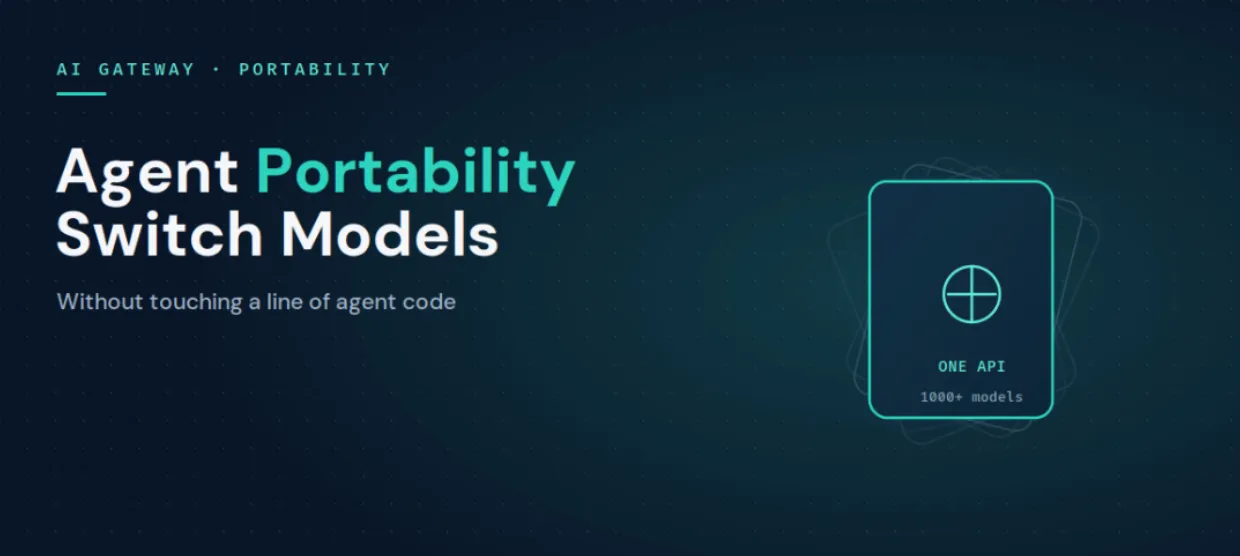
AI agent portability is the property that an agent's logic stays the same while the model underneath it can change. The agent refers to a model by name and calls a stable interface. Which provider actually serves the request, and which credentials are used, live outside the agent entirely.
Contrast that with the common starting point. An agent is written against a specific provider SDK, the provider's API key sits in the agent's environment, and the model name is scattered through the code. Every one of those is a thread tying the agent to one vendor. Portability is what happens when you cut all three.
The payoff is practical: you can adopt a newer model the day it ships, fall back to a second provider when the first has an outage, route cheap requests to a smaller model, and keep self-hosted and commercial models behind the same interface. None of that should require touching the agent.
For a single-turn chatbot, swapping models is close to a one-line change already. Agents raise the difficulty for a few reasons worth naming, because they shape what a good portability layer has to handle.
A portability layer that only swaps a model string but leaves credentials, routing, and fallbacks inside the agent has not really made the agent portable. It has just moved the problem.
TrueFoundry's approach is to manage model access once, at the AI Gateway, and let every agent reference models by name. The gateway holds the provider credentials, enforces access policies, and routes traffic. Agents inherit all of it.
Every model, whether it is OpenAI, Anthropic, Azure OpenAI, Google Vertex, AWS Bedrock, Databricks, Together AI, or something you host yourself, sits behind a single OpenAI-compatible API. You point your code at the gateway once and switch models by changing the model name in the request. Same URL, same credentials.
from openai import OpenAI

client = OpenAI(
    api_key="your-truefoundry-api-key",   # a gateway token, never a provider key
    base_url="https://gateway.truefoundry.ai",
)

# Today:
resp = client.chat.completions.create(
    model="openai-main/gpt-4o",
    messages=[{"role": "user", "content": "Draft the release notes"}],
)

# Tomorrow, swap the model. Nothing else changes:
resp = client.chat.completions.create(
    model="anthropic-main/claude-sonnet-4",
    messages=[{"role": "user", "content": "Draft the release notes"}],
)
The agent code did not change in any meaningful way. The credential did not change. The only edit is the model name, and even that can be abstracted away, which is the next piece.
In TrueFoundry's Agent Harness, the model is a selection in the builder, not a value in code. You pick any model enabled for you in the gateway, and switching is a one-click change with no code edits and no new credentials.
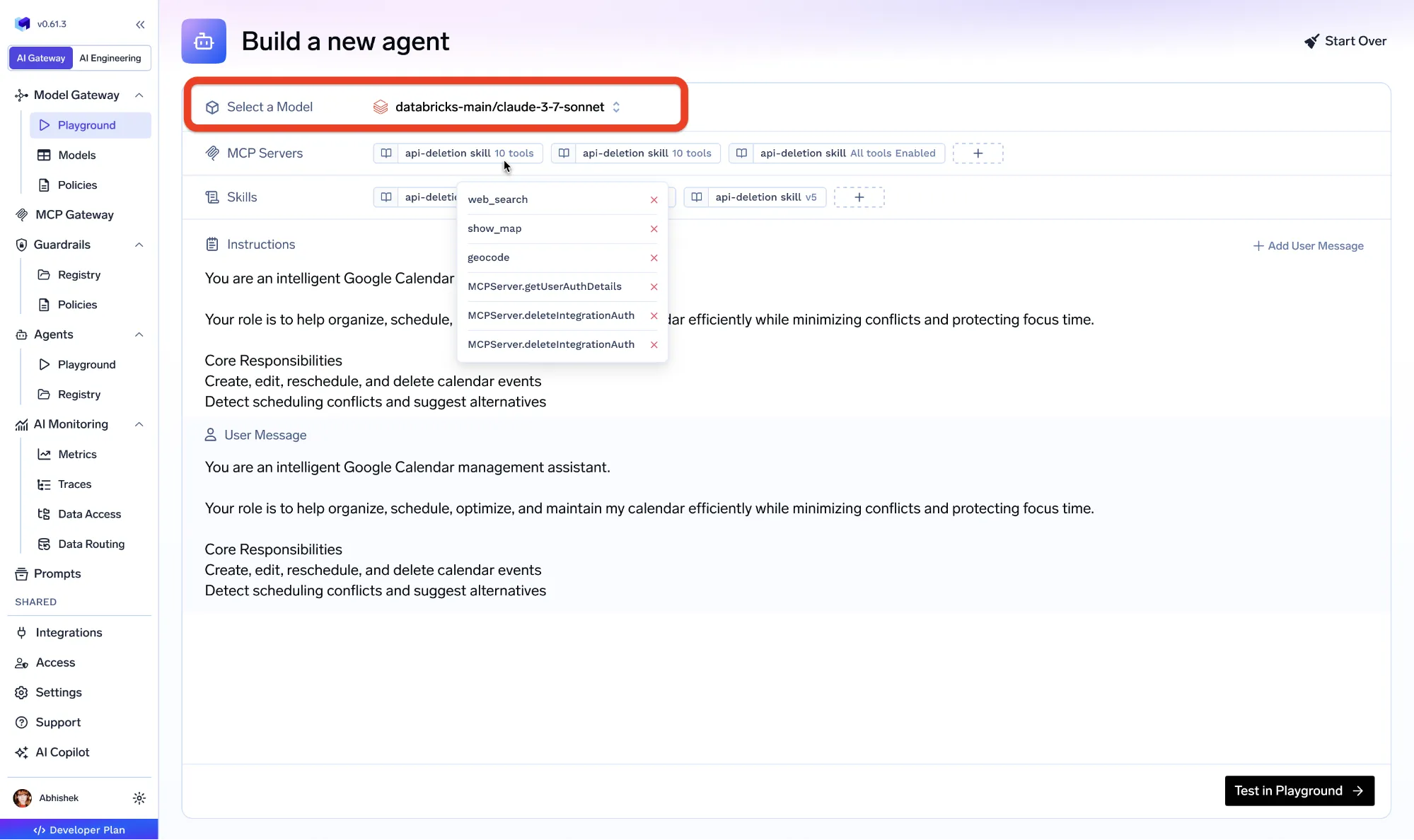
Product screenshot, TrueFoundry docs: Agent Harness model selector.
The difference from other managed-agent products is where credentials live. In several of them you supply provider API keys when you create an agent, or register them per workspace. In TrueFoundry, model access is managed once at the gateway layer and agents simply reference model names.
TrueFoundry AI Gateway delivers ~3–4 ms latency, handles 350+ RPS on 1 vCPU, scales horizontally with ease, and is production-ready, while LiteLLM suffers from high latency, struggles beyond moderate RPS, lacks built-in scaling, and is best for light or prototype workloads.





.webp)


.png)
.png)
.png)
.png)
.png)
.png)