.webp)
October 14, 2026
|
5 min de lecture


Accédez instantanément à un environnement TrueFoundry en direct. Déployez des modèles, acheminez le trafic LLM et explorez la plateforme complète : votre sandbox est prête en quelques secondes, aucune carte de crédit n'est requise.


Published: October 6, 2026
Une méthode incroyablement rapide pour créer, suivre et déployer vos modèles !
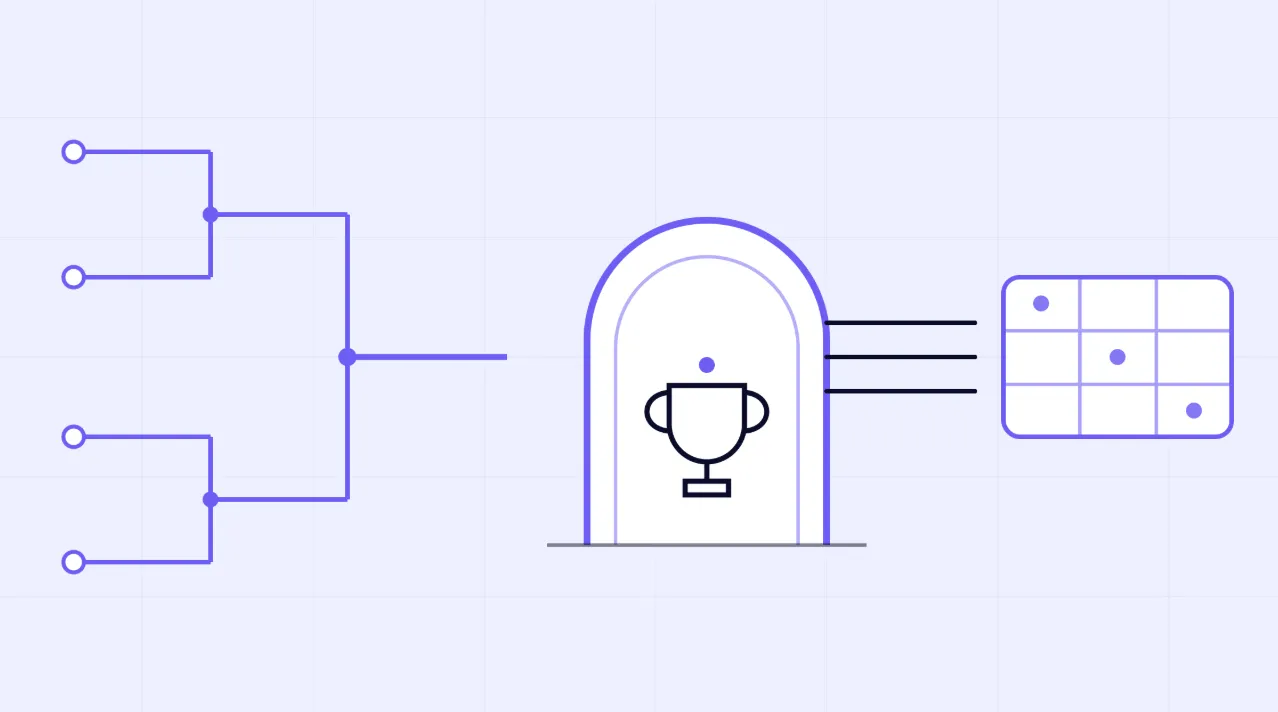
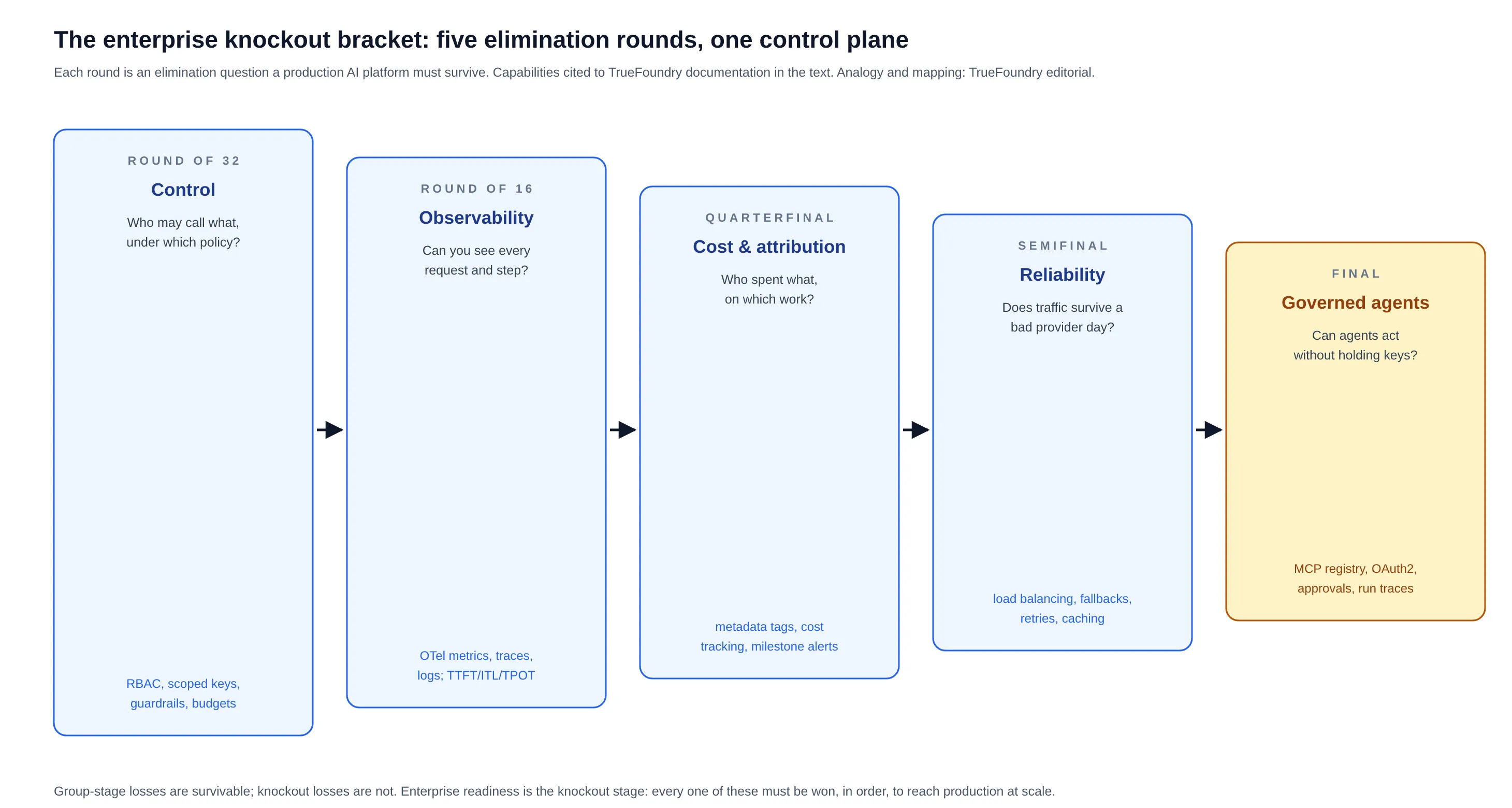
On Sunday, July 19, 2026, at MetLife Stadium — called New York New Jersey Stadium in FIFA materials — one team lifts the trophy that ends the first 48-team FIFA World Cup™ — a tournament of 104 matches whose defining property is a phase change. For two weeks, the group stage forgave: you could lose a match, rotate a squad, try a formation that failed, and still advance. Then the bracket began, and the arithmetic inverted. In the knockout rounds — a Round of 32 for the first time, then 16, quarterfinal, semifinal, final — nobody accumulates points. You win, or you go home. Whoever lifts the trophy on July 19 will have survived five consecutive elimination games. Enterprise AI just went through the same phase change. The last three years were the group stage: many companies shipped something — a pilot, a copilot, or an internal chatbot — and losses were survivable because the stakes were experimental. That phase is over. What decides who reaches production at scale is a knockout bracket of a different kind: enterprise readiness, played out as five elimination rounds — control, observability, cost attribution, reliability, and governed agents — where a single unanswered question ends the run. This post plays each round in order, with the technical detail cited to TrueFoundry's documentation, because the pattern that wins all five is the same pattern that wins any of them: a control plane in the path of the traffic. The analogy is ours; the capabilities are documented.
The group stage exists to be forgiving. Three matches, points accumulate, a defeat is data. Teams use it the way enterprises used 2023–2025: to try squads, formations, and ideas whose failure costs little. That era produced real learning — many organizations now have AI systems in active use somewhere in the business — but it also produced habits that the next phase punishes. API keys pasted into application configs, because it was faster. Spend discovered on the monthly invoice, because nobody was watching per-request. One provider integration per team, because each team started alone. No trace of what the agent actually did, because the agent was a demo. None of these lost a group-stage match. All of them lose knockout matches, because the knockout phase changes what a gap costs. The table below is the phase change in one view; the rest of this post plays the bracket.
One more property of tournaments transfers uncomfortably well: the team that tops its group is not necessarily the team that lifts the trophy. Group-stage dominance measures performance in low-stakes conditions — and enterprise AI’s group stage measured exactly that. The pilot that wowed the demo room, the copilot with the best internal adoption numbers, the chatbot that topped the hackathon: those are group-stage results. And group-stage wins are real wins — worth celebrating, worth learning from. A sharp demo that impresses a room full of executives; a fancy V1 AI app that everyone expects to take off; the internal tool that earns a standing slot in the all-hands — each is the enterprise equivalent of topping the group on goal difference: proof of attacking quality, measured in conditions where a bad outing cost nothing but pride. History’s group-stage darlings are a warning as much as an inspiration — tournament lore is full of sides that scored freely for three matches and went home in the first knockout round to opponents who could defend. Knockout rounds ask a different question — not “who looked best when losing was survivable” but “who holds up when a single failure ends the run.”
Ferguson’s line is the knockout thesis in eight words, and Vogels’ is its enterprise translation: capability wins demos; the discipline of surviving failure wins production. Every round below is a defensive question.
The first knockout round eliminates the most teams, and it eliminates them on fundamentals. For an AI platform the fundamental is access: the moment more than one team calls more than one model, "who may call what" stops being a spreadsheet question and becomes a request-path question. The gateway's documented answer has four layers, all configuration rather than application code. Identity and authorization: role-based access control and scoped API keys for users, teams, and applications, so a data-science team's key cannot invoke the customer-facing production route (access control docs). Throttles: rate limits definable per user, per model, and per application (rate limiting docs). Money: tenant- and team-scoped budgets whose rules match users, models, and metadata, with warn-only and hard-enforcement modes and budget milestone alerts — the mechanism that lets discovery run loose while production runs strict (budget docs). And content: guardrails for PII detection, prompt-injection screening, content moderation, and custom policies, applied to requests and responses in the serving path (guardrails docs). Teams that clear this round barely notice it — which is the point. Control is the round you win by having answered the question before anyone asked it in an incident review.
Before the round-by-round tour, the platform in one picture: a single gateway plane between every application and every model, tool, and agent — the same plane each of the five rounds below interrogates from a different angle.
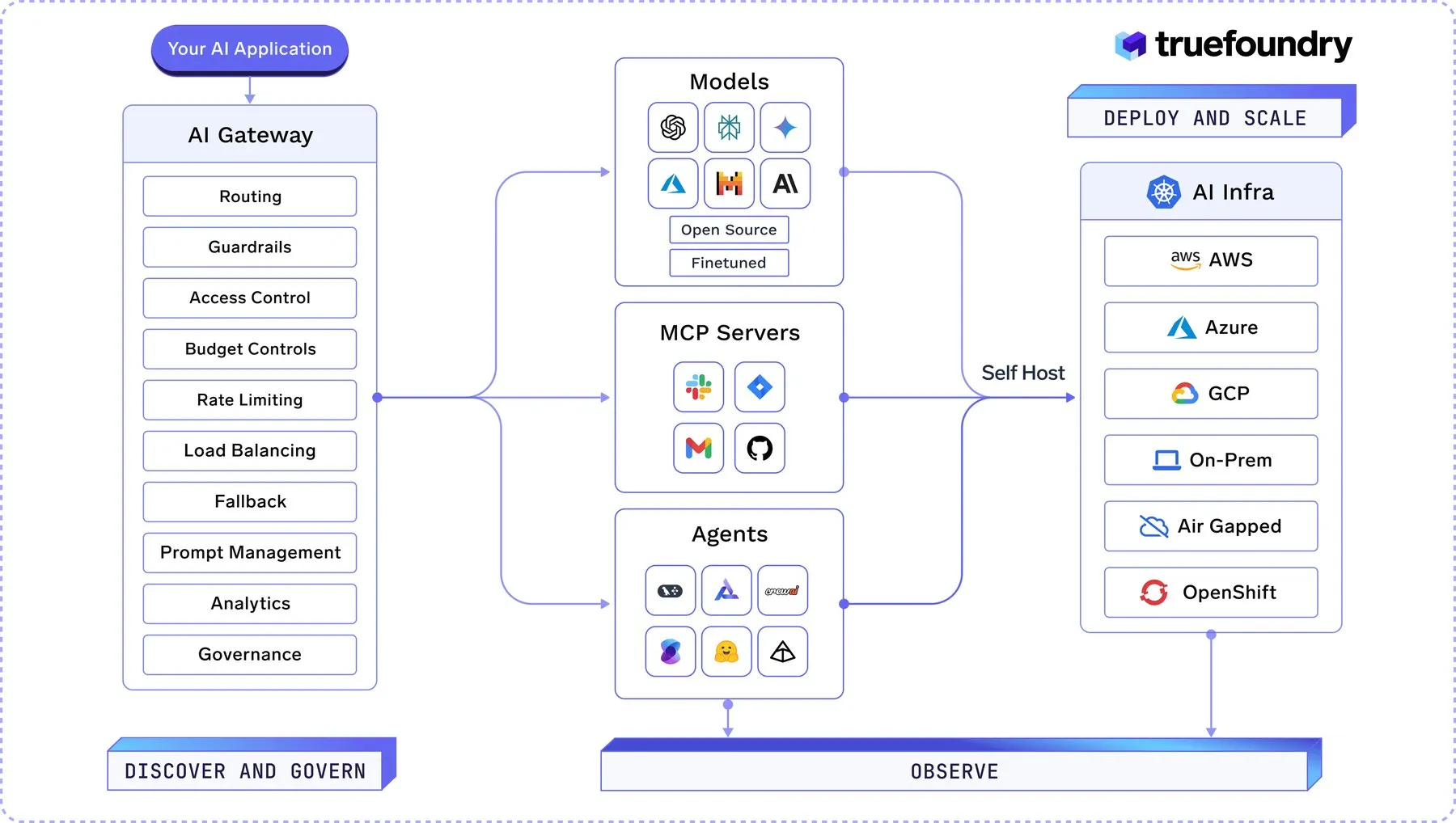
In a knockout match the manager who cannot see the pitch loses to the one who can. Observability is that round, and it is where this post goes deepest, because the documentation does. (Speaking of trophies: TrueFoundry received two industry awards in 2026 — AI Breakthrough’s LLM Platform of the Year and AIBoomi’s DevTools & Infrastructure Startup of the Year — and was listed as a Representative Vendor in the 2025 Gartner Market Guide for AI Gateways.) TrueFoundry's Metrics Dashboard is documented as giving, in its own words, "a complete picture of your AI Gateway's health and efficiency" — this post's one direct quotation from the docs — and the fine print underneath that sentence is the substance (observability docs). The Overview tab summarizes both LLM and MCP traffic on one screen: total cost with period-over-period comparison, total LLM calls, total MCP calls, incoming-request breakdowns by endpoint type, error breakdowns for model and MCP traffic separately, a guardrails summary showing evaluation counts and outcomes — blocked, flagged, or mutated — and ranked leaderboards down to the level of the individual MCP tool called most often.
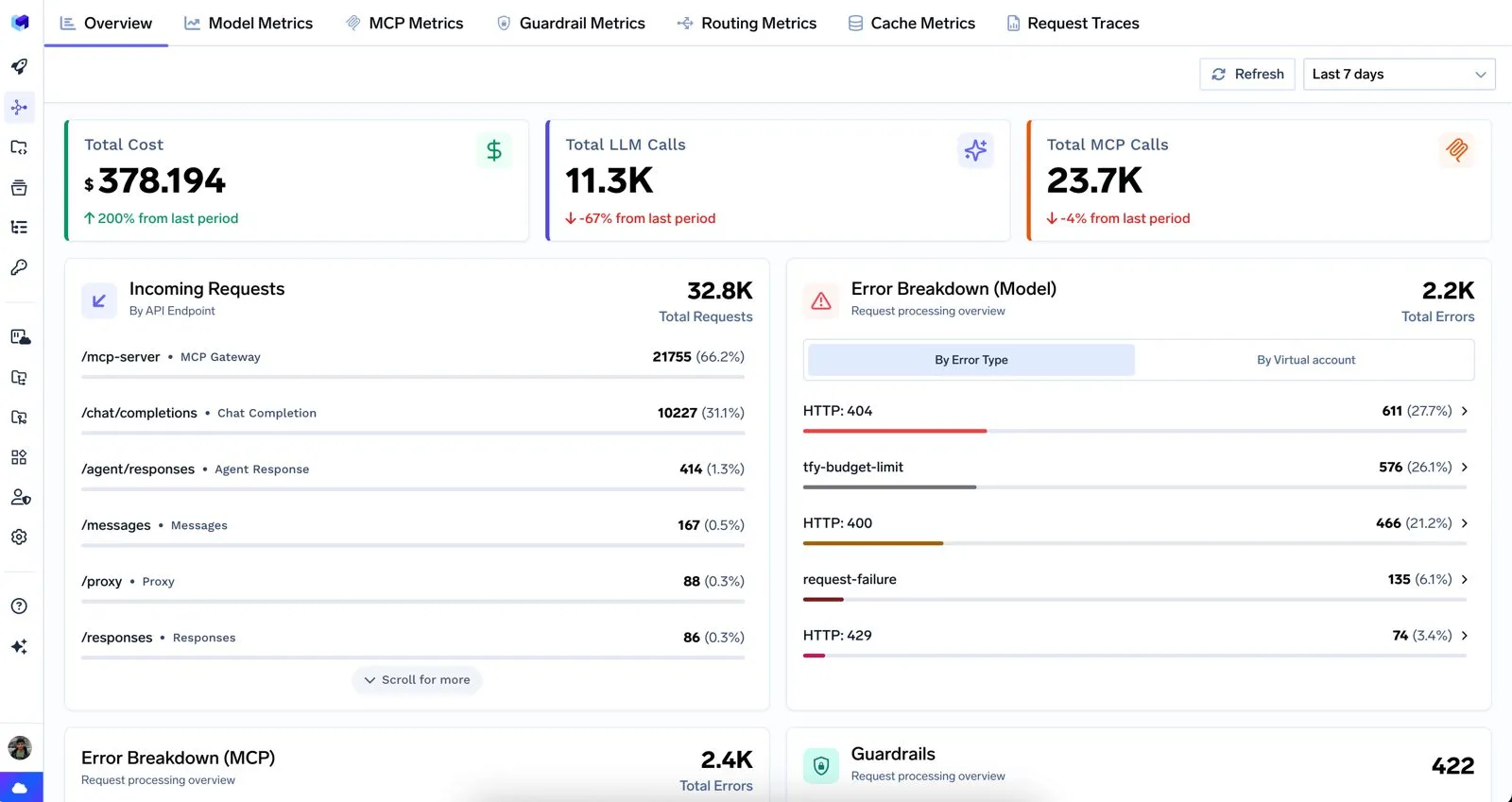
The Model Metrics tab is where match-day performance lives, and its latency vocabulary is precisely the one streaming AI products need. Four documented signals, each with P50/P75/P90/P99 percentile selectors: request latency (end-to-end, gateway receipt to complete response), time to first token (the streaming user's perception of speed), inter-token latency (the smoothness of the stream), and time per output token (generation throughput). Beside them: requests per second, failure rate over time, and failure breakdowns by error type and HTTP status class. For agentic traffic, the documentation describes step-level traces — which tools an agent called, how intermediate results flowed — and a request-level view that shows for logged requests, prompt and response data and how routing, fallbacks, and guardrails applied to that specific call (platform overview). And because no enterprise wants another monitoring silo, the telemetry is OpenTelemetry-compatible and can be exported to external observability backends, including the Prometheus and Grafana setup documented by TrueFoundry (gateway docs). The table below reads the documented signals as knockout questions.
Quarterfinals are where good teams lose to organized ones, and cost is where good AI programs lose to attributed ones. The mechanism that decides this round is a selector. The documented Metrics Dashboard pivots every chart through a View-by dimension: models, virtual models, users, virtual accounts, teams — or custom metadata keys sent in request headers, which the documentation describes as the way to build views by tenant, environment, or feature (observability docs). That last option is the quiet winner of the round. Metadata tagging at the request plus cost pricing at the response means cost of inference charts over time by the dimension the organization budgets on — team for chargebacks, virtual account for per-application tracking, metadata for whatever structure the business actually has. Attribution then feeds enforcement: the same budget mechanism from the Round of 32 escalates from milestone alert to warn to hard stop as a team approaches its line (budget docs). And two documented capabilities shrink the bill before attribution ever sees it: semantic caching, which cuts cost and latency on repeat requests, and batch APIs for asynchronous workloads at batch pricing (caching docs; gateway docs). Teams that reach this round with shared keys and one invoice line discover the problem is not that they spent too much — it is that they cannot say on what, and an unattributable bill cannot be defended or reduced.
By the semifinal, everyone left is good; what separates them is what happens when something breaks mid-match. Model providers have bad days — rate-limit storms, elevated error rates, regional slowdowns — and the knockout question is whether their bad day becomes your product's bad day. The documented answer is routing policy at the gateway: load balancing across models by weight, latency, or priority, with automatic retries and fallback chains, configured as virtual models rather than coded into applications (load balancing and fallbacks docs). The observability round feeds this one directly — failure-rate-by-error-type charts and per-provider error breakdowns are how a team sees a provider degrading early enough for the fallback chain to matter, and the documented request-level view shows, for any individual call, whether routing or fallbacks applied. The compound effect is the one enterprises actually buy: an application keeps its single endpoint and its OpenAI-compatible schema while the gateway re-routes beneath it, so a provider incident can, with suitable fallback capacity and policy, be contained as a routing event rather than automatically becoming the product's bad day. In bracket terms: the semifinal is won at the team selection, before kickoff — by the configuration that decided in advance what happens when the first-choice option goes down.
The final is the newest and most operationally demanding game in this framework: agents that act — calling tools, touching systems, holding the potential for consequence — under governance that survives a security review. The documented architecture plays this final with a specific shape. Tools live in an MCP registry where servers are hosted, published, and discovered in one place (MCP registry docs). Authentication is centralized at the MCP Gateway with OAuth2, RBAC, per-user delegation, and tool-level restrictions, so agents can reference registered MCP servers and tools without embedding downstream service credentials in agent code (MCP authentication & security docs; MCP servers in the Agent Harness). Virtual MCP servers combine tools from multiple servers into one governed surface (virtual MCP docs). And the run itself happens in the Agent Harness — orchestration, sandboxed execution, human approval gates on configured sensitive or destructive tool calls, and step-level traces with cost per step (Agent Harness docs). Notice what the final inherits from every earlier round: the agent's model calls pass through the Round-of-32 controls, its steps appear in the Round-of-16 traces and the MCP tool metrics, its spend lands in the quarterfinal's attribution, and its model traffic rides the semifinal's routing. That is the actual thesis under the analogy — the final is not a separate competition. It is the same control plane, extended to systems that act.
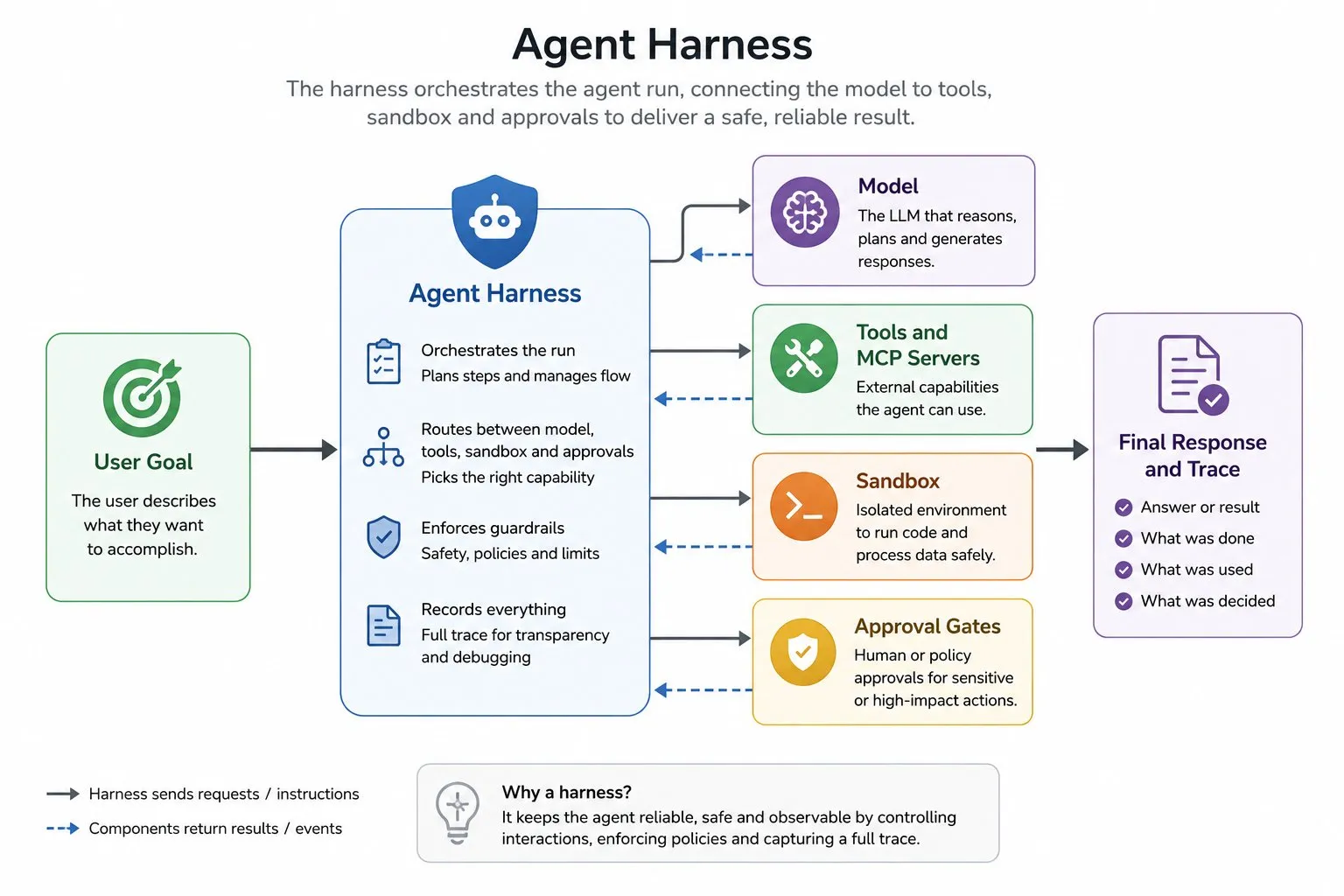
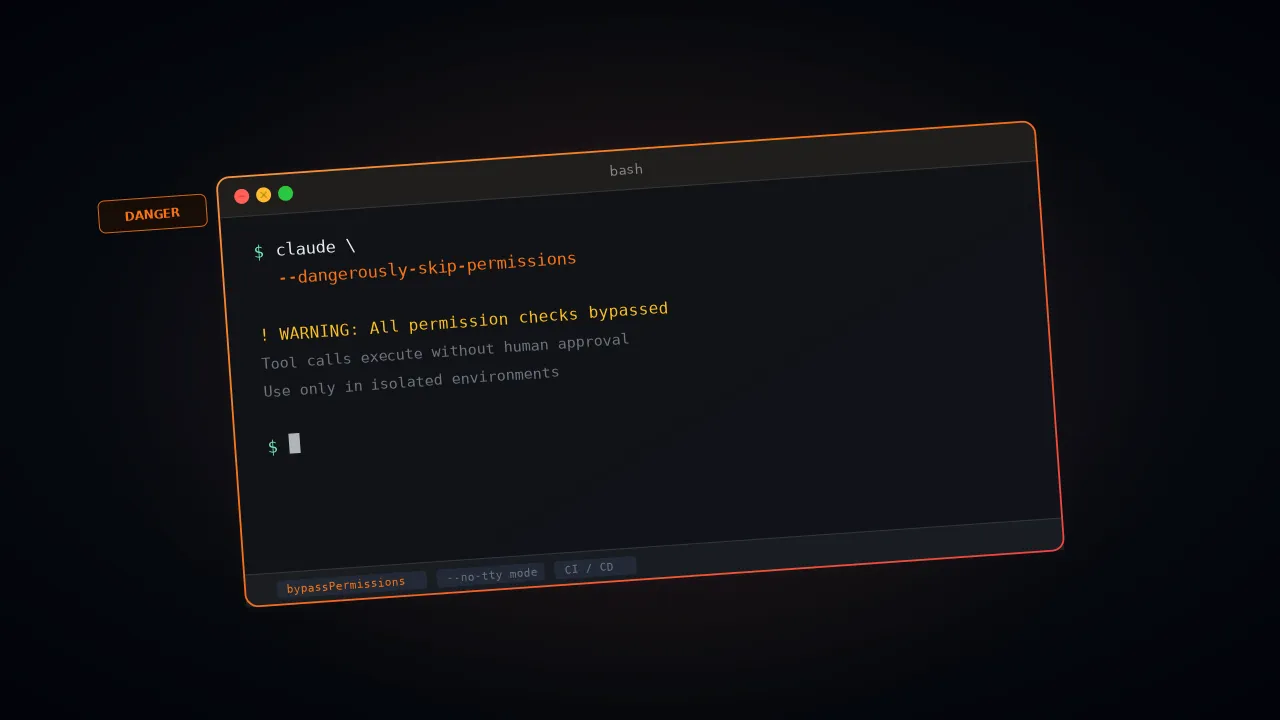
One discipline beyond this post’s five rounds deserves a mention: loop engineering — designing the systems that prompt your agents, run after run. It is not a native TrueFoundry feature; it is a practice you build, and the Agent Harness is the runtime it assumes. Our Loop Engineering at Enterprise Grade post makes that case — the craft meets approvals, budgets, traces, and governed credentials — and its fleet-scale sequel extends it to many loops at once. If the final is won on this pitch, loop engineering is next season’s training regimen.
Analogies are lenses, not evidence, so here is where this one distorts. First, production is a season, not a final: there is no whistle after which an AI platform has permanently won, only standards that must hold every day — the bracket describes the standard, not the calendar. Second, knockout football is single-elimination and enterprise engineering mercifully is not; a failed readiness review costs time and credibility, not existence. Third, no control plane wins the tournament by itself. The recurring finding across enterprise AI research this year — including BCG's, which this blog has covered — is that most of the scaling work is people, process, and strategy — the emphasis of BCG’s published work on scaling AI, with its recurring 10-20-70 allocation weighting people and process over algorithms; a gateway is the technology-and-tooling side of that equation, and this post's mapping of rounds to capabilities is TrueFoundry's editorial framing, not an industry standard. What genuinely transfers is the bracket's core property: in the knockout phase, strengths do not offset gaps. A team with the tournament's most gifted forward still goes home if it cannot defend a set piece. A platform with a frontier model still fails its readiness review if it cannot say who called what, at what cost, with which tools. Elimination questions are answered one at a time, and each must be answered.
On the night of July 19, one squad will have done something arithmetically brutal: survived five consecutive elimination matches in which a single loss meant elimination — 32 teams entered that bracket; one finishes it with the trophy. On Monday morning, your AI platform plays its next elimination round, because in the enterprise the bracket never stops being played: a new security review, a new budget cycle, a new agent workload asking for tool access. The teams that survive brackets are not the ones that improvise each round; they are the ones whose spine — keeper, defense, midfield — holds across all of them. For enterprise AI that spine is the control plane: control, observability, attribution, reliability, and agent governance, one gateway plane, documented capability by capability above. The group stage was fun. The knockout rounds are where it counts.
Shankly’s adage, read against Ng’s, is the closing argument: model leaderboards are form — they change quarterly. The governed plane underneath — identity, budgets, traces, controlled tools — is class: the infrastructure that stays valuable no matter which model tops the next cycle.
The World Cup analogy and the round-to-capability mapping are TrueFoundry editorial framing. TrueFoundry capabilities are paraphrased from the linked public documentation current at the time of writing, with a single direct quotation under fifteen words attributed to the Metrics Dashboard documentation; the two product images are TrueFoundry's own documentation assets, reproduced with attribution. FIFA World Cup™ and related marks are trademarks of FIFA (Fédération Internationale de Football Association); tournament facts are credited to FIFA’s official materials at fifa.com. This post is an independent commentary, is not affiliated with, sponsored, or endorsed by FIFA, uses the tournament solely as an editorial analogy, and names no participating teams, players, or match outcomes.
TrueFoundry AI Gateway offre une latence d'environ 3 à 4 ms, gère plus de 350 RPS sur 1 processeur virtuel, évolue horizontalement facilement et est prête pour la production, tandis que LiteLM souffre d'une latence élevée, peine à dépasser un RPS modéré, ne dispose pas d'une mise à l'échelle intégrée et convient parfaitement aux charges de travail légères ou aux prototypes.





Les dernières nouvelles, articles et ressources envoyés dans votre boîte de réception

.png)
.png)
.png)

.png)
.png)
.png)
.png)
.png)