October 13, 2026
|
Lesedauer: 5 Minuten


Erhalten Sie sofortigen Zugriff auf eine TrueFoundry-Live-Umgebung. Stellen Sie Modelle bereit, leiten Sie den LLM-Verkehr weiter und erkunden Sie die gesamte Plattform — Ihre Sandbox ist in Sekundenschnelle einsatzbereit, ohne dass eine Kreditkarte erforderlich ist.


Published: October 6, 2026
Unglaublich schnelle Methode zum Erstellen, Verfolgen und Bereitstellen Ihrer Modelle!
Teil 1 betrachtete zwei BCG-Publikationen gemeinsam – die AI at Work Umfrage 2026 (Juni) und The Agentic Leadership Playbook: A Scaling Strategy for CTOs and CIOs (Anfang Juli 2026; von den Experten Mark Abraham und Neveen Awad) – und ordnete ausgewählte Umfrage- und Führungserkenntnisse dokumentierten AI-Gateway-Kontrollen zu. Dieser Teil greift die Agenten-Erkenntnisse beider Dokumente auf – die Statistiken der Umfrage zu Einführung versus Governance sowie die Beobachtungen der Experten im Playbook darüber, was sich ändert, wenn Agenten handeln statt nur Empfehlungen auszusprechen – und setzt das abschnittsweise Muster fort. Er knüpft direkt an die Vorgabe aus Teil 1 an: Agenten auf einem vertrauenswürdigen Kern aufbauen, ihre beobachtbare Ausführung und gemessenen Ergebnisse prüfen und bei wachsendem Vertrauen skalieren. BCG-Berichte zeigen, dass sich Agenten schnell durchsetzen, während die Governance hinterherhinkt: Etwa 30 % der Befragten geben an, dass ihre Unternehmen KI-Agenten in Arbeitsabläufe integriert haben, rund 61 % erwarten, dass Agenten innerhalb von drei Jahren die Hälfte ihrer Arbeit erledigen, doch etwa die Hälfte der Befragten gibt an, dass ihren Unternehmen eine klare Governance für Teams fehlt, die aus Menschen und KI bestehen. Dieser Teil wendet dieselbe redaktionelle Methode auf diese Agenten-Erkenntnisse an und fragt, wie kontrollierter Tool-Zugriff (das MCP Gateway) und eine verwaltete Laufzeitumgebung (das Agent Harness) einen Teil der Lücke im Betriebsmodell schließen können. Wie in Teil 1 werden die BCG-Zahlen paraphrasiert, mit Primärquellen belegt und die Funktionen direkt mit der Dokumentation von TrueFoundry verknüpft.
Teil 1 etablierte die Methode: BCG benennt eine Lücke; eine dokumentierte Kontrolle wird einem technischen Teilbereich zugeordnet; die operativen Entscheidungen verbleiben beim Unternehmen. Die Erkenntnisse betrafen den Modell-Traffic und waren auf das AI Gateway ausgerichtet. Die Agenten-Erkenntnisse von BCG sind anderer Natur. Ein Agent ist kein einzelner Modellaufruf; es ist eine Schleife, die plant, Tools aufruft, Ergebnisse beobachtet und entscheidet, ob sie fortfährt – und diese Tool-Aufrufe greifen auf echte Systeme zu und erfordern echte Anmeldedaten. Einen Agenten zu steuern bedeutet daher, zwei Dinge zu regeln, die das AI Gateway allein nicht vollständig abdeckt: die Tools, die der Agent aufruft, und die Laufzeitumgebung, die die Schleife steuert.
Deshalb führt dieser Teil zwei weitere Funktionen ein, anstatt die ersten zu wiederholen. Das MCP Gateway regelt den Tool-Zugriff – den Datenverkehr des Model Context Protocol zwischen Agenten und den Systemen, auf denen sie agieren. Das Agent Harness ist die Laufzeitumgebung, die die Agenten-Schleife mit integrierter Governance ausführt. Die folgenden Abschnitte behandeln diese nacheinander: das Defizit, Tool-Governance, die Laufzeitumgebung sowie die Neugestaltung und Bereitstellung von Arbeitsabläufen.
Die Agenten-Daten von BCG enthalten gleichzeitig Chancen und Warnungen: Etwa 30 % der Befragten geben an, dass ihre Unternehmen KI-Agenten in Arbeitsabläufe integriert haben – ein Anstieg von 13 % im Vorjahr – und etwa 61 % glauben, dass Agenten innerhalb von drei Jahren mindestens die Hälfte ihrer beruflichen Aufgaben übernehmen könnten (bcg.com/press/3june2026). Dem gegenüber steht die Governance-Situation: Etwa die Hälfte der Befragten gibt an, dass ihren Unternehmen eine klare Governance für die Verwaltung von Teams fehlt, die aus Menschen und KI bestehen, und eine Mehrheit berichtet von einem begrenzten Verständnis darüber, was Agenten überhaupt sind.
Dass die Einführung der Governance vorausläuft, ist bei Agenten kritischer als bei Chat-Anwendungen, da ein Agent handelt, Aktionen über Tools hinweg verkettet und dafür häufig Anmeldedaten bereithält. Eine ungeregelte Agenten-Population stellt daher ein ständiges Risiko dar – durch nicht registrierte Agenten, eingebettete Anmeldedaten und nicht geprüfte Tool-Zugriffe. Das einen Monat später veröffentlichte Playbook, das eine andere Perspektive einnimmt, zeigt dasselbe Bild: Etwa 5 % der Unternehmen setzen auf eine "Agent-First"-Strategie, die meisten anderen liegen unter 30 % bei der Einführung. Der Unterschied wird eher der Führung und der Disziplin bei Veränderungsprozessen zugeschrieben als der Wahl des Modells (das Playbook). Es benennt auch, warum die Governance-Lücke bei Agenten schwerer wiegt als bei Chat-Anwendungen: Agenten handeln, anstatt nur Empfehlungen zu geben. Die Kosten einer falschen Eingabe verschieben sich daher von einer irreführenden Folie hin zu einer fehlerhaften Aktion – das Beispiel der Experten: eine fehlerhafte Definition von "abgewanderten Kunden", die eine Kampagne in die falsche Richtung lenkt. Die Lücke, die BCG bei der Belegschaft misst, ist dieselbe, die ein Infrastruktur-Team von oben betrachtet. Die beiden folgenden Abschnitte ordnen sie zwei dokumentierten technischen Kontrollinstanzen zu, die einen Teil davon adressieren können: MCP-vermittelter Tool-Zugriff und eine kontrollierte Agenten-Laufzeitumgebung.
Die erste Hälfte der Agenten-Governance besteht aus den Tools. Viele Agenten greifen über Tools auf externe Systeme zu, zunehmend über das Model Context Protocol – und wo immer dies geschieht, stellt jedes Sicherheitsteam dieselbe Frage: Mit wessen Anmeldedaten, unter welcher Autorisierung und mit welchem Audit-Trail? Dies entspricht dem MCP Gateway. Laut der Dokumentation von TrueFoundry erfolgt die Authentifizierung von Agenten-Tools im MCP Gateway und nicht im Agenten selbst: Agenten rufen Tools beim Namen auf, und das Gateway übernimmt die Injektion der Anmeldedaten, die Token-Aktualisierung sowie die benutzerbezogene Delegation (docs/agent-platform/agent-harness/overview). Die Produktoberfläche ergänzt die Kontrollen, die dies unternehmenstauglich machen: MCP-Tool-Aufrufe werden über registrierte Server geleitet, OAuth2, RBAC und metadatenbasierte Richtlinien werden auf Gateway-vermittelte Tool-Aufrufe angewendet, und diese Aufrufe werden für Sicherheits- und Compliance-Prüfungen nachverfolgt und zugeordnet (MCP-Server in der Agent Harness-Dokumentation).
Dies adressiert die Gefahren ungesteuerter Agenten: Eine zentralisierte, vom Gateway verwaltete Authentifizierung reduziert die Notwendigkeit, Anmeldedaten in Agentendefinitionen einzubetten. Anmeldedaten lassen sich so leichter rotieren, begrenzen und widerrufen, da sie zentral gespeichert werden, anstatt sie in Konfigurationsdateien einzufügen. Zentralisierte Identität, Delegation, tool-spezifisches RBAC und Tool-Beschränkungen können dazu beitragen, das Risiko von „Confused-Deputy“-Szenarien und übermäßigen Berechtigungen zu verringern. Und da Gateway-vermittelte Tool-Aufrufe nachverfolgt und zugeordnet werden, erhält die implizite Frage der BCG – welcher Agent hat was mit welchem System und welchen Daten getan – für den Datenverkehr, den das Gateway verarbeitet, eine Antwort. Das MCP Gateway erweitert die Leitplanken aus Teil 1 von Modellaufrufen auf Tool-Aufrufe: das gleiche Prinzip der Governance am Gateway, angewendet auf die Aktionen, die ein Agent ausführt, statt nur auf den Text, den er generiert. Es ist zudem die konkrete Form der Datendoktrin des Playbooks. Wenn Experten dazu raten, Agenten auf Basis eines vertrauenswürdigen Datenkerns zu entwickeln und die Oberfläche mit wachsendem Vertrauen zu erweitern, fungiert das Register als ein Zugriffskontrollmechanismus um diesen Kern: Es schränkt ein, welche genehmigten Server und Tools der Agent verwenden darf, begrenzt durch RBAC und benutzerbezogene Delegation, und die Erweiterung ist eine bewusste, prüfbare Änderung am Register. Die Organisation muss dennoch die Qualität, Herkunft und semantische Korrektheit der zugrunde liegenden Daten sicherstellen.
Die zweite Hälfte der Agenten-Governance ist die Laufzeitumgebung – die Schleife selbst und ihre Kontrollen. Dies entspricht dem Agent Harness, das TrueFoundry als verwaltetes Framework beschreibt, das auf dem AI Gateway und dem MCP Gateway aufbaut: Sie wählen ein Modell, verbinden MCP-Server, fügen Fähigkeiten hinzu und schreiben Anweisungen, während die Plattform Orchestrierung, Sandbox-Lebenszyklus, Tool-Ausführung, Genehmigungen, Governance und Observability verwaltet (docs/agent-platform/agent-harness/overview). Sein entscheidendes Governance-Merkmal: Es werden niemals API-Schlüssel oder Anmeldedaten in Agentendefinitionen eingefügt – Modelle, MCP-Server und Fähigkeiten werden über eine zentrale Steuerungsebene namentlich referenziert, wobei Modell-Anmeldedaten im AI Gateway, die Tool-Authentifizierung im MCP Gateway und Fähigkeiten in einem versionierten, RBAC-gesteuerten Fähigkeiten-Register (Skills Registry) verwaltet werden.
Das Harness adressiert einen technischen Teil des Governance-Defizits der BCG. Laut Dokumentation führt es eine Orchestrierungsschleife aus – planen, handeln, beobachten, fortfahren oder stoppen – mit Tool-Routing und -Ausführung, Speicher- und Kontextkontrollen für lang laufende Aufgaben, Sicherheitsgrenzen einschließlich Sandboxing und Berechtigungen sowie Genehmigungsprozessen mit menschlicher Beteiligung (Human-in-the-Loop), die sensible Tool-Aufrufe pausieren und eine explizite Freigabe erfordern, bevor sie ausgeführt werden (docs/agent-platform/agent-harness/overview). Da das Harness in derselben Gateway-Ebene wie der Modell- und MCP-Datenverkehr läuft, bleiben Governance und Observability in einem einzigen System statt in dreien. Das Ergebnis ist ein technischer Teil der „Governance für Mensch-KI-Teams“, ausgedrückt als Laufzeitumgebung: Agenten agieren mit verwalteten Identitäten, greifen auf sanktionierte Modelle und Tools zurück und pausieren konfigurierte sensible oder destruktive Tool-Aufrufe zur Genehmigung. Hier wird auch die stufenweise Disziplin des Playbooks operativ: Entwickeln Sie auf Basis des vertrauenswürdigen Kerns und nutzen Sie dann Laufzeit-Traces, Auswertungen und Geschäftsergebnisse, um zu entscheiden, wann der Datenzugriff oder die Befugnisse eines Agenten erweitert werden sollen.
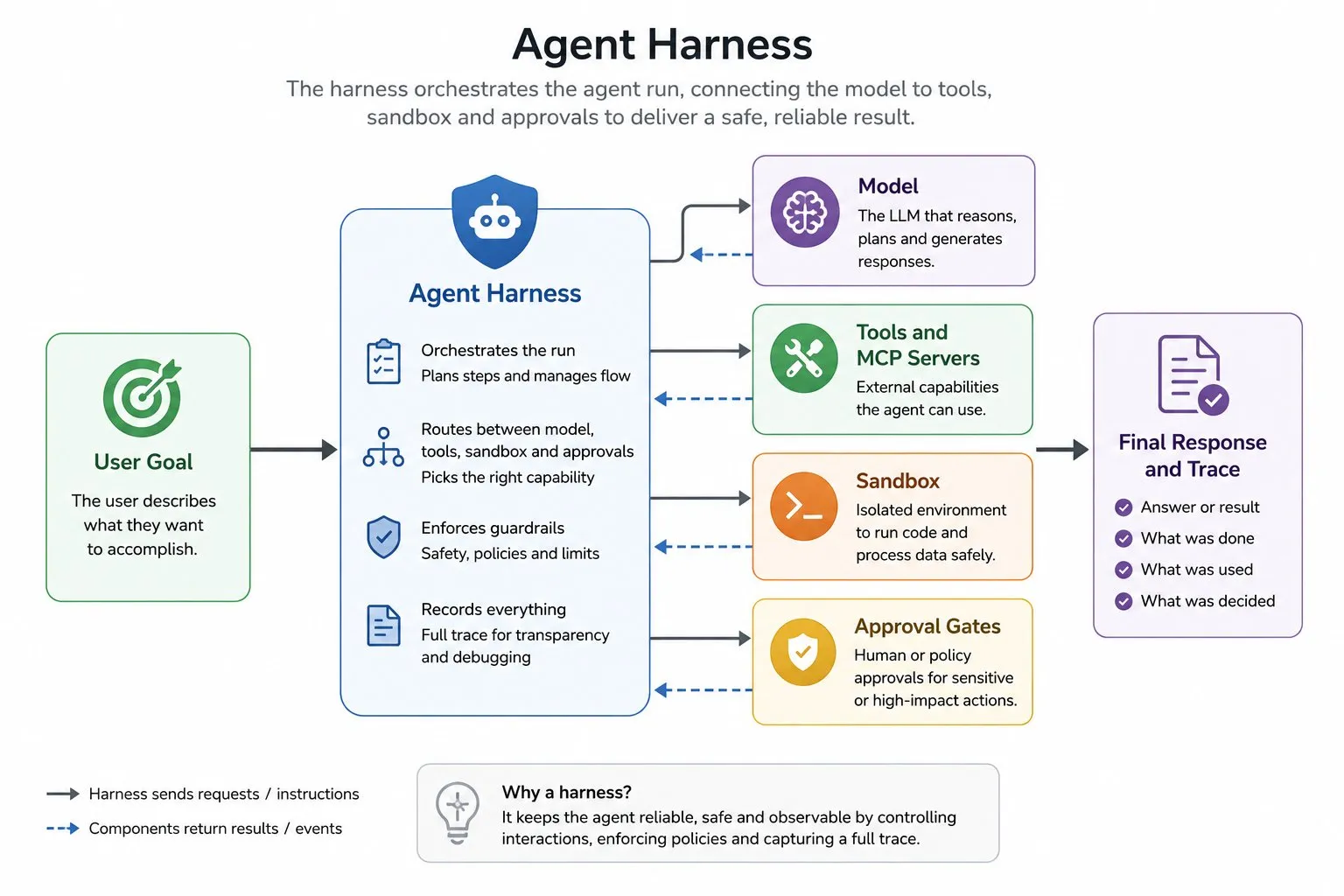
Agenten heben die Überwachungsfrage aus Teil 1 auf eine höhere Ebene – die Steuerung eines Agenten ist schwieriger als die eines einzelnen Aufrufs – und die Antwort des Harness ist die schrittweise Nachverfolgung (Tracing) sowie Genehmigungs-Gates. Laut TrueFoundry sollte die Observability über Modell-, Tool- und Agenten-Datenverkehr hinweg aus einer einzigen Ansicht bestehen – End-to-End-Traces pro Lauf, mit Kosten, Token-Verbrauch und Latenz pro Schritt (blog/agent-harness-managed-ai-agents). Dieses schrittweise Tracing liefert einem Vorgesetzten ein lesbares Protokoll darüber, was ein Agent getan hat, welches Tool er aufgerufen hat und was jeder Schritt gekostet hat – die Version der Transparenz auf Agentenebene, die die Erkenntnisse der BCG zur Management-Revolution erfordern, und die praktische Umsetzung des Ratschlags aus dem Playbook, die Leistung von Agenten zu beobachten und Schlussfolgerungen zu ziehen, bevor deren Befugnisse erweitert werden: Laufzeit-Traces machen den beobachtbaren Ausführungspfad lesbar – aufgerufene Tools, ausgewählte Aktionen, explizite Zwischenergebnisse, Genehmigungen, Kosten –, auch wenn sie das private interne Denken eines Modells nicht offenlegen.
Die Freigabe-Instanz bildet die andere Hälfte: Ausgewählte sensible oder wirkungsstarke Tool-Aufrufe pausieren für eine explizite menschliche Autorisierung – eine gezielte Überwachung statt ständiger Kontrolle. Freigabe-Instanzen und MCP-Zugriffskontrollen können den Wirkungsbereich konfigurierter sensibler Aktionen begrenzen; sie beseitigen jedoch nicht die umfassenderen Risiken in Bezug auf Governance und Betriebsmodell, die laut den Daten der BCG von den meisten Unternehmen noch nicht angegangen wurden.
Die durchgängige Neugestaltung von Workflows erfordert eine Ausführungsumgebung, in der agentenbasierte Workflows erstellt, beobachtet und gesteuert werden können; das Agent Harness ist eine solche verwaltete Laufzeitumgebung. Es übernimmt Modellzugriffsrichtlinien, Budgets, Ratenbegrenzungen und Leitplanken vom AI Gateway, während Laufzeit-Ausführungskontrollen und Freigabe-Instanzen dabei helfen, das konfigurierte Verhalten zu steuern (Harness-Dokumentation; zur Begrenzung von Schleifen allgemein siehe unseren Beitrag zum Loop-Engineering) – dieselbe Budget- und Richtlinien-Maschinerie aus Teil 1, angewendet auf die Agenten-Schleife, weshalb das Harness auf dem AI Gateway aufbaut und nicht davon getrennt ist.
Die Bereitstellung macht dies für die regulierten Unternehmen in der 14-Märkte-Stichprobe der BCG nutzbar: Die Plattform läuft als SaaS, selbst gehostet oder On-Premise, mit einer Split-Plane-Architektur, bei der die Compute-Ebene – einschließlich des Gateways – innerhalb des eigenen Cloud-Kontos des Kunden ausgeführt wird, sodass Prompts, Vervollständigungen und Daten dieses nicht verlassen müssen (blog/field-notes-ai-cost-gateway-not-a-switch). Für eine Bank oder ein Krankenhaus ist die Frage „Wo läuft das?“ selbst eine strategische Entscheidung. Die Flexibilität bei der Bereitstellung ermöglicht es, dass Zuordnung, Leitplanken und MCP-Governance in der Gateway-Ebene verbleiben, während das Harness in derselben vom Kunden kontrollierten Umgebung läuft – einschließlich Workloads, die kein Multi-Tenant-SaaS nutzen können. Diese Flexibilität kann den gesteuerten Agentenbetrieb für souveränitätssensible oder regulierte Workloads erst möglich machen. Das Playbook ergänzt die Neugestaltung um ihren Beschleuniger und ihre Grenzen: Agenten komprimieren den langsamsten Input – einen achtwöchigen Zyklus zur Datenerfassung und -bereinigung auf etwa eine Woche im Konto der Anwender –, während die Intelligenzebene – nach Abrahams Definition die Abbildung des tatsächlichen Geschäftskontexts eines Unternehmens auf seine Daten, damit Agenten die Geschäftstreiber verstehen – menschliche Arbeit bleibt, der am meisten unterschätzte Teil des agentenbasierten Einsatzes. Awad beschreibt die Ausrichtung der Führungskräfte mit dem einzigen direkten Zitat aus dem Playbook in diesem Beitrag: „Sie fragen: ‚Wie arbeiten wir anders?‘“ – nicht, wie man Agenten einsetzt (das Playbook). Agenten beschleunigen die Neugestaltung; sie entwerfen sie nicht.
Es wäre eine falsche Darstellung von BCG und TrueFoundry, zu behaupten, die Plattform schließe die Wertschöpfungslücke von allein; TrueFoundry benennt die Grenze in seinen eigenen Ausführungen: Diese Grundbausteine machen das Betriebsmodell erst möglich – sie sind nicht das Betriebsmodell selbst; die Plattform liefert Ihnen die Stellschrauben und die Daten, und ein kompetentes Team muss dennoch die Schwellenwerte festlegen und auf Warnmeldungen reagieren (blog/field-notes-ai-cost-gateway-not-a-switch). Das entspricht genau der Arbeitsteilung, die der Kontrast zwischen Strategie und Tools bei BCG impliziert (+25 Punkte für strategische Klarheit gegenüber +5 für Tool-Zugriff im Vergleich der Umfrage) – und das Playbook belegt dies mit eigenen Zahlen: Der Erfolg bei der Implementierung von Agenten besteht zu etwa 70 % aus Menschen und Change Management, wobei die am weitesten fortgeschrittenen Unternehmen mehr als die Hälfte ihrer Belegschaft geschult haben. Die Strategie legt die Schwellenwerte fest, entscheidet, was gemessen werden soll, wählt aus, was eingestellt werden soll, und bestimmt, welche höherwertigen Aufgaben die durch KI frei gewordenen Stunden füllen sollen. Die vier in dieser Serie aufgezeigten Fähigkeiten – AI Gateway, Leitplanken, MCP Gateway, Agent Harness – können ausgewählte technische Richtlinien durchsetzbar machen und die Telemetrie liefern, die Unternehmen bei deren Überprüfung unterstützt. BCG schreibt diese Architektur nicht vor; die Zuordnung ist die Interpretation von TrueFoundry, wie ein Teil der Antwort operationalisiert werden kann.
Die Abfolge aus Teil 1 gilt auch auf Agentenebene: erst die Strategie, dann die Ausführungsebene, die das Handeln ermöglicht. Eine gesteuerte Laufzeitumgebung ohne Strategie führt zu gesteuerten Agenten, die unklare Arbeit verrichten; eine Agentenstrategie ohne gesteuerte Ausführung lässt den technischen Teil der Lücke im Betriebsmodell, die BCG misst, offen. Über beide Teile hinweg blieb die Aussage konstant und präzise: Die Strategie bleibt die Variable mit der größeren Hebelwirkung; eine gemeinsame Steuerungsebene kann dabei helfen, Teile dieser Strategie in gesteuertes technisches Verhalten zu übersetzen.
Zusammengenommen bringen die beiden Teile die Erkenntnisse der BCG mit vier Fähigkeiten über die Gateway- und Laufzeitebenen hinweg in Einklang, die jeweils durch Dokumentationen belegt sind: Kostenzuordnung und Beobachtbarkeit (AI Gateway), Leitplanken und Policy-as-Configuration, Tool-Governance (MCP Gateway) sowie die gesteuerte Laufzeitumgebung (Agent Harness) – ergänzt durch Freigabe-Instanzen, Traces und SaaS/Self-Hosted/On-Premise-Bereitstellung. Das Muster blieb unverändert: ein BCG-Ergebnis auf der einen Seite, eine dokumentierte Fähigkeit auf der anderen und die operativen Entscheidungen, die durchgehend beim Unternehmen verbleiben.
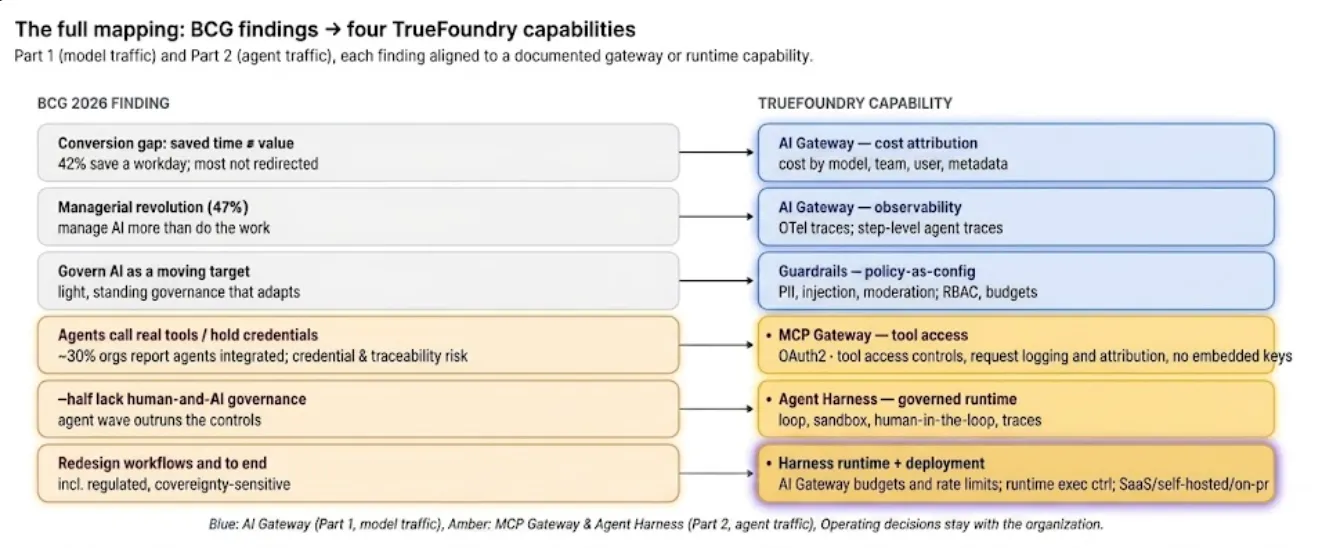
Diese Konsistenz ist das Argument. Der Beitrag der BCG belegt, dass nicht die Werkzeuge, sondern die Strategie der entscheidende Hebel ist – und verlagert den Fokus von der Frage „Welches Modell gewinnt?“ hin zur operativen Umsetzung. Diese Serie ergänzt lediglich eine Ebene, auf der ausgewählte technische Richtlinien durchgesetzt und operative Telemetriedaten erfasst werden können. Dies wird so konkret dargestellt, dass es überprüfbar ist: durch Gateway- und Harness-Funktionen, die eine klare Strategie in gesteuertes technisches Verhalten übersetzen. Gemessen wird dort, wo das Gateway den Datenverkehr tatsächlich abwickelt, statt nur in Präsentationen und Adoptionsstatistiken. Strategie ist wichtiger als Werkzeuge. Sie läuft jedoch auf einer Infrastruktur – und die Lücke zwischen einer proklamierten und einer tatsächlich umgesetzten Strategie ist der Unterschied zwischen KI-Einführung und KI-Wettbewerbsvorteil.
Warum werden das MCP Gateway und der Agent Harness erst in Teil 2 eingeführt? Weil die Funktion der Erkenntnis folgt. Teil 1 ordnete Bedenken hinsichtlich des Modell-Traffics dokumentierten KI-Gateway-Kontrollen zu. Die Erkenntnisse in Teil 2 beziehen sich auf Agenten, die Tool-Aufrufe (gesteuert durch das MCP Gateway) und eine Laufzeitschleife (gesteuert durch den Agent Harness) hinzufügen. Würde man alle vier gleichzeitig einführen, bliebe unklar, welche Funktion welche Lücke schließt; die abschnittsweise Paarung ist hier der entscheidende Punkt.
Macht der Agent Harness menschliche Aufsicht überflüssig? Nein. Genehmigungs-Gates bieten explizite Kontrollpunkte: Konfigurierte sensible oder destruktive Tool-Aufrufe halten für eine menschliche Autorisierung an – und diese Genehmigungs-Gates bestimmen für sich genommen nicht die breitere Arbeitsteilung des Unternehmens (docs/agent-platform/agent-harness/overview). Genehmigungs-Gates sind eine Laufzeitkontrolle für diese Governance-Lücke; sie sind kein vollständiges Betriebsmodell. Sie bieten präzise platzierte Kontrollpunkte, keine ständige Überwachung.
Was ist mit dem spezifischen Problem eingebetteter Anmeldedaten? Eingebettete Anmeldedaten sind ein Fehlerbild, das durch das Harness-Design adressiert wird: Laut Dokumentation werden Anmeldedaten nicht in Agentendefinitionen kopiert – Agenten referenzieren Modelle, Tools und Fähigkeiten namentlich, während die Anmeldedaten zentral in den Gateways gespeichert sind (docs/agent-platform/agent-harness/overview). Der Zugriff eines Agenten ist eine gesteuerte Konfiguration und kein in die Konfiguration kopiertes Geheimnis, was eine häufige und erhebliche Quelle für Risiken bei der Agenten-Governance darstellt.
Steht diese Analyse in Verbindung mit der BCG? Nein. Es handelt sich um einen unabhängigen Kommentar zu den veröffentlichten, öffentlichen Erkenntnissen der BCG, die mit Quellenangaben und URLs paraphrasiert wurden. Die BCG-Zahlen basieren auf selbst gemeldeten Umfrageergebnissen, und der Vergleich zwischen Strategie und Werkzeugen ist eine vom Bericht gezogene Schlussfolgerung, keine kontrollierte Kausalitätsanalyse; der Kontrast von +25 zu +5 Punkten ist daher eher als richtungsweisend zu verstehen. Die Funktionen von TrueFoundry werden im Text durch Verweise auf die öffentliche Dokumentation belegt.
Was fügt das Playbook der BCG vom Juli 2026 der Zuordnung in Teil 2 hinzu? Die Tragweite (da Agenten handeln, führen Datenfehler zu fehlerhaften Aktionen), die Methode (ein vertrauenswürdiger Kern mit der Registry als einem der Zugriffskontrollmechanismen, Überprüfung der ausgeführten Prozesse und eine stufenweise Erweiterung basierend auf gemessenen Ergebnissen) und die Grenze (die Intelligenzebene bleibt von Menschen gestaltet). Die Zuordnung ist eine redaktionelle Synthese von TrueFoundry.
Serie: Teil 2 von 2 · ← Teil 1: Von strategischer Klarheit zu Gateway-Kontrollen
Dies ist der zweite Teil einer zweiteiligen Analyse; Teil 1 stellt die BCG-Umfrage vor und ordnet deren modellseitige Ergebnisse dem AI Gateway zu. Alle Funktionen von TrueFoundry werden direkt mit den entsprechenden öffentlichen Produkt- oder Dokumentationsseiten verlinkt und spiegeln den Stand zum Zeitpunkt der Veröffentlichung wider; da sich Funktionen weiterentwickeln, prüfen Sie bitte die aktuelle Dokumentation. Die BCG-Zahlen sind paraphrasierte Angaben aus dem Bericht „AI at Work“ von 2026 sowie Pressematerialien und basieren auf selbst gemeldeten Umfrageergebnissen; dies ist ein unabhängiger Kommentar, der nicht mit BCG verbunden ist oder von BCG unterstützt wird. Eine Plattform ist kein Ersatz für eine Strategie, was den Kernpunkt beider Teile darstellt.
TrueFoundry AI Gateway bietet eine Latenz von ~3—4 ms, verarbeitet mehr als 350 RPS auf einer vCPU, skaliert problemlos horizontal und ist produktionsbereit, während LiteLM unter einer hohen Latenz leidet, mit moderaten RPS zu kämpfen hat, keine integrierte Skalierung hat und sich am besten für leichte Workloads oder Prototyp-Workloads eignet.





Die neuesten Nachrichten, Artikel und Ressourcen werden in Ihren Posteingang gesendet

.webp)
.png)
.png)
.png)
.png)
.png)
.png)