


September 14, 2026
|
5 min read


Obtenha acesso instantâneo a um ambiente TrueFoundry ao vivo. Implante modelos, direcione o tráfego de LLM e explore a plataforma completa — seu sandbox estará pronto em segundos, sem necessidade de cartão de crédito.



Published: July 30, 2026
Blazingly fast way to build, track and deploy your models!
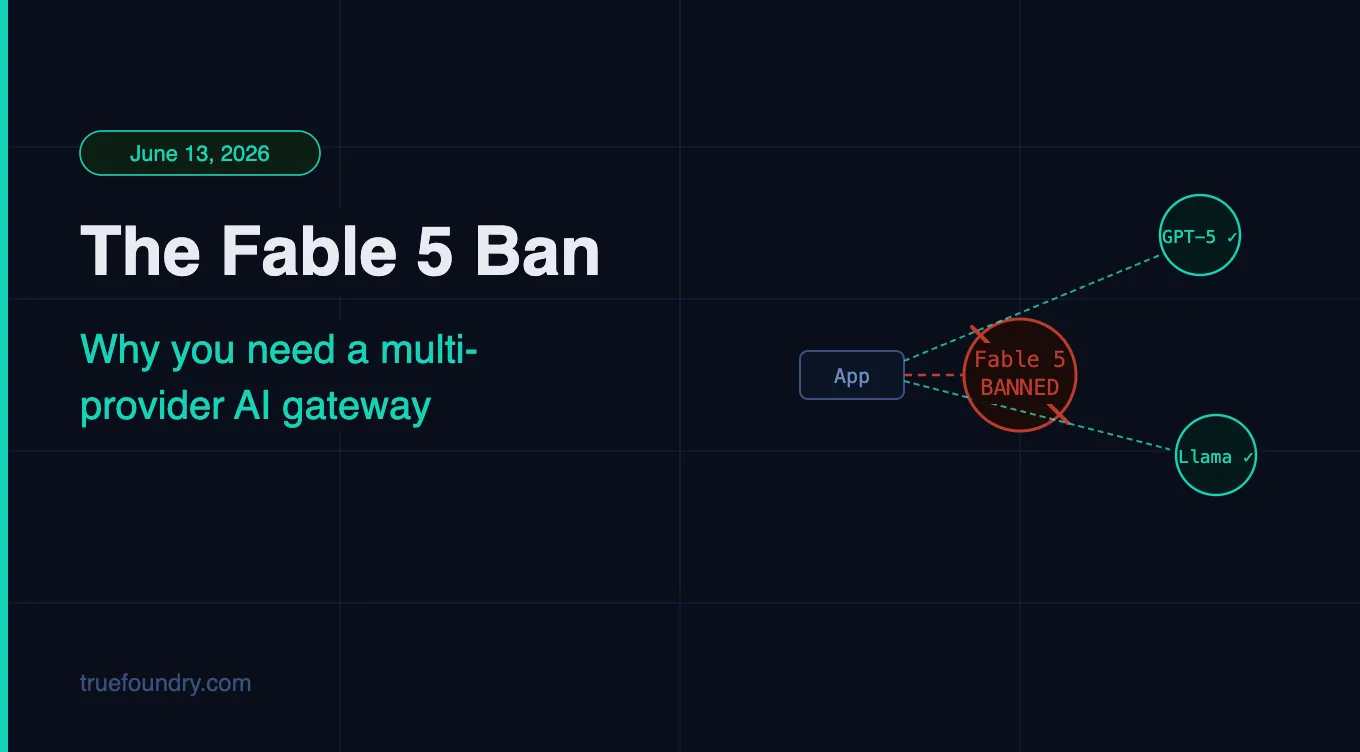
On Friday, June 13, 2026, Anthropic abruptly disabled access to Fable 5 and Mythos 5 — its two most capable models — for every customer on earth. The cause wasn't an outage or a safety rollback the company chose. It was a US Department of Commerce export-control directive, and it turned a routine API dependency into a single point of failure overnight. For anyone building on a single provider, it's the clearest argument yet for putting a multi-provider AI gateway in front of your models.
This post covers what actually happened, why it's a structural risk rather than a one-off, and the resilience architecture that makes a model disappearing a non-event.
The timeline is short and unusually sharp. Anthropic publicly released Fable 5, its most capable model to date, and roughly four days later received an emergency directive from the US Commerce Department. Citing national-security authorities, the government ordered Anthropic to suspend all access to Fable 5 and its underlying Mythos 5 model by any foreign national — whether located outside the United States or on US soil, and including Anthropic's own non-American employees. According to Anthropic's account, the trigger was the government becoming aware of a method to bypass, or "jailbreak," Fable 5's safeguards.
Because Anthropic could not reliably verify the nationality of every user making a request in real time, it could not comply selectively. So it complied completely: both models were switched off for all customers — Americans included — across hundreds of millions of users. As multiple outlets noted, this appears to be the first time a leading AI company has taken a publicly deployed, commercially available model offline because of a direct US government intervention.
The detail that matters for engineering teams is the one that's easy to skim past: there was no graceful deprecation window, no six-month sunset notice, no "migrate to the next version by Q3." Access went from available to gone. If your code path assumed those models would answer the next request, that assumption failed instantly.
It would be easy to read this as a story about one company or one model. It isn't. The Fable 5 / Mythos 5 ban is a concrete demonstration of a risk that applies to every frontier provider: when you depend on a single model behind a single vendor's API, you've accepted several failure modes you don't control.
There are three worth naming explicitly. The first is regulatory and geopolitical — export controls, sanctions, regional licensing, and data-residency rules can remove a model from your reach with no relationship to your own uptime or spend. The second is the ordinary operational kind — provider outages, capacity throttling, and rate-limit changes that hit during your peak. The third is model lifecycle — deprecations and forced version migrations on the vendor's schedule, not yours. The Fable ban is the most dramatic version of the first category, but all three produce the same symptom: a model you were relying on stops answering, and you had no second path.
This is what people mean by AI vendor lock-in in practical terms. It isn't only about pricing leverage. It's about how much of your product stops working when one provider, for any reason, says no.
The blast radius of the Fable ban depended almost entirely on one architectural choice: whether the model was called directly or through an abstraction.
Teams that wired a single provider's SDK straight into their application — the model name, the base URL, and the auth all hardcoded against one vendor — had no place to send the next request when access vanished. The failure wasn't degraded; it was total. Switching to another model meant a code change, a review, a deploy, and a release window, all under incident pressure while the product was down.
Teams that routed their traffic through a gateway experienced the same news very differently. The model going dark was a routing event, not an outage: requests fell through to a configured alternative, and the fix was a configuration update rather than an emergency deploy. Same external shock, completely different Friday.
A multi-provider AI gateway is an abstraction layer that sits between your application and every model you might use. Instead of integrating each provider separately, your code talks to one endpoint, and the gateway handles which model actually serves each request. If you want the deeper architectural primer, our explainer on what an LLM gateway is walks through the building blocks; here we'll focus on the four capabilities the Fable ban makes non-negotiable.
A unified API across many models. With a single OpenAI-compatible API in front of 1,000+ models, switching providers is a matter of changing the model name in the request — same URL, same credentials. The integration work to "add a backup provider" is already done before you ever need it, which is the only version of a backup that helps during an incident.
Automatic fallback and failover. You define a chain — primary model, then fallbacks — and when the primary returns errors or becomes unavailable, the gateway retries against the next option without your application knowing. This is precisely the mechanism that converts "our model was banned" into a transparent reroute.
Load balancing and routing. Beyond failover, the gateway can spread traffic across providers and regions by latency, cost, or availability. Our writeups on LLM load balancing and what an LLM router is go deeper, but the resilience point is simple: traffic is already distributed, so losing one destination degrades capacity instead of removing it.
An open-weight and self-hosted backstop. A gateway lets you keep open-weight or self-hosted models in the same routing pool as the commercial APIs, so a sovereign, fully-controlled fallback is one config entry away. We benchmarked exactly this pattern in open-weight routing at scale — routing between an open-weight model and a frontier model through one gateway. When the failure mode is "a third party revoked access," a model you host yourself is the backstop that no external directive can switch off.
Here's The Evaluation Framework for Proposal Template
| Criteria | What should you evaluate ? | Priority | TrueFoundry |
|---|---|---|---|
| Unified API & Routing | |||
| Unified OpenAI-compatible endpoint | Is the gateway API compatible with OpenAI's /v1/chat/completions and /v1/responses formats, allowing consistent access across different models through a standardized interface? | Must have | ✅ Supported: OpenAI-compatible endpoint across all providers. |
| Provider and model coverage | Does it support leading providers like OpenAI, Azure OpenAI, Amazon Bedrock, Anthropic, Gemini, Groq, plus self-hosted models? | Must have | ✅ Supported: 1000+ LLMs across hosted and self-hosted providers. |
| Model onboarding speed | How quickly can new models (OpenAI-compatible and non-standard APIs) be added without code changes? | Must have | ✅ Supported: config-driven onboarding within minutes. |
| Multimodal support | Does the gateway support text, vision, audio, image generation, and embeddings through a single interface? | Depends on use case | ✅ Supported: chat, embeddings, images, audio, rerank, and realtime APIs. |
| Routing, load balancing, fallback | Can requests be routed by model, provider, latency, priority, weight, region, and failure state with automatic retries? | Must have | ✅ Supported: load balancing, fallbacks, weighted and latency-based routing. |
| Model switching without code change | Is model switching supported via headers or config without changing client code? | Must have | ✅ Supported: header-based and config-based model switching. |
The capabilities above translate into a handful of patterns that are worth treating as defaults rather than nice-to-haves.
Start with primary-to-fallback chains for every production route, where the fallback is a different provider, not just a different model from the same vendor — a same-vendor fallback offers no protection against a vendor-wide event like this one. Layer in multi-region routing so a regionally scoped restriction doesn't take out your only path. Keep an open-weight model warm in the routing pool as a provider-independent floor on availability. And for regulated or sensitive workloads, run an on-prem or air-gapped deployment as the ultimate sovereign fallback — our air-gapped AI guide and our take on the on-premise AI platform cover how teams in regulated industries make models impossible to remotely disable.
None of these patterns require predicting the next Fable-style event. They require only accepting that some provider, at some point, will become unavailable on a timeline you don't set.
We built the TrueFoundry AI Gateway for exactly this class of problem — keeping AI applications running when an individual model or provider doesn't.
You call a single OpenAI-compatible API that fronts 1,000+ LLMs, so adding or switching providers means changing a model name, not rewriting an integration. Automatic fallback chains let you define primary and backup models across different providers, and the gateway reroutes on failure without any change to your application code. Load balancing and routing distribute traffic across providers and regions by cost, latency, or availability, so a single destination going dark degrades capacity rather than causing an outage. And because the gateway treats open-weight and self-hosted models as first-class routing targets, you can keep a provider-independent backstop — including fully on-prem or air-gapped deployments — in the same pool as the commercial APIs.
It does this without becoming the bottleneck: the gateway adds roughly ~3–4 ms of overhead and handles 350+ RPS on a single vCPU, so it sits in the hot path safely. It runs in your own VPC, on-prem, air-gapped, hybrid, or across clouds, with RBAC, SSO, and audit logging built in — which is what makes the sovereign-fallback story real rather than theoretical for regulated teams.
The point isn't that any gateway could have prevented the export directive. Nothing could. The point is that the gateway determines whether that directive is an incident or a footnote.
The Fable 5 and Mythos 5 ban is the first time a frontier model was pulled offline by government order, but it won't be the last time a model becomes unavailable on a schedule you don't control — whether through regulation, an outage, or a deprecation. A multi-provider AI gateway is what decides how much that costs you: with one API across many models, automatic fallback, and an open-weight or self-hosted backstop, a vanished model is a routing event, not a down product.
See how the TrueFoundry AI Gateway keeps your applications running across 1,000+ models with automatic failover →
Q: What is a multi-provider AI gateway? A: A multi-provider AI gateway is an abstraction layer between your application and the AI models it uses. Instead of integrating each provider directly, your code calls one endpoint and the gateway decides which model serves each request — enabling automatic fallback, load balancing, and provider switching without code changes. It's the layer that lets you treat "which model" as configuration rather than as a hardcoded dependency.
Q: Were Fable 5 and Mythos 5 permanently banned? A: The models were disabled in response to a US export-control directive barring foreign-national access; because nationality couldn't be verified per request, Anthropic disabled them for all users. The situation is governed by an ongoing government order rather than a normal product decision, so any future availability depends on that directive — check Anthropic's official statement for the current status before assuming access.
Q: Could an AI gateway have prevented the Fable 5 outage for my app? A: A gateway can't reverse a government directive, but it changes the impact entirely. With a fallback chain configured across providers, requests that would have gone to Fable 5 reroute automatically to an available model, turning a hard outage into a transparent switch you resolve with a config change instead of an emergency deploy.
Q: Can I deploy TrueFoundry in my own VPC or on-prem? A: Yes. TrueFoundry runs in your VPC, on-prem, air-gapped, hybrid, or across multiple clouds, and no data leaves your domain. This is also what makes a self-hosted model a genuine sovereign fallback — one that no external provider or directive can switch off remotely.
Q: How many LLMs does TrueFoundry support? A: 1,000+ LLMs through a single OpenAI-compatible API. You switch models by changing the model name in the request — same URL, same credentials — which is what makes adding a backup provider a configuration step rather than an engineering project.
TrueFoundry AI Gateway delivers ~3–4 ms latency, handles 350+ RPS on 1 vCPU, scales horizontally with ease, and is production-ready, while LiteLLM suffers from high latency, struggles beyond moderate RPS, lacks built-in scaling, and is best for light or prototype workloads.





As últimas notícias, artigos e recursos enviados para sua caixa de entrada


.webp)
.webp)
.webp)
.webp)
.webp)


