.webp)
October 14, 2026
|
5 min read


Obtenha acesso instantâneo a um ambiente TrueFoundry ao vivo. Implante modelos, direcione o tráfego de LLM e explore a plataforma completa — seu sandbox estará pronto em segundos, sem necessidade de cartão de crédito.



Published: October 12, 2026
Blazingly fast way to build, track and deploy your models!
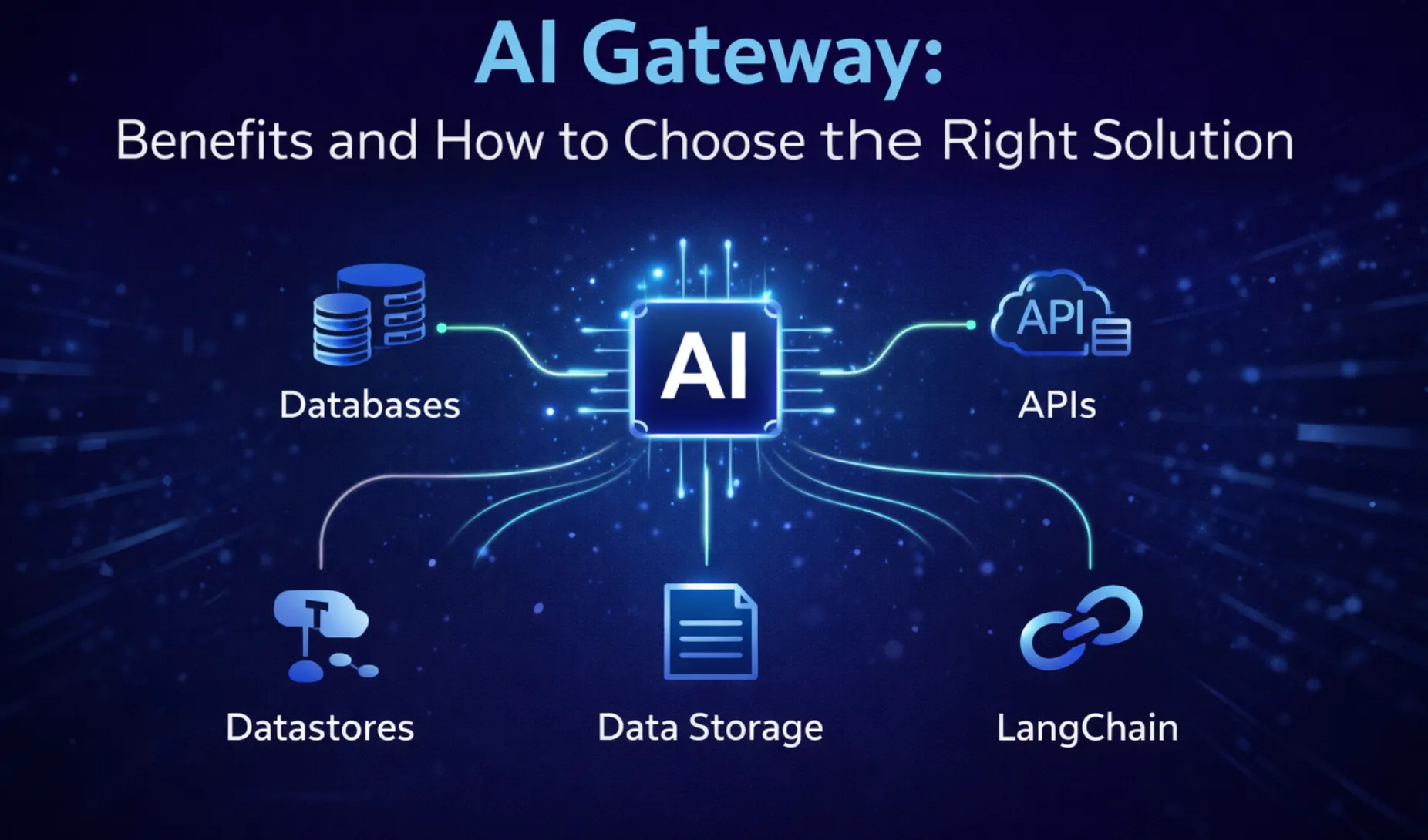
As AI moves beyond POC’s and dev environments, many teams face the same issue: Building and integrating a model is easy, but running it reliably at scale is hard. AI Gateways solve this problem by acting as a centralized control plane for all LLM usage, standardizing how teams query, monitor, and scale models in production.
They unify multiple providers (like OpenAI, Anthropic, Mistral, and open-source LLMs) under a single API, enforce authentication policies, track usage, and enable cost attribution. TrueFoundry’s AI Gateway is one such enterprise-grade solution designed for modern GenAI applications, offering observability, rate limiting, prompt versioning, and more, helping businesses deploy AI reliably, securely, and at scale.
In this guide, we'll cover the core architecture of an AI gateway, essential features for governance, metrics for evaluating providers, and the key differences between AI and traditional API gateways.
An AI Gateway is an abstraction layer that unifies access to multiple Large Language Models (LLMs) through a single API interface. It provides a consistent, secure, and optimized way to interact with models across providers such as OpenAI, Anthropic, Cohere, Together.ai, or open-source models like Mistral and LLaMA 2 deployed on your own infrastructure.
At its core, an AI Gateway handles the heavy lifting of integrating, routing, authenticating, and monitoring LLM usage across different endpoints. Instead of dealing with multiple SDKs, authentication tokens, rate limits, and pricing models, teams can route all model requests through the Gateway. This streamlines development and enables governance at scale.
TrueFoundry’s AI Gateway is built for enterprise-grade performance and observability. It allows teams to:
In addition, the Gateway supports streaming and non-streaming modes, tool calling (function calling), prompt templating, and tagging for team-level cost breakdowns. With built-in observability, TrueFoundry enables tracking of not just latency and token usage but also user-specific access, traffic trends, and per-endpoint performance.
As LLM usage grows across teams, use cases, and environments, an AI Gateway becomes the foundation for operationalizing generative AI in production. It provides control, visibility, and optimization across the entire lifecycle of LLM interactions.
The increase in AI gateways is mainly in response to growing complexity. Most teams no longer use a single model from one provider. They are testing multiple models, balancing performance with cost, and supporting different use cases across teams. Without an abstraction layer, this situation can quickly become fragile and hard to manage.
Cost pressure has also had a significant impact. As AI usage grows, token consumption and latency shift from being technical issues to business concerns. AI gateways enable teams to route traffic smartly, enforce budgets, and gain insights into actual spending.
Governance is another important factor. As systems handle more sensitive data and regulated workflows, organizations require stronger controls over access, auditing, and compliance. A gateway serves as a natural point for enforcing those policies.
Also Read: OpenRouter vs AI gateway
An AI Gateway brings a structured and scalable approach to managing LLM usage across teams and environments. Below are the key features that make it essential for modern GenAI workflows:
Unified Access: AI Gateways offer a single API interface to access multiple LLMs across vendors like OpenAI, Anthropic, or in-house models. This eliminates the need to manage individual APIs, SDKs, or keys for each provider.
Authentication and Authorization: AI Gateways enforce secure access through centralized key management. Developers receive scoped API keys while root keys remain protected, integrated with secret managers like AWS SSM, Google Secret Manager, or Azure Vault.
Role-Based Access Control (RBAC): Ensures that only authorized users can access specific models or actions, aligning with enterprise security standards.
Performance Monitoring: Track latency, error rates, and token throughput for each model endpoint. This helps detect issues early, optimize routing, and maintain SLAs.
Usage Analytics: Detailed logs and dashboards show who used which model, when, and how, offering transparency across projects and enabling cost attribution per user, team, or feature.
Cost Management: Gateways track token-level usage and associate costs with users, teams, or endpoints. This provides clear visibility into spend patterns and helps prevent cost overruns.
API Integrations: Support for external APIs and tools such as evaluation pipelines, prompt guardrails, or vector databases enables seamless integration with broader AI/ML ecosystems.
Custom Model Support: Users can bring their own fine-tuned or proprietary models into the Gateway, routing traffic alongside commercial models.
Caching: Store and reuse identical or similar LLM responses to save tokens and reduce latency.
Routing and Fallbacks: Intelligent request routing based on latency, cost, or reliability. Includes fallback mechanisms and auto-retries to improve resiliency.
Rate Limiting and Load Balancing: Supports user-level quotas, rate limiting, and load balancing across model providers for optimal throughput and stability.
Evaluating the best AI gateway requires a comprehensive assessment of its capabilities across access control, model integration, observability, and cost governance.
Key Metrics for Evaluating Gateway
| Criteria | What should you evaluate ? | Priority | TrueFoundry |
|---|---|---|---|
| Latency | Adds <10ms p95 overhead for time-to-first-token? | Must Have | ✅ Supported |
| Data Residency | Keeps logs within your region (EU/US)? | Depends on use case | ✅ Supported |
| Latency-Based Routing | Automatically reroutes based on real-time latency/failures? | Must Have | ✅ Supported |
| Key Rotation & Revocation | Rotate or revoke keys without downtime? | Must Have | ✅ Supported |
| Key Rotation & Revocation | Rotate or revoke keys without downtime? | Must Have | ✅ Supported |
| Key Rotation & Revocation | Rotate or revoke keys without downtime? | Must Have | ✅ Supported |
| Key Rotation & Revocation | Rotate or revoke keys without downtime? | Must Have | ✅ Supported |
| Key Rotation & Revocation | Rotate or revoke keys without downtime? | Must Have | ✅ Supported |
A robust AI Gateway should simplify model usage while ensuring scalability, performance, and security for production-grade applications.
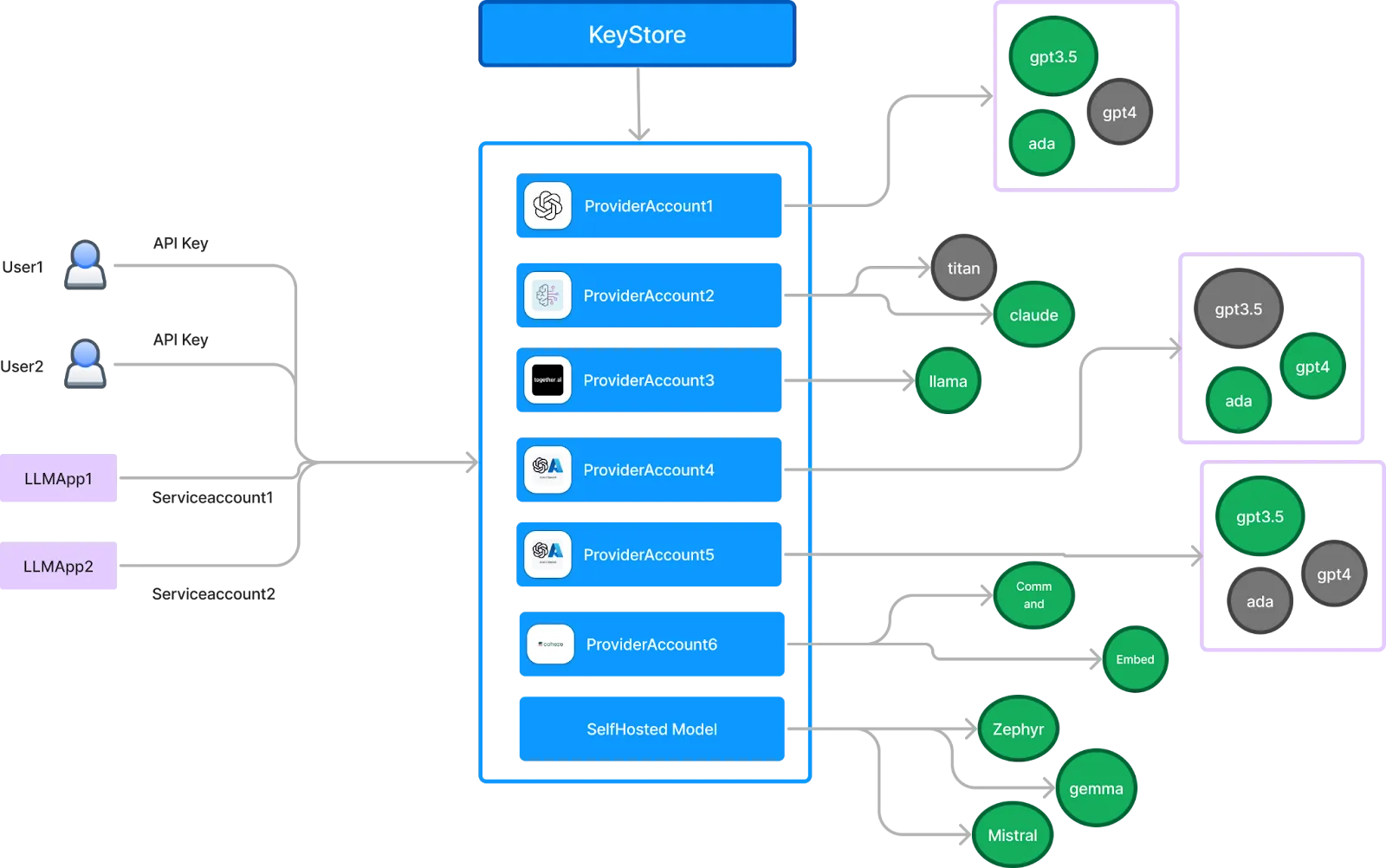
A strong AI Gateway centralizes API key management by issuing individual keys to each user or service while safeguarding root keys using secret managers like AWS SSM, Google Secret Store, or Azure Vault.
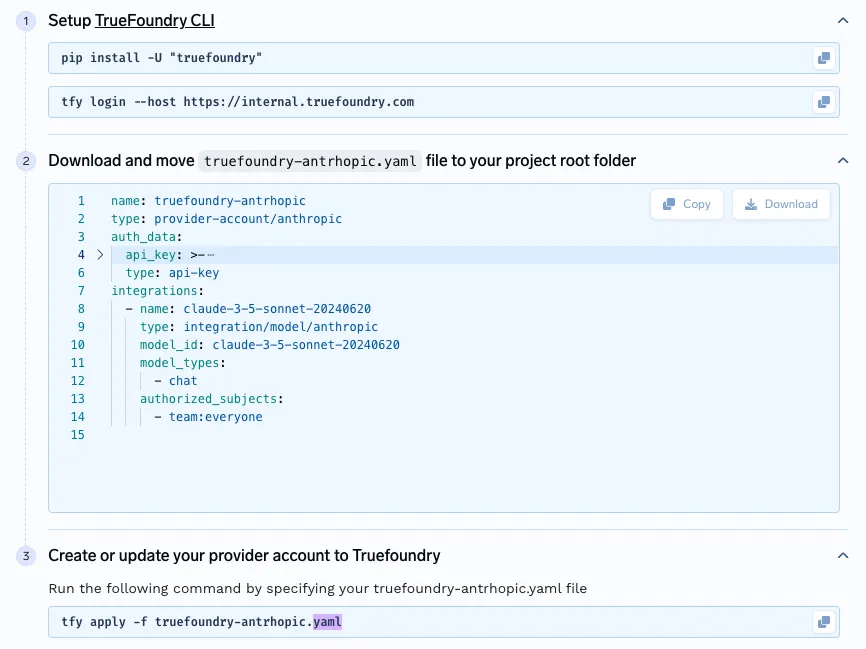
TrueFoundry’s Gateway allows administrators to manage fine-grained access to all integrated models, whether self-hosted or third-party, via a unified admin interface. Access control configurations are tracked in versioned YAML files, ensuring auditability and compliance.
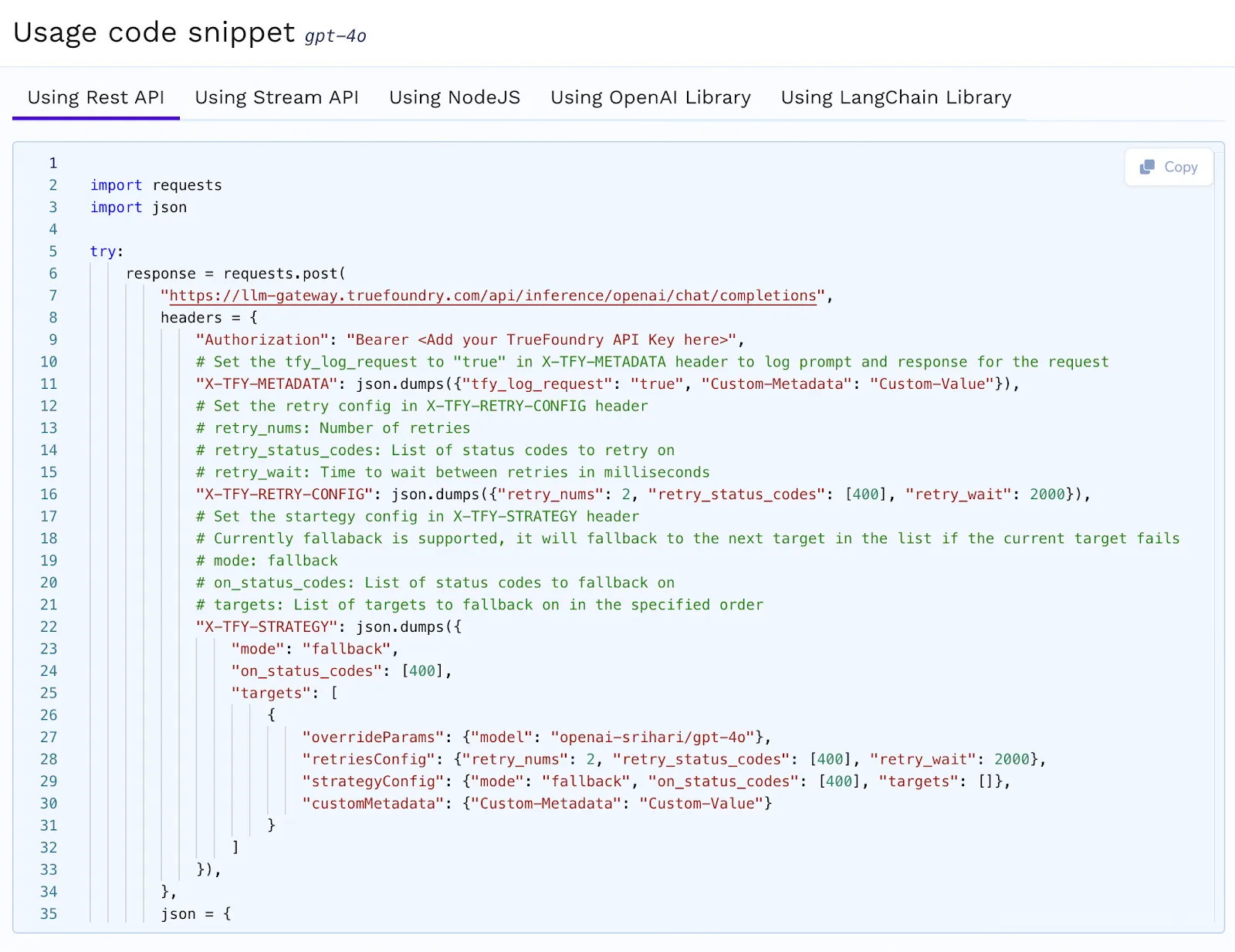
The AI Gateway should offer a standardized interface for interacting with multiple models. TrueFoundry follows the OpenAI request-response format, making it compatible with LangChain and OpenAI SDKs. Developers can switch between models without modifying their code. TrueFoundry also provides auto-generated code snippets for different providers and programming languages, simplifying integration.
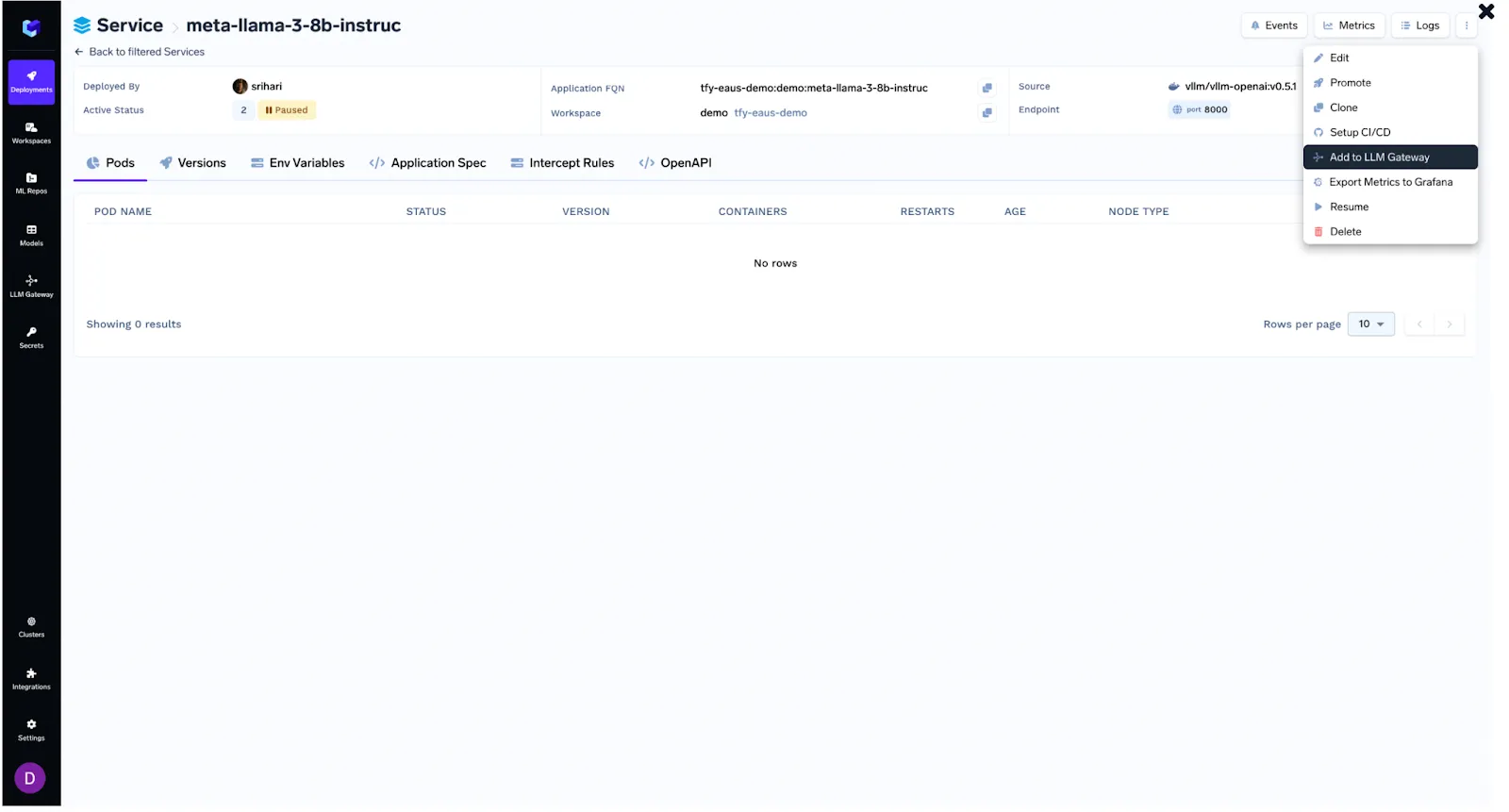
TrueFoundry supports three key routes for model access: third-party providers (like OpenAI, Cohere, AWS Bedrock, and Anthropic), self-hosted open-source models (deployed via HuggingFace or custom infrastructure), and TrueFoundry-hosted models shared across clients. This flexibility enables teams to mix and match models based on use case, budget, or latency requirements.
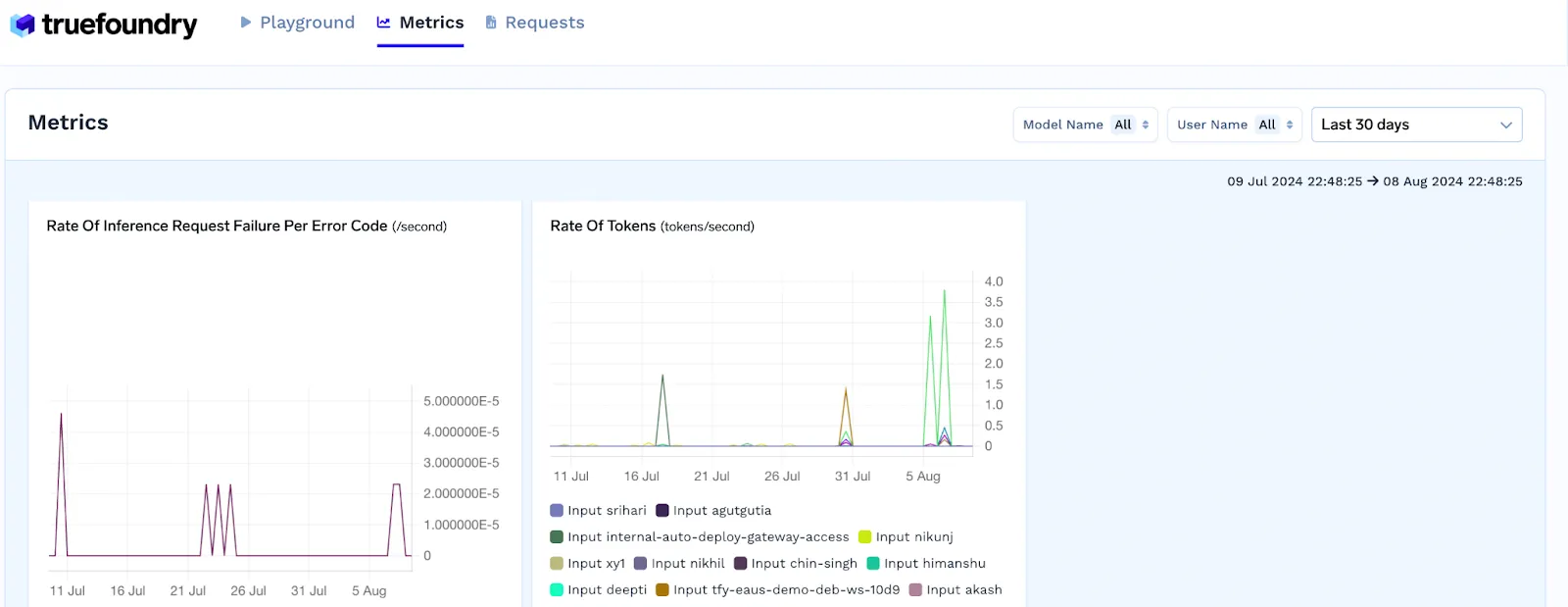
To ensure reliability, the Gateway should monitor latency, error rates, throughput, and inference failures. TrueFoundry captures key metrics like request latency, rate of tokens, and rate of inference failures, making it easy to identify performance bottlenecks through real-time dashboards.
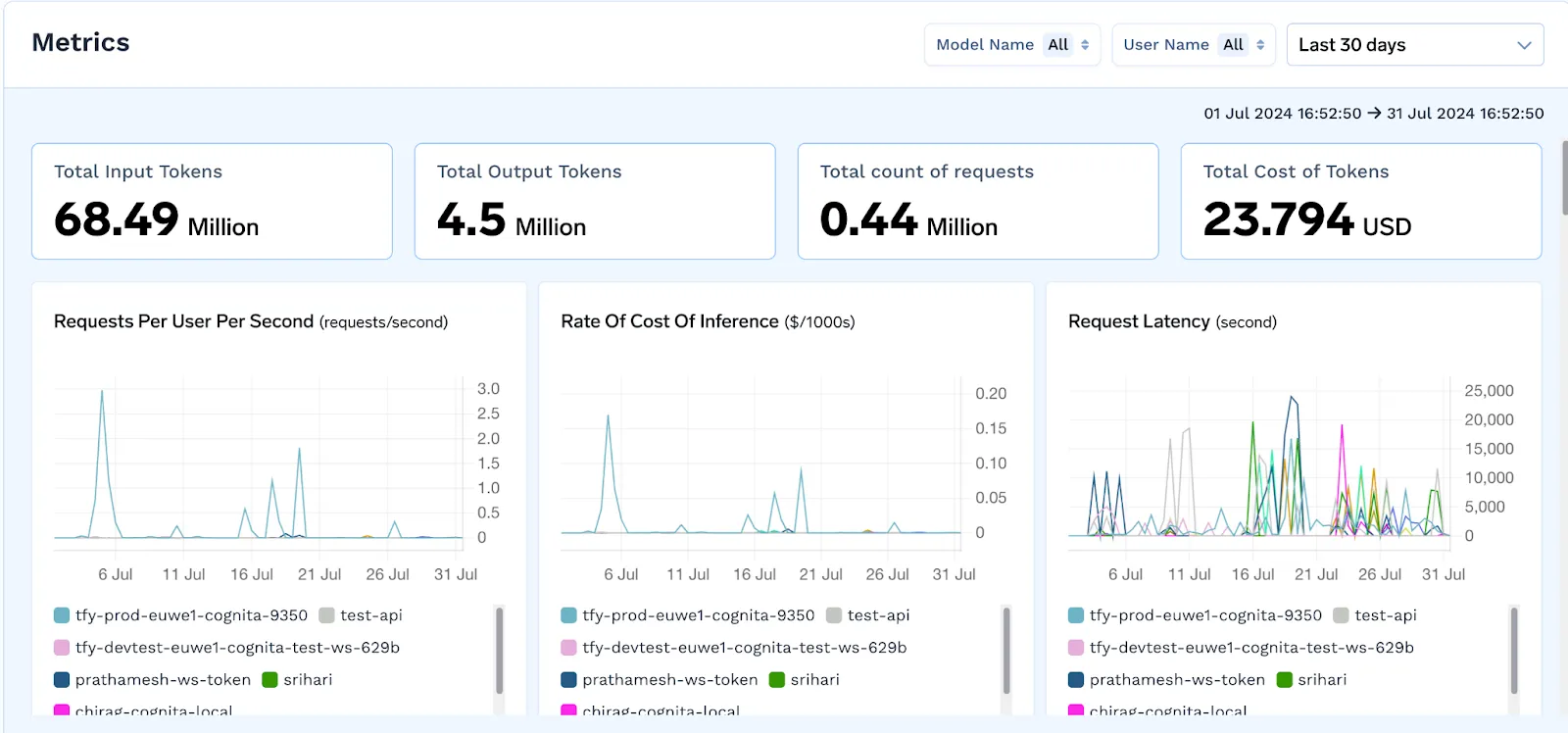
Understanding how, when, and by whom models are used is critical for governance. TrueFoundry logs detailed request and response activity, token consumption, and cost per model. These insights help teams manage workloads and optimize usage patterns.
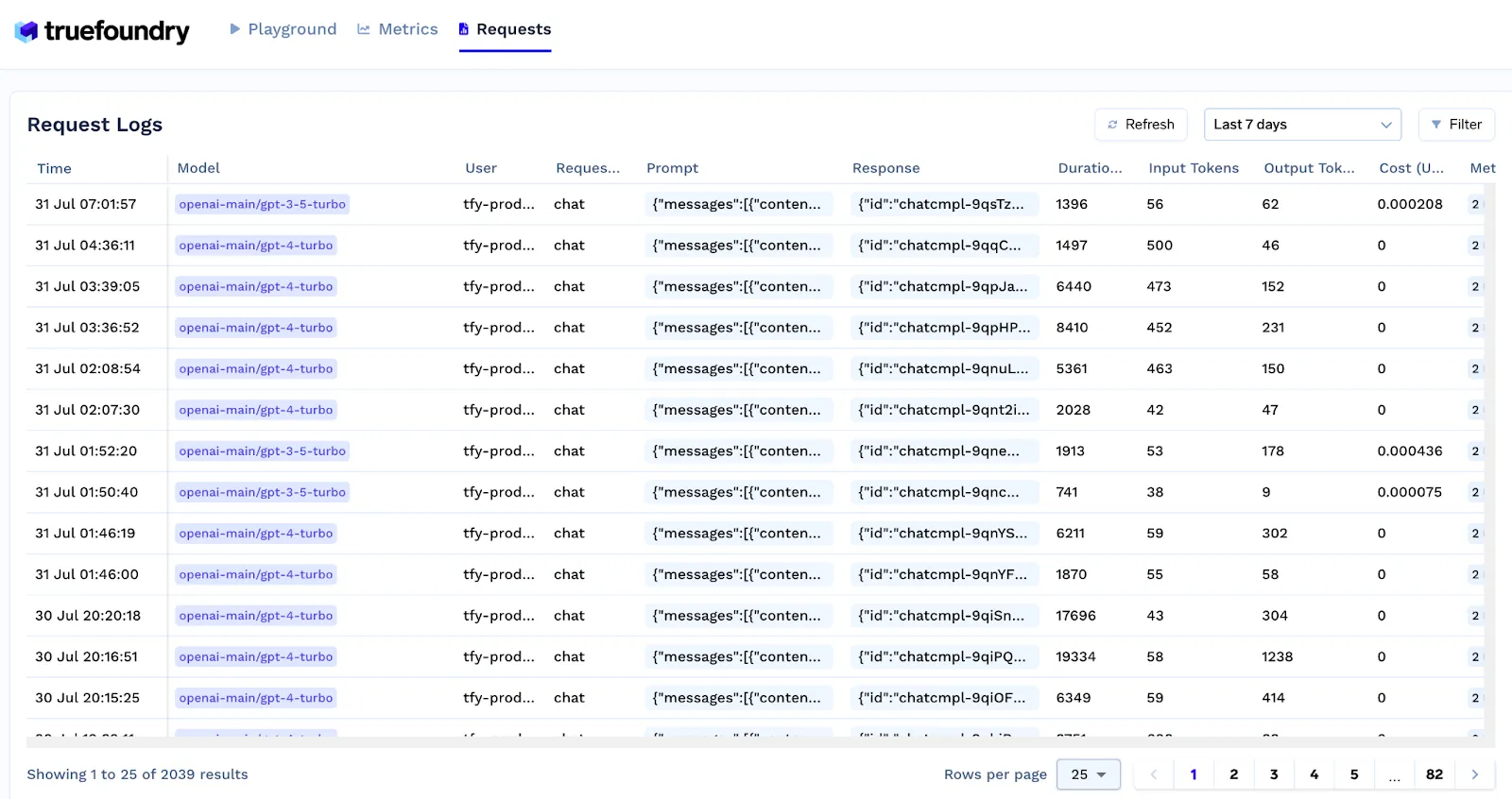
The Gateway should log costs from all model interactions, whether hosted internally or through commercial APIs. TrueFoundry provides full visibility into model usage costs across users, teams, and projects. Integrated dashboards allow organizations to track spend, configure alerts, and apply rate limits or budget caps to control overages.
Advanced features in an AI Gateway determine how effectively it can operate in real-world, production-scale environments. TrueFoundry’s AI Gateway brings a rich set of capabilities that optimize performance, improve reliability, and seamlessly integrate with broader systems, making it enterprise-ready from day one.
Caching helps reduce latency and save costs by avoiding redundant model calls. TrueFoundry supports both exact match caching (for identical prompts) and semantic caching (for similar meaning queries), which enhances speed without compromising on relevance. You can configure cache expiration policies and manually invalidate outdated entries when needed. This ensures that the gateway serves fast, accurate, and up-to-date responses.
For production-critical applications, the gateway automatically routes traffic to alternative models if the primary one fails, ensuring uninterrupted service. Automatic retries help recover from transient errors without user intervention. Built-in rate limiting helps enforce quotas and prevent overuse, while load balancing distributes traffic across multiple models or providers to maintain optimal throughput and minimize latency.
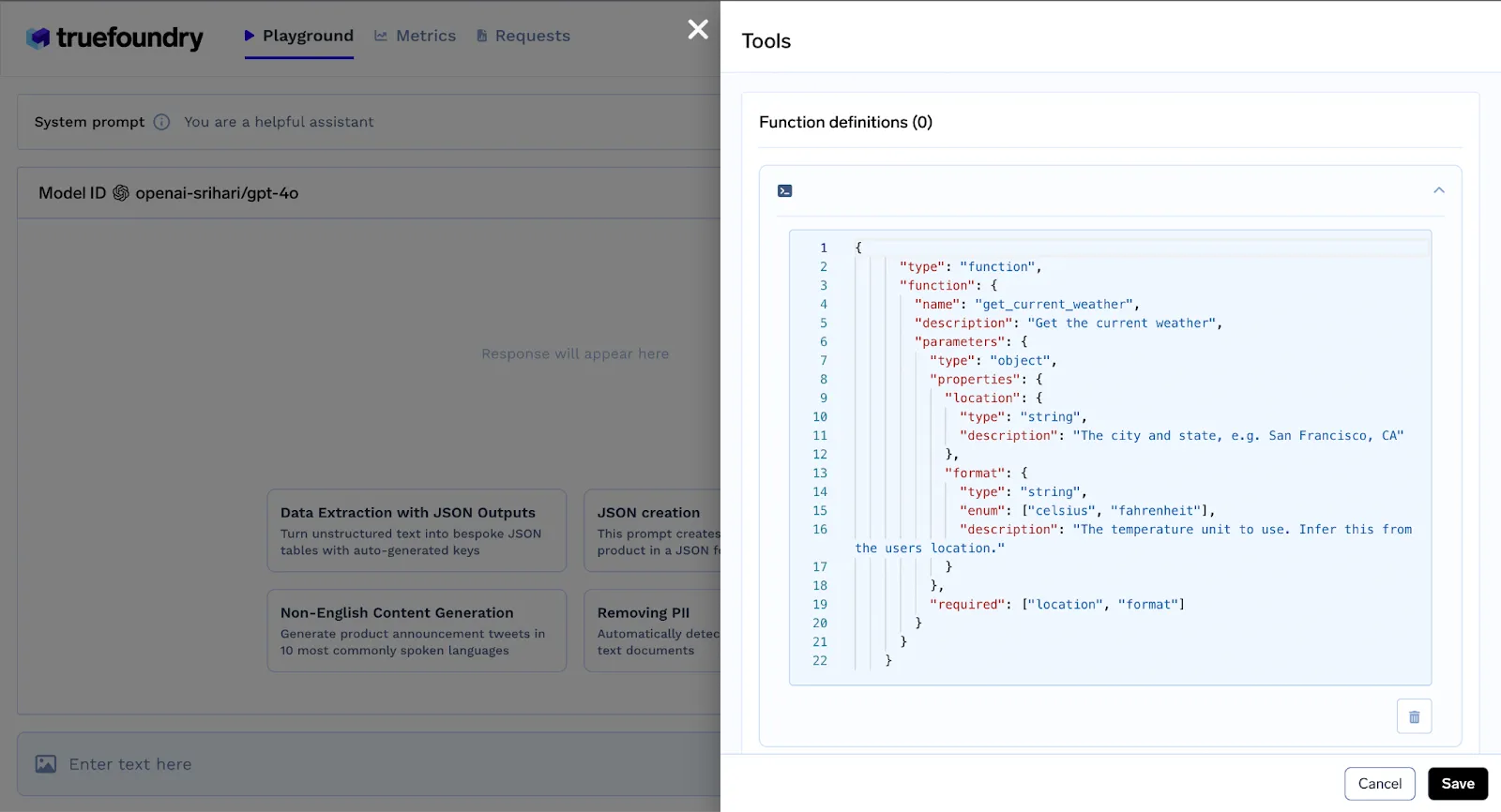
TrueFoundry’s Gateway supports tool calling by simulating interactions with external APIs. While the actual function is not executed by the gateway, the model can return structured outputs representing the intended tool call. This is ideal for building workflows where LLMs need to decide when and how to invoke tools, enabling developers to design and test these behaviors safely.
Modern applications often involve more than just text. The Gateway supports multimodal inputs such as text and images within the same request, which unlocks use cases like document Q&A, visual search, or customer support enriched with screenshots or product photos. This makes the AI Gateway suitable for both traditional NLP and next-gen AI applications that require context from multiple data formats.
TrueFoundry enables deep integration with your existing stack. You can plug in observability tools like Prometheus and Grafana for real-time monitoring, implement safety layers using Guardrails AI or NeMo Guardrails, and evaluate model quality continuously using Arize or MLflow. This connected ecosystem ensures that your AI system is not just performant, but also safe, transparent, and continuously improving.
An AI Gateway delivers significant operational, financial, and engineering advantages for organizations integrating large language models (LLMs) into their products and workflows. It acts as a control plane for AI consumption, providing a consistent interface, enforcing security, and optimizing performance at scale.
Centralized Access and Governance
Quando várias equipes ou aplicações precisam interagir com diferentes provedores de LLM, gerenciar chaves individuais, tokens e direitos de acesso torna-se complexo. Um AI Gateway centraliza o controle de acesso, permitindo permissões baseadas em função, registro de auditoria e gerenciamento seguro de chaves.
Exemplo: Uma empresa global que implementa recursos de IA em suas equipes de marketing, produto e suporte usa um AI Gateway para atribuir chaves de API com escopo definido e restringir o acesso de cada equipe a modelos específicos, reduzindo o risco de uso indevido acidental ou vazamento de dados.
Transparência de Custos e Controle Orçamentário
LLMs podem se tornar um custo operacional significativo, especialmente com o aumento do uso entre as equipes. AI Gateways fornecem rastreamento de custos detalhado por usuário, equipe ou projeto. Essa visibilidade ajuda as organizações a gerenciar orçamentos, identificar ineficiências e introduzir modelos de rateio de custos (chargeback) quando apropriado.
Exemplo: Uma empresa SaaS que oferece recursos de IA aos seus clientes monitora o uso através do gateway e utiliza os dados para implementar preços por níveis com base no consumo real de tokens.
Troca Contínua de Modelos e Abstração
A camada unificada de API permite que as organizações troquem LLMs ou provedores sem modificar o código da aplicação. Isso facilita o teste de novos modelos, a negociação de melhores preços ou a transição de implantações comerciais para de código aberto.
Exemplo: Uma startup que inicialmente usava um LLM comercial faz a transição para um modelo de código aberto ajustado para privacidade de dados e economia de custos, sem alterar sua base de código, graças à abstração do gateway.
Confiabilidade e Resiliência Aprimoradas
Gateways oferecem mecanismos de fallback integrados, novas tentativas automáticas, cache e balanceamento de carga para garantir serviço ininterrupto e desempenho consistente, mesmo sob carga ou durante interrupções do provedor.
Exemplo: Um sistema de chatbot de alto tráfego lida com picos repentinos de tráfego roteando dinamicamente as solicitações entre vários provedores e recorrendo a respostas em cache quando necessário.
Conformidade e Observabilidade
Para indústrias regulamentadas, a capacidade de rastrear e auditar o uso de modelos é crítica. AI Gateways se integram com ferramentas de monitoramento, registro (logging) e segurança para atender aos padrões de conformidade e às políticas de governança interna.
Exemplo: Uma empresa de saúde registra cada solicitação e resposta através do gateway, permitindo rastreabilidade completa para fins de auditoria enquanto mantém os limites de acesso aos dados.
Se termos como API gateway e AI gateway parecem fáceis de confundir, você não está sozinho. Muitas equipes encontram gateways pela primeira vez ao escalar suas APIs. Com esse contexto em mente, veja como os gateways de IA diferem e por que eles existem.
Os gateways de IA são projetados especificamente para as complexidades dos Grandes Modelos de Linguagem (LLMs). Eles vão além do simples gerenciamento de tráfego para lidar com a "inteligência" dos dados.
Aqui está uma comparação clara entre Gateways de API tradicionais e Gateways de IA especializados.
Em resumo, um gateway tradicional gerencia como os dados se movem. Um gateway de IA gerencia o custo dos dados e como eles se comportam. Para uma pilha de IA moderna, o gateway é sua principal defesa contra custos crescentes e riscos de segurança.
À medida que as organizações escalam o uso de grandes modelos de linguagem, a necessidade de uma interface segura, confiável e eficiente torna-se crítica. Um Gateway de IA serve como essa camada fundamental, abstraindo a complexidade de gerenciar múltiplos provedores, aplicando controles de acesso, rastreando custos e garantindo desempenho em escala. Ele capacita as equipes a experimentar, implantar e monitorar aplicativos baseados em LLM com confiança e controle.
Seja você construindo copilotos internos, interfaces de chat para clientes ou fluxos de trabalho de IA multimodal, um Gateway de IA ajuda a padronizar a infraestrutura, mantendo-se flexível o suficiente para suportar ecossistemas de modelos em evolução. Recursos como cache, roteamento, atribuição de custos e chamada de ferramentas ampliam ainda mais seu valor para implantações de nível empresarial.
Em um cenário de IA em rápida mudança, adotar um Gateway de IA não é apenas uma conveniência; é um investimento estratégico em maturidade operacional, observabilidade e escalabilidade a longo prazo.
Pronto para ver essas capacidades em ação? Agende uma demonstração com a TrueFoundry hoje para saber como podemos centralizar e proteger sua infraestrutura de IA empresarial.
Um gateway de IA atua como um plano de controle centralizado que unifica múltiplos provedores de LLM sob uma única API. Ele gerencia o trabalho pesado de roteamento de requisições, autenticação e monitoramento de desempenho em diferentes endpoints. Ao lidar com novas tentativas automatizadas e definir limites de taxa específicos da equipe, garante que sua infraestrutura de IA permaneça estável e econômica.
O melhor gateway de IA deve oferecer confiabilidade de nível de produção e flexibilidade de fornecedor. A TrueFoundry é uma forte candidata porque oferece recursos empresariais exclusivos, como cache semântico para menor latência e fallbacks de modelo automatizados para evitar interrupções. Isso permite que as equipes alternem facilmente entre modelos comerciais e auto-hospedados sem reescrever o código do aplicativo.
Enquanto um firewall de IA se concentra especificamente em ameaças de segurança como injeção de prompt, um gateway de IA gerencia a "inteligência" mais ampla do fluxo de dados. O gateway lida com tarefas operacionais como balanceamento de carga baseado em token, cache semântico e failover de modelo. Pense no gateway como a camada de gerenciamento completa e no firewall como um guarda de segurança específico.
A TrueFoundry capacita as empresas a escalar a IA, fornecendo visibilidade granular sobre o uso de tokens e custos entre os departamentos. Simplifica a governança através do controle de acesso baseado em função e do gerenciamento de prompts versionados, garantindo conformidade e reprodutibilidade. Essa abordagem centralizada permite que as organizações passem de protótipos experimentais para ambientes de produção seguros e de alto desempenho de forma eficiente.
TrueFoundry AI Gateway delivers ~3–4 ms latency, handles 350+ RPS on 1 vCPU, scales horizontally with ease, and is production-ready, while LiteLLM suffers from high latency, struggles beyond moderate RPS, lacks built-in scaling, and is best for light or prototype workloads.





As últimas notícias, artigos e recursos enviados para sua caixa de entrada

.png)
.png)
.png)

.png)
.png)
.png)
.png)
.png)