



October 1, 2026
|
5 min read

Published: August 3, 2026

Blazingly fast way to build, track and deploy your models!
Not every Cloudflare AI alternative solves the same problem. Some platforms focus on faster experimentation, others prioritize GPU access, and only a handful are built for running production-grade AI systems at scale.
To create a practical comparison, we evaluated each platform using the criteria that matter most when building and operating modern AI applications.
Can you run the platform in your own AWS, Google Cloud, or Azure environment, or are you tied to a vendor-managed infrastructure?
Infrastructure ownership is becoming increasingly important for organizations that need stronger data privacy, compliance controls, and long-term cost efficiency.
Can you deploy any model you want, including fine-tuned open-source models, custom embeddings, or proprietary models? Or are you restricted to a predefined model catalog?
The ability to choose and manage your own models is often one of the biggest reasons teams look beyond Cloudflare.
AI costs can rise quickly as usage grows. We looked at whether each platform supports cost-saving options such as:
Platforms with transparent pricing and predictable costs scored higher, especially for teams running large-scale workloads.
Today's AI applications require far more than simple inference. We evaluated how well each platform supports:
These capabilities are increasingly essential for building sophisticated AI products.
A powerful platform is only useful if developers can work with it efficiently.
We assessed onboarding, APIs, SDKs, deployment workflows, and day-to-day operational complexity to understand how quickly teams can move from prototype to production.
Running AI in production requires much more than model deployment. We evaluated each platform's observability, monitoring, governance, security controls, and operational tooling to determine how well it supports real-world AI systems.
Using these criteria, we ranked the top Cloudflare AI alternatives for 2026, highlighting the platforms best suited for teams building scalable, production-ready AI applications.
Here is a quick overview of the top Cloudflare AI alternatives:
As AI applications evolve beyond simple inference into agentic workflows, RAG architecture, and multi-model deployments, teams increasingly need platforms that offer more flexibility, control, and scalability.
The alternatives below were selected based on their ability to provide:
We start with the strongest overall Cloudflare AI alternative for teams building and scaling AI applications in 2026.
Alt text: TrueFoundry as Cloudflare AI alternative
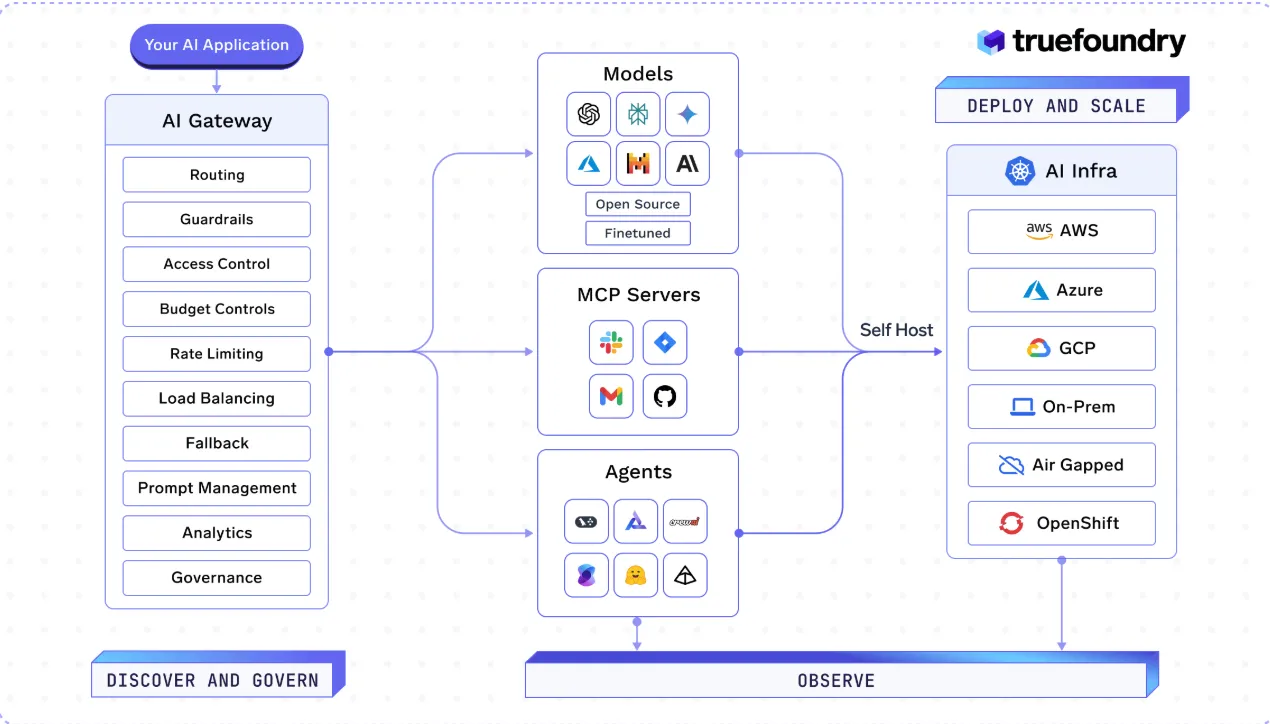
TrueFoundry is a full-stack AI platform designed for teams that want to run production-grade AI workloads in their own cloud or VPC, without giving up developer velocity. Unlike Cloudflare Workers AI, which abstracts away infrastructure entirely, TrueFoundry gives teams control where it matters - while still providing a high-level, PaaS-like experience.
TrueFoundry supports the entire AI lifecycle, from training and fine-tuning to deployment, inference, and observability. At its core, it enables teams to deploy any model - open source or proprietary on Kubernetes across AWS, GCP, or Azure, with built-in scaling, cost controls, and governance. This makes it particularly well-suited for enterprises building long-lived AI systems rather than lightweight edge demos.
Cloudflare excels at edge-based inference, but TrueFoundry is built for ownership, scale, and flexibility:
TrueFoundry follows a transparent, usage-based pricing model, aligned with how teams actually consume infrastructure.
Since workloads run in your own cloud, infrastructure costs remain visible and optimizable unlike opaque serverless pricing.
TrueFoundry is rated highly on platforms like G2 and Capterra, with consistent praise for:
Many customers highlight how TrueFoundry helped them move from prototypes to scalable, compliant AI platforms without rebuilding their stack.
Alt text: AWS Bedrock
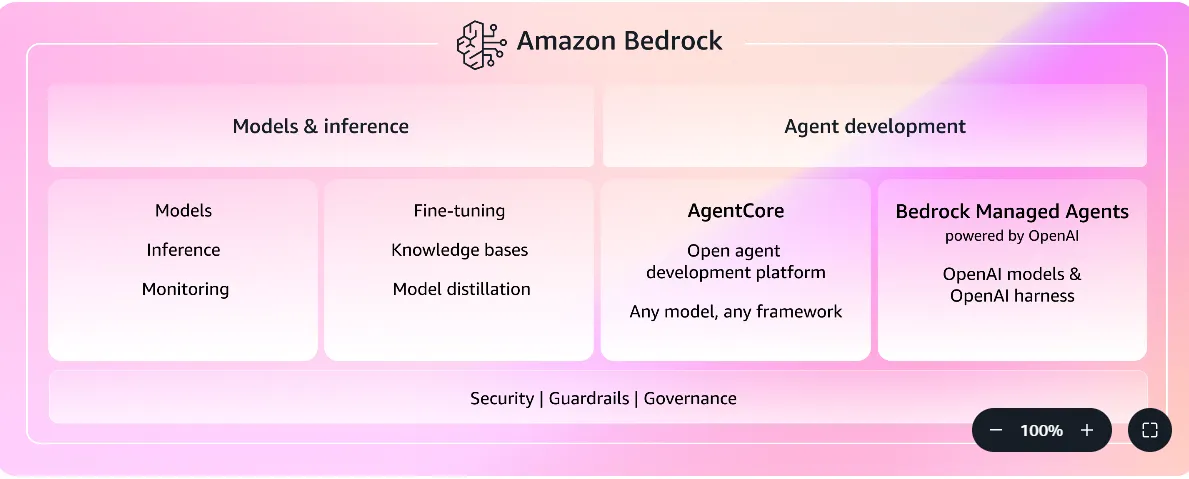
Amazon Web Services Bedrock is AWS’s managed service for accessing foundation models such as Anthropic Claude, Amazon Titan, and selected third-party models. It is designed for teams already deeply invested in the AWS ecosystem who want a native way to consume LLMs without managing infrastructure directly.
While Bedrock removes operational overhead, it still follows a managed, API-first model that limits flexibility as workloads grow more complex.
TrueFoundry allows teams to deploy any model on their own infrastructure, including fine-tuned open-source models, while offering better cost predictability through spot instances and autoscaling. Unlike Bedrock, TrueFoundry is cloud-agnostic and supports the entire AI lifecycle beyond managed inference APIs.
Alt text: RunPod
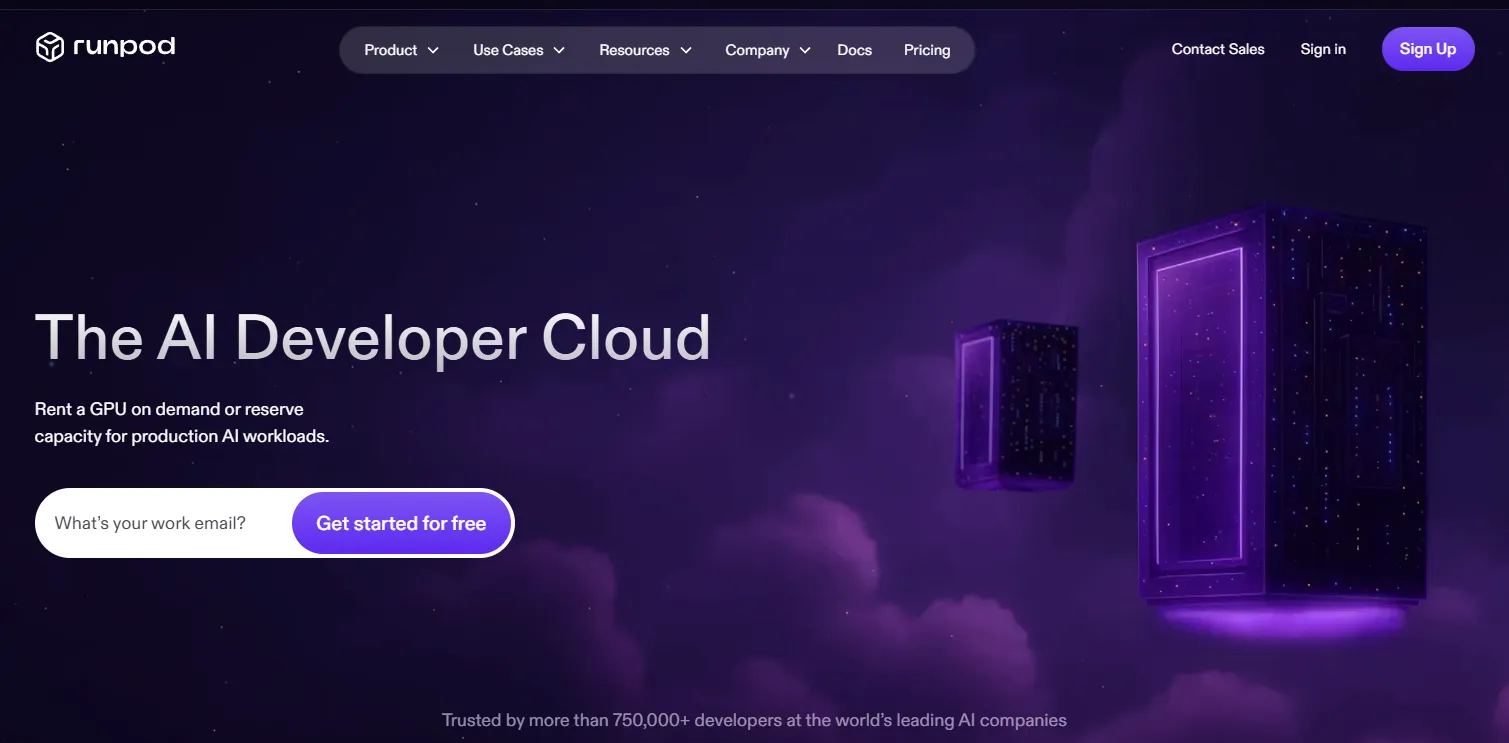
RunPod is a GPU cloud platform popular with developers who want low-cost access to GPUs for inference or experimentation. It is often used as a Cloudflare alternative when teams outgrow serverless pricing and want direct control over compute.
Runpod focuses on raw GPU access, leaving orchestration, scaling, and governance largely to the user.
TrueFoundry provides production-ready orchestration, observability, and governance on top of Kubernetes, while still enabling cost optimization through spot instances. Teams get the benefits of raw compute efficiency without having to build and maintain their own platform layer.
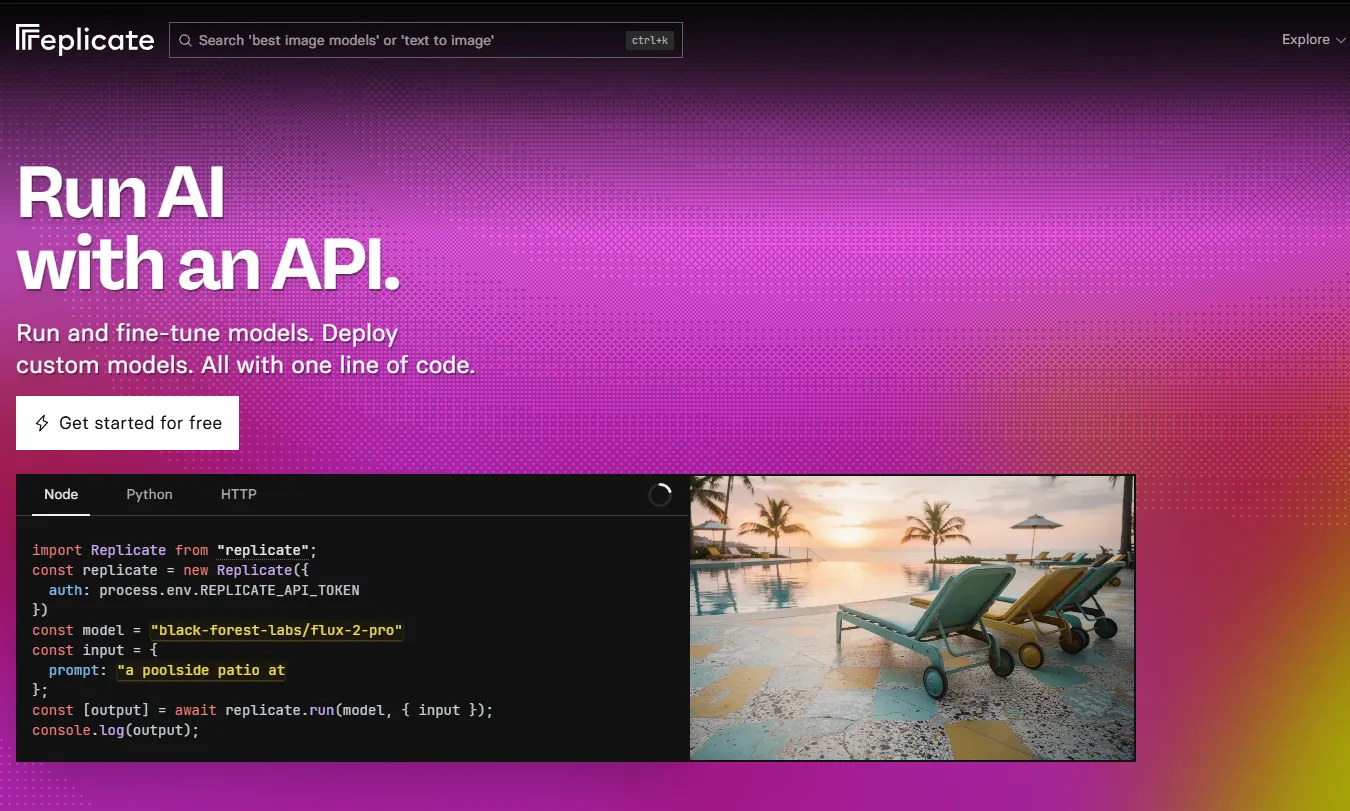
Alt text: Replicate
Replicate is a popular API-based platform that makes it easy to run open-source models without managing infrastructure. Developers can deploy models with minimal setup and pay per second of execution, making Replicate attractive for prototyping and small-scale production.
However, Replicate’s convenience comes with trade-offs as workloads scale and requirements around privacy, cost predictability, and customization increase.
TrueFoundry enables teams to run the same open-source models inside their own cloud, with full observability, governance, and cost optimization. Unlike Replicate’s black-box execution, TrueFoundry gives platform teams visibility and control over performance, data, and spend.
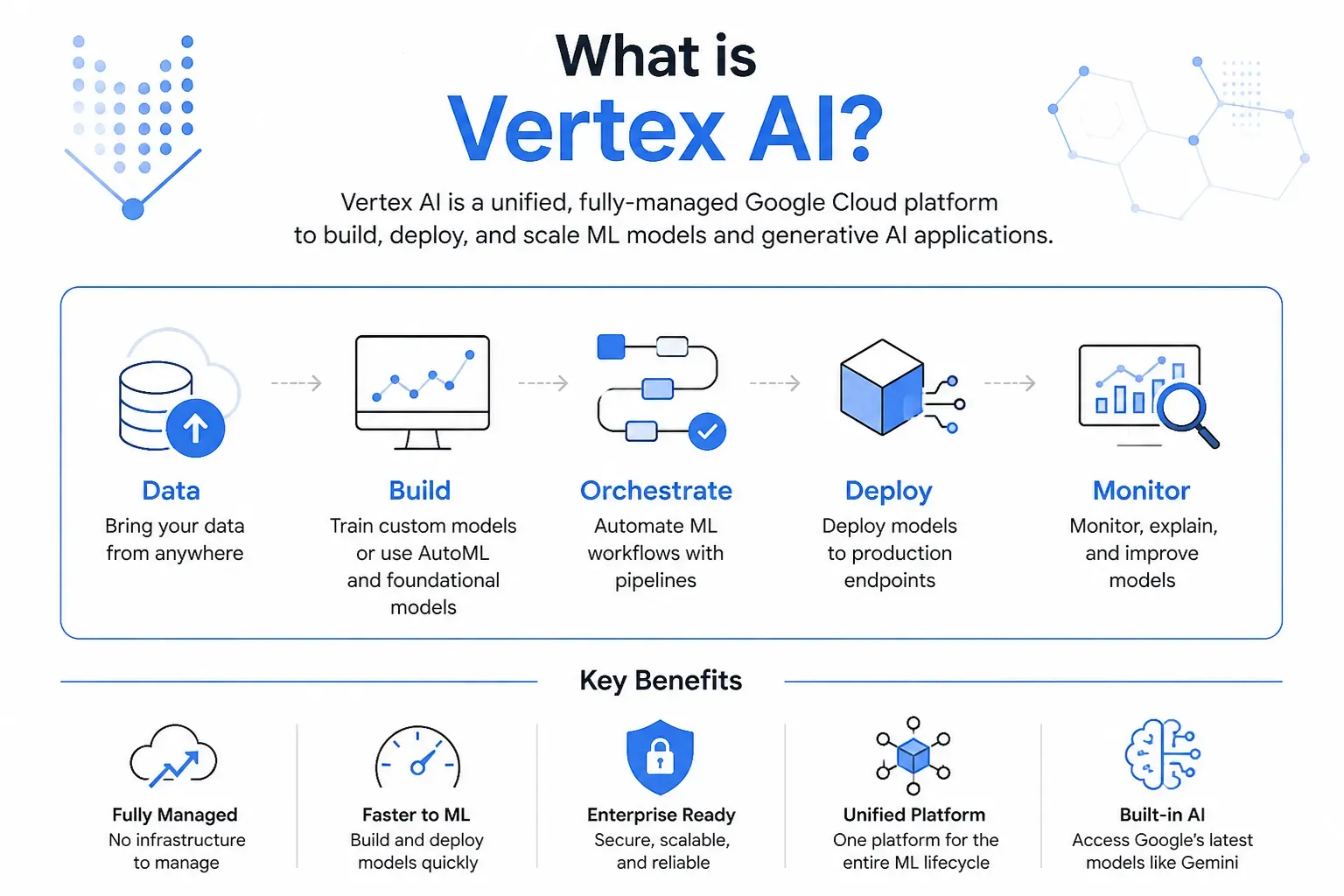
Alt text: Google Vertext AI
Google Vertex AI is Google Cloud’s end-to-end platform for training, deploying, and serving ML and LLM models. It supports Google’s Gemini models alongside custom training and managed pipelines, making it a strong option for teams standardized on GCP.
While powerful, Vertex AI remains tightly coupled to Google Cloud and follows a managed-service approach that limits flexibility for hybrid or multi-cloud strategies.
TrueFoundry offers a cloud-agnostic, lighter-weight platform that focuses on deployment, inference, and governance without locking teams into a single hyperscaler. It provides more flexibility to optimize costs and run AI consistently across AWS, GCP, or Azure.
TrueFoundry ensures cost efficiency for Cloudflare AI alternatives
Alt text: Modal
Modal is a developer-first serverless platform that makes it easy to run Python-based AI workloads without managing infrastructure. It is popular for fast experimentation, internal tools, and lightweight inference pipelines.
Modal prioritizes developer speed, but its abstraction layer can become limiting as AI systems grow in complexity and scale.
TrueFoundry provides full infrastructure ownership and lifecycle control while maintaining a strong developer experience. It is better suited for long-lived, production AI systems that require governance, predictable costs, and support for complex pipelines beyond simple serverless execution.
Alt text: Hugging Face Inference Endpoints
Hugging Face Inference Endpoints allow teams to deploy Hugging Face models as managed APIs with minimal setup. It is widely used for serving open-source models quickly and integrating them into applications.
While convenient, the managed nature of the service limits flexibility for teams with strict cost, networking, or compliance requirements.
TrueFoundry enables teams to deploy the same Hugging Face models inside their own cloud, with deeper observability, cost controls, and support for advanced workflows like agents and RAG pipelines, without being locked into a managed SaaS model.
Alt text: Anyscale (Ray)
Anyscale is the commercial platform behind Ray, an open-source framework for distributed computing and AI workloads. It is often used by teams building large-scale, distributed inference, training, and agent systems that need fine-grained control over execution.
Anyscale is powerful, but it assumes a high level of platform and distributed systems expertise, which can slow down teams that want faster time-to-production.
TrueFoundry delivers production-ready abstractions on top of Kubernetes without forcing teams to build everything using Ray primitives. It offers faster onboarding, built-in observability, and cost controls while still supporting complex workflows.
Alt text: Lambda Labs
Lambda Labs provides GPU cloud infrastructure optimized for machine learning workloads. It is commonly used as a cost-effective alternative to hyperscalers for training and inference. Lambda Labs focuses on raw infrastructure, leaving orchestration, scaling, and governance entirely up to the user.
TrueFoundry provides a complete AI platform layer, orchestration, observability, scaling, and governance, on top of cloud infrastructure. Teams get the cost benefits of optimized compute without needing to assemble and maintain their own platform stack.
Alt text: Northflank
Northflank is one of the strongest Cloudflare AI alternatives for teams building and scaling production AI applications. Unlike Cloudflare Sandboxes, which primarily focus on edge-based code execution, Northflank provides a complete platform with GPU workloads, databases, CI/CD, observability, and sandbox environments.
A major advantage is its Bring Your Own Cloud (BYOC) model, allowing you to deploy into your own AWS, Google Cloud, Azure, or other cloud environments while retaining full control over data and infrastructure.
TrueFoundry offers a more AI-focused platform with built-in model serving, AI gateway, observability, and governance capabilities. This allows teams to deploy and manage production AI workloads faster while maintaining full control over their infrastructure.
Cloudflare Workers AI is a good option for quickly building and deploying lightweight AI applications at the edge. However, as your use cases grow into production-scale systems, you may start needing more control, visibility, and flexibility than a managed platform can offer.
Cloudflare provides basic metrics, but production AI systems often require deeper insights like prompt tracing, token-level tracking, and detailed cost breakdowns. Without this, it becomes harder to optimize performance and spending at scale.
Large teams usually need stronger controls such as role-based access, audit logs, and strict environment separation. These features are important for compliance and secure multi-team collaboration.
Workers AI uses a fixed model catalog and managed environment, which can limit teams that want to run custom models, fine-tuned deployments, or use specific GPU types like H100s within their own cloud setup.
As workloads grow, teams often need finer control over budgets, rate limits, and infrastructure scaling. For latency-sensitive AI applications, even small overheads from managed layers can become noticeable.
In short, these limitations often push teams toward more flexible Cloudflare AI alternatives for production workloads.
While both platforms help teams deploy AI models, TrueFoundry and Cloudflare Workers AI are designed for fundamentally different stages of AI maturity. The table below highlights how they compare across the dimensions that matter most for 2026-scale AI workloads.
Feature
TrueFoundry
Cloudflare Workers AI
Deployment Model
Hybrid (Your Cloud / VPC)
SaaS (Cloudflare Cloud)
Data Privacy
High – Data stays in your VPC
Medium – Depends on Cloudflare-managed environment
Model Support
Any model (custom, open-source, fine-tuned)
Limited curated model catalog
Cost Control
High – Spot instances, autoscaling, FinOps visibility
Medium – Per-request / per-token pricing
Developer Experience
High – Full PaaS across cloud providers
High – Great for JS and edge developers
Agent & RAG Support
Native support for agents, MCP, and large RAG pipelines
Limited, mainly inference-focused
Observability & Governance
Built-in observability, budgets, and policy controls
Basic metrics and logs
AI Lifecycle Coverage
Full lifecycle: training, fine-tuning, deployment, inference
Primarily inference only
As AI systems become more central to products and operations, teams are rethinking where and how inference runs. Three major trends explain why platforms like TrueFoundry are gaining ground over edge-only solutions.
The ‘Hybrid’ Shift (Sovereign AI): 2026 trends clearly point toward companies wanting to own their inference stack rather than renting APIs. TrueFoundry enables this sovereignty without the operational burden of raw Kubernetes, giving you the security of ownership with the ease of a managed service.
Cost Predictability: Serverless billing is opaque and scales linearly with traffic. TrueFoundry’s FinOps features give you visibility into every dollar spent on compute, preventing the "bill shock" common with providers like Replicate or Cloudflare by utilizing your own negotiated cloud rates and Spot Instances.
Beyond Inference: Cloudflare is mostly just an inference engine. TrueFoundry handles the entire lifecycle , Training, Fine-Tuning, Evaluation, and Deployment -- in one platform, consolidating your MLOps stack.
Cloudflare Workers AI is an excellent choice for edge-based applications, quick experimentation, and developer-friendly inference close to users. For hobby projects, prototypes, and latency-sensitive edge use cases, it delivers a fast and elegant experience.
However, as teams move toward production-grade AI systems with agentic workflows, large RAG pipelines, custom models, and strict data governance many outgrow the constraints of a fully managed, serverless model. At that stage, infrastructure ownership, cost predictability, and model flexibility become decisive.
This is where TrueFoundry stands out. By enabling teams to run AI workloads in their own cloud or VPC while preserving a PaaS-like developer experience, TrueFoundry offers the flexibility required to scale AI responsibly in 2026.
If you are building serious AI products and want long-term control over cost, data, and models, sign up for free to see how TrueFoundry compares in real-world deployments.
TrueFoundry AI Gateway delivers ~3–4 ms latency, handles 350+ RPS on 1 vCPU, scales horizontally with ease, and is production-ready, while LiteLLM suffers from high latency, struggles beyond moderate RPS, lacks built-in scaling, and is best for light or prototype workloads.



.png)
.png)
.png)
.png)
.png)
.png)
.png)
.png)
.png)
.png)
.png)





