November 4, 2026
|
5 min read


Blazingly fast way to build, track and deploy your models!
Most enterprises first met artificial intelligence through a text box. Someone typed a prompt, and a model drafted an email or summarized a contract. A person then decided what to do with the result. That Generative AI pattern now supports daily work across support, legal, sales, and engineering.
The next pattern removes people from selected decisions. Agentic AI gives a model a goal, tools, memory, and permissions. It can plan smaller steps, call systems, inspect results, and continue until the task reaches an end condition. This creates more autonomy than conventional Generative AI applications.
Gartner expects at least 15% of day-to-day work decisions to be made autonomously by agentic AI by 2028. That share was effectively zero in 2024.
The Agentic AI vs. Generative AI question, therefore, goes beyond model capabilities. It affects model calls, permissions, cost, and human oversight. It also changes what platform teams must govern across enterprise systems and business processes.
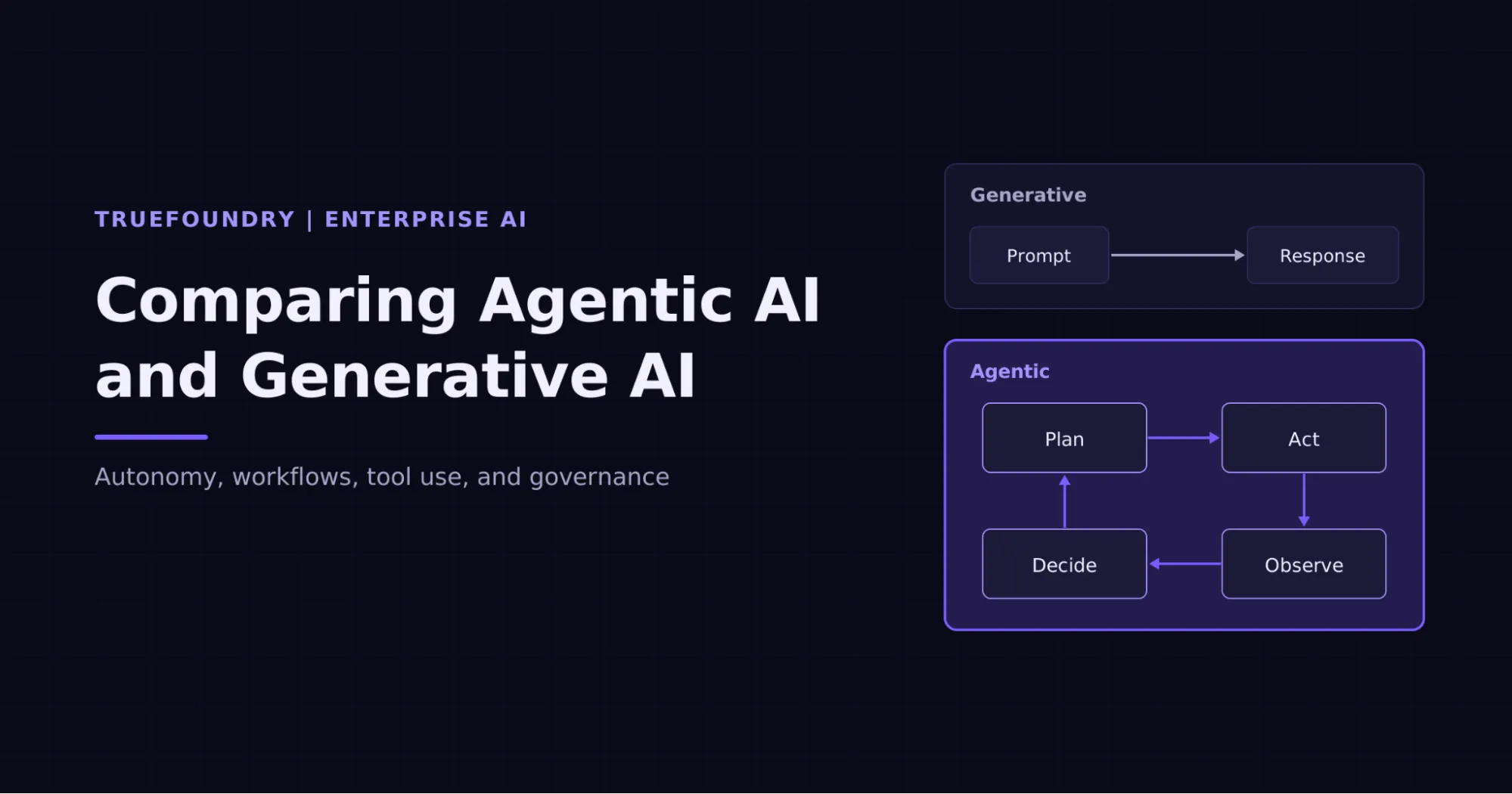
The main difference is autonomy. Generative AI receives an input and produces an output. Agentic AI takes an objective, determines the steps, calls external tools, observes results, and continues. Most key differences in Generative AI vs Agentic AI follow from that property.
Put differently, a generative system responds while an agentic system acts. A generative system still depends on human input for the next business action. An AI agent can choose what should happen next within predefined boundaries.
The final row matters most operationally. Generative AI usually keeps a person between the model and business action. Agentic systems move some control into predefined rules. That makes human intervention an exception path rather than a required step.
Generative systems are built on machine learning, deep learning, and neural networks. Modern large language models also rely heavily on natural language processing. Those technologies explain capability, while autonomy explains the operational difference
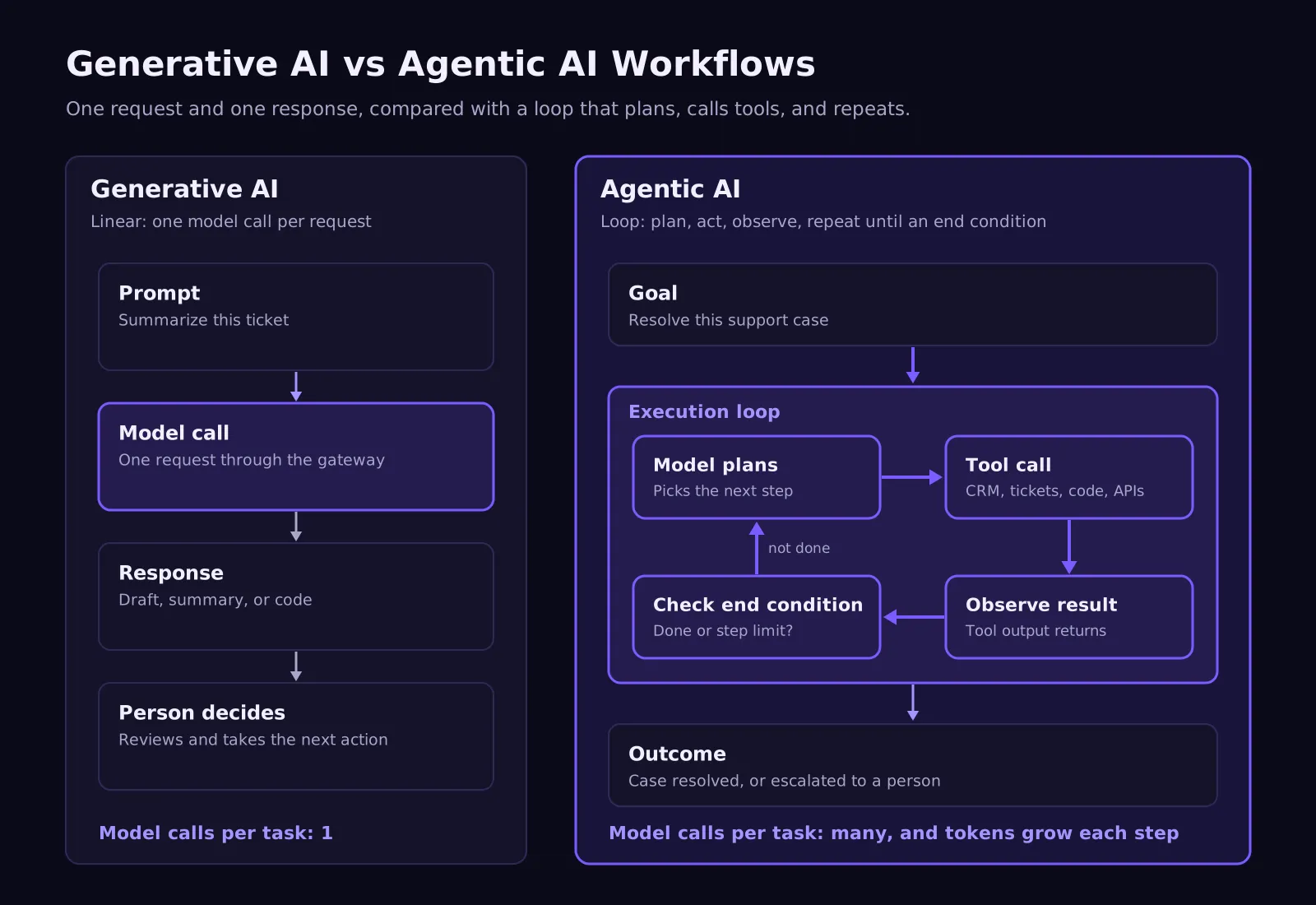
That shift in human involvement comes from a change in how the work flows. A generative AI workflow is usually linear. The application sends a prompt to a model, receives a response, and presents or processes that output.
summary = client.chat.completions.create( model="support/drafting-model", messages=[{"role": "user", "content": f"Summarize this ticket:\n{ticket_text}"}],).choices[0].message.contentOne request goes in, and one response comes back. An LLM Gateway can govern model access, routing, fallback, cost, and observability. That keeps provider logic away from individual applications.
The comparison between Agentic AI and Generative AI shifts sharply once execution becomes iterative. An agent reads a goal, selects a tool, evaluates the result, and calls the model again. The loop repeats until the objective finishes or a control stops it:
import jsondef run_agent(goal, tools, call_tool, max_steps=8): messages = [{"role": "user", "content": goal}] for _ in range(max_steps): reply = client.chat.completions.create( model="support/agent-model", messages=messages, tools=tools ).choices[0].message messages.append(reply) if not reply.tool_calls: return reply.content for call in reply.tool_calls: result = call_tool(call.function.name, json.loads(call.function.arguments)) messages.append({ "role": "tool", "tool_call_id": call.id, "content": json.dumps(result), }) raise RuntimeError("Step limit reached before the goal finished")Three parts of the loop carry the difference:
This structure introduces tool calling, memory, and repeated reasoning. It also makes the complete workflow more expensive. Anthropic found that agents used about 4 times as many tokens as in chat interactions. Multi-agent systems used about fifteen times more in its research system.
That finding matters for Agentic AI vs Generative AI planning. A single generative request may use one model call. One agent objective can create many model and tool calls. Teams should include these differences when planning AI gateway costs.
The call_tool line is where the comparison stops being theoretical. A generative model usually works from the relevant context it receives. An agent can fetch new information or change something inside a connected system.
That might mean querying customer relationship management software, updating a ticket, checking inventory, or running software code. The same pattern appears in supply chain, financial services, and customer service workflows.
The Model Context Protocol increasingly standardizes model-to-tool connections. Anthropic contributed MCP to the Linux Foundation’s Agentic AI Foundation in December 2025. The ecosystem had more than 10,000 published MCP servers around that period.
Once tools enter the workflow, the security question changes. A read-only tool may expose enterprise data or sensitive records. A write tool may change a customer account. OWASP describes Excessive Agency as excessive functionality, permissions, or autonomy in tool-enabled LLM systems.
A central MCP Gateway can govern which tools agents discover and invoke. More granular MCP access control can keep authentication and permissions outside individual applications. This matters when data privacy requirements differ across tools.
Tool access explains why both approaches fit different use cases. The agentic AI vs gen AI decision depends on how much of each process AI should own. Tasks ending with a draft need less autonomy than tasks ending with a changed system state:
Read the table by the final action. Generative AI fits content creation, summaries, suggestions, and content generation where someone still acts. Agentic AI is well-suited to business tasks that require multiple decisions and system changes.
This distinction also appears across familiar enterprise functions. Marketing teams may use generative models for product descriptions and other new content. Human resources teams may generate job materials while agents coordinate onboarding tasks across multiple systems.
Generative systems can also create synthetic data, draft software code, and summarize training data. Agentic systems are stronger where several actions must happen in sequence. That includes financial risk management, account servicing, and operational remediation.
Generative AI remains the simpler choice when the output is text, code, images, summaries, classifications, or recommendations. A person or conventional application remains responsible for what happens next. That keeps execution risk lower than a comparable agentic AI system.
It also creates less operational complexity. Teams primarily govern model access, prompt safety, latency, quality, cost, and exposure of production data. Each request remains relatively independent, so budgets and limits map clearly to individual calls.
Common Generative AI applications include copilots, search experiences, knowledge assistants, code generation, and document workflows. Amazon Q and Google Gemini illustrate how enterprise users can work with natural-language interfaces across knowledge and productivity tasks.
Generative AI can also support patient data summarization when privacy controls permit that use. The same architecture can generate draft responses for financial services or support teams. These examples still require appropriate controls around relevant information and regulated data.
In these cases, Generative AI vs Agentic AI is mainly a question of execution authority. If someone reviews every result, an agent loop adds complexity. A straightforward generative workflow is often the right approach.
Agentic AI adds complexity when finishing a task requires multiple decisions or system interactions. The system must break complex tasks into smaller actions and adapt as results arrive. That is different from producing one response.
A support agent might read account history, check policy, issue a refund, update the CRM, and close the case. An IT agent might diagnose an incident, run remediation, and verify recovery. These complex workflows need more than a model response.
The same applies to business processes in which actions span multiple applications. Agents can route requests, gather context from multiple data sources, and proceed with minimal human intervention. That can reduce repetitive manual handoffs across repetitive tasks.
McKinsey’s 2026 State of AI survey included 1,719 respondents across 97 countries. About two in ten respondents said their organizations were scaling AI agents. Larger enterprises reported significantly higher scaling rates.
An Agent Gateway becomes useful when execution spans models and tools. It can apply retries, timeouts, limits, and traceability across agentic workflows rather than individual model requests.
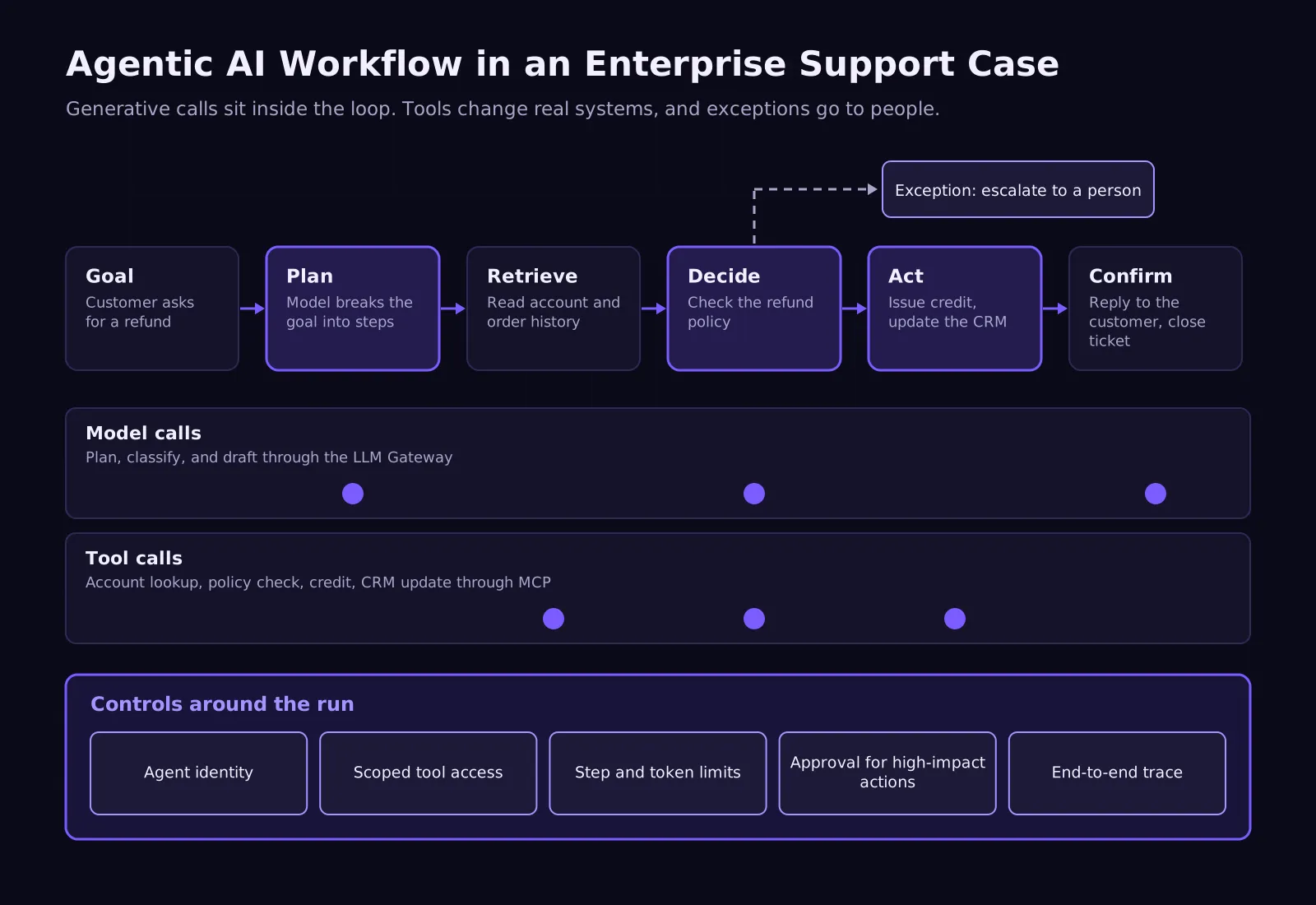
Generative AI risk often centers on what the model says. Agentic AI adds risk around what the system can do. An incorrect answer may mislead someone. An incorrect action can alter a record, expose information, or trigger another workflow.
Autonomy also introduces loops, cascading failures, repeated tools, and harder attribution. One business outcome may depend on several internal steps. Therefore, the comparison between Agentic AI and Generative AI changes the required risk management model.
The National Institute of Standards and Technology provides a cross-sector AI Risk Management Framework and a Generative AI profile. That guidance emphasizes governance, monitoring, documentation, and controls throughout the AI lifecycle.
Effective AI agent governance therefore requires identity, authorization, scoped tools, limits, audit trails, and response controls. In practice, those controls should cover:
Observability changes as well. Inspecting a single prompt and a single response no longer explains the outcome. Teams need the full sequence, and AI agent observability connects model calls, tool calls, latency, cost, and workflow outcomes into a single trace.
This is where traditional AI controls can fall short. Conventional systems often have more fixed execution paths. Autonomous systems make more runtime decisions in response to changing context, which increases the importance of live controls.
Yes. Agentic AI and Generative AI operate as layers within a single architecture. Most production agents depend on generative models for reasoning, classification, summarization, or language generation. The agent adds planning, tools, state, and execution logic.
In the earlier loop, each client.chat.completions.create call is a generative model request. The surrounding code decides what happens with the response. That distinction separates Generative AI models from the orchestration logic controlling the workflow.
A procurement example clearly shows the same split. Generative AI summarizes supplier proposals and extracts key facts. Agentic logic compares criteria, retrieves contracts, identifies missing information, and prepares an approval step. Generative AI and Agentic AI, therefore, support different layers within a single controlled process.
This also explains the relationship between generative artificial intelligence and agents. Generative models create or interpret information. The agent uses that information to decide which action happens next. This combination can automate work while retaining controls where needed.
The move toward agents expands the governance surface. Enterprises must control models, tools, credentials, budgets, policies, and workflow execution. Generative applications usually begin with model requests, whereas agents add requirements for tools and runtime control.
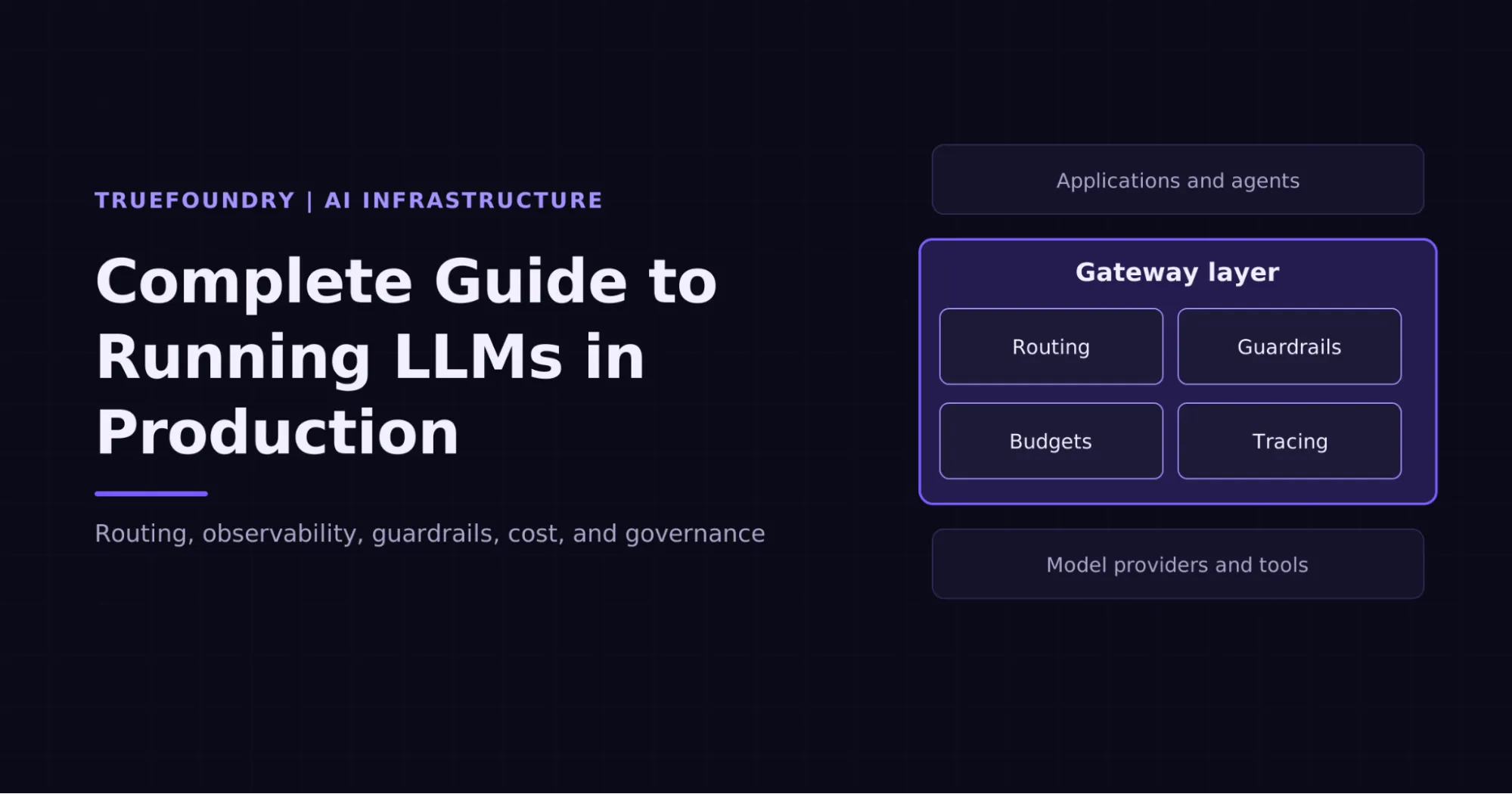
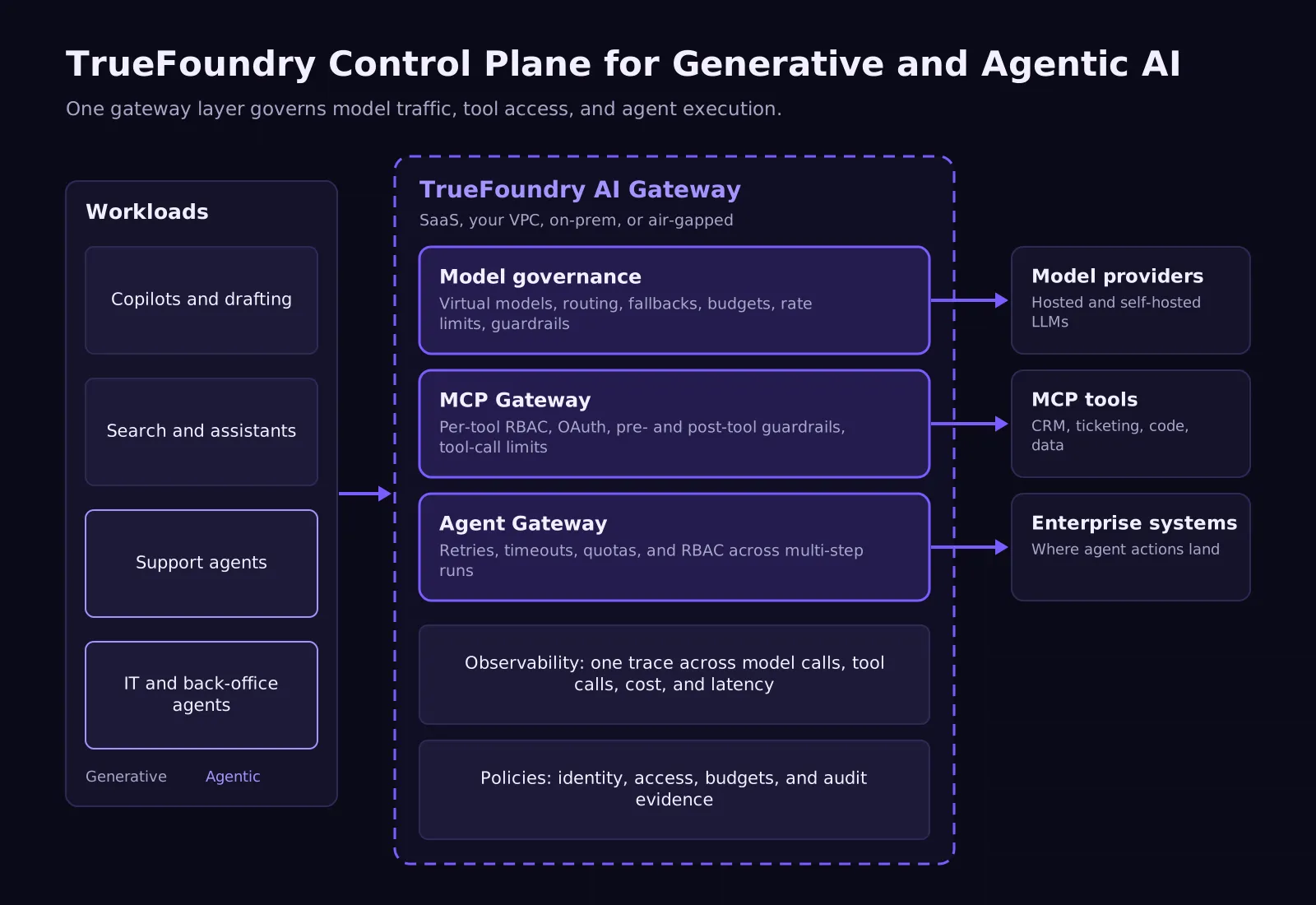
TrueFoundry provides one enterprise control layer as workloads evolve. Its AI Gateway governs model access, routing, budgets, rate limits, guardrails, and observability across providers.
On the tool side, MCP controls can apply RBAC, authentication, guardrails, and usage limits. On the agent side, runtime controls add retries, timeouts, quotas, and traceability. This lets teams maintain a single architecture as autonomy increases.
Teams can use this practical framework when evaluating gateway requirements:
This architecture gives platform teams more than just model routing. It creates a shared control point for workloads spanning models, tools, and agents. That becomes more important as Agentic AI vs Generative AI moves from experimentation into production
Choose generative AI when the main requirement is to create, transform, or understand information. It provides useful AI capability without unnecessary workflow autonomy. This is usually the right choice when people still review outputs before execution.
Choose agentic AI when the system must go beyond generation to complete a multi-step objective. It should have enough context, permissions, and safeguards to execute those actions responsibly. The workflow also needs clear limits when conditions change.
Most enterprises will run both approaches. Generative AI can handle reasoning and content creation. Agents can coordinate actions around those capabilities. A thorough analysis of Agentic AI vs Generative AI should therefore account for the autonomy each process requires.
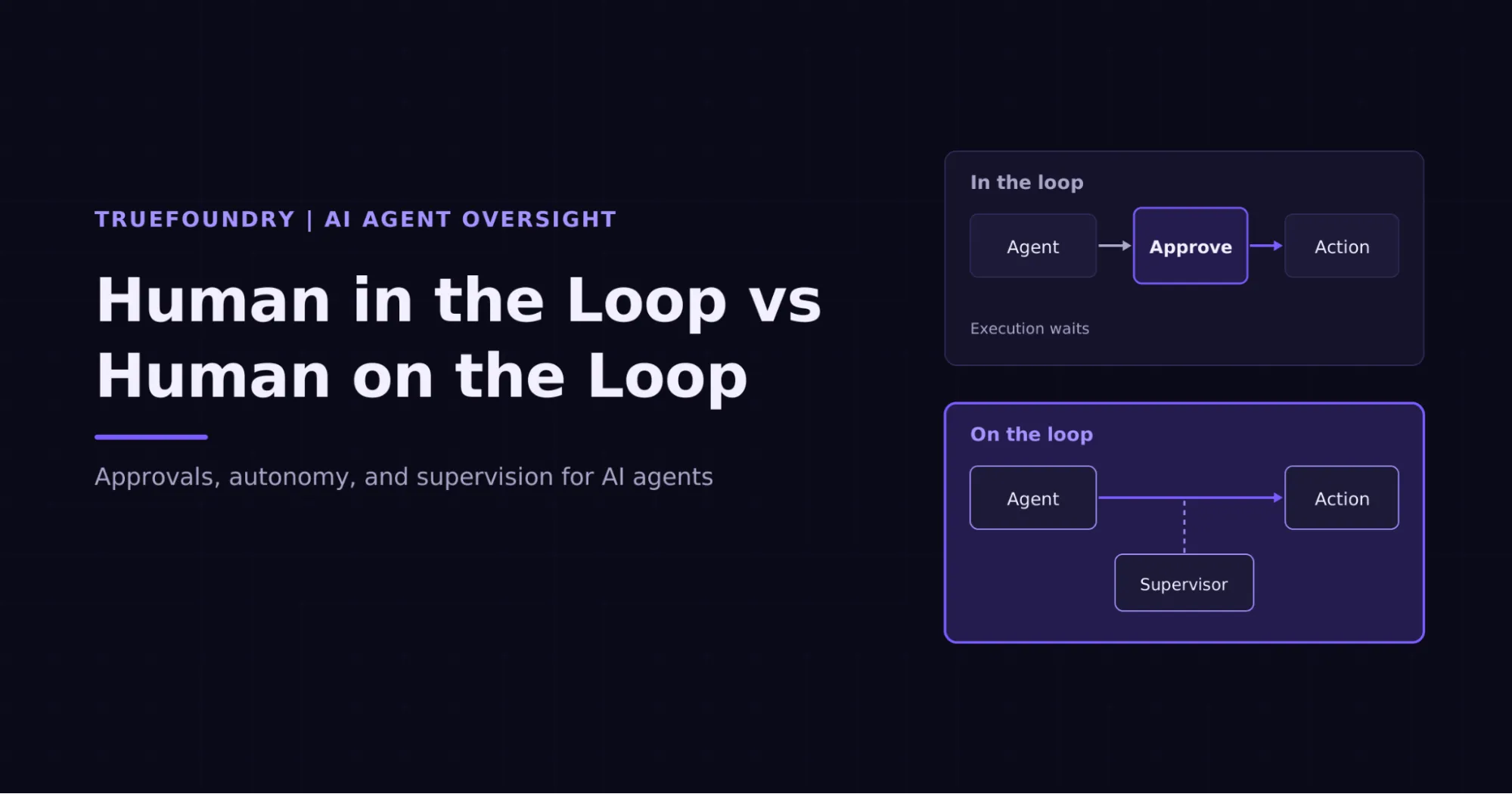
A practical test is simple. List every action the proposed system would take. Then identify which actions still need a person. If people approve every step, a generative assistant may be enough. If actions are bounded and routine, an agent can take more responsibility.
The choice between Generative AI and Agentic AI should therefore be guided by business value, risk, and execution complexity. Treating agents as an automatic upgrade adds cost without guaranteeing better outcomes.
If you want to see model, tool, and agent governance running on your own workloads, book a demo with the TrueFoundry team.
TrueFoundry AI Gateway delivers ~3–4 ms latency, handles 350+ RPS on 1 vCPU, scales horizontally with ease, and is production-ready, while LiteLLM suffers from high latency, struggles beyond moderate RPS, lacks built-in scaling, and is best for light or prototype workloads.