


October 1, 2026
|
5 min read


Published: July 6, 2026
Blazingly fast way to build, track and deploy your models!
The Model Context Protocol (MCP), introduced by Anthropic in late 2024, quietly rewired how we connect AI agents to the tools and data they need. Instead of brittle, one-off integrations, MCP standardizes the “adapter” layer so agents can talk to services like Slack, Jira, or GitHub with far less custom work. That’s powerful — and messy. As companies deploy LLM-powered agents, they’re spinning up thousands of MCP servers. Without a control plane, that growth quickly becomes integration chaos: duplicate connectors, scattered credentials, and little visibility into who’s giving AI access to what.
Obot MCP Gateway (launched by Obot AI in August 2025) attempts to solve this. Think of it as both an internal App Store and an air-traffic controller: a central control plane where IT can onboard, secure, and monitor MCP servers while employees discover and connect approved tools.
While Obot offers a well-designed open-source approach, enterprises often need deeper observability, multi-cloud support, and governance — capabilities where Truefoundry's MCP Gateway and other advanced alternatives lead.
This guide explores how Obot works, where it fits, and five top alternatives to Obot MCP Gateway for enterprise-scale AI infrastructure.
Obot is an open-source control plane for MCP servers designed for enterprise governance. At its core it solves three everyday problems: discovery (how employees find the tools they’re allowed to use), access control (who’s allowed to call which MCP), and observability (who did what, when, and how often). The result is fewer “shadow” MCPs running unchecked and more consistent, auditable connections between agents and enterprise systems.
Practically, Obot bundles a service registry, a web-based catalog, RBAC and policy enforcement, credential management, and proxying. Admins can add MCP entries via a UI or GitOps, attach docs and metadata, and publish a curated catalog to employees. Users then pick a tool and get a one-time connection URL that plugs into an LLM client — no manual auth or hand-wiring required. Meanwhile, Obot enforces the policies and sits between the client and the MCP server to provide centralized logging and auditing.
Put simply: Obot gives IT teams the tooling to treat MCP servers like first-class, governed infra instead of a fast-growing set of ad-hoc connectors.
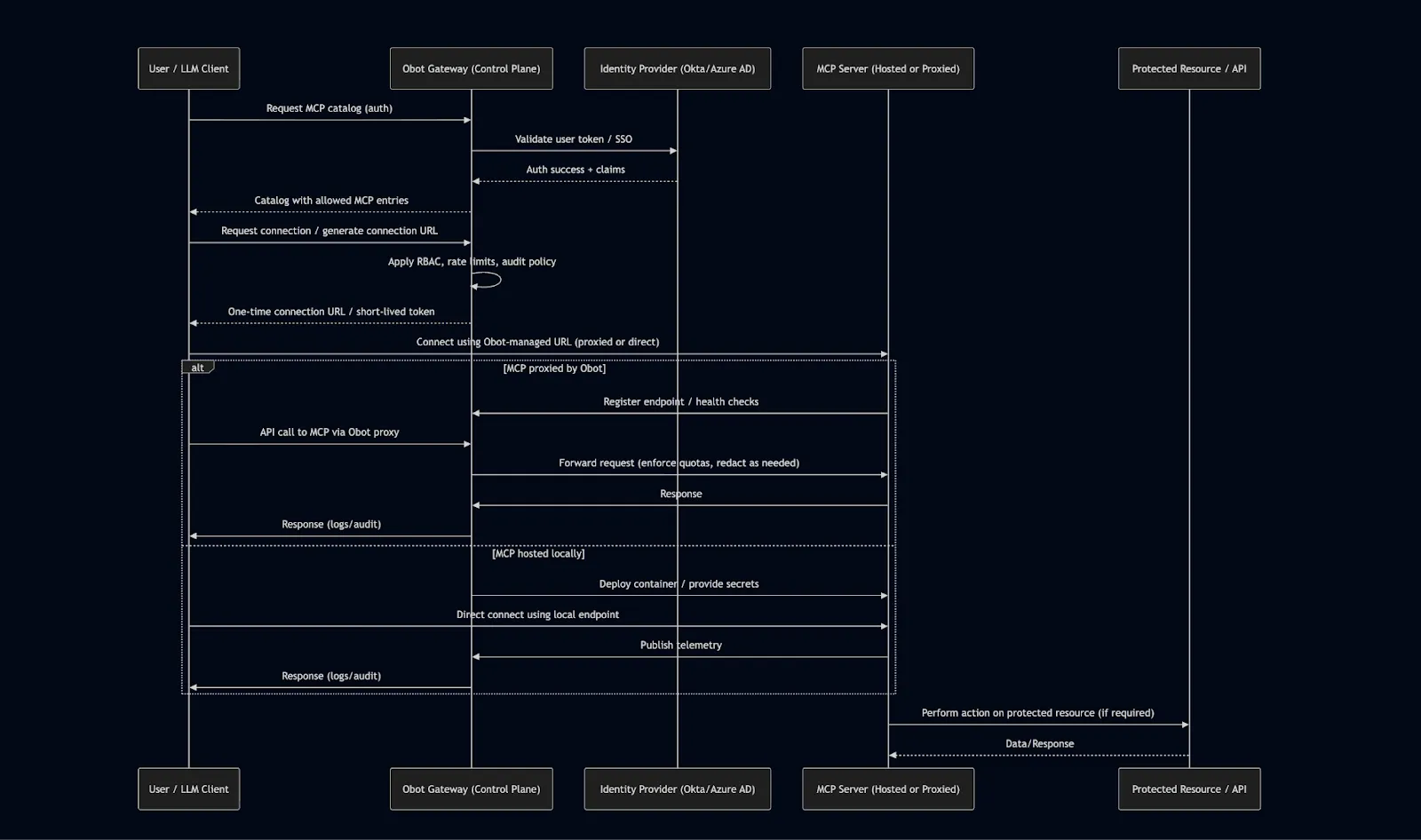
Under the hood, Obot functions as a secure proxy and control plane for all MCP traffic. The typical workflow is as follows:
Admin Setup & Integration
IT deploys the Obot Gateway (often on Kubernetes) and integrates it with identity providers like Okta, Azure AD, or Google Workspace for unified authentication.
Catalog Configuration
Obot includes common MCP connectors (Slack, GitHub, Notion, etc.) out of the box. Admins can add more through a UI or GitOps workflow, tagging each with metadata and usage docs.
Access Control & Policies
Administrators define which teams can access which MCP servers. Policies are enforced directly by Obot’s gateway.
User Discovery & Connection
Employees browse a web catalog of approved MCPs, connect via one-click URLs, and instantly authorize their AI tools to use the selected service.
Routing & Observability
Every MCP request passes through Obot’s proxy layer, providing a unified audit trail, request logs, and performance metrics for compliance and debugging.
While Obot MCP Gateway offers a strong open-source foundation for managing Model Context Protocol servers, it’s primarily designed for lightweight, internal use cases.
Enterprises operating at scale — with hundreds of agents, strict compliance needs, and multi-cloud deployments require deeper governance, observability, and performance optimization.
Key considerations include:
Security & Compliance: Some gateways (like Lasso Security) focus on advanced security controls and real-time scanning of agent calls. An enterprise handling sensitive or regulated data may prefer a gateway with built-in guardrails and threat detection.
Integration Ecosystem: Obot provides many connectors, but other vendors (e.g. TrueFoundry, Microsoft Azure Gateway) offer deeper integration with specific platforms or services. For example, if an organization is heavily invested in Azure, Microsoft’s MCP gateway (which is built into Azure services) might fit more smoothly into existing workflows.
Performance & Scalability: Gateways differ in their overhead and throughput. TrueFoundry’s MCP gateway, for instance, touts sub-3ms latency under load by handling auth and rate limits in-memory. If thousands of concurrent tool calls are expected, performance-optimized solutions may be preferred.
Deployment Model: Some teams prioritize container-native approaches. Docker’s MCP Gateway treats each MCP as a sandboxed container with strict resource limits and security boundaries. Enterprises already using Docker may find that approach familiar and easy to adopt.
Flexibility & Extensibility: Alternatives may offer plugin architectures or unique features. Lasso’s open-source gateway, for instance, lets users add custom security interceptors to filter or transform requests. Other platforms (like IBM’s Context Forge) allow composing “virtual” MCP servers from existing APIs.
Also Read: What is MCP Gateway
Key Metrics for Evaluating Gateway
| Criteria | What should you evaluate ? | Priority | TrueFoundry |
|---|---|---|---|
| Latency | Adds <10ms p95 overhead for time-to-first-token? | Must Have | ✅ Supported |
| Data Residency | Keeps logs within your region (EU/US)? | Depends on use case | ✅ Supported |
| Latency-Based Routing | Automatically reroutes based on real-time latency/failures? | Must Have | ✅ Supported |
| Key Rotation & Revocation | Rotate or revoke keys without downtime? | Must Have | ✅ Supported |
| Key Rotation & Revocation | Rotate or revoke keys without downtime? | Must Have | ✅ Supported |
| Key Rotation & Revocation | Rotate or revoke keys without downtime? | Must Have | ✅ Supported |
| Key Rotation & Revocation | Rotate or revoke keys without downtime? | Must Have | ✅ Supported |
| Key Rotation & Revocation | Rotate or revoke keys without downtime? | Must Have | ✅ Supported |
TrueFoundry MCP Gateway is an enterprise-grade solution designed to unify and govern large-scale MCP deployments. Built as part of the TrueFoundry AI Platform, it provides a single control plane that seamlessly integrates with existing AI infrastructure — including LLM management, telemetry, and compliance enforcement — enabling teams to manage both models and tools without fragmentation.
Because it’s deeply integrated into the TrueFoundry ecosystem, enterprises gain a single-pane-of-glass view of all AI activity — from LLMs to connected tools — ensuring consistent governance, compliance, and performance visibility.
In short, TrueFoundry MCP Gateway is more than just a connector — it’s a complete AI infrastructure control plane. For organizations that need scale, reliability, and compliance, TrueFoundry stands out as the most comprehensive alternative to Obot.
For enterprises evaluating the best MCP gateway for scale, compliance, and performance, TrueFoundry offers a unified control plane purpose-built for production-grade AI systems.
TrueFoundry goes beyond being a gateway — it’s a complete orchestration and governance platform for AI infrastructure.
By unifying model management, observability, and policy enforcement under one system, TrueFoundry eliminates integration sprawl and provides a single pane of glass for all AI agent activity.
Its sub-3 ms latency, deep observability, and enterprise-grade compliance make it the preferred choice for organizations building scalable, secure, and compliant AI systems.
Docker MCP Gateway is a container-native solution offered as a Docker plugin, aimed at teams already familiar with containerization workflows. It treats each MCP server as a containerized workload with strong isolation and resource caps, aggregating multiple MCP servers behind a single, secure interface. A standout feature is its Interceptor Framework — allowing custom scripts or plugins to inspect, modify, or block requests in real time.
For example:
Docker’s MCP Gateway excels at security filtering and auditability, with tight integration into Docker Desktop and Docker Swarm. The trade-off is added latency (50–200 ms typical round trip) and a container-centric model, but for teams already using Docker infrastructure, it offers familiarity and strong isolation by default.
IBM’s Context Forge is an open-source MCP gateway and registry designed for large enterprises needing federation and extensibility. It can auto-discover multiple gateways via mDNS, merge capabilities from different deployments, and even compose several MCP servers into a single endpoint.
Key highlights:
Context Forge feels like traditional IBM middleware — highly configurable, federation-friendly, and security-conscious.
However, it’s still in beta and lacks official enterprise support, making it best suited for organizations with strong DevOps capabilities that can manage a DIY setup.
Instead of offering a standalone gateway, Microsoft has integrated MCP functionality directly into its Azure ecosystem. The Azure MCP Gateway acts as a session-aware reverse proxy for Kubernetes-hosted MCP servers and connects with Azure API Management, Container Apps, and Azure Monitor.
これはAzureとの深い統合と運用簡素化をもたらしますが、マルチクラウドやオンプレミス環境でのセットアップはより複雑になる可能性があり、カスタマイズの選択肢も限られています。
要するに、Microsoftのアプローチは、ポータビリティよりも利便性とエコシステムとの整合性を重視しています。
Lasso SecurityのMCPゲートウェイは、リスク管理と脅威検出に重点を置いた、オープンソースでセキュリティを最優先するゲートウェイです。すべてのMCPインタラクションにおいてプロキシおよびオーケストレーターとして機能し、あらゆるリクエストにセキュリティ、ガバナンス、監視を組み込みます。
主な差別化要因は以下の通りです。
深いセキュリティ層は多少のオーバーヘッドを発生させる可能性がありますが、Lassoは、厳格な監査可能性とポリシー制御を必要とする規制対象業界やセキュリティを最優先する組織に最適です。
Obot MCPゲートウェイは、統合されたAI統合における重要な一歩であり、最新のMCPデプロイメントにガバナンス、スケーラビリティ、相互運用性をもたらす無料のオープンソースコントロールプレーンを提供します。
しかし、企業全体でAIエージェントの導入が加速するにつれて、堅牢で本番環境レベルのゲートウェイの必要性がますます重要になっています。
ObotやTrueFoundryのようなプラットフォームは、低遅延のオーケストレーションとエンドツーエンドのライフサイクル管理を重視しています。一方、Docker、IBM、Microsoftなどのベンダーは、既存のインフラエコシステムを拡張してAIワークロードの要求に対応しています。その一方で、Lasso Securityのようなセキュリティを最優先するゲートウェイは、脅威検出とコンプライアンスの強制を通信レイヤーに直接組み込み、大規模なAIとツールのインタラクションを保護しています。
これらのアプローチを慎重に比較することで、企業は自身のアーキテクチャ、ガバナンス、パフォーマンス目標に最も適したMCPゲートウェイを選択できます。
長期的には、この進化するエコシステムにより、組織はAIエージェントを実世界のシステムと自信を持って接続できるようになり、あらゆるデプロイメントにおいてセキュリティ、信頼性、柔軟性が中心であり続けることが保証されます。
高度な制御を備えたObot MCPゲートウェイの主要な代替案には、TrueFoundry、Docker MCP Gateway、Lasso Securityなどがあります。これらのプラットフォームは、超低遅延、コンテナネイティブな分離、高度なセキュリティスキャンといった特殊な機能を提供します。それぞれの代替案は、開発者向けのプラグインから本格的なエンタープライズガバナンスおよび可観測性ソリューションまで、さまざまなニーズに対応しています。
3ミリ秒未満のレイテンシー、詳細な監査証跡、マルチクラウド対応といった本番環境レベルの機能が必要な場合は、代替案を検討すべきです。Obotは有用な入り口となりますが、機密データや複雑な分散型AIインフラストラクチャを管理する組織に必要な、深いガバナンスやエンタープライズコンプライアンス基準が不足しています。
Obotは主に、よりシンプルな設定のための基本的なサーバー検出と内部プロキシに焦点を当てています。対照的に、TrueFoundryのような高度なソリューションは、LLMとツールの両方に対応する包括的なコントロールプレーンを提供します。これには、構造化されたトレーシングによるより深い可観測性、統合されたコスト管理、そして基本的なレジストリでは実現できないネイティブKubernetesスケーリングが含まれます。
はい、Lassoのゲートウェイや様々なDockerベースのプラグインなど、いくつかのオープンソースオプションがあり、複雑さは異なりますが同様の機能を提供します。これらのコミュニティ主導のプロジェクトにより、開発者はセキュリティインターセプターをカスタマイズしたり、独自のコネクタを追加したりすることができ、商用ライセンス費用を回避しつつ、MCPサーバーのデプロイと管理方法において柔軟性を維持できます。
TrueFoundryは、3ミリ秒未満のレイテンシーとネイティブKubernetesスケーリングを備えた高性能なコントロールプレーンを提供するため、Obot MCPゲートウェイの理想的な代替案です。モデル管理とツールガバナンスを単一のダッシュボードに統合し、VPC内でのデータレジデンシーを確保します。セキュリティ、速度、詳細なテレメトリーのこの組み合わせは、大規模組織にとって最高の選択肢となります。
TrueFoundry AI Gateway delivers ~3–4 ms latency, handles 350+ RPS on 1 vCPU, scales horizontally with ease, and is production-ready, while LiteLLM suffers from high latency, struggles beyond moderate RPS, lacks built-in scaling, and is best for light or prototype workloads.



.png)
.png)
.png)
.png)
.png)
.png)
.png)
.png)
.png)
.png)
.png)





