


September 24, 2026
|
5 min de lecture


Accédez instantanément à un environnement TrueFoundry en direct. Déployez des modèles, acheminez le trafic LLM et explorez la plateforme complète : votre sandbox est prête en quelques secondes, aucune carte de crédit n'est requise.



Published: June 23, 2026
Une méthode incroyablement rapide pour créer, suivre et déployer vos modèles !
L'IA fantôme est déjà responsable de 20 % des violations de données en entreprise, coûtant aux organisations en moyenne 670 000 $ de plus que les incidents standards. Les dispositions d'application à haut risque de la loi européenne sur l'IA sont entrées en vigueur en août 2026, avec des amendes pouvant atteindre 35 millions d'euros ou 7 % du chiffre d'affaires mondial. Et Gartner prévoit que 40 % des applications d'entreprise intégreront des systèmes d'IA autonomes d'ici fin 2026, contre moins de 5 % en 2025.
La gouvernance de l'intelligence artificielle n'est plus une question de planification. C'est une exigence opérationnelle, et l'écart entre ce que la plupart des équipes ont déployé et ce dont elles ont besoin se creuse rapidement.
Le marché des outils de gouvernance de l'IA, couvrant tout, de la documentation des politiques d'intelligence artificielle aux passerelles d'application en temps réel, s'est rapidement développé pour répondre à cette demande, mais tous les outils ne résolvent pas le même problème. Certains documentent la conformité. Certains surveillent les performances et la dérive des modèles. Certains appliquent des contrôles en temps réel.
Choisir le mauvais outil signifie investir dans une couche de gouvernance qui semble exhaustive sur le papier mais ne fait rien pour empêcher un agent mal configuré d'accéder à des données sensibles à 2 heures du matin un mardi.
Cet article compare les principaux outils de gouvernance de l'IA en 2026 : ce que chacun fait, ses lacunes et comment choisir en fonction des besoins de votre équipe en production. Poursuivez votre lecture !
Les outils de surveillance vous disent ce qui s'est passé. Les outils de gouvernance de l'IA empêchent ce qui ne devrait pas arriver. Cette distinction est importante car au moment où vous voyez quelque chose dans un tableau de bord de surveillance, les données ont déjà été déplacées, le coût a déjà été engagé ou la politique a déjà été violée.
Les flux de travail de conformité et les fonctionnalités bloquées derrière des niveaux de prix d'entreprise signifient effectivement que la gouvernance est inaccessible à la plupart des équipes. Si les contrôles qui comptent vraiment, RBAC, la journalisation des audits, la rédaction des PII, nécessitent une mise à niveau de contrat, les équipes les contournent. C'est exactement là que l'IA fantôme commence.
Les plateformes de gouvernance de l'IA les plus robustes opèrent au niveau de l'infrastructure. Elles appliquent automatiquement l'application des politiques à chaque requête sans exiger des développeurs qu'ils écrivent la logique de politique dans le code de l'application. Si la gouvernance dépend du fait que les développeurs se souviennent de l'implémenter, elle ne sera pas cohérente.

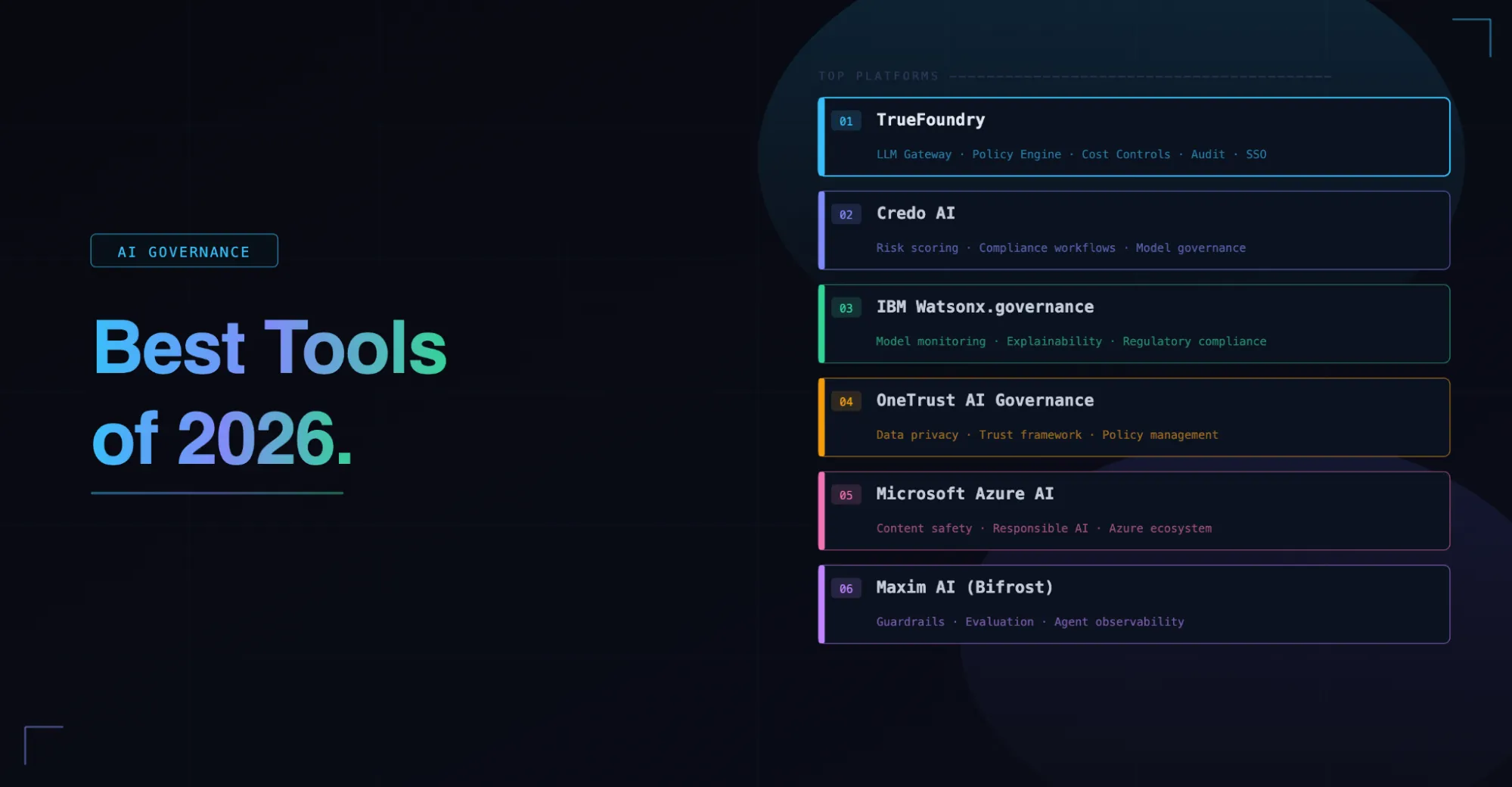
TrueFoundry est reconnu comme un fournisseur représentatif dans le 2025 Gartner Market Guide for AI Gateways, traitant plus de 10 milliards de requêtes par mois pour des entreprises du Fortune 1000. Il se déploie en tant que plateforme native VPC plateforme de passerelle IA au sein de votre compte AWS, GCP ou Azure, maintenant tous les appels d'inférence, les invites et les réponses des modèles à l'intérieur de votre propre périmètre réseau.
TrueFoundry est spécialement conçu pour les équipes d'entreprise qui ont besoin d'une gouvernance de l'IA appliquée au niveau de l'infrastructure pour les modèles, les agents et les outils. C'est la solution idéale pour les secteurs réglementés, les déploiements multi-cloud et les organisations exigeant une souveraineté totale des données ainsi que des pistes d'audit prêtes pour la conformité.
TrueFoundry propose des plans flexibles, y compris un niveau Pro avec déploiement VPC et des outils de gouvernance essentiels, et un niveau Entreprise pour les organisations qui déploient l'IA à grande échelle avec des exigences strictes en matière de conformité, de sécurité avancée et de déploiement personnalisé. Le plan Pro commence à 499 $/mois. Le tarif Entreprise est disponible sur demande.
Prêt à gérer chaque appel de modèle, action d'agent et connexion d'outil depuis un plan de contrôle unifié au sein de votre propre cloud ?
Explorez notre démo en direct et découvrez la plateforme en direct et son fonctionnement avec vos propres charges de travail.

Credo AI est une plateforme de gouvernance de l'IA tout au long du cycle de vie, axée sur l'automatisation de la conformité et la documentation prête pour l'audit. Elle fournit des packs de politiques pré-construits alignés sur la loi européenne sur l'IA, le NIST AI RMF, l'ISO 42001, SOC 2 et HITRUST avec des flux de travail automatisés de collecte de preuves.
Credo AI documente les exigences de gouvernance mais ne les applique pas au niveau de la couche d'exécution. La passerelle IA de TrueFoundry applique les contrôles d'accès, les budgets de coûts et la journalisation d'audit sur chaque requête de modèle en direct, rendant la gouvernance opérationnelle plutôt qu'aspirationnelle.

IBM Watsonx.governance offre une gestion des risques liés à l'IA de niveau entreprise, couvrant la surveillance du cycle de vie, la détection des biais, l'explicabilité et le suivi du comportement des modèles. Il a obtenu l'autorisation FedRAMP, ce qui en fait l'une des rares plateformes de gouvernance de l'IA approuvées pour les déploiements fédéraux américains.
IBM Watsonx.governance fonctionne de manière optimale au sein de la pile technologique d'IBM et nécessite une surcharge importante en dehors de celle-ci. La plateforme de passerelle IA de TrueFoundry est conçue pour être indépendante des fournisseurs, gouvernant les charges de travail sur OpenAI, Anthropic, Azure, AWS Bedrock et les modèles auto-hébergés à partir d'un plan de contrôle unique natif VPC.
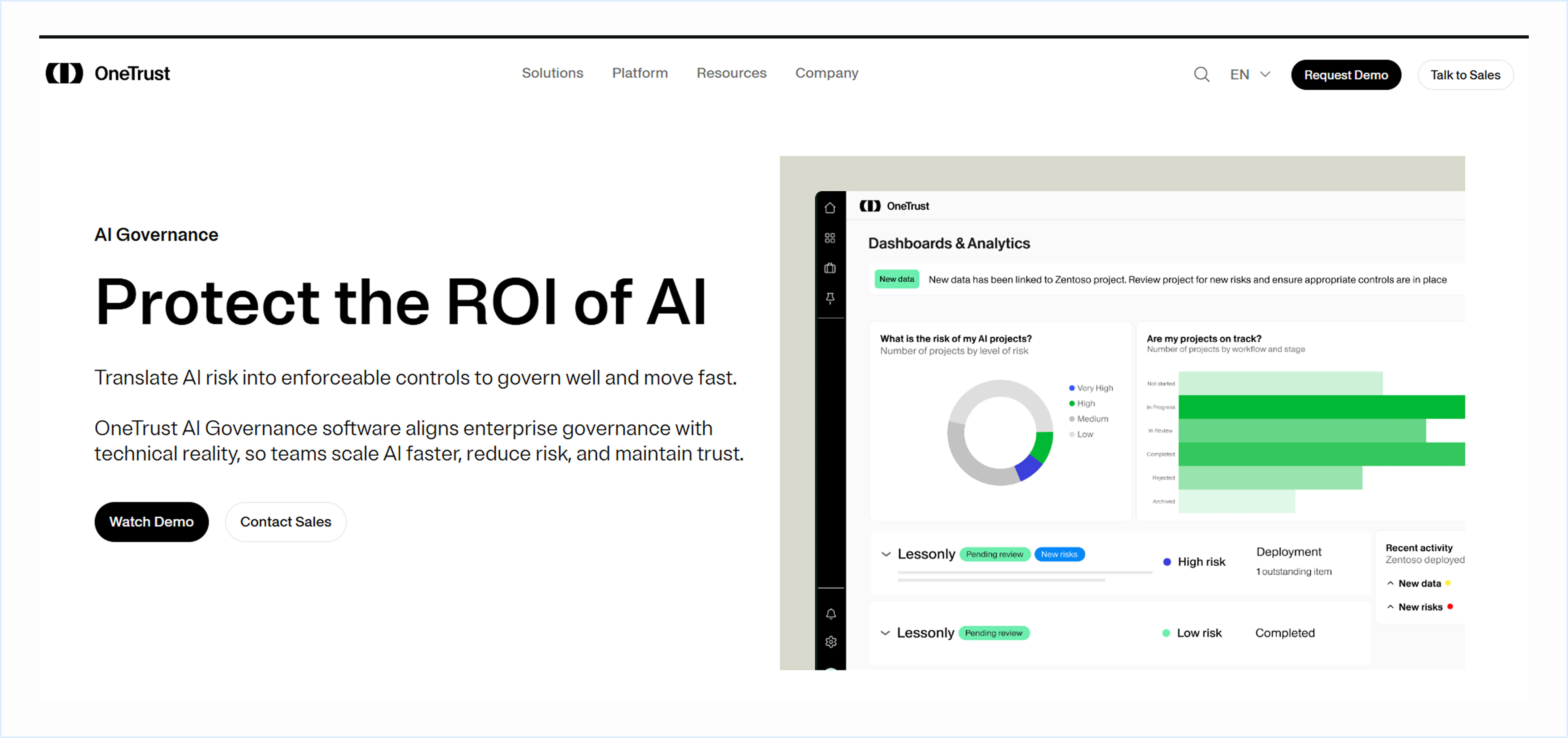
OneTrust Gouvernance IA est spécialisée dans les flux de travail GRC pour les industries réglementées, étendant la plateforme de confidentialité des données établie de OneTrust pour couvrir les inventaires de systèmes IA, les évaluations des risques et la gestion des fournisseurs. En mars 2026, OneTrust s'est étendue pour inclure la surveillance continue et la détection d'agents IA en temps réel.
OneTrust gère l'inventaire IA et le risque fournisseur au niveau de la couche de politique. La passerelle MCP et la passerelle IA de TrueFoundry appliquent la gouvernance au niveau de la couche de requête, en appliquant des contrôles d'accès, des garde-fous de contenu et la journalisation d'audit à chaque appel de modèle et invocation d'outil d'agent en temps réel.

La Sécurité du contenu IA et l'IA responsable d'Azure offrent une gouvernance native du cloud pour les modèles déployés au sein d'Azure, y compris Prompt Shield pour la défense contre l'injection de prompts et des évaluations d'impact de l'IA responsable intégrées directement dans le portail Azure. Pour les organisations déjà standardisées sur Azure, ces contrôles ne nécessitent aucune surcharge de déploiement supplémentaire.
La gouvernance Azure AI ne fonctionne que dans les limites d'Azure. La passerelle IA de TrueFoundry gère les charges de travail sur Azure, AWS, GCP et les modèles auto-hébergés à partir d'un plan de contrôle unique natif VPC, en appliquant les mêmes contrôles d'accès et la même journalisation d'audit, quel que soit l'endroit où le modèle s'exécute.

Maxim AI combine la gouvernance au niveau de l'infrastructure via sa couche de passerelle Bifrost, incluant les contrôles budgétaires, la gestion des accès et la journalisation d'audit, avec une plateforme intégrée d'évaluation et d'assurance qualité des LLM pour les équipes produit et d'ingénierie.
Maxim AI gère l'évaluation et la gouvernance de base pour les petites équipes. La solution de TrueFoundry Agent Gateway et la passerelle IA servent les équipes d'entreprise avec un déploiement natif VPC, une configuration RBAC approfondie, une gouvernance des flux de travail agentiques et des pistes d'audit prêtes pour la conformité que les plateformes d'infrastructure dédiées exigent.
Les plateformes de documentation de conformité produisent des artefacts d'audit à partir d'entrées manuelles et de révisions périodiques. Elles n'interceptent pas un agent mal configuré accédant à des données sensibles en temps réel. La documentation et l'application sont deux couches distinctes, et la plupart des outils de gouvernance n'en traitent qu'une seule. Au moment où un rapport de conformité révèle une lacune, l'accès a déjà eu lieu et les données ont déjà été déplacées.
Les capacités de gouvernance natives du cloud d'Azure, AWS et Google Vertex limitent l'application à leurs propres environnements d'hébergement de modèles. Les organisations exécutant des charges de travail sur plusieurs fournisseurs, ou utilisant des modèles auto-hébergés, constatent que ces contrôles ne s'appliquent tout simplement pas en dehors de l'infrastructure propre du fournisseur. Le résultat est une IA gouvernée sur un sous-ensemble de charges de travail, tandis que le reste fonctionne sans surveillance. C'est dans cette lacune que l'IA fantôme se développe.
La plupart des plateformes de gouvernance traitent la gouvernance comme une fonctionnalité au sein d'un produit plus large plutôt que comme une infrastructure fondamentale. Des capacités essentielles comme les budgets de coûts par équipe, le RBAC granulaire et la rédaction de PII en temps réel se retrouvent derrière des contrats d'entreprise. Les équipes incapables d'accéder à ces fonctionnalités les contournent, ce qui est précisément la façon dont l'IA fantôme se propage au sein des organisations qui croient que la gouvernance est déjà en place. Le rapport Gartner 2026 sur les meilleures pratiques pour optimiser les coûts de l'IA agentique renforce l'idée que les contrôles de coûts et de gouvernance doivent opérer au niveau de l'infrastructure pour être efficaces.
Aucune des plateformes axées sur la conformité ne comble le fossé de la responsabilité des coûts qui apparaît lorsque des dizaines d'équipes exécutent des charges de travail d'inférence de manière indépendante. La finance voit une facture consolidée. L'ingénierie n'a aucun mécanisme pour identifier quelle équipe, quelle application ou quel modèle est responsable des pics de coûts. La passerelle LLM de TrueFoundry résout ce problème en étiquetant chaque requête avec des métadonnées d'utilisateur, d'équipe, de modèle et d'environnement au moment de l'exécution, produisant une attribution par requête sans pipelines d'analyse personnalisés.

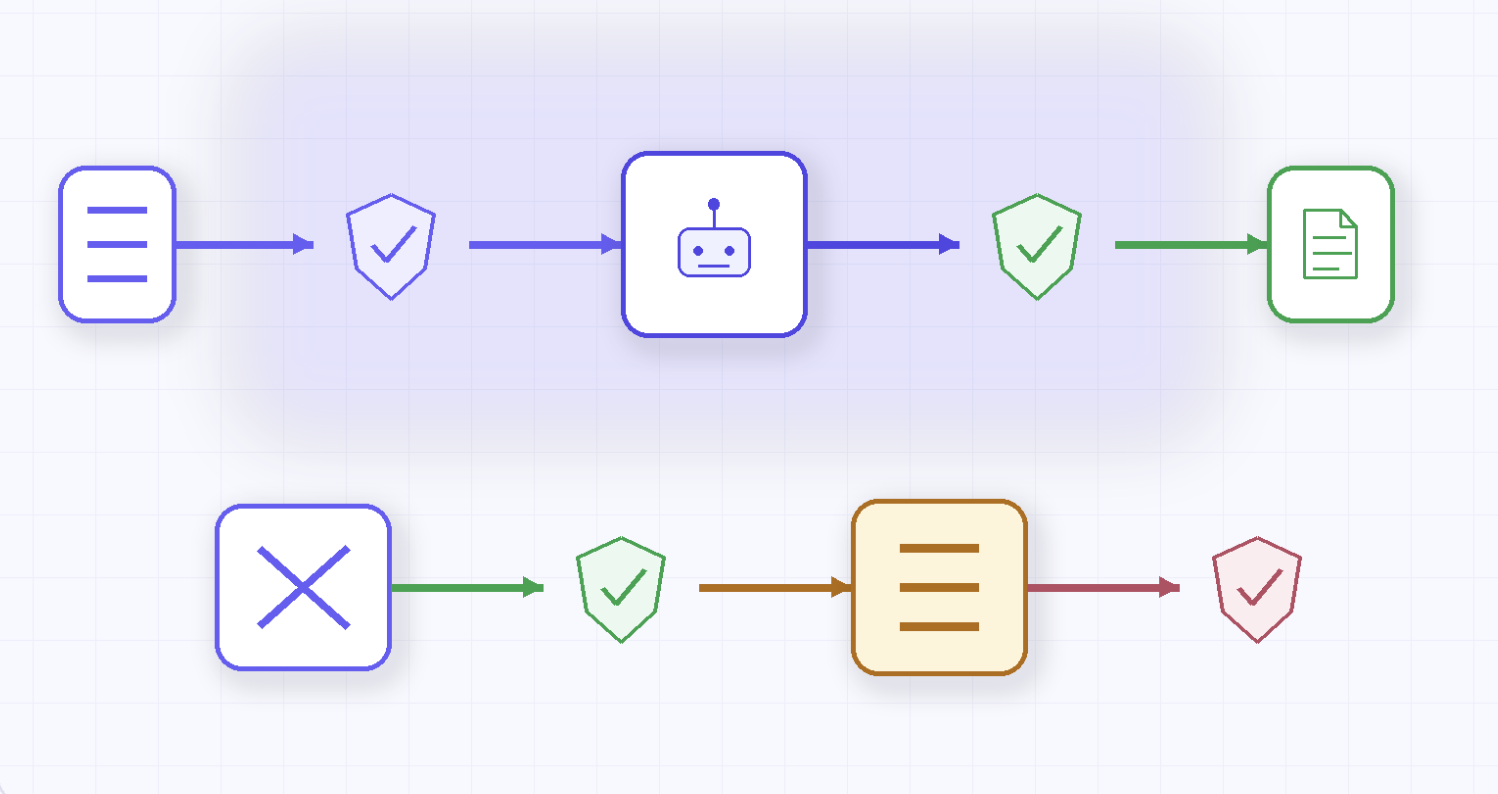
Voici pourquoi les entreprises ont besoin d'une gouvernance au niveau de l'infrastructure :
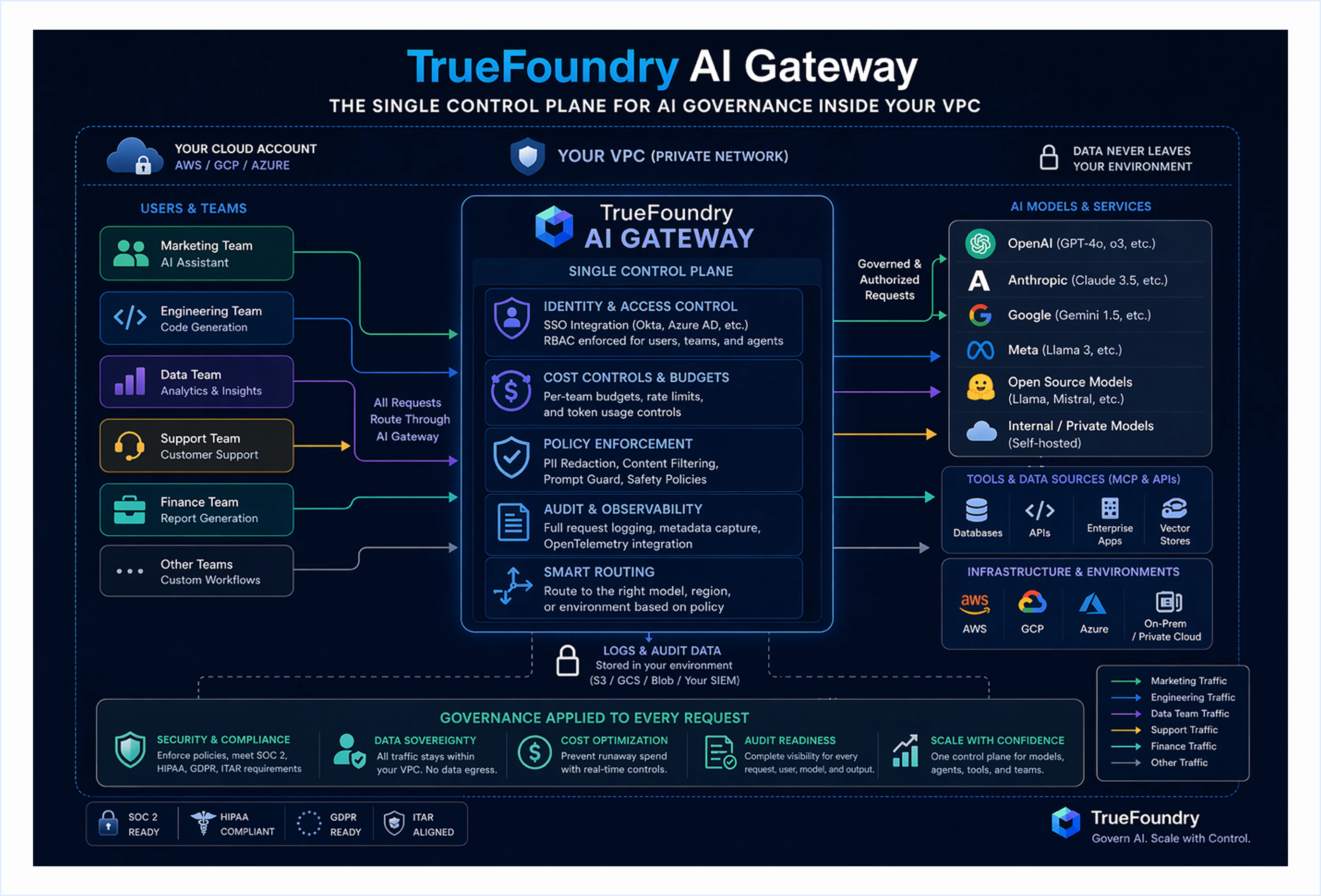
TrueFoundry est construit autour d'un principe simple : la gouvernance de l'IA est un problème d'infrastructure, pas un flux de travail d'automatisation de la conformité. Chaque contrôle réside au niveau de la couche de passerelle et s'applique automatiquement à chaque requête. Aucun développeur n'a à implémenter de logique d'automatisation de politique dans le code de l'application pour que cela fonctionne.
Réservez une démo gratuite dès aujourd'hui pour commencer.
TrueFoundry AI Gateway offre une latence d'environ 3 à 4 ms, gère plus de 350 RPS sur 1 processeur virtuel, évolue horizontalement facilement et est prête pour la production, tandis que LiteLM souffre d'une latence élevée, peine à dépasser un RPS modéré, ne dispose pas d'une mise à l'échelle intégrée et convient parfaitement aux charges de travail légères ou aux prototypes.





Les dernières nouvelles, articles et ressources envoyés dans votre boîte de réception
.webp)
.webp)
.webp)
.webp)
.webp)
.png)
.png)
.png)
.png)
.png)
.png)
.png)


