


.webp)
September 24, 2026
|
5 min de lecture


Accédez instantanément à un environnement TrueFoundry en direct. Déployez des modèles, acheminez le trafic LLM et explorez la plateforme complète : votre sandbox est prête en quelques secondes, aucune carte de crédit n'est requise.



Published: May 13, 2026
Une méthode incroyablement rapide pour créer, suivre et déployer vos modèles !
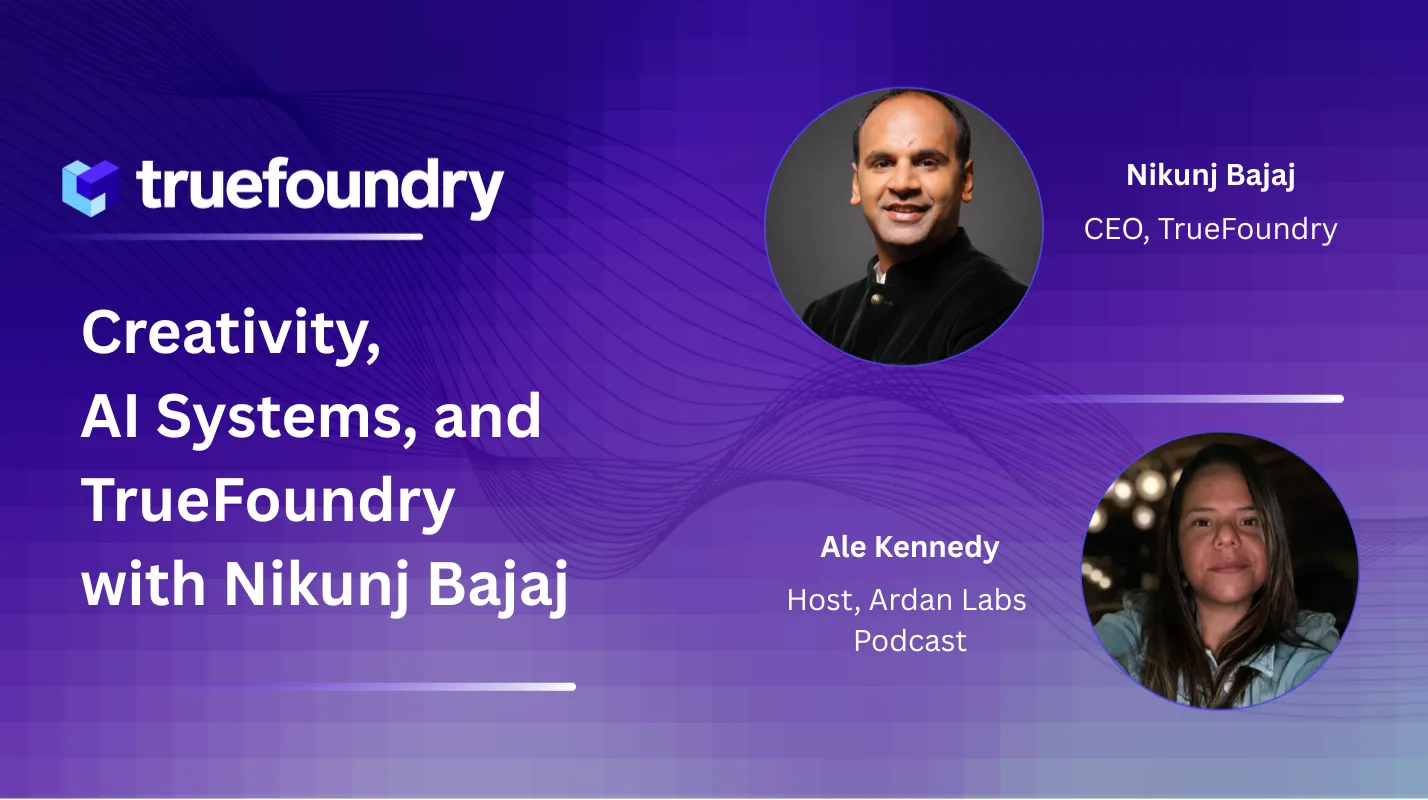
There is a particular kind of founder who builds not from opportunity, but from deeply lived experience. Nikunj Bajaj, co-founder and CEO of TrueFoundry, is that kind of founder. In a recent conversation on the Arden Labs Podcast, he traced the full arc of his journey from growing up in Calcutta, to cracking one of India's most competitive entrance exams, to spending a pandemic lockdown on a mattress in a single room with his two co-founders, ideating the company that would eventually become TrueFoundry.
It is a story that rewards patience to hear in full.
Nikunj grew up in a grounded, modest household in Calcutta, the kind of upbringing he describes as stable and consistent: same house, same friends, same neighborhood for years. He was not, by his own admission, someone who had dreamed of IIT growing up. The idea found him gradually, through conversations with people who had walked that path, and through a growing interest in engineering and mathematics.
What followed was two years of intense preparation for the entrance examination for India's IITs Half a million students sit the exam each year. A few thousand get in. Nikunj was one of them.
At IIT Kharagpur, the oldest and largest of the IITs, he chose instrumentation engineering as he was drawn to robotics and the promise of building things that moved and responded to the world. Outside the classroom, he did exactly that. His team built an autonomous ground vehicle and became the first team from India to represent the country at a robotics competition in the United States. It was his first trip to America.
An internship at UC Berkeley followed, secured through research recommendations from advisors in both Israel and India. That internship changed everything. His research went well enough that his advisor invited him to return for a master's degree. He also met his wife there who had come in the same program, her roommate, his lab mate. One internship, he reflects, sorted both his career and his life.
After completing his master's at Berkeley in 2014, Nikunj joined Reflektion, an AI company serving the e-commerce industry, as one of its earliest machine learning engineers. Over three and a half years he rose to lead the ML team and built out an internal machine learning developer platform which was his first real glimpse of the infrastructure problem he would later dedicate his career to solving.
Then came Meta.
At Meta, Nikunj worked in the conversational AI team at a time when the company was pushing deep into transformer-based models, the same technology that would later power ChatGPT and the generative AI wave. But beyond the technical exposure, it was the operational reality of Meta's internal ML platform that stayed with him.
"As an individual developer at Meta, I could build a machine learning model and launch it on 10,000 nodes by myself without depending on anyone else," he shared on the podcast. Outside of Meta, that kind of capability simply did not exist in the public cloud ecosystem. Enterprises were building machine learning applications on fragmented, parallel stacks: one for software, one for ML, and increasingly a third for generative AI. The inefficiency was obvious to anyone who had seen the alternative.
That observation became the founding hypothesis of TrueFoundry: that machine learning would eventually hit an inflection point, at which point enterprises would urgently need a unified, verticalized infrastructure platform much like what Meta had built internally. The question was not whether it would happen, but when.
Before TrueFoundry, there was Enthire. In early 2020, Nikunj and his two co-founders- Abhishek, who had also been at Meta, and Anurag, who had been using machine learning to build trading strategies at WorldQuant quit their jobs to solve a different problem: the inefficiency of technical hiring interviews.
The timing, as Nikunj puts it, could not have been worse (or more clarifying!) They arrived in Bangalore in March 2020, days before India went into lockdown. With nowhere else to go, all three ended up sharing a single room in a friend's two-bedroom apartment for months, laying out mattresses and building a company from scratch.
Enthire grew. Within a year they had 40 to 50 customers and had been accepted into Y Combinator. But a pivotal conversation with their YC partner, someone who had spent four years and over $35 million building a strikingly similar company before joining YC gave them the honest validation they needed to hear: the business model had a ceiling they would not be able to break through. It was too operations-intensive, too niche, and not a strong fit for three founders with deep technology backgrounds.
They made the decision to exit the business which was acquired by a large Indian enterprise and returned to the drawing board. What came next was TrueFoundry, built on the infrastructure insight Nikunj and Abhishek had carried with them since their time at Meta.
TrueFoundry was founded at the end of 2021, more than a year before ChatGPT made generative AI a mainstream conversation. That head start mattered enormously. Because the platform was designed from the beginning with Meta's architecture as its north star, treating generative AI as a special case of machine learning, and machine learning as a special case of software. It was already capable of supporting large language model workloads when the market suddenly demanded exactly that.
"When ChatGPT launched, we did not have to make any fundamental architectural changes," Nikunj said. "We were thinking of machine learning, and it would support LLMs by default."
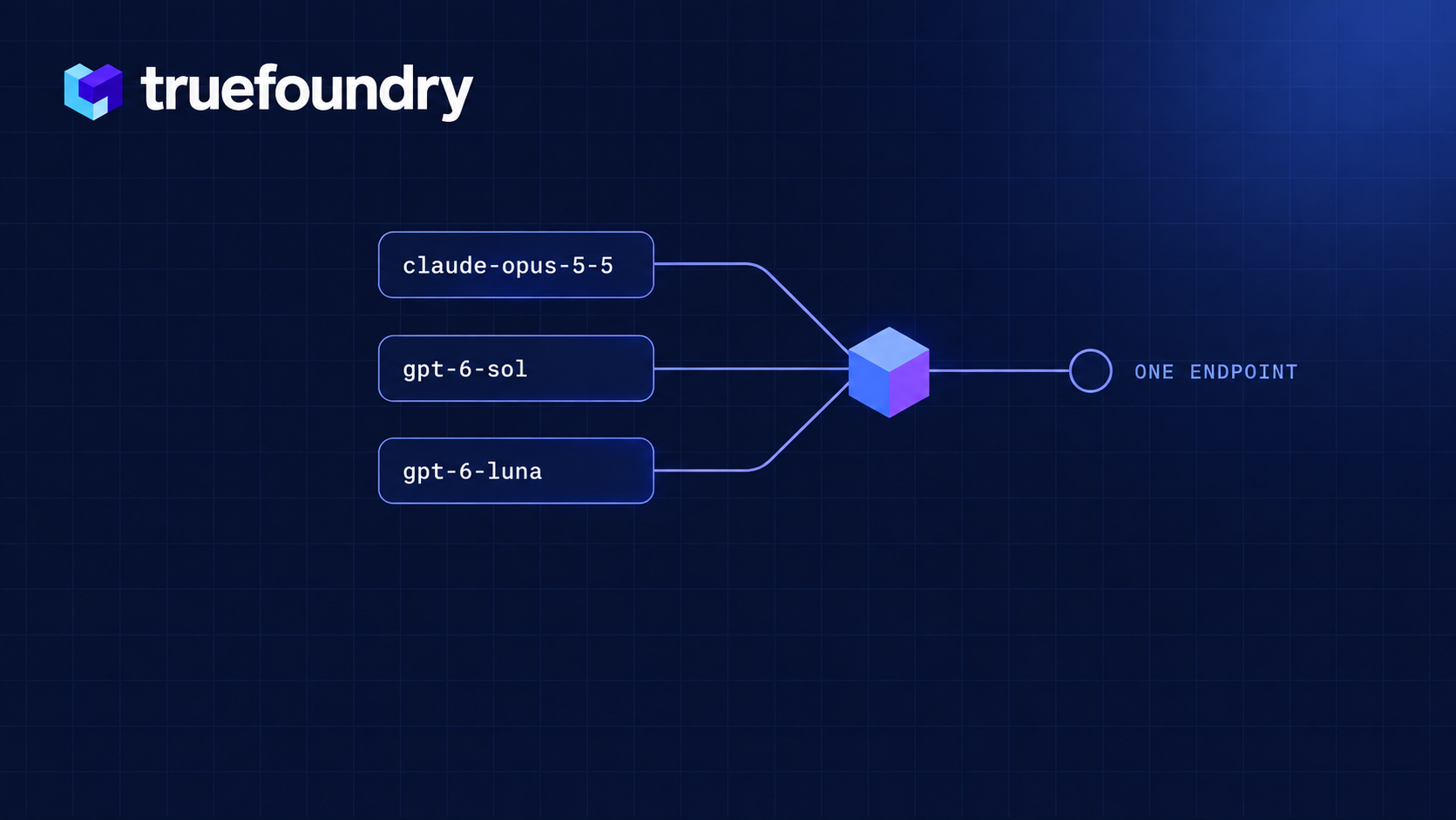
Their first major enterprise customer was one of the world's largest pharmaceutical companies. Since then, TrueFoundry has grown to a team of close to 100 people across the Bay Area, Boston, Bangalore, and London. The product has expanded from its original AI deployments platform which lets enterprises run custom models and agents on their own infrastructure to include an AI Gateway, a unified control plane that sits in the middle of every API call an enterprise makes to its models, agents, and MCP servers.
The gateway enforces governance, compliance, and cost controls. It provides complete observability across the AI stack. And it runs across 17 regions globally, achieving over four nines of uptime with sub-five-millisecond latency, handling tens of thousands of requests per second for production-critical applications.
Asked what advice he would give to himself at the start of this journey, Nikunj's answer was characteristically grounded.
Do the unglamorous work and do it exceptionally well.
"Oftentimes when we're working on cool problem statements, we enjoy it. And when the work becomes slightly uncool, we start questioning everything," he said. "My advice is: no matter what you're doing, do it so well that you feel proud of that work itself, even if the work was not interesting."
The compounding effect of that approach, he argues, is underestimated. People notice world-class execution even on mundane tasks. Those are the people who later want to come back and work with you. Your personal growth and your ecosystem grow together.
It is, in many ways, the philosophy that has run through every chapter of his story from two years of quiet preparation in Calcutta, to choosing a master's degree over a six-figure salary, to rebuilding from scratch after Enthire, to spending a year heads-down on infrastructure before TrueFoundry served its first production workload.
The long game, played consistently, tends to pay off.
Listen to the full conversation with Nikunj Bajaj on the Arden Labs Podcast, available now on Spotify and Apple Podcasts.
TrueFoundry AI Gateway offre une latence d'environ 3 à 4 ms, gère plus de 350 RPS sur 1 processeur virtuel, évolue horizontalement facilement et est prête pour la production, tandis que LiteLM souffre d'une latence élevée, peine à dépasser un RPS modéré, ne dispose pas d'une mise à l'échelle intégrée et convient parfaitement aux charges de travail légères ou aux prototypes.





Les dernières nouvelles, articles et ressources envoyés dans votre boîte de réception
.webp)
.webp)
.png)
.png)
.png)
.png)
.png)
.png)
.png)
.png)
.png)


