Accédez instantanément à un environnement TrueFoundry en direct. Déployez des modèles, acheminez le trafic LLM et explorez la plateforme complète : votre sandbox est prête en quelques secondes, aucune carte de crédit n'est requise.
9,9
From Agent Harness to System Intelligence: What Graph Engineering Changes in Production AI
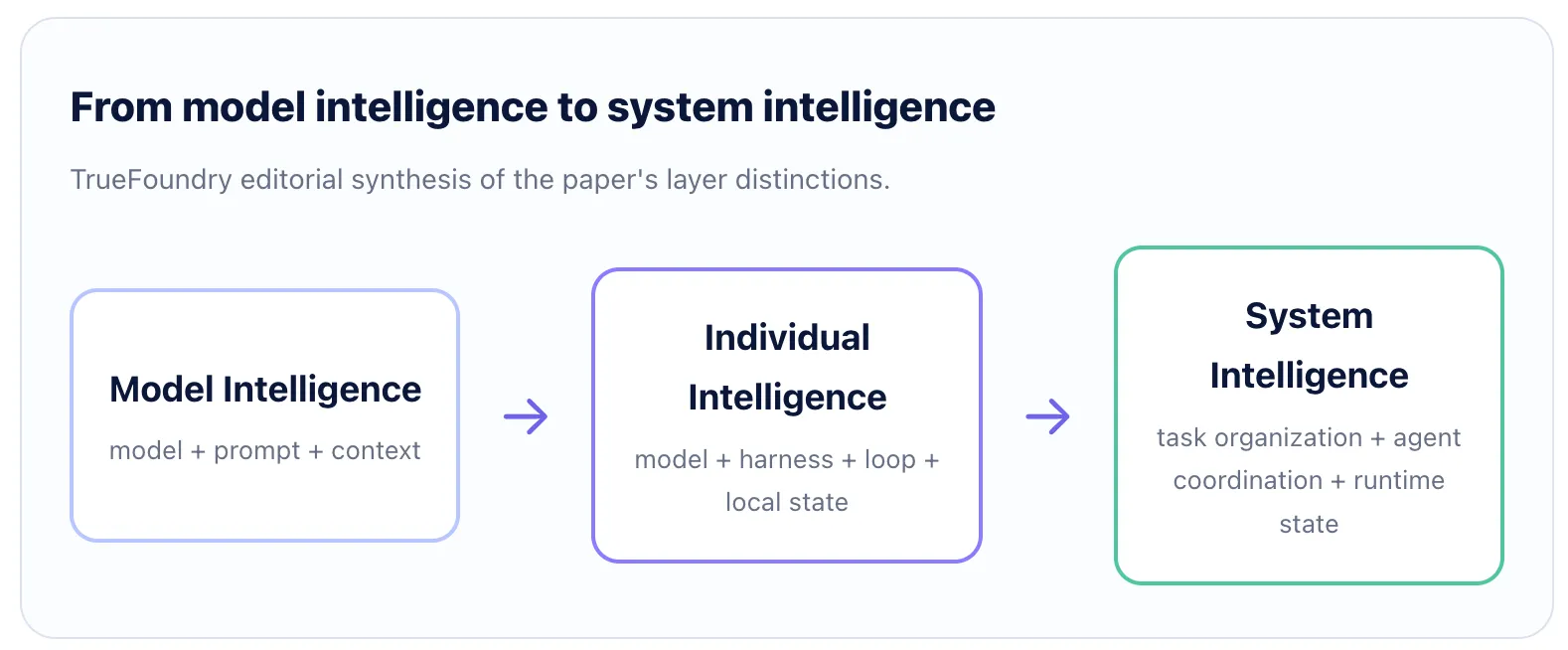
A new survey proposing Graph Engineering as an emerging paradigm offers a useful hierarchy for agent builders: prompting and context shape a model call; a harness and loop turn that model into a persistent agent; graph-level organization coordinates multiple agents, work structures, and runtime states into a system.
Graph Engineering Article Extract
Source note. This article is a TrueFoundry interpretation of Graph Engineering in the Era of LLM Agents: From Individual Intelligence to System Intelligence (arXiv:2608.21156, August 21, 2026). The paper introduces its own terminology and research framing. The product mapping to TrueForge and TrueFoundry is ours; the paper does not evaluate or endorse TrueFoundry products.
The paper's most useful production insight appears before its graph taxonomy. It reduces an individual agent to a compact systems equation:
That formula matters because it moves the engineering unit away from the model call. A model can reason and generate. An agent must keep resources available across calls, invoke tools, preserve state, interact with an environment, accept feedback, pause, resume, and keep operating as the task changes.
The production principle: the harness turns model capability into durable individual execution; graph engineering begins when the problem becomes how multiple units of execution, responsibility, and state should be organized as one system.
Key Takeaways - Graph Engineering
Key Takeaways
The agent harness is a first-class systems layer. The paper treats Harness Engineering as the runtime around the model: tools, memory, skills, execution environments, state, verification, and supporting mechanisms.
Harness and loop are different engineering objects. The harness determines which durable capabilities exist and how they are exposed; the loop determines how they are repeatedly invoked and adapted during execution.
Graph Engineering starts above the individual agent. Its three core concerns are Task Organization, Agent Coordination, and Runtime State Management.
TrueForge maps naturally to the individual-agent runtime. It runs the model/tool loop with MCP, context controls, sandboxing, approvals, subagents, sessions, and events.
TrueFoundry Gateways map to shared system boundaries. AI Gateway governs routed model traffic; MCP Gateway governs routed tool/data traffic; Agent Gateway provides shared agent registry/control surfaces. None of them replaces the application's graph orchestrator.
A "graph-native agent operating system" remains a research direction. Some of its proposed services resemble today's harness and gateway primitives, but it would be inaccurate to claim that current products already implement the paper's future architecture.
1. The paper makes the harness an engineering object, not glue code
The survey places Prompt Engineering, Context Engineering, Harness Engineering, Loop Engineering, and Graph Engineering on different layers rather than treating them as competing labels. Prompt and context operate closest to inference. Harness Engineering extends the model with persistent and executable capabilities across calls. Loop Engineering organizes repeated interaction with those capabilities. Graph Engineering addresses organization at the system level.
That separation is useful because “agent framework” often collapses very different concerns into one bucket. A tool schema, a session store, a sandbox, an approval checkpoint, and a retry loop are not the same kind of thing even if one SDK exposes them through one API.
The paper's Harness Engineering section groups four areas:
What actions and external capabilities the agent can reach
Memory management
Persistent memory, consolidation, retrieval, update, reconstruction and recovery
What information and experience survive beyond one model call
Skill composition
Reusable procedural capabilities, skill libraries, maintenance and evolution
How successful procedures become named, reusable runtime assets
Runtime orchestration
Configuration, security, verification, execution environments and optimization
How the surrounding runtime turns capabilities into a governable agent
The important point is scope. Harness Engineering is not simply “give the LLM tools.” It concerns the persistent runtime in which those tools, memories, skills, execution boundaries and controls remain usable across calls.
2. TrueForge maps cleanly to the paper's individual-agent runtime
This is where TrueForge has an unusually direct mapping to the paper's vocabulary. TrueForge's current documentation describes it as an open-source agent harness—the runtime layer around an LLM that runs the execution loop and connects MCP tools, skills, sandboxing, approvals, subagents, context management, and persistent session state.
The mapping is not merely rhetorical. TrueForge's server documentation says the server plans a turn, calls the model, executes tools, streams steps, pauses for human approval on sensitive actions, keeps context lean for long tasks, and persists sessions across reconnects and restarts. Its SDK makes Agent, Session, Turn, Event, and Delta explicit runtime objects.
TrueFoundry AI Gateway offre une latence d'environ 3 à 4 ms, gère plus de 350 RPS sur 1 processeur virtuel, évolue horizontalement facilement et est prête pour la production, tandis que LiteLM souffre d'une latence élevée, peine à dépasser un RPS modéré, ne dispose pas d'une mise à l'échelle intégrée et convient parfaitement aux charges de travail légères ou aux prototypes.
Conçu pour la vitesse : latence d'environ 10 ms, même en cas de charge







.webp)
.png)
.png)
.png)
.png)
.png)
.png)