September 30, 2026
|
5 min de lecture


Accédez instantanément à un environnement TrueFoundry en direct. Déployez des modèles, acheminez le trafic LLM et explorez la plateforme complète : votre sandbox est prête en quelques secondes, aucune carte de crédit n'est requise.



Published: September 30, 2026
Une méthode incroyablement rapide pour créer, suivre et déployer vos modèles !
Gartner has published the Hype Cycle for AI Governance Technologies, 2026 and it’s critical reading for platform architects and information security officers. This is the first edition to treat AI governance tooling as a market in its own right, separate from the governance disciplines it serves, and it arrives at the moment most enterprises are discovering that their AI policy documents have no enforcement surface behind them.
TrueFoundry was named as a Sample Vendor in two profiles in this Hype Cycle: AI Gateways and AI Engineering. Those two categories sit at opposite ends of the same problem. One is the runtime control point that every model call, MCP tool call and agent hop passes through. The other is the discipline Gartner rates as Transformational, defined in the report as "the discipline of designing, developing, delivering, operating, and governing tools and systems that use/deploy/apply AI to deliver business value."
Being recognized in both reflects the position we have taken since we started: governance that is bolted on after the platform is built will never be enforced, and a platform that cannot enforce policy is not an enterprise platform. Below are the nine findings we consider most consequential.
Get complimentary access to the full report here: Gartner® Hype Cycle™ for AI Governance Technologies, 2026
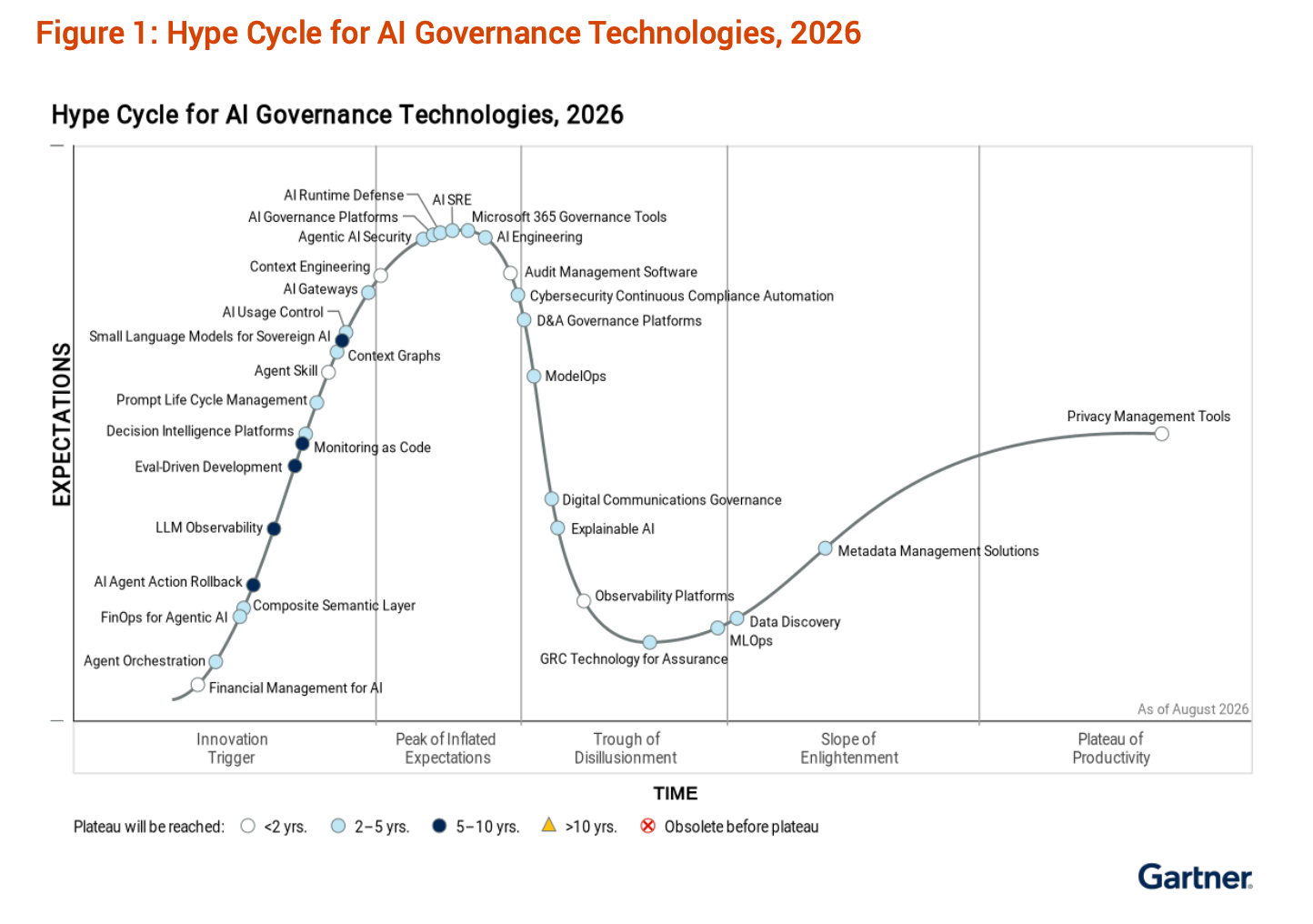
There are now two companion Hype Cycles. One covers governance disciplines, operating models and organizational capabilities, addressing what an organization must govern. This one covers the technologies that answer a different question, which Gartner states as "How will organizations implement governance at scale?"
The relationship between them is important. As the report puts it:
"Some technology markets respond to urgent operational challenges faster than organizations can evolve governance operating models."
The consequence is that several of these technologies are maturing alongside or ahead of the disciplines they were meant to serve. For platform leaders, that inverts the usual sequence. Your tooling decisions will land before your policy decisions do, which means the control point you select this year will define the outer limit of what your governance program can enforce for the next three.
Among the report's strategic planning assumptions:
"By 2028, loss of control, where agents pursue misaligned goals or act outside constraints, will be the top concern for 40% of Fortune 1000 organizations."
This is a material shift in what governance is being asked to do. Model risk is a property you can assess before deployment, through evaluation, documentation and review. Behavioral risk is a property of a system in motion, and it can only be addressed where the action actually happens. That distinction explains the composition of this Hype Cycle, where the newer and earlier-stage innovations are overwhelmingly runtime enforcement points rather than assessment frameworks.
Two further assumptions add more context to this finding. Gartner projects that governance technologies will reduce regulatory compliance costs by 70% by 2028, and that by 2029 enterprises implementing AI governance will outperform ungoverned competitors in AI adoption by 25%.
The Gartner Board of Directors Survey 2026 found 91% of surveyed board members view AI as an opportunity to drive shareholder value. The 2025 Gartner AI Survey, CIO and Technology Leader View, found 74% of CIOs reporting that implementation costs break even with or outweigh realized benefits.
The mechanism behind that gap is agentic economics, which Gartner describes as:
"Agentic AI changes the spend pattern from a predictable 'per user per session' to an unpredictable 'per decision path' that can branch, retry, call tools, expand context or involve multiple agents."
The report groups three emerging capabilities against this: financial management for AI, FinOps for agentic AI, and AI usage control. Gartner also cites its forecast that task-specific agents will feature in roughly 40% of enterprise applications by the end of 2026, up from under 5% in 2025.
The operational conclusion is unambiguous. Cost attribution has to resolve to the decision path rather than the user or the application. Budget enforcement, model routing, caching and per-step attribution are governance controls in an agentic estate, and they belong at the same chokepoint as access control.
In the Gartner report, the lead theme is that agentic governance is becoming operational, covering agent orchestration, agent skill management, action rollback and agentic AI security. The report is clear about what happens without a control plane:
"Without orchestration, AI agents will sprawl across the enterprise and become chaotic and unmanageable, limiting business impact."
Agent orchestration currently sits at less than 1% market penetration with an Emerging maturity rating, which tells you how early the enforcement layer is relative to the deployment curve.
Interestingly, AI agent action rollback, rated Embryonic, identifies and reverses the effects of an agent's actions on data, identity objects and infrastructure state. The report’s framing of why it exists deserves to be read by anyone who believes guardrails are sufficient:
"Agentic AI guardrails can limit agent activity, but they do not remediate its consequences."
Prevention and remediation are separate capabilities, and most enterprise agent programs today have neither at the hop level.
"As AI systems gain greater decision-making authority and require less direct human intervention, governance and cybersecurity teams increasingly require shared capabilities for inventory management, policy enforcement and monitoring."
The technologies Gartner groups under this theme include AI governance platforms, D&A governance platforms, explainable AI, cybersecurity continuous compliance automation, Microsoft 365 governance tools, GRC technology for assurance and audit management software. The report also reports a striking effectiveness gap:
"Organizations that have deployed AI governance platforms are more than three times as effective in their AI governance programs than those who did not deploy them."
The organizational implication is the one most enterprises will get wrong. When two functions independently require the same inventory and the same enforcement point, the default outcome is two of each, neither authoritative. Establishing ownership of the chokepoint early is considerably cheaper than reconciling two partial registries later.
The report's position on where AI failures originate is one platform teams should internalize:
"Organizations increasingly recognize that AI failures often stem from inadequate context, poor grounding and unmanaged knowledge assets."
The enabling technologies here are context engineering, context graphs, AI gateways, decision intelligence platforms and prompt life cycle management. The report's taxonomy of context failure modes gives platform teams precise vocabulary for problems they are already debugging without names: information lost in the middle of a long window, poisoning through repeated hallucinated content, distraction where excessive context crowds out training knowledge, confusion from irrelevant content, and clash between contradictory sources.
"Organizations are increasingly moving from periodic governance reviews to continuous assurance. They are achieving this by monitoring AI behavior in real time and applying automated controls, which embed governance directly into AI operations."
Four technologies carry this theme: LLM observability, AI runtime defense, monitoring as code, and eval-driven development. LLM observability is rated Embryonic at 1% to 5% penetration, and the report explains why existing monitoring stacks do not transfer:
"As GenAI systems move into business-critical workflows, traditional monitoring approaches prove insufficient to detect quality degradation, hallucinations or compliance risks."
Latency and uptime tell you nothing about hallucination rate, factual accuracy, bias, toxicity or token utilization. Gartner further predicts that explainable AI will drive observability investment across half of GenAI deployments by 2028.
Of the four, eval-driven development is where we would concentrate effort first. Applying test-driven principles to nondeterministic systems, with evals operating as fitness functions in both development and production, is the only reliable method for extracting predictability from components that do not provide it natively.
"Growing requirements for data residency, jurisdictional oversight and infrastructure independence are driving interest in sovereign AI."
Gartner positions established investments in privacy management, metadata management and data discovery as the foundational controls that sovereign AI is built on, with sovereign cloud and small language models for sovereign AI as the operationalizing technologies. The latter is rated High benefit at Emerging maturity.
One recommendation from that profile has application well beyond sovereignty:
"Evaluate AI workloads by cost, latency, data sensitivity and regulatory risk, not model capability alone."
For platform leaders this resolves to a deployment topology question. Whether the gateway, control plane and model serving can operate entirely inside your own boundary is no longer a line item on a security questionnaire. In financial services, healthcare and public sectors, it determines whether the programme proceeds.
AI Gateways sit at 1% to 5% market penetration with an Embryonic maturity rating. Gartner is explicit about the trajectory:
"As the market matures, expect to see consolidation into a single offering that supports multiple use cases."
The AI Engineering profile reaches the same conclusion from the delivery side. Gartner identifies tooling fragmentation as a critical obstacle, describing how "enterprises accumulate separate point tools for pipelines, model registries, observability, evaluation, and governance," with integration debt that slows delivery and undermines auditability.
The Gartner buying guidance for gateways follows from the same analysis: run a rigorous proof of concept, evaluate against real technical and operational requirements before full deployment, and weight vendor innovation roadmap heavily, because standards and regulations in this space are still moving and retrofits are expensive.
Our inclusion in both the AI Gateways and AI Engineering profiles reflects an architectural position rather than two separate product lines.
Gartner defines an AI gateway as "a tool that acts as an intermediary between applications and various artificial intelligence services or models," providing a central point for security, governance and observability. The TrueFoundry AI Gateway is that central point for models, MCP servers and agents together, with access control, key management, budget and rate limiting, guardrails, prompt management and full request tracing built into the data path rather than assembled around it.
Our agent governance model operates directly on the call path. At every hop, the gateway resolves both the end user and the calling agent as distinct principals, evaluates authorization before any token is issued, mints a token scoped to exactly the next callee rather than forwarding one unchanged, applies content guardrails to the request and the response, and records the subject, actor chain, decision and scope for audit.
The split-plane architecture allows the control plane, gateway plane and compute plane to run inside your own cloud account or on-premises environment, which addresses the sovereignty requirements the report's sixth theme describes.
To evaluate this against your own architecture, speak with our team and we will work through your actual agent call paths.
TrueFoundry AI Gateway offre une latence d'environ 3 à 4 ms, gère plus de 350 RPS sur 1 processeur virtuel, évolue horizontalement facilement et est prête pour la production, tandis que LiteLM souffre d'une latence élevée, peine à dépasser un RPS modéré, ne dispose pas d'une mise à l'échelle intégrée et convient parfaitement aux charges de travail légères ou aux prototypes.





Les dernières nouvelles, articles et ressources envoyés dans votre boîte de réception
.webp)
.png)
.png)
.png)
.png)
.png)
.png)
.png)
.png)
.png)
.png)
.png)