noviembre 19, 2026
|
5 minutos de lectura


Obtenga acceso instantáneo a un entorno TrueFoundry en vivo. Implemente modelos, dirija el tráfico de LLM y explore la plataforma completa: su sandbox estará listo en segundos, sin necesidad de tarjeta de crédito.




¡Una forma increíblemente rápida de crear, rastrear e implementar sus modelos!
Publishing detail
Value
Meta description
The Oodle integration with TrueFoundry AI Gateway sends traces, cost and metrics to Oodle without code changes. See how to set it up and track LLM spend.
URL slug
/blog/oodle-integration-with-truefoundry-ai-gateway
Primary keyword
oodle integration with truefoundry ai gateway
Secondary keywords
AI observability, agent observability, LLM observability, AI agent observability, OpenTelemetry LLM tracing
Link-text keywords
AI gateway observability, LLM cost tracking
SEO title
Oodle integration with TrueFoundry AI Gateway: no SDK needed
Hero image alt text
TrueFoundry and Oodle logos on a co-branded launch banner
Byline
Rohan Ganesh, Partnerships at TrueFoundry
Publish date
November 17, 2026

When an AI agent gives a wrong answer or runs up a surprising bill, the first question is which request caused it. Most teams can't answer that quickly. Every app logs its model calls a little differently, if it logs them at all, and finance wants spend by team in a format nobody planned for. Today we're launching the Oodle integration with TrueFoundry AI Gateway, which answers that question at the one point every model call already passes through.
With export turned on, each LLM call through the gateway appears in Oodle as a trace with its model, latency and cost, next to the rest of your telemetry. That is what AI observability means in practice: a record of what each model and agent call did, how long it took, what it cost and where it failed. A platform admin turns on the export once in the gateway settings, and app teams don't change any code.
The TrueFoundry AI Gateway sits between your applications and the models they call. Teams reach 1,600+ models through one OpenAI-compatible API, while the platform team sets routing, fallbacks, guardrails, budgets and rate limits in one place. Our MCP Gateway puts access control and guardrails on the tools that agents call.
Because every request passes through it, the gateway knows things no single app does: which team sent a request, which model served it, whether a guardrail stepped in or a budget blocked it, and what it cost. Our guide to AI gateway observability covers these signals in more depth.
Oodle describes itself as "observability built for agents". Alongside metrics, logs, traces, APM, real user monitoring and infrastructure monitoring, it offers AI agent observability: traces, evaluations, prompt management and automated insights. We run alerting for our own gateway and platform on Oodle.
Oodle is built on OpenTelemetry, the open source, vendor-neutral framework for traces, metrics and logs. The gateway can label its spans with OpenTelemetry's semantic conventions for generative AI, the standard names for model calls, so Oodle recognizes them as GenAI traces. Oodle also keeps every trace by default instead of sampling, so the one request a user complains about is still there when you look for it.
Most AI observability starts inside the application. Each team adds an SDK, and coverage depends on who remembered to. OpenTelemetry LLM tracing at the gateway works differently: the gateway records every model call as a standard trace, so one export setting covers every app and agent that calls a model through TrueFoundry, including the ones nobody instrumented. It also captures events only the gateway sees, such as fallbacks between providers and requests blocked by a budget or rate limit.
Area
TrueFoundry AI Gateway
Oodle
Each request
Records a timed span for each guardrail check, the model call and the provider call
Shows the request as a GenAI trace with model, latency and cost, plus the prompt and response
Cost
Calculates the cost of every request
Prices each call from model rates set in Oodle and breaks down spend for chargeback
Limits and alerts
Enforces budgets and rate limits and records each block
Runs monitors with runbooks and routes alerts to on-call tools
Quality
Applies guardrails and records each result
Scores traffic with LLM-as-judge evaluators and turns failing traces into test datasets
Agent access
Lists the Oodle MCP server and controls who can call which of its tools
Answers agents' queries about logs, metrics, traces and alerts
Setup and data
An admin turns on export once, and TrueFoundry keeps its own copy
Keeps every trace by default instead of sampling
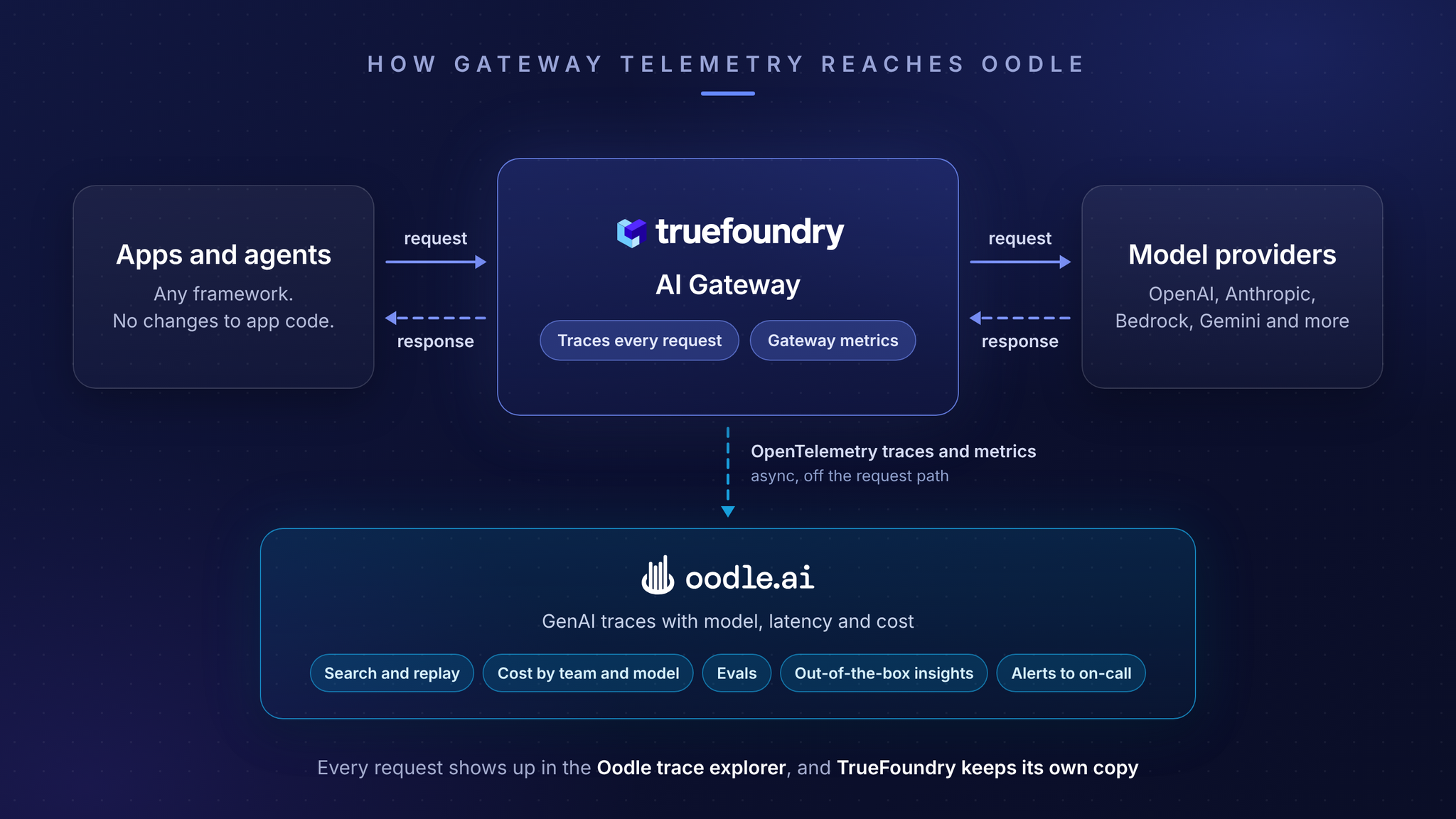
Gateway traces cover every model call. For full agent sessions, per-user views and agent graphs, teams also add OpenTelemetry to the app itself. When the app passes its trace context along, the gateway continues the same trace, and the app's spans line up with the gateway's in Oodle.
Our Oodle setup guide and Oodle's TrueFoundry guide have the details for each step.
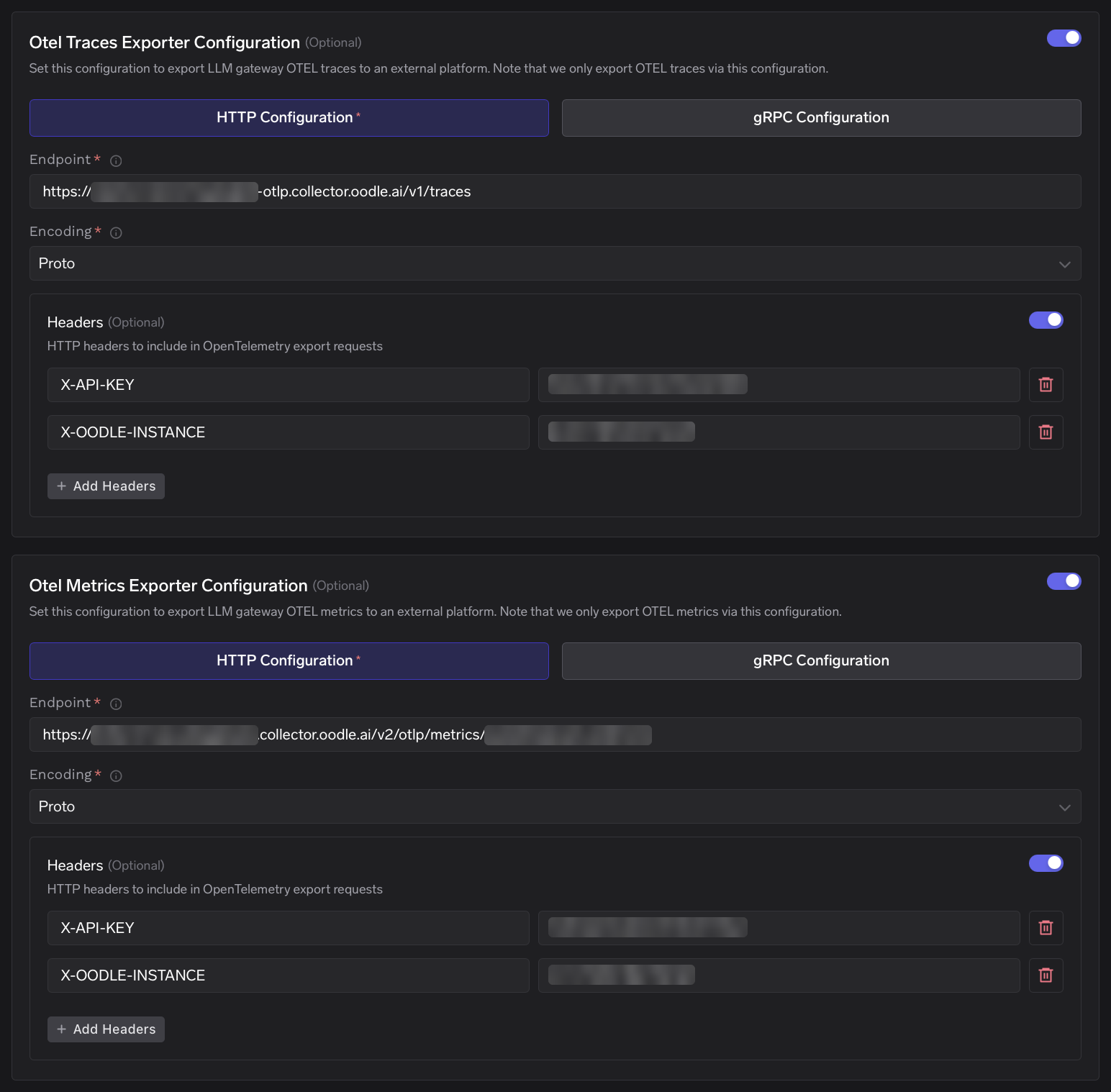
In hybrid and self-hosted deployments, the gateway running in your own cluster sends the traces to Oodle itself, and the setup guide covers that path. Gateway traces can include full prompts and responses, so check Oodle's data handling terms before you turn on export.
When someone reports a bad answer, you can find the exact request behind it by searching on user, team, error type, guardrail result, request metadata or text in the prompt or response. A gateway trace in Oodle contains:
We verified the first two on gateway traffic in our test environment. If a fallback kicked in, Oodle shows each attempt as its own span under the same request, and you can open the trace in Oodle's playground to replay the conversation and test a fix.
We compared Oodle's cost figures with the gateway's own in our test environment, and the per-request figures matched. On one test request, Oodle showed $0.030 and the gateway $0.029958, the same amount rounded to a tenth of a cent.
Oodle prices each call from the model rates you set in Oodle, so keep those in line with your provider pricing. From there you can split spend by model, team, user or any metadata label for chargeback, and get an alert when spending climbs. For the finance side, see our guide to LLM cost tracking.
In our tests, these gateway metrics arrived in Oodle next to the traces:
Oodle monitors can alert on any of these and send the alert to Slack, PagerDuty, Opsgenie, Rootly, Google Chat or Microsoft Teams with a runbook attached.
Oodle can flag behavior as traces arrive, such as refusals or a user asking the same thing again without getting an answer, and you can describe a custom signal in plain English. It also runs LLM-as-judge evaluators for issues like hallucination and toxicity.
Teams can add failing traces to a dataset and test a new prompt or model against those real cases before it ships. We haven't tested these features on gateway traffic yet, so Oodle's docs are the reference for how they behave.
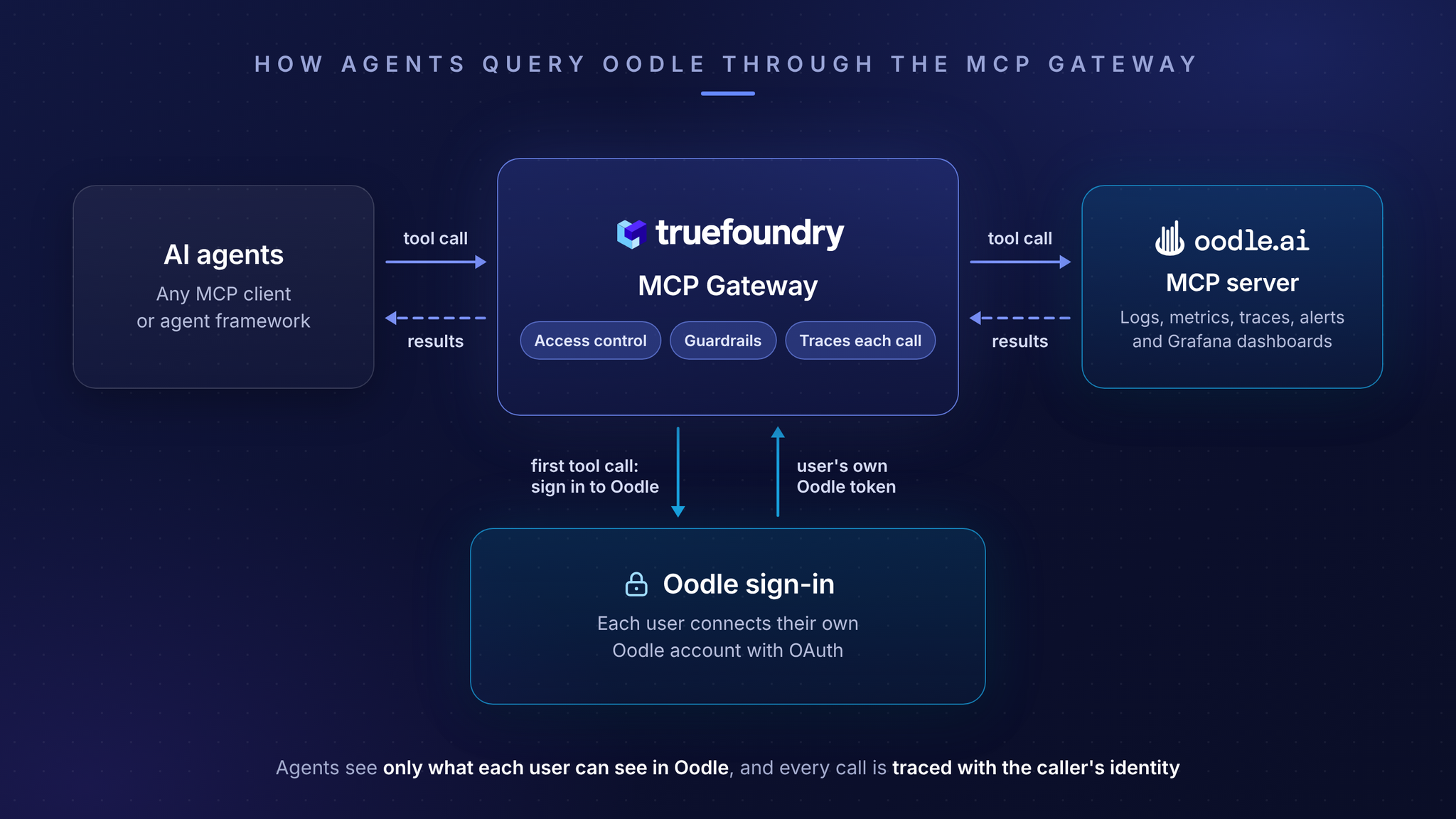
The Oodle MCP server is listed among the official remote MCP servers in our MCP Gateway. Agents behind the gateway can use it to query logs, metrics, traces and alerts in Oodle and to work with Grafana dashboards. An on-call agent, for example, can list active alerts and pull the traces behind them.
With OAuth sign-in, each user connects their own Oodle account, so an agent sees only what that person can see in Oodle (an Oodle API key works too). The gateway decides who can use which Oodle tools, applies guardrails to those calls and traces each one with the caller's identity.
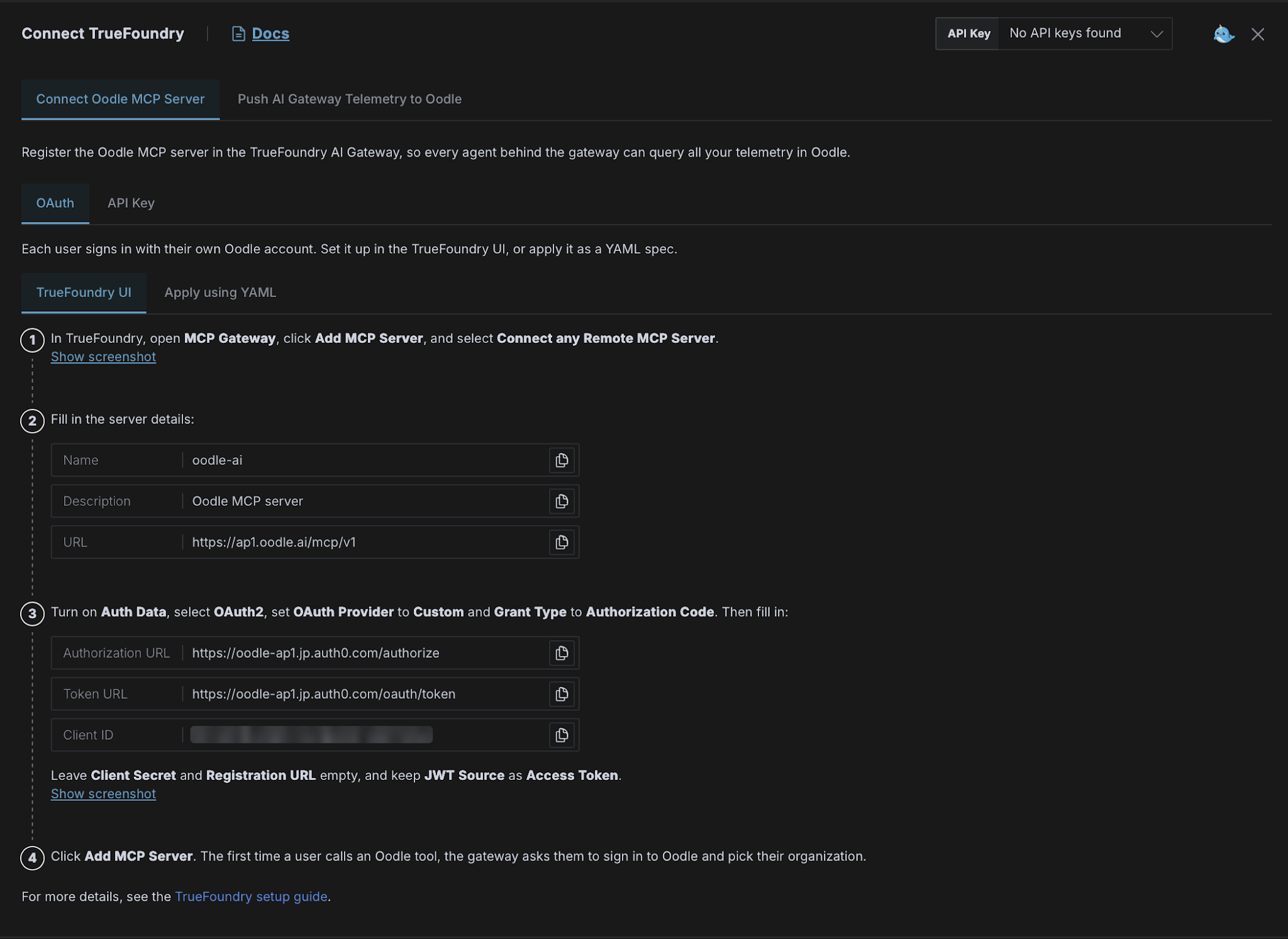
It connects the two products in two ways, and each works on its own. The gateway exports OpenTelemetry traces and metrics for every request to Oodle, where teams debug calls and track cost. Separately, Oodle's MCP server is available in TrueFoundry's MCP Gateway, so agents can query Oodle under the gateway's access controls.
LLM observability tracks individual model calls: the prompt, the response, latency, errors and cost. That is enough to debug a single slow or wrong answer. Agent observability follows a whole agent run across many model and tool calls to explain why the agent did what it did. Gateway export covers every model call, and instrumenting the agent itself joins those calls into full agent traces in Oodle.
Very little. The gateway adds under 3 ms of internal latency, and in our published benchmark, run on a machine with 1 vCPU and 1 GB of memory, it handled 350+ RPS. Telemetry export to Oodle runs off the request path, so an Oodle outage can't block a model call.
Yes. The MCP Gateway sits in front of the MCP servers your agents use, including Oodle's. It controls who can call which tool and applies guardrails to those calls, and it traces each call with the caller's identity. Gateway metrics in Oodle include MCP request counts and latency, so tool traffic shows up next to model traffic.
Yes. The gateway exports standard OpenTelemetry traces and metrics, so it works with Oodle and with other OpenTelemetry-compatible backends you may already run. Our export docs explain how to connect them.
Turning on the Oodle integration with TrueFoundry AI Gateway is a one-time change in the gateway settings that needs no application code. From then on, every model call through the gateway reaches Oodle as a trace with its cost attached, where engineers can debug it and finance can report on it.
Book a demo to see the gateway and Oodle working together on your own traffic, or explore the TrueFoundry AI Gateway. To set it up now, follow our Oodle setup guide or Oodle's TrueFoundry guide, and start at oodle.ai if you don't have an Oodle account yet.
These estimates come from Google Trends (US, last 12 months, each term compared against "llm gateway"). They were converted to monthly searches using two Semrush volumes from the BOFU keyword sheet ("llm gateway" 720 and "mcp gateway" 880, treated as 2025 averages and brought forward with each term's own Trends history), and checked against Google Autocomplete and live search results. Semrush itself was not used.
The order between terms is reliable. The larger terms are probably within ±50%, and terms under about 300 searches a month are too thin for Trends to measure.
Term
Searches a month now (US)
12-month average
Last 6 months
Ranking difficulty
Use in post
agent observability
~2,400 (1,900 to 3,000)
~3,200
Rising, 2.1×
Very hard
Oodle section heading
ai observability
~2,300 (1,800 to 2,900)
~5,300
Steady
Very hard
H1 and meta description
llm evaluation
~2,600 (2,100 to 3,300)
~9,900
Easing
Not checked
Mention only
llm observability
~800 (650 to 1,050)
~5,900
Falling after an early-2026 peak
Very hard
Intro and FAQ
ai agent observability
~250 (200 to 350)
~960
Rising, 2.7×
Very hard
Body text
llm monitoring
~200 (150 to 250)
~750
Steady
Hard
Skip
ai observability tools
~220
~1,100
Falling
Very hard (listicles)
Skip
llm observability tools
Under ~100
~310
Falling
Very hard (listicles)
Skip
opentelemetry llm
Under ~300
~620
Steady
Medium
How it works
llm tracing
Under ~300
~350
Steady
Medium
Body text
llm cost tracking
Under ~300
~510
Falling
Medium
Link text only
ai gateway observability
Under ~200
~220
Rising from a tiny base
Medium
Link text only
agentic observability
Under ~300
~520
Steady
Not checked
Skip
truefoundry ai gateway
Under ~100
n/a
n/a
Not checked
Body text
oodle ai
Under ~100
n/a
n/a
Easy
"Oodle (oodle.ai)" on first mention
oodle integration with truefoundry ai gateway
Under ~100
n/a
n/a
Easy, nothing ranks yet
Primary keyword
Where TrueFoundry already ranks:
TrueFoundry AI Gateway ofrece una latencia de entre 3 y 4 ms, gestiona más de 350 RPS en una vCPU, se escala horizontalmente con facilidad y está listo para la producción, mientras que LitellM presenta una latencia alta, tiene dificultades para superar un RPS moderado, carece de escalado integrado y es ideal para cargas de trabajo ligeras o de prototipos.



Las últimas noticias, artículos y recursos enviados a tu bandeja de entrada