noviembre 18, 2026
|
5 minutos de lectura


Obtenga acceso instantáneo a un entorno TrueFoundry en vivo. Implemente modelos, dirija el tráfico de LLM y explore la plataforma completa: su sandbox estará listo en segundos, sin necesidad de tarjeta de crédito.



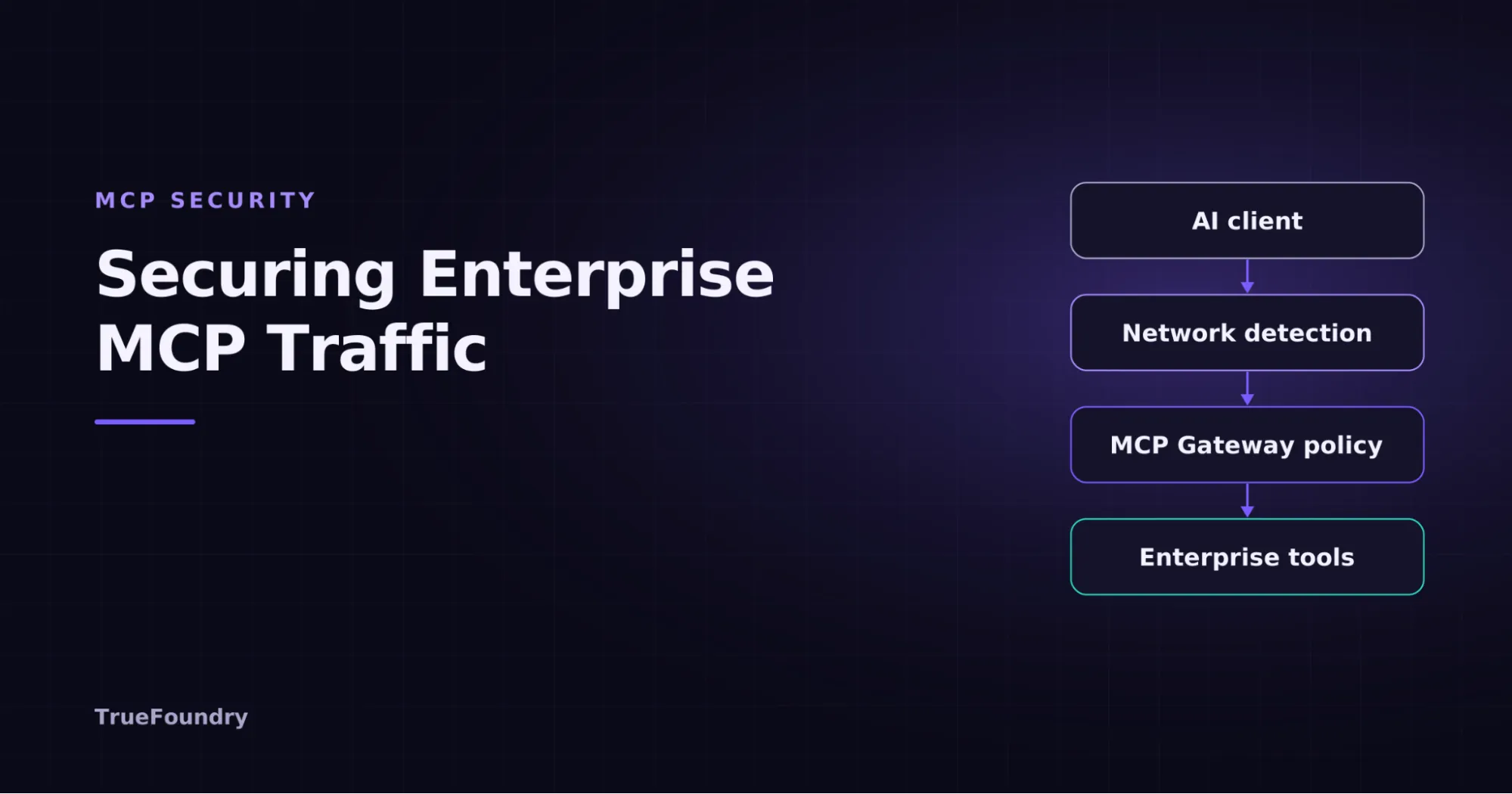
¡Una forma increíblemente rápida de crear, rastrear e implementar sus modelos!
A developer can add a remote MCP server URL to an AI coding assistant within minutes. The connection may reach customer data, data sources, or other sensitive data before security teams know it exists. That speed makes the Model Context Protocol useful, while also creating a new enterprise security path.
Understanding how Cloudflare detects MCP traffic starts at the network layer. Remote Streamable HTTP connections can pass through a Secure Web Gateway, where network control can identify protocol signals. Cloudflare added automatic MCP detection to Gateway on August 12, 2026. It can then apply policy to detected traffic.
Detection still covers only the first security layer. Enterprises also need to know which tools an AI agent can discover and invoke. For teams searching for how Cloudflare Secure MCP traffic, the complete answer includes network enforcement and protocol-aware tool governance.
Cloudflare MCP traffic detection identifies remote connections moving through managed Gateway paths. This gives security teams visibility into MCP clients and the destinations they reach. How Cloudflare detects MCP traffic shows whether managed network paths can recognize MCP activity before deeper policy evaluation.
That matters because developers can connect Claude Code or another client directly to MCP servers. These direct MCP connections can create Shadow MCP when teams use unapproved servers outside approved governance. Shadow MCP traffic can therefore appear before a central AI platform has any record of the connection.
Cloudflare also distinguishes approved portal use from a direct connection that bypasses the portal. MCP Server Portals place multiple approved servers behind one endpoint and Cloudflare Access policy. Portal traffic can then follow a curated tool catalog, authentication controls, and logging.
Detection therefore proves that an MCP connection exists before deeper policy evaluation. It does not prove that every tool behind the connection is safe. That distinction becomes important once tool usage can change business systems.
Earlier detection approaches often depended on hostnames, paths, or request bodies. Those signals can miss an individual server hosted on an ordinary URL. How Cloudflare detects MCP traffic now relies on protocol-specific headers and payload characteristics available after TLS decryption. Gateway exposes detected traffic through the beta experimental.is_mcp selector. Because it remains beta, teams should review behavior as controls evolve in the coming months.
For modern MCP 2026-07-28, the core protocol is stateless. Every Streamable HTTP POST request carries its protocol version, and standard headers include Mcp-Method and Mcp-Name. The modern revision removed the initialize handshake entirely. Older 2025-era clients still begin with an initialize request before later exchanges.
This change makes Streamable HTTP clients easier for gateways to recognize and route. Cloudflare can apply HTTP policies after the request travels through the Cloudflare One Client and Gateway. Detection therefore depends on traffic reaching the inspected path and exposing usable protocol signals.
Matching activity appears in Gateway HTTP logs and the AI security report. The dashboard shows MCP requests, unique users, unique servers, and related Gateway policies. Teams can also use the Traffic Source selector to distinguish approved portal routes from other traffic.
This produces a network-level view without requiring manual server inventories. Cloudflare treats those protocol signals as a strong positive indicator of MCP. Missing signals still do not prove MCP is absent. Coverage depends on transport, inspection, and client behavior.
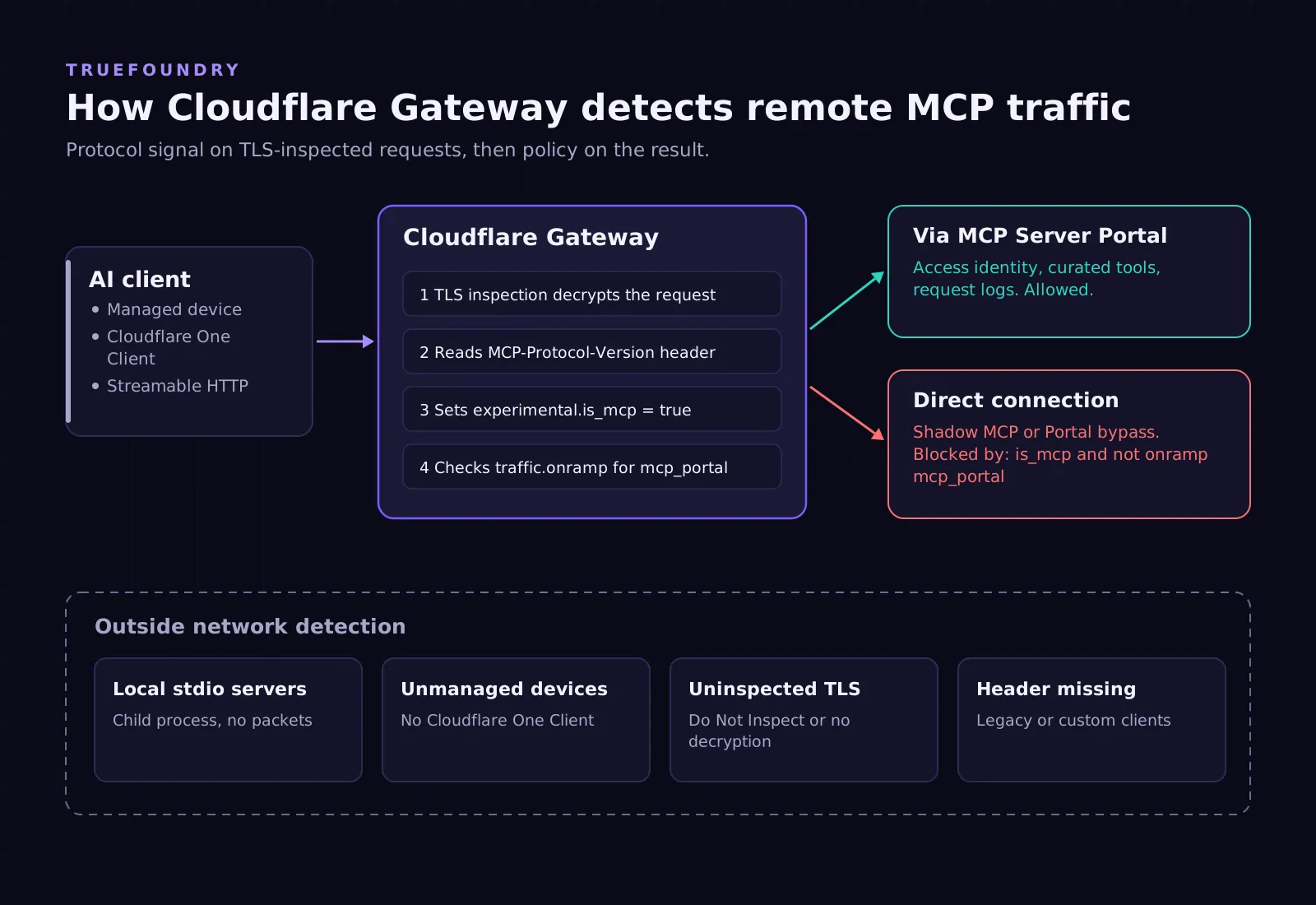
A detection signal matters only when it feeds an enforceable decision. Gateway can support allow, block, or isolate actions through HTTP policies. Security teams can evaluate the user, device, destination, and route before traffic reaches the public internet.
A baseline policy can block MCP when the Traffic Source is not the approved MCP Portal. That limits Shadow MCP traffic on managed paths and makes approved Portal traffic easier to identify. Teams can first observe the rule in logs before enforcing it.
Portal traffic routes can also pass through Cloudflare Gateway for richer logging and Data Loss Prevention scanning. Administrators can create an Access application, define an Access policy, and decide which users can enter the portal. This adds identity checks before portal sessions reach any upstream server.
Cloudflare portals support OAuth-protected servers through Dynamic Client Registration or manual OAuth credentials. For OAuth clients, admins can register a new server through an OAuth application. That setup can include client IDs, a client secret, and a callback URL. Custom headers can authenticate an upstream provider when OAuth providers are not appropriate.
The same portal can reduce tool context with Code Mode. Cloudflare's Agents SDK can also connect agents to MCP servers as a client. These controls help secure MCP servers, although they do not replace tool-level authorization inside the MCP execution path.
Origin-side enforcement hints at the larger limit. Network detection does not capture every MCP interaction, and the blind spots stem from how MCP and proxies operate.
Cloudflare itself frames the header as a strong positive signal whose absence proves nothing. Treat detection coverage as partial by design.
The deeper split is between two kinds of questions. Network controls answer: where is the client connecting? Application-level MCP governance answers: what is the agent allowed to do after it connects? Map both the network paths and the MCP execution paths when you define coverage.
Seeing a connection does not explain what each tool can do. One server may expose harmless search alongside record updates or destructive administration. Cloudflare MCP security therefore needs a second control layer after network admission.
Cloudflare portals can curate available tools and log tool activity. Network rules answer whether the client can reach the destination. An MCP-aware gateway answers which tool a specific identity can discover or invoke. That distinction is central to MCP access control.
The tool policy also needs sufficient business context to make safe decisions. A read operation can still expose sensitive data, while a write operation can change state. Per-tool access should consider identity, server, tool, arguments, and environment, rather than treating every tool equally.
TrueFoundry's enterprise MCP governance guidance follows this control boundary. It places deterministic tool access outside prompts and inside infrastructure. That model is useful when network policy has already approved the connection.
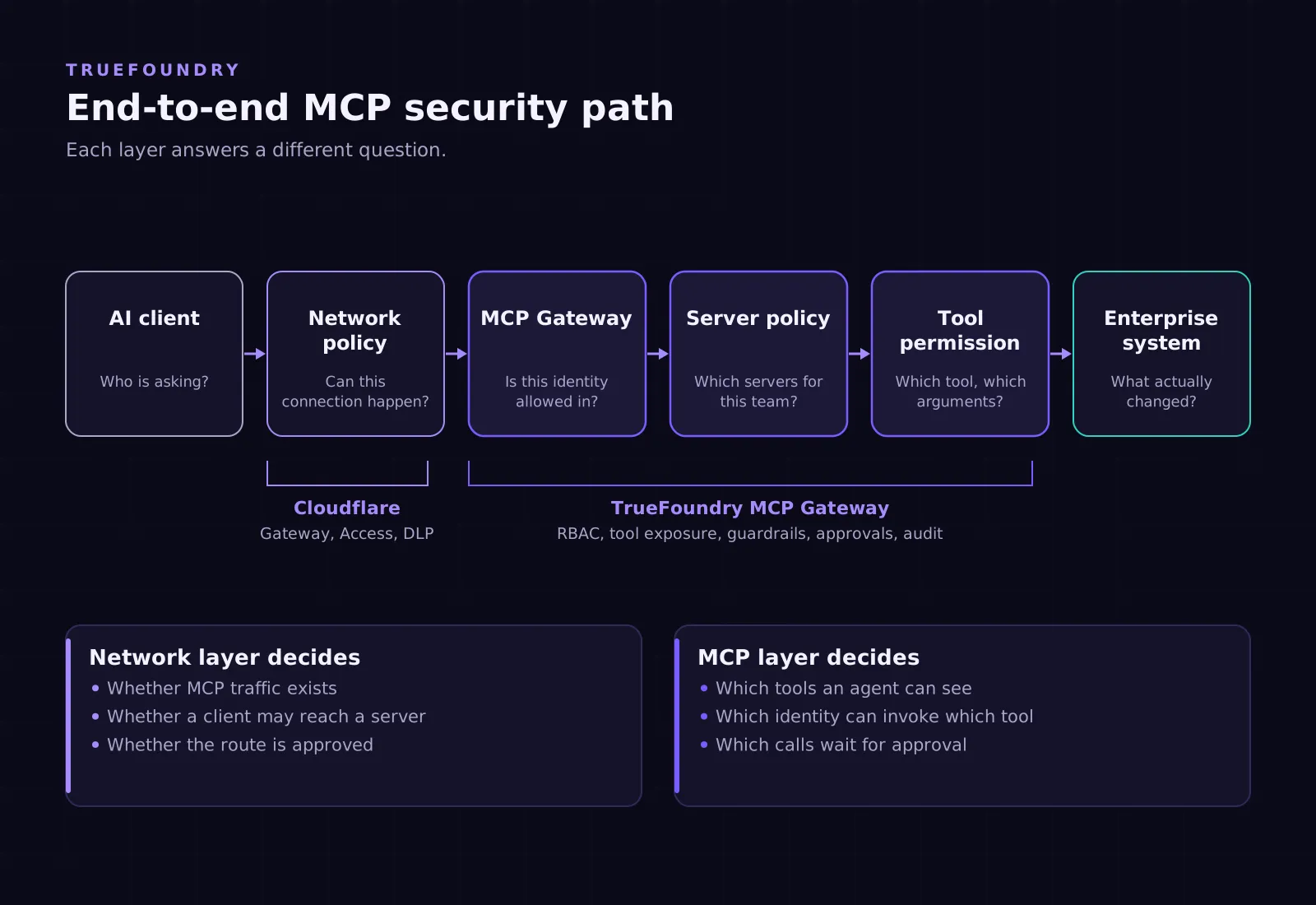
Strong MCP security uses multiple layers rather than a single product. The network layer controls where clients connect, while an MCP Gateway controls access to servers and tools. An LLM Gateway can separately govern model requests when the same application also calls LLM providers.
The approved architecture usually follows this straightforward security path:
AI client → network policy → MCP Gateway → server policy → tool permission → enterprise system
Teams can make the MCP Gateway the approved destination for every remote MCP server. Developers then register a single governed gateway URL for each client. The gateway can hold upstream credentials instead of placing secrets on laptops.
{
  "mcpServers": {
    "github": {
      "url": "https://<gateway>/<tenant>/mcp/github/server"
    }
  }
}
On first use, the client opens a TrueFoundry sign-in (SSO where configured), and per-user provider tokens stay in the gateway rather than on the laptop. On the network side, the Cloudflare rule can then allow MCP only toward that hostname. One way to write it, with the gateway's real host substituted:
experimental.is_mcp == true and http.request.host != "<gateway-host>"
Action: Block
This design separates network control from execution control. It also gives teams a stable place for tool policies, approvals, guardrails, and audit records. How Cloudflare detects MCP traffic becomes one input to a broader security architecture rather than the final enforcement decision.
Per-request controls are easier when a person initiates each operation. Autonomous agents can make many calls while completing one objective. A billing agent may search records, retrieve an invoice, update a CRM field, and send a reply.
At the network layer, those calls can look unrelated. An Agent Gateway connects model calls, tool activity, limits, costs, and execution traces across the same run. AI agent observability then helps teams reconstruct why one action followed another.
This workflow context matters when a single bad result triggers several subsequent calls. Network logs identify destinations, while agent traces explain intent and sequence. The combination gives teams more useful evidence during investigation.
Blocking unapproved servers is only the starting point. Approved servers and tools still need monitoring because allowed paths can fail as well. Teams should track MCP usage, denied calls, authentication failures, tool latency, and unexpected changes in tool activity.
Teams should monitor these signals after policies take effect:
Two signals deserve alerts rather than passive dashboards. Repeated denials can indicate a misconfigured agent or permission probing. Sudden growth in write tools without matching user demand can indicate a retry loop. A broader operating model should connect these alerts with agent and MCP investigation workflows.
Cloudflare Gateway analytics can also be queried through the GraphQL Analytics API. That gives teams another way to aggregate HTTP activity across managed traffic. Network telemetry still requires tool-level logs to provide a complete execution trail.
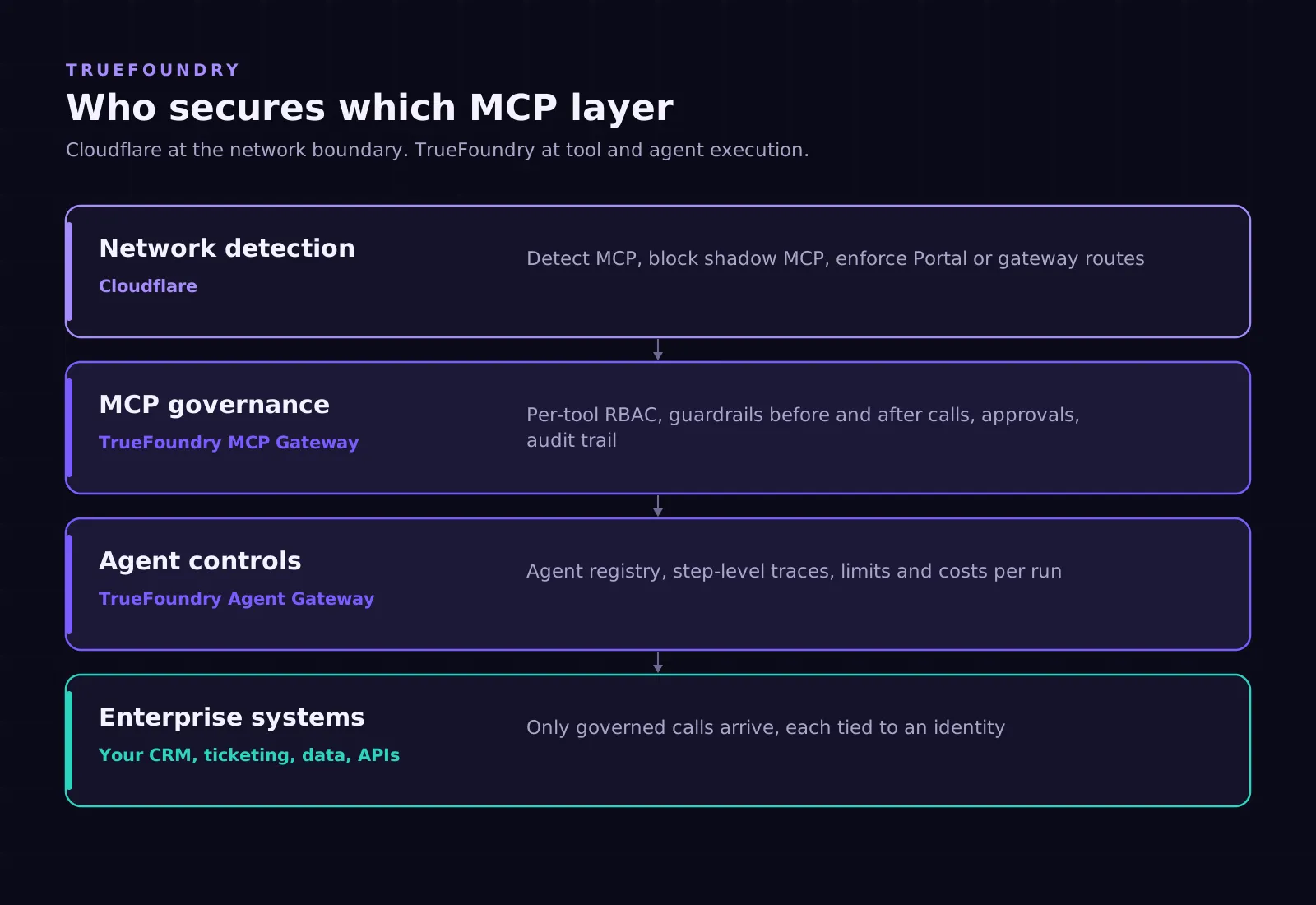
Cloudflare and TrueFoundry operate at different control layers. Cloudflare handles network visibility and connection policy across managed paths. TrueFoundry governs AI traffic, MCP tools, and agent execution after those paths are approved.
For teams evaluating how Cloudflare detects MCP traffic, this division keeps responsibilities clear. Network enforcement answers whether a connection should reach the approved route. TrueFoundry's AI Gateway adds a broader control plane for models, tools, guardrails, budgets, and agents.
On the MCP side, TrueFoundry can apply per-server and per-tool access rules. MCP tool approvals can pause higher-impact calls before execution. Guardrails and audit records then remain close to the actual tool request rather than the surrounding network session.
TrueFoundry also supports VPC, on-premises, and air-gapped deployment options. This helps organizations keep sensitive tool traffic and credentials inside approved environments. The result complements Cloudflare MCP traffic security with execution-level governance closer to enterprise systems.
If you want to walk through that layered setup against your own MCP servers, book a demo with the TrueFoundry team.
TrueFoundry AI Gateway ofrece una latencia de entre 3 y 4 ms, gestiona más de 350 RPS en una vCPU, se escala horizontalmente con facilidad y está listo para la producción, mientras que LitellM presenta una latencia alta, tiene dificultades para superar un RPS moderado, carece de escalado integrado y es ideal para cargas de trabajo ligeras o de prototipos.



Las últimas noticias, artículos y recursos enviados a tu bandeja de entrada