Erhalten Sie sofortigen Zugriff auf eine TrueFoundry-Live-Umgebung. Stellen Sie Modelle bereit, leiten Sie den LLM-Verkehr weiter und erkunden Sie die gesamte Plattform — Ihre Sandbox ist in Sekundenschnelle einsatzbereit, ohne dass eine Kreditkarte erforderlich ist.
9,9
TrueFoundry vs. Portkey vs. Helicone: Enterprise-KI-Gateway-Vergleich für 2026
TrueFoundry vs. Portkey vs. Helicone: Vergleich von KI-Gateways für Unternehmen für 2026
TrueFoundry, Portkey und Helicone stehen alle auf den Shortlists für KI-Gateways für Unternehmen. Jedes hat sich in der Praxis bewährt und löst das zentrale LLM-Proxy-Problem mit echter Kompetenz: eine einheitliche API für mehrere Anbieter, Nutzungsprotokollierung und grundlegende Kostentransparenz. Sind dies Ihre einzigen Anforderungen, ist der Vergleich kurz und der Preis wird ausschlaggebend sein.
Der Vergleich wird komplizierter für Unternehmensteams in der Beschaffungsphase mit regulierten Daten, agentischen KI-Bereitstellungen, Multi-Cloud-Umgebungen oder Anforderungen an Compliance-Audits. Diese drei Plattformen sind grundlegend unterschiedliche architektonische Kompromisse eingegangen. Portkey beginnt bei 49 US-Dollar pro Monat und unterstützt mehr als 1.600 LLMs, was es zu einer der entwicklerfreundlichsten Optionen auf dem Markt macht. Helicone ist Open Source und kostenlos selbst zu hosten, primär für eine tiefe Beobachtbarkeit konzipiert. TrueFoundry ist eine vollständige Unternehmensplattform, die KI-Gateway, MCP-Gateway, Modellbereitstellung und Multi-Cloud-Management in einer einzigen Steuerungsebene vereint, die für die Anforderungen von Fortune-500-Unternehmen entwickelt wurde.
Dieser Vergleich richtet sich an technische Führungskräfte, Plattformarchitekten und IT-Entscheidungsträger, die KI-Gateway-Plattformen für den Produktionseinsatz evaluieren. Er konzentriert sich auf sechs Dimensionen, die durchgängig die Eignung für Unternehmen bestimmen, darunter Governance-Tiefe, Bereitstellungsflexibilität, Zugriffskontrolle und Compliance-Bereitschaft. Alle Plattformfunktionen stammen aus öffentlich zugänglicher Dokumentation und spiegeln den Stand jedes Produkts zum Zeitpunkt der Erstellung wider.
Die sechs Evaluationsdimensionen, die Enterprise Gateways von Entwickler-Tools unterscheiden
Anbieterabdeckung und Basispreise sind Grundvoraussetzungen. Jedes ernstzunehmende KI-Gateway unterstützt OpenAI, Anthropic und Azure. Die folgenden Dimensionen sind entscheidend dafür, ob Ihr CISO die Bereitstellung genehmigt, ob Ihr Compliance-Team die benötigten Prüfnachweise erbringen kann und ob die Plattform von fünf auf fünfhundert Teams skaliert, ohne dass dabei Governance-Lücken entstehen.
MCP-Gateway und Governance für agentische KI: KI-Agenten, die Tools über das Model Context Protocol aufrufen, benötigen eine Governance-Schicht für diesen Tool-Zugriff, getrennt von und zusätzlich zur Modellzugriffs-Governance. Da agentische KI-Tools im Enterprise Engineering zum Standard werden, ist dies das wichtigste Alleinstellungsmerkmal für 2026. Ihr Fehlen erzwingt eine zweite Beschaffung, ein zweites Integrationsprojekt und einen Audit-Trail mit zwei Systemen, den Compliance-Teams abgleichen müssen.
On-Premise- und VPC-Bereitstellung: Die Möglichkeit, die komplette Plattform im eigenen Cloud-Konto des Kunden zu betreiben, ohne Datenabfluss zur Infrastruktur des Anbieters. Erforderlich für HIPAA-geschützte Daten und für Organisationen mit Datenresidenzpflichten. Compliance-Zertifizierungen für ein SaaS-Produkt erfüllen diese Anforderung nicht, unabhängig vom Zertifizierungsstatus des Anbieters.
Enterprise-SSO und RBAC: Integration mit Okta, Azure Active Directory oder SAML 2.0 für vollständiges Identitäts-Lebenszyklus-Management, nicht nur Single Sign-On. Entwickler, die dem Unternehmen beitreten oder es verlassen, erhalten und verlieren den Zugriff auf das KI-Gateway über dieselben Bereitstellungs- und Entzugsworkflows, die alle anderen Unternehmenssysteme steuern.
Compliance und strukturierte Audit-Protokollierung: Strukturierte, abfragbare Audit-Protokolle im JSON-Format mit Feldabdeckung, die SOC2-, HIPAA- und GDPR-Anforderungen erfüllt, gespeichert in der eigenen Infrastruktur des Unternehmens mit konfigurierbarer Aufbewahrungsdauer. Rohe Anforderungsprotokolle in einem Anbieter-Dashboard sind keine Compliance-Prüfnachweise.
Vereinheitlichte Multi-Cloud-Steuerungsebene: Eine einzige Verwaltungsoberfläche, die AWS, Azure und GCP gleichzeitig steuert, mit einem vereinheitlichten Audit-Protokoll und konsistenten RBAC-Richtlinien. Bereitstellungen pro Cloud mit separatem Verwaltungsaufwand schaffen Governance-Lücken und erschweren die Compliance-Berichterstattung erheblich.
Modellbereitstellung über das Gateway-Routing hinaus: Die Möglichkeit, feinabgestimmte Modelle und Open-Source-LLMs von derselben Plattform aus bereitzustellen und zu bedienen, die den Zugriff auf Anbietermodelle steuert. Nur-Gateway-Plattformen erfordern eine separate Modellbereitstellungslösung, eine separate Bereitstellungspipeline und eine separate Governance für selbst gehostete Modelle.
TrueFoundry: Vollständige Enterprise AI-Plattform
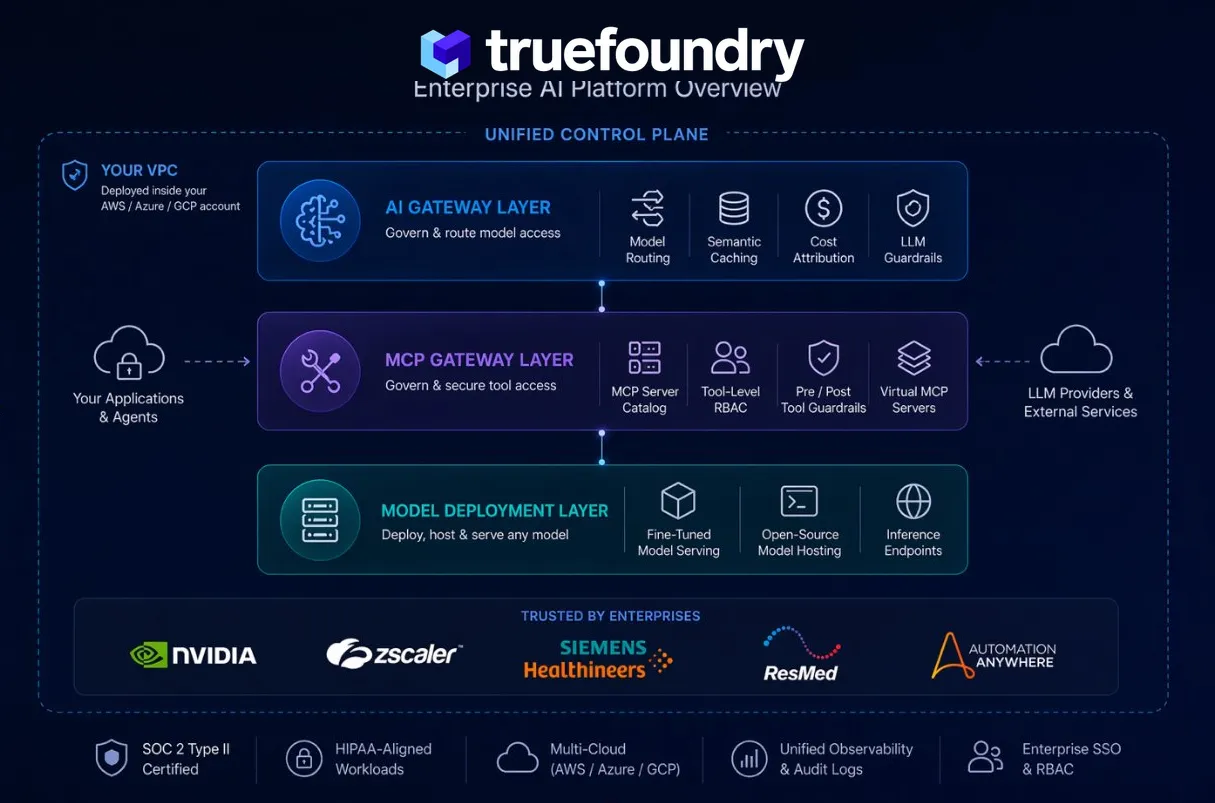
TrueFoundry wurde nicht als AI-Gateway entwickelt, das später Enterprise-Funktionen hinzufügte. Es ist eine Enterprise AI-Plattform, bei der das AI-Gateway, das MCP-Gateway, die Infrastruktur für die Modellbereitstellung und das Multi-Cloud-Management integrierte Schichten einer einzigen Steuerungsebene sind, die von Anfang an für regulierte Unternehmensanforderungen konzipiert wurde.
Zu den bestätigten Unternehmensimplementierungen gehören NVIDIA, Zscaler, Siemens Healthineers, ResMed und Automation Anywhere. Die Plattform verarbeitet über 10 Milliarden Anfragen pro Monat bei Fortune-1000-Unternehmen und verwaltet mehr als 1.000 Cluster. Sie besitzt die SOC2 Typ II-Zertifizierung und unterstützt HIPAA-konforme Workloads auf AWS GovCloud.
AI-Gateway-Funktionen: Verbindet sich mit über 1.600 LLMs über eine einheitliche API mit einem geringen Latenz-Overhead im einstelligen Millisekundenbereich, je nach Konfiguration. Virtuelle Modelle leiten den Datenverkehr über Anbieter hinweg nach Gewicht, Latenz oder Priorität mit automatischen Wiederholungsversuchen und Failback, wenn ein Anbieter ausfällt. Exakte und semantische Zwischenspeicherung erfolgt über den x-tfy-cache-config-Header, unter Verwendung von Kosinus-Ähnlichkeitsabgleich mit OpenAI text-embedding-3-small auf SaaS und einem konfigurierbaren Embedding-Modell bei selbst gehosteten Implementierungen. Die Kostenattribution pro Team und feste Budgetgrenzen, die neue Anfragen blockieren, wenn ein Budget erreicht ist, sind in der Verwaltungsoberfläche konfigurierbar. Die vollständige Audit-Protokollierung erfolgt über AI Gateway > Monitor > Requests und wird über OpenTelemetry an Grafana, Datadog oder Splunk exportiert.
MCP-Gateway: Die vollständigste Produktions-MCP-Governance-Schicht in diesem Vergleich. Ein zentralisierter Serverkatalog mit Prüfungs-Workflows steuert, welche MCP-Server Entwicklungsumgebungen erreichen. OAuth2 mit sechs ausgehenden Authentifizierungsmustern verwaltet den gesamten nachgelagerten Anmeldeinformations-Lebenszyklus. Auf dem Gateway durchgesetztes Tool-Level-RBAC stellt sicher, dass Agenten nur die Tools entdecken und aufrufen, die ihre Rolle autorisiert. Pre-Tool-Schutzmaßnahmen, einschließlich SQL Sanitizer, Prompt Injection Detection und Secrets Detection, werden ausgeführt, bevor ein Tool ausgeführt wird. Post-Tool-Schutzmaßnahmen, einschließlich Post-Execution-Validierung mit PII- und Output-Sicherheitsprüfungen, werden ausgeführt, bevor die Ergebnisse den Agenten erreichen. Virtuelle MCP-Server ermöglichen es Plattformteams, kuratierte Tool-Untergruppen aus mehreren Servern zusammenzustellen. Jeder Tool-Aufruf wird in strukturiertem JSON mit vollständigen Metadaten protokolliert.
On-Prem-VPC-Bereitstellung: Vier Bereitstellungsoptionen decken das gesamte Spektrum ab, von vollständig verwaltetem SaaS ohne Infrastrukturkosten bis hin zu vollständiger Control Plane plus Gateway Plane innerhalb der Kunden-Cloud zu Infrastrukturkosten von ca. 800 bis 1.000 US-Dollar pro Monat, basierend auf repräsentativen Unternehmensbereitstellungsszenarien. Die Optionen 3 und 4 stellen sicher, dass keine LLM-Inferenzdaten oder MCP-Tool-Aufrufparameter den Unternehmensperimeter verlassen, um die Infrastruktur von TrueFoundry zu erreichen. Audit-Protokolle werden im Parquet-Format in den S3-, GCS- oder Azure Blob-Speicher des Kunden geschrieben und sind über Spark, DuckDB oder Athena abfragbar.
Modellbereitstellung inklusive: Bereitstellung feinabgestimmter Modelle, Hosting von Open-Source-Modellen und Verwaltung von Inferenz-Endpunkten befinden sich auf derselben Plattform wie das Gateway, unter derselben RBAC- und Audit-Logging-Infrastruktur. Organisationen benötigen keine separate Lösung für die Modellbereitstellung.
Am besten geeignet für: Fortune-500-Unternehmen in regulierten Branchen, die eine einzige Plattform benötigen, die den Modellzugriff, den Agenten-Tool-Zugriff und die Modellbereitstellung mit VPC-Isolation, SOC2 Typ II-Dokumentation und vertraglichen SLAs regelt.
Portkey: Entwicklerfreundliches Gateway mit guter LLM-Abdeckung
Portkey hat eine starke Entwicklerakzeptanz aufgebaut, indem es das LLM-Routing wirklich zugänglich gemacht hat. Mit einer Plattformgebühr von 49 US-Dollar pro Monat und separat über Anbieter abgerechneten LLM-Tokens ist es der kostengünstigste Einstieg in ein kommerziell unterstütztes AI-Gateway mit echten unternehmensnahen Funktionen. Die über 1.600 LLM-Integrationen über eine einheitliche API machen Portkey außergewöhnlich für Teams, die eine breite Anbieterabdeckung benötigen, ohne individuelle Integrationen pflegen zu müssen. Das Observability-Dashboard, die Prompt-Versionierung und die A/B-Testfunktionen sind ausgereift und entwicklerfreundlich.
Portkey besitzt SOC2-, HIPAA-, GDPR- und ISO-Zertifizierungen. Diese gelten für die SaaS-Infrastruktur von Portkey, wo Kundendaten die Systeme von Portkey durchlaufen, bevor sie die LLM-Anbieter erreichen. Die Plattform bedient mehr als 200 Unternehmen in der Produktion, wobei täglich ein erhebliches Token-Volumen über ihre Plattform verarbeitet wird.
LLM-Abdeckung und Routing: Über 1.600 LLM-Integrationen stellen die breiteste Anbieterabdeckung in diesem Vergleich dar. Fallback-Routing, Lastausgleich und bedingtes Routing basierend auf Modellfähigkeiten sind alle verfügbar. Das Open-Source-Gateway auf GitHub unterstützt das Self-Hosting unter einer permissiven Lizenz für Teams, die die volle Kontrolle über die Routing-Schicht wünschen.
Observability und Prompt-Management: Sitzungsverfolgung, Kostenattribution pro Team, Prompt-Versionierung und A/B-Tests sind detailliert und produktionsreif. Die Observability von Portkey ist eine echte Stärke für Entwicklungsteams, die die Modellleistung und Prompt-Qualität in großem Maßstab debuggen.
SOC2-, HIPAA-, GDPR-, ISO-Zertifizierungen: Die Compliance-Zertifizierungen von Portkey reduzieren den Aufwand für die Lieferantenrisikobewertung für Beschaffungsteams, die ein SaaS-Gateway evaluieren. Dies ist ein signifikanter Vorteil gegenüber Open-Source-Alternativen mit Selbsthosting, bei denen der Kunde seine eigenen Kontrollen implementiert und zertifiziert.
MCP-Status im Jahr 2026: Portkey hat die MCP-Kompatibilität eingeführt und positioniert sich als eines der ersten Gateways, das diese Funktion anbietet, mit vereinheitlichter Authentifizierung und Erkennung für interne und externe MCP-Server. Anfang 2026 wird dies als Early Access beschrieben. Unternehmen mit aktiven agentischen KI-Implementierungen sollten die aktuelle Funktionsreife überprüfen, insbesondere ob Pre-Tool-Guardrails, strukturierte Audit-Logs pro Tool und RBAC auf Tool-Ebene produktionsreif sind, bevor sie dies mit der MCP-Gateway-Implementierung von TrueFoundry vergleichen.
On-Premise-Bereitstellung: Eine Option für eine luftgesperrte Enterprise-Bereitstellung existiert für Organisationen mit VPC-Isolationsanforderungen. Der Umfang dieser Option, welche Funktionen im Vergleich zum Cloud-Produkt verfügbar sind und das operative Managementmodell sollten mit dem Enterprise-Vertriebsteam von Portkey bestätigt werden, bevor es als gleichwertig mit einer vollständig VPC-nativen Bereitstellung betrachtet wird.
Am besten geeignet für: Startups und mittelgroße Entwicklungsteams, die umfassendes LLM-Routing und Observability zu geringen Einstiegskosten benötigen, mit einem SaaS-Bereitstellungsmodell vertraut sind und Zeit haben zu bewerten, ob Portkeys MCP Early Access ihre Anforderungen an die Governance von agentischer KI erfüllt.
Helicone: Open-Source-Observability-Plattform
Helicone ist eine Open-Source-LLM-Observability-Plattform, Y Combinator W23, kostenlos selbst zu hosten unter der Apache 2.0 Lizenz. Eine SaaS-gehostete Version ist für Teams verfügbar, die eine verwaltete Infrastruktur bevorzugen. Helicone pflegt separat ein Open-Source-KI-Gateway, das in Rust geschrieben ist, ein leichter Proxy, der sich von der Observability-Plattform selbst unterscheidet.
Für Entwicklungsteams, die detaillierte LLM-Aufrufprotokollierung, Prompt-Debugging, Token-Verbrauchsanalyse und die volle Kontrolle über ihre Observability-Infrastruktur benötigen, bietet Helicone echten Mehrwert bei minimalem Integrationsaufwand. Das Hinzufügen von Helicone ist eine Codeänderung in einer Zeile. Die Observability erfasst vollständige Prompt- und Antworttexte, Token-Anzahlen, Latenz, Kosten, Modell und benutzerdefinierte Metadaten.
Open Source und kostenlos selbst zu hosten: Der vollständige Helicone-Quellcode ist auf GitHub unter Apache 2.0 verfügbar. Selbstgehostete Bereitstellungen verwenden Docker Compose für die lokale Entwicklung oder ein Produktions-Helm-Chart für Unternehmens-Workloads. Teams mit der technischen Kapazität, die Plattform zu betreiben, zahlen nur Infrastrukturkosten.
Observability-Tiefe: Die vollständige Protokollierung von Prompt- und Antworttexten, Token-Anzahlen, Latenz, Kosten, Modell und benutzerdefinierten Metadaten macht Helicones Observability stark für Debugging und Kostenanalyse. Die LangGraph-Integration bietet Einblick in Multi-Agenten-Workflow-Traces. Die LLM Cost API deckt über 300 Modelle für die Kostenattribution ab.
MCP-Situation: Helicone veröffentlicht einen MCP-Server, der Clients wie Claude Desktop Lesezugriff auf Helicone-Anfrageprotokolle und Analysedaten gewährt. Dies ist kein MCP-Governance-Gateway. Es kontrolliert nicht, welche Tools Agenten aufrufen können, erzwingt kein RBAC für den Tool-Zugriff, führt keine Pre-Tool-Guardrails vor der Tool-Ausführung aus oder erstellt strukturierte Audit-Logs pro Tool-Aufruf. Unternehmen, die Agenten einsetzen, die geschäftskritische Tools über MCP aufrufen, benötigen ein speziell entwickeltes MCP-Gateway, keinen Observability-MCP-Server.
Lücken in der Unternehmens-Governance: Helicones Fokus liegt auf Observability. RBAC mit strikter Durchsetzung, SCIM-Provisionierung, strukturierte Compliance-Berichterstattung, Budgetbeschränkungen pro Team und Richtliniendurchsetzung auf der Anforderungsebene fehlen entweder im Kernprodukt oder erfordern einen Enterprise-Kontakt. Die selbstgehostete Version überträgt die gesamte Sicherheitshärtung, HA-Konfiguration und Implementierung von Compliance-Kontrollen auf den Kunden. Helicone erfüllt die SOC2- und GDPR-Compliance für sein SaaS-Produkt; selbstgehostete Bereitstellungen erfordern, dass der Kunde seine eigenen Kontrollen implementiert und zertifiziert.
Am besten geeignet für: Entwicklungsteams, die eine umfassende Beobachtbarkeit von LLM-Aufrufen für Debugging, Kostenanalyse und Überwachung der Prompt-Qualität wünschen, mit voller Kontrolle über ihre Beobachtbarkeitsinfrastruktur und die bereit sind, separate Tools für Gateway-Routing, MCP-Governance und Modellbereitstellung zu verwenden.
Direkter Funktionsvergleich
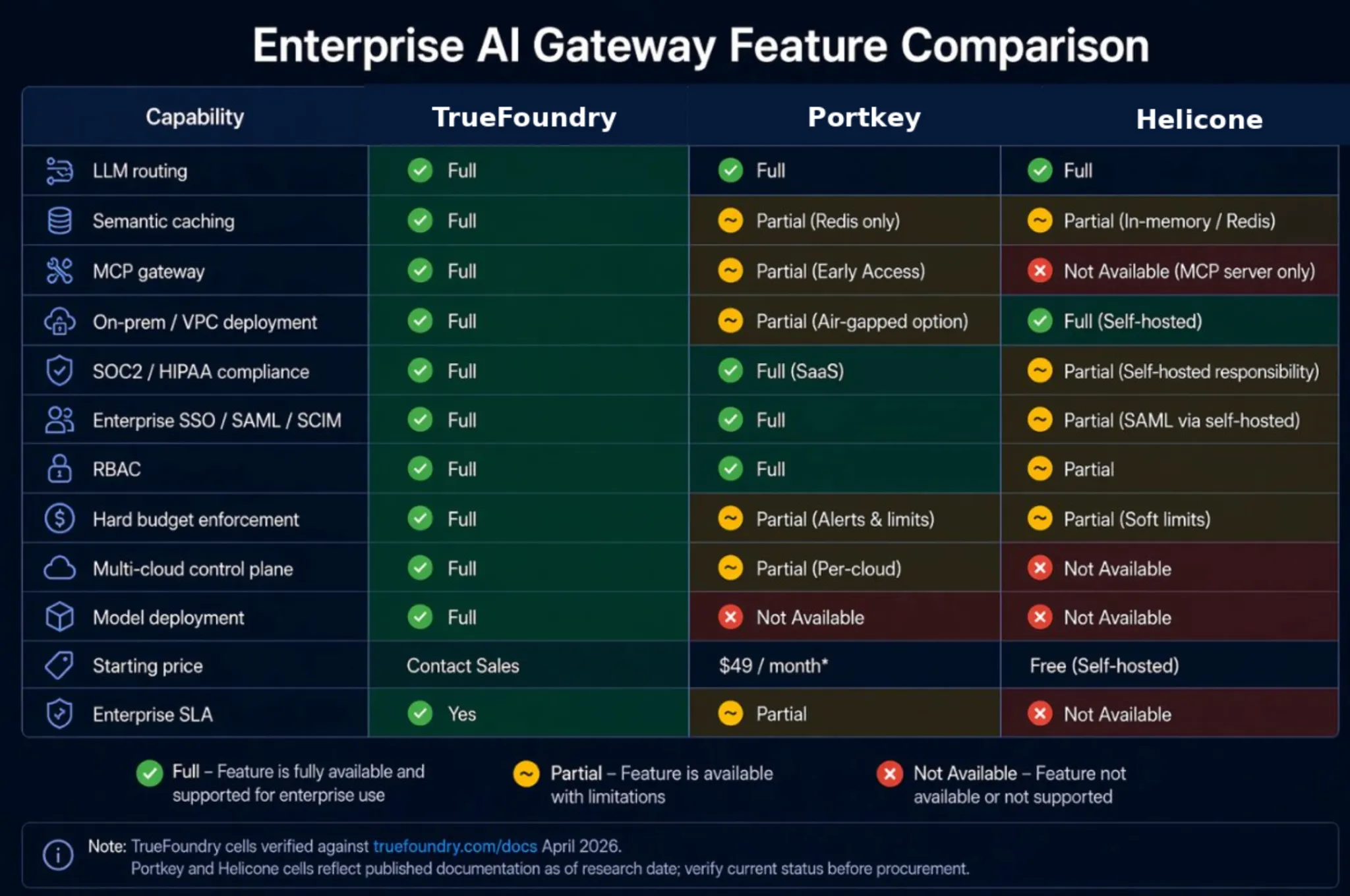
Die folgende Tabelle bewertet Enterprise-KI-Gateway-Plattformen anhand eines konsistenten Kriteriensatzes, der für Produktionsbereitstellungen relevant ist, einschließlich Zugriffssteuerung, Governance-Abdeckung, Bereitstellungsflexibilität und Compliance-Bereitschaft. Die Funktionen von TrueFoundry basieren auf öffentlich zugänglicher Produktdokumentation. Die Verfügbarkeit von Funktionen für andere Plattformen spiegelt die zum Zeitpunkt der Erstellung öffentlich dokumentierte Funktionalität wider und kann sich ändern, wenn Produkte aktualisiert werden.
Capability
TrueFoundry
Portkey
Helicone
LLM routing and multi-provider
Full: 1,600+ LLMs via unified API; Virtual Models with
weight, latency, or priority routing; automatic retries and
fallback
Full: 1,600+ LLMs; fallback, load balancing, conditional
routing based on model capability
Partial: 100+ providers; routing available via separate
open-source AI Gateway; observability is the primary focus
Semantic caching
Full: exact-match and semantic via x-tfy-cache-config header;
cosine similarity matching; up to 40% redundancy reduction
(TrueFoundry documented)
Full: semantic caching available (verify current reduction
benchmarks with Portkey)
Partial: caching available via header; verify semantic vs
exact-match capability in current version
MCP gateway
Full: OAuth2, RBAC, server catalog with vetting workflow,
Pre/Post Tool guardrails, Virtual MCP Servers, metadata
policies
Partial: MCP compatibility introduced in early 2026 described
as early access; verify governance depth before procurement
Not available: Helicone publishes an MCP server for read
access to its own observability data only; not an agent tool
governance gateway
On-prem/VPC deployment
Full: customer's own AWS, Azure, or GCP; zero data egress to
TrueFoundry infra; Gateway Plane ~$600/month infra; Control
Plane + Gateway ~$800-$1,000/month
Partial: Enterprise air-gapped deployment option available;
verify feature scope and management capability with Portkey
sales
Partial: Docker and Helm self-hosting available under Apache
2.0; enterprise Helm chart for production; all security
hardening is customer's responsibility
SOC2 / HIPAA compliance
Full: SOC2 Type II certified; HIPAA-aligned VPC deployment;
audit logs written to customer's own S3/GCS/Azure Blob in
Parquet format
Full: SOC2, HIPAA, GDPR, ISO certifications for SaaS product
(applies to Portkey infrastructure; verify for air-gapped
option)
Partial: SOC2 and GDPR compliance for SaaS product;
self-hosted requires customer to implement and certify own
controls
Enterprise SSO/SAML/SCIM
Full: Okta, Azure AD, SAML 2.0, any JWKS-compatible IdP; full
identity lifecycle management across all deployment options
Full: SSO and SCIM on enterprise tier; verify tier
requirements and availability for air-gapped option
Partial: need to verify the current IdP support for
self-hosted version; enterprise features require contacting
enterprise@helicone.ai
RBAC by team and role
Full: tool-level and model-level RBAC enforced at gateway;
per-team, per-environment, per-agent policies updated without
server redeployment
Partial: workspace and role-based access available;
per-department budgets and usage quotas; verify tool-level
enforcement granularity
Full: hard token spending limits per team, service, and
endpoint that block new requests when budget is reached; not
advisory
Partial: budget controls and spending quotas available; verify
whether enforcement is hard-block or soft advisory limit
Not available in core product: cost tracking and alerts
available; hard blocking requires verification with Helicone
Multi-cloud unified control plane
Full: AWS, Azure, GCP simultaneously from single management
interface; consistent RBAC and audit log across all clouds
Partial: multi-provider LLM routing; not unified multi-cloud
infrastructure governance in a single control plane
Not available: observability SaaS or self-hosted per
deployment; no unified multi-cloud management layer
Model deployment and hosting
Full: fine-tuned model serving, open-source model hosting,
inference endpoint management; governed by same access control
and audit logging as gateway
Not available: gateway and observability only; separate model
serving solution required
Not available: observability platform and gateway proxy only;
no model hosting capability
Starting price
Enterprise pricing: contact TrueFoundry sales; self-hosted
Gateway Plane from ~$600/month infrastructure cost; fully
managed SaaS available
$49/month platform fee; LLM tokens billed separately by
providers; enterprise tier for air-gapped and advanced
governance
Free: open-source self-hosted under Apache 2.0; SaaS tier
available; enterprise pricing on request
Enterprise SLA
Full: contractual SLA and dedicated support for enterprise
accounts
Partial: verify current SLA terms and response times with
Portkey sales; enterprise support available
Not available for self-hosted; SaaS SLA terms apply to hosted
product only
Wie TrueFoundry löst, was Portkey und Helicone nicht können
Die Einschränkungen von Portkey und Helicone für den Unternehmenseinsatz sind keine Mängel in der Umsetzung. Sie spiegeln das natürliche Ergebnis unterschiedlicher Designprioritäten wider. Portkey ist auf Entwicklerzugänglichkeit und LLM-Anbieterabdeckung optimiert. Helicone ist auf Beobachtbarkeitstiefe und Open-Source-Transparenz optimiert. Keines der beiden wurde primär für die Governance-Anforderungen eines regulierten Unternehmens entwickelt, das agentische KI in großem Maßstab einsetzt.
MCP-Gateway: die Unternehmensanforderung, die Portkey und Helicone derzeit nicht erfüllen können: Das MCP-Gateway von TrueFoundry ist die einzige produktionsreife Option in diesem Vergleich mit vollständigen Pre-Tool- und Post-Tool-Schutzmechanismen, einem Serverkatalog mit Prüfungs-Workflows, RBAC auf Tool-Ebene und strukturierten Audit-Logs pro Aufruf. Portkey führte eine frühe MCP-Kompatibilität ein, aber Unternehmen sollten die Governance-Tiefe anhand ihrer tatsächlichen Anforderungen an die Agentenbereitstellung überprüfen, bevor sie diese als gleichwertig betrachten. Helicones MCP-Präsenz ist ein Datenzugriffsserver für die eigene Beobachtbarkeitsplattform, keine Governance-Schicht für Agenten-Tools. Für Unternehmen, in denen KI-Agenten Tools über MCP aufrufen, ist es unerlässlich, diese Lücke zu schließen. Es ist die Kontrollschicht, die agentische KI einsetzbar macht, ohne ungeprüften Zugriff auf geschäftskritische Systeme zu ermöglichen.
VPC-Bereitstellung: Ihre Daten verlassen niemals Ihr Perimeter: Die Optionen Gateway Plane und Control Plane plus Gateway Plane von TrueFoundry werden vollständig innerhalb des Cloud-Kontos des Kunden bereitgestellt. Alle LLM-Inferenzdaten und MCP-Tool-Aufrufparameter bleiben innerhalb des Unternehmensperimeters. Die Air-Gapped-Option von Portkey erfordert eine Beschaffung auf Unternehmensebene und eine Überprüfung des Umfangs. Helicones selbst gehostete Option bietet Datenkontrolle, legt aber die gesamte Implementierung von Sicherheit und Compliance in die Verantwortung des Kundenteams. Für HIPAA-geschützte klinische Daten oder Finanzunterlagen mit Anforderungen an die Datenresidenz ist der Unterschied zwischen einem vom Anbieter zertifizierten SaaS-Produkt und einer vom Kunden kontrollierten VPC der Unterschied zwischen einer kompensierenden Kontrolle und vollständiger Compliance.
Strikte Budgetdurchsetzung: nicht nur Dashboards: TrueFoundry setzt strikte Token-Ausgabenlimits pro Team, Dienst und Endpunkt über Budgetkontrollen im Gateway durch. Wenn das Budget eines Teams erschöpft ist, werden neue Anfragen gestoppt, bevor sie einen Modell-Anbieter erreichen. Der Unterschied zwischen einer in einem Dashboard sichtbaren Kostenexplosion und einer Kostenexplosion, die verhindert wird, ist der Unterschied zwischen Beobachtbarkeit und Governance. Überprüfen Sie, ob die Budgetkontrollen von Portkey als strikte Anforderungsblockierung oder als Schwellenwertwarnungen fungieren, bevor Sie diesen Vergleich für ein bestimmtes Bereitstellungsszenario anstellen.
Vollständige ML-Plattform: über reines Gateway hinaus: Sowohl Portkey als auch Helicone sind Gateway- und Beobachtbarkeitstools. Keines der beiden hostet feinabgestimmte oder Open-Source-Modelle. Organisationen, die ihre eigenen Modelle bereitstellen und gleichzeitig den Zugriff auf Anbietermodelle steuern müssen, benötigen eine separate Lösung, wenn sie sich für eine der beiden Plattformen entscheiden. TrueFoundry deckt das Serving feinabgestimmter Modelle, das Hosting von Open-Source-Modellen und das Management von Inferenz-Endpunkten unter derselben Zugriffssteuerungs- und Audit-Logging-Infrastruktur ab wie die Gateway-Schicht. Es gibt keine separate Modell-Serving-Bereitstellung, die verwaltet oder gesteuert werden muss.
Enterprise-SLAs und dedizierter Support: TrueFoundry bietet vertragliche Uptime-SLAs und dedizierten Kundenerfolg für Unternehmenskonten. Für Organisationen, bei denen das KI-Gateway auf dem kritischen Pfad von Produktionsgeschäftsanwendungen liegt, ist ein vertraglicher SLA eine Beschaffungsanforderung, kein optionaler Vorteil.
TrueFoundry AI Gateway bietet eine Latenz von ~3—4 ms, verarbeitet mehr als 350 RPS auf einer vCPU, skaliert problemlos horizontal und ist produktionsbereit, während LiteLM unter einer hohen Latenz leidet, mit moderaten RPS zu kämpfen hat, keine integrierte Skalierung hat und sich am besten für leichte Workloads oder Prototyp-Workloads eignet.
Auf Geschwindigkeit ausgelegt: ~ 10 ms Latenz, auch unter Last










.png)
.png)
.png)
.png)
.png)
.png)


