


September 25, 2026
|
Lesedauer: 5 Minuten


Erhalten Sie sofortigen Zugriff auf eine TrueFoundry-Live-Umgebung. Stellen Sie Modelle bereit, leiten Sie den LLM-Verkehr weiter und erkunden Sie die gesamte Plattform — Ihre Sandbox ist in Sekundenschnelle einsatzbereit, ohne dass eine Kreditkarte erforderlich ist.



Published: September 11, 2026
.webp)
Unglaublich schnelle Methode zum Erstellen, Verfolgen und Bereitstellen Ihrer Modelle!
LiteLLM is the most widely used open-source LLM proxy. It solves a real problem elegantly: you get a unified OpenAI-compatible API that routes across dozens of providers, and the community version costs nothing to run. The routing logic is solid. The developer experience is good. For teams that just need a lightweight proxy and have the DevOps capacity to run it, it works.
The conversation changes when teams hit the limits of the self-managed open-source version and start evaluating LiteLLM Enterprise. Public references and vendor discussions commonly cite a Basic tier around $250/month and a Premium tier near $30,000/year, but LiteLLM does not publish standardized pricing and final costs are typically negotiated directly with the vendor. These figures reflect publicly referenced estimates, but LiteLLM pricing is not fully standardized and should be verified directly with the vendor. LiteLLM Enterprise is a self-hosted product. You provision the infrastructure, you manage the PostgreSQL database and Redis cache, you handle upgrades and security patches, and you own the on-call rotation when the proxy goes down at 2am. None of that shows up on the pricing page.
This is not a feature list comparison. It is an honest total cost of ownership analysis covering LiteLLM enterprise pricing, infrastructure costs, engineering maintenance overhead, the MCP governance gap, and how TrueFoundry compares before you commit to a vendor.
LiteLLM Enterprise is the commercial layer built on top of the open-source proxy. It adds governance features that are not available in the community version: SSO/SAML integration, granular RBAC for model access, Prometheus metrics, custom callbacks, LLM guardrails for content filtering, JWT authorization, and priority support.
Two tiers target different organizational profiles. Verify current details at litellm.ai/enterprise before making purchasing decisions.
Enterprise buyers comparing AI gateway options frequently start with the license fee and stop there. The actual litellm enterprise cost picture only becomes clear after deployment, when the infrastructure bill arrives and the first engineering rotation hits the calendar. There are three cost categories that consistently exceed the licensing fee over a two-to-three year horizon.
The figures below are based on representative enterprise deployments and internal benchmarks rather than standardized vendor pricing, and should be treated as directional estimates rather than fixed costs.
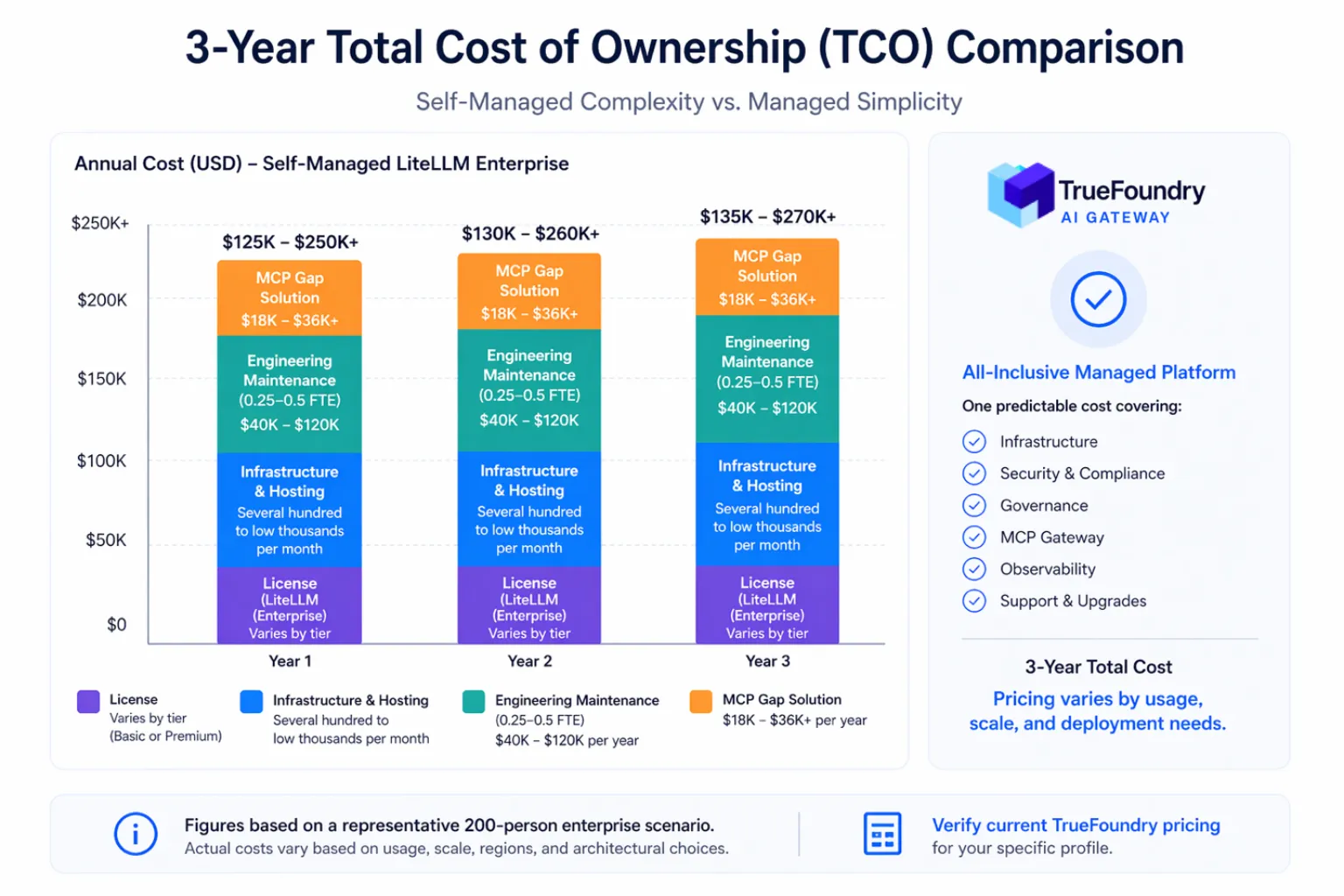
LiteLLM Enterprise typically runs on a dedicated compute stack: a proxy server or cluster, often alongside a PostgreSQL database for configuration and audit logging, and a Redis instance for caching and rate limit counters. On AWS or Azure, a production-grade high-availability deployment for meaningful LLM traffic typically falls in the range of several hundred to low thousands of dollars per month in cloud infrastructure costs, separate from the license fee.
Teams that need 99.9% uptime for their LLM gateway, which is a reasonable requirement when the gateway sits on the critical path of production AI features, require multi-region redundancy and database replication that push monthly infrastructure costs toward the higher end. These costs also escalate. Cloud provider pricing changes, data transfer fees, and log management overhead add 10 to 15 percent annually to a realistic 3-year infrastructure projection.
Self-hosted infrastructure requires ongoing engineering attention that does not show up in vendor pricing but absolutely shows up in headcount planning. Activities include applying security patches, managing version upgrades (LiteLLM releases frequently, and upgrades occasionally require configuration changes), handling gateway outages, and managing configurations as the organization adds new models or teams.
Enterprises that migrate from self-managed LiteLLM to managed platforms often underestimate the ongoing engineering overhead required to maintain the system. In practice, organizations typically allocate approximately 0.25 to 0.5 full-time-equivalent engineering capacity to support LiteLLM operations, including maintenance, scaling, and reliability work. Based on a fully-loaded senior engineer cost of $250,000 per year, the 0.25 to 0.5 FTE allocation translates to an estimated $62,500 to $125,000 per year in engineering effort dedicated purely to infrastructure management, often more than the license fee. And this grows nonlinearly: an organization that starts with five teams on LiteLLM and grows to fifty will find that configuration complexity and maintenance burden compound faster than team count.
As of current documentation and feature availability, LiteLLM does not provide a native MCP gateway. Organizations deploying agentic AI systems where agents invoke tools through the Model Context Protocol need a separate solution to govern MCP server access. That means a second vendor evaluation, a second security review, a second procurement process, and a separate integration project to make two governance systems produce a unified audit trail and enforce consistent identity policies.
Gartner projects that 70% of software engineering teams building multimodal applications will use AI gateways, including for agentic tool access, by 2028. Organizations that choose LiteLLM for LLM routing today are choosing a platform that will need supplementation as their agentic AI footprint grows. The integration cost of connecting two separate governance systems is real and is consistently underestimated in initial procurement decisions. A second tool's annual cost, plus the ongoing engineering overhead of maintaining the integration, adds a meaningful additional annual cost depending on vendor choice, integration complexity, and compliance requirements.
The following uses a representative enterprise scenario: a 200-person engineering organization routing approximately 500 million tokens per month through the gateway, operating across two cloud providers, with 20 teams on the platform and compliance requirements that mandate structured audit logging. Adjust the numbers for your actual profile.
LiteLLM Enterprise Premium: Year 1 Cost Breakdown
The fully-loaded cost comparison frequently inverts what the license-only comparison suggests. Organizations that account for engineering maintenance and MCP governance find that managed platforms are cost-competitive, and sometimes cheaper, than self-hosted alternatives at enterprise scale. The question is not whether LiteLLM Enterprise licensing is reasonably priced. It is. The question is whether the total cost of the self-hosted model, including everything the customer operates themselves, fits the organization's budget and capacity.
License cost and infrastructure cost tell you what you pay. Feature coverage tells you what you get. The following covers the capabilities that enterprise procurement teams consistently identify as evaluation criteria for AI gateway decisions in 2026.
Feature Comparison: LiteLLM Enterprise vs TrueFoundry
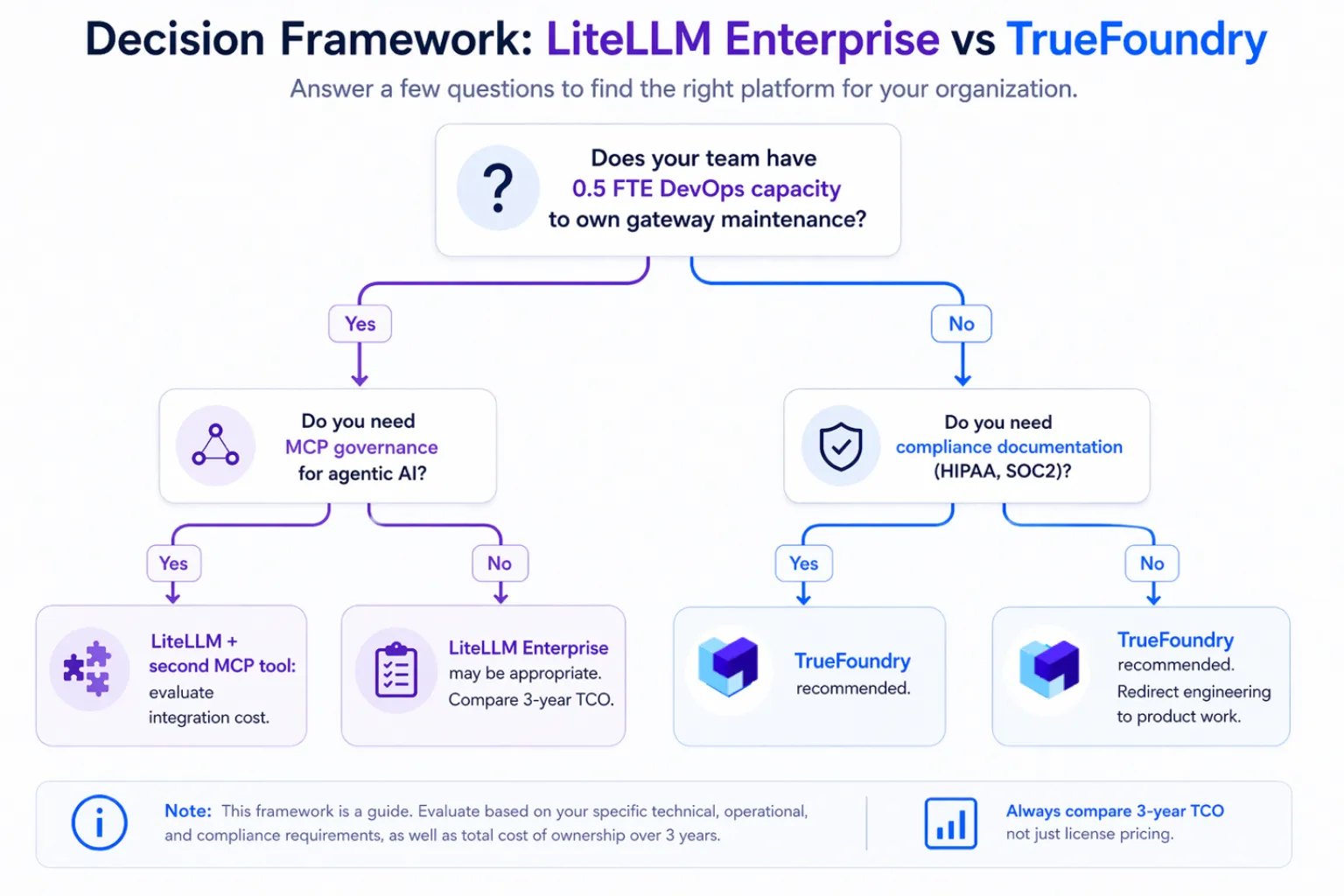
TrueFoundry is not a LiteLLM replacement that does the same thing with a different price tag. It is a broader platform that addresses the governance gap that emerges as enterprise AI deployments mature beyond simple LLM proxy routing into agentic AI with tool use, multi-cloud deployments, and regulated data handling.
TrueFoundry AI Gateway bietet eine Latenz von ~3—4 ms, verarbeitet mehr als 350 RPS auf einer vCPU, skaliert problemlos horizontal und ist produktionsbereit, während LiteLM unter einer hohen Latenz leidet, mit moderaten RPS zu kämpfen hat, keine integrierte Skalierung hat und sich am besten für leichte Workloads oder Prototyp-Workloads eignet.




LiteLLM Enterprise Basic erweitert den Funktionsumfang der Open-Source-Version für ca. 250 $ pro Monat um eine Enterprise-Management-Benutzeroberfläche, SSO/SAML-Integration, Prometheus-Metriken, JWT-Authentifizierung, LLM-Guardrails für die Inhaltsfilterung und einen dedizierten Slack-Support-Kanal. Enterprise Premium, für ca. 30.000 $ pro Jahr, bietet zusätzlich vorrangigen Support mit definierten SLA-Reaktionszeiten, dediziertes Account Management, kundenspezifische Funktionsentwicklung und Unterstützung bei Compliance-Zertifizierungen für SOC2 und HIPAA.
Der praktische Unterschied liegt im Support und der Unterstützung bei Compliance-Fragen. Basic bietet Ihnen die Governance-Funktionen. Premium stellt Ihnen einen Anbieterpartner für die unternehmensweite Bereitstellung zur Seite. Überprüfen Sie die aktuelle Funktionsübersicht unter litellm.ai/enterprise vor dem Kauf, da sich die Verfügbarkeit von Funktionen mit neuen Releases ändern kann.
LiteLLM Enterprise wird in allen Tarifen selbst gehostet. Die Lizenz umfasst die Software und den Support. Der Kunde stellt die gesamte Infrastruktur bereit und betreibt sie: einen Proxy-Server oder -Cluster, eine PostgreSQL-Datenbank für Konfiguration und Audit-Logging sowie eine Redis-Instanz für Caching und Ratenbegrenzungszähler. Hochverfügbarkeits-Bereitstellungen erfordern zusätzlich Load Balancer und Datenbankreplikation. LiteLLM bietet zwar Cloud- und selbstverwaltete Bereitstellungsoptionen an, die Betriebsverantwortung liegt jedoch unabhängig vom gewählten Bereitstellungsmodell beim Kunden.
Unternehmen, die von selbstverwaltetem LiteLLM auf verwaltete Plattformen migriert sind, berichten durchweg von 0,25 bis 0,5 Vollzeitäquivalenten (VZÄ) an laufender Engineering-Kapazität, die für die Wartung aufgewendet wird. Die anfängliche Bereitstellung erfordert zwei bis vier Wochen Zeit von erfahrenen DevOps-Ingenieuren, um Kubernetes-Cluster einzurichten, Load Balancer zu konfigurieren, CI/CD-Pipelines aufzubauen und Überwachungssysteme zu integrieren. Die laufende Wartung erfordert zusätzlich 10 bis 20 Stunden pro Monat für Sicherheitspatches, Abhängigkeits-Updates, Skalierungsanpassungen und die Fehlerbehebung der Infrastruktur. Die Reaktion auf Vorfälle bei Gateway-Ausfällen liegt vollständig in der Verantwortung des Bereitschaftsteams des Kunden.
Bei jährlichen Gesamtkosten von 250.000 US-Dollar für einen erfahrenen Ingenieur beläuft sich der laufende Wartungsaufwand auf 62.500 bis 125.000 US-Dollar an jährlichen Engineering-Ausgaben, die ausschließlich für die Infrastrukturverwaltung aufgewendet werden. Dieser Betrag steigt mit zunehmender Anzahl von Teams und Anwendungsfällen auf dem Gateway.
Ja. Das AI Gateway von TrueFoundry stellt eine OpenAI-kompatible API bereit, sodass Anwendungen, die auf der vereinheitlichten API von LiteLLM basieren, auf den Gateway-Endpunkt von TrueFoundry zeigen können, ohne den Anwendungscode umschreiben zu müssen. Die Migration umfasst die Aktualisierung von Endpunkt-URLs, das Verschieben von Anbieter-Anmeldeinformationen in den Credential Vault von TrueFoundry, die Konfiguration von RBAC und Teambudgets in der TrueFoundry-Verwaltungsoberfläche und die Einrichtung der SSO-Integration mit Ihrem bestehenden Identitätsanbieter.
Das Solutions-Team von TrueFoundry bietet Migrationsunterstützung und kann für Teams, die den Wechsel in Betracht ziehen, einen personalisierten TCO-Vergleich erstellen. Die typische Migrationsdauer für ein mittelständisches Engineering-Unternehmen beträgt zwei bis vier Wochen für die technische Migration zuzüglich einer Parallelbetriebsphase zur Validierung des Verhaltens, bevor die LiteLLM-Bereitstellung außer Betrieb genommen wird.
Das semantische Caching von TrueFoundry gleicht Prompts basierend auf semantischer Ähnlichkeit ab, anstatt auf exakter Zeichenkettenübereinstimmung. Es liefert zwischengespeicherte Antworten für Prompts, die funktional äquivalent sind, selbst wenn sie anders formuliert wurden. Die dokumentierte Reduktionsrate von TrueFoundry beträgt bis zu 40 % bei redundanten LLM-API-Aufrufen. Die Caching-Implementierung von LiteLLM verwendet eine exakte Übereinstimmung und veröffentlicht keine unabhängigen Benchmarks für Reduktionsraten basierend auf semantischer Ähnlichkeit. Überprüfen Sie die aktuellen Caching-Funktionen von LiteLLM unter docs.litellm.ai, bevor Sie einen Vergleich anstellen.
Für Organisationen mit einer hohen Wiederholungsrate bei Abfragemustern, wie z. B. im Kundensupport, bei der Dokumentationssuche oder bei internen Frage-Antwort-Tools, kann der Unterschied durch semantisches Caching erheblich sein. Bei monatlichen LLM-API-Ausgaben von 100.000 US-Dollar führt eine 40-prozentige Reduktion durch semantisches Caching zu direkten Einsparungen von 40.000 US-Dollar pro Monat, was einen erheblichen Teil der Kosten für verwaltete Gateways ausgleicht.
Die Preisgestaltung von TrueFoundry basiert auf Nutzung und Bereitstellungsmodell und nicht auf einem festen, veröffentlichten Tarif für diese Größenordnung. Die vollständig verwaltete SaaS-Option eliminiert die Infrastrukturkosten vollständig. Die Option mit selbst gehosteter Gateway-Ebene verursacht Infrastrukturkosten von etwa 600 $ pro Monat allein für die Gateway-Bereitstellung. Die Option mit vollständig selbst gehosteter Steuerungsebene und Gateway kostet etwa 800 bis 1.000 $ pro Monat.
Für eine spezifische Organisation mit 50 Teams und 1 Milliarde Tokens pro Monat erstellt das Solutions-Team von TrueFoundry ein personalisiertes Preis- und TCO-Modell, das Token-Volumen, Teamanzahl, Compliance-Anforderungen und das Bereitstellungsmodell berücksichtigt. Buchen Sie einen 20-minütigen Anruf, um die tatsächlichen Zahlen für Ihr Szenario zu erhalten, anstatt sich auf allgemeine Schätzungen zu verlassen.



Die neuesten Nachrichten, Artikel und Ressourcen werden in Ihren Posteingang gesendet


.webp)
.webp)
.webp)
.webp)
.webp)
.webp)
.png)
.png)
.png)
.png)
.png)
.png)


