


September 21, 2026
|
Lesedauer: 5 Minuten


Erhalten Sie sofortigen Zugriff auf eine TrueFoundry-Live-Umgebung. Stellen Sie Modelle bereit, leiten Sie den LLM-Verkehr weiter und erkunden Sie die gesamte Plattform — Ihre Sandbox ist in Sekundenschnelle einsatzbereit, ohne dass eine Kreditkarte erforderlich ist.



Published: September 21, 2026
.png)
Unglaublich schnelle Methode zum Erstellen, Verfolgen und Bereitstellen Ihrer Modelle!
TrueFoundry AI Gateway bietet eine Latenz von ~3—4 ms, verarbeitet mehr als 350 RPS auf einer vCPU, skaliert problemlos horizontal und ist produktionsbereit, während LiteLM unter einer hohen Latenz leidet, mit moderaten RPS zu kämpfen hat, keine integrierte Skalierung hat und sich am besten für leichte Workloads oder Prototyp-Workloads eignet.




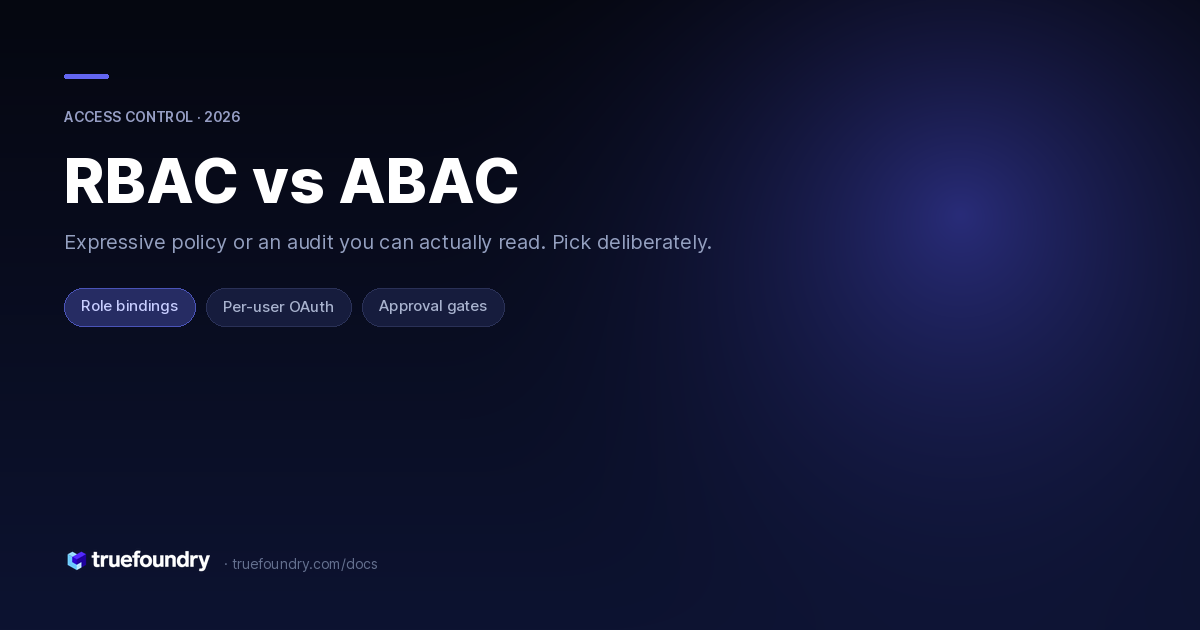
RBAC grants permissions to named roles and assigns subjects to those roles, so a decision is a lookup against the subject’s role bindings. ABAC evaluates a policy at request time over attributes of the subject, resource, action, and environment, so a decision is a computation. RBAC is easier to audit; ABAC is more expressive. The difference bites when someone asks who can access a resource: RBAC answers from a table, ABAC requires evaluating the policy.
On paper, yes — an agent’s appropriate authority varies with which tool it calls, which data it touches, and who it acts for. In practice most teams ship RBAC with resource-scoped bindings, because the attributes an agent policy would need are either unavailable at decision time or better answered by delegating to the upstream system through per-user credentials. The auditability loss also lands hardest on agents, which is what security review scrutinises most.
Yes, and it is the most common real deployment. Roles form the backbone and a few conditions apply where warranted. TrueFoundry’s version is RBAC role bindings plus four gates: per-resource scoping, per-user OAuth so upstream permissions apply, per-tool enable and disable, and human approval on sensitive tool calls. That is deliberately not a policy engine.
Yes. TrueFoundry runs in your VPC, on-prem, air-gapped, or hybrid, so prompts and responses never leave your domain even as you route across many providers.
Yes. It includes an MCP Gateway, an Agent Gateway, and an MCP & Agents Registry with tool-level access control. Agents on LangGraph, CrewAI, AutoGen, or a custom framework can all be governed centrally.
Ja. Das Gateway ist OpenTelemetry-kompatibel und lässt sich in Grafana, Datadog, Prometheus oder Ihren bevorzugten Stack integrieren. Es verfolgt jede Anfrage vom Prompt bis zur Ausführung von Tools und Modellen, sodass Sie eine einheitliche Protokollierung erhalten, ohne Ihre bestehenden Systeme entfernen zu müssen.



Die neuesten Nachrichten, Artikel und Ressourcen werden in Ihren Posteingang gesendet
.png)
.png)
.png)
.png)
.png)
.png)
.png)
.png)


