Erhalten Sie sofortigen Zugriff auf eine TrueFoundry-Live-Umgebung. Stellen Sie Modelle bereit, leiten Sie den LLM-Verkehr weiter und erkunden Sie die gesamte Plattform — Ihre Sandbox ist in Sekundenschnelle einsatzbereit, ohne dass eine Kreditkarte erforderlich ist.
9,9
KI-Agenten-Leitplanken: Überprüfung jedes Werkzeugaufrufs und Modellschritts
AI agent guardrails inspect what flows through an agent — the prompts, the model outputs, and every MCP tool call — and block or rewrite anything unsafe before it acts. Identity decides whether a call is allowed; guardrails decide what the call is allowed to contain. On TrueFoundry, guardrails run at the AI Gateway on four hooks (LLM input, LLM output, MCP pre-tool, MCP post-tool), so the same policy covers every agent with no per-agent code. This guide walks through where guardrails run, which risks they stop, and how to roll them out.
A chatbot with a bad response embarrasses you. An agent with a bad response acts on it. That single difference is why AI agent guardrails have become a production requirement rather than a nice-to-have. The moment a model can call tools — query a database, hit an internal API, run code, post to Slack — a hallucinated argument or an injected instruction stops being a wording problem and becomes an action your systems execute.
The 2025 Comet browser incident is the canonical example: a webpage carried hidden instructions written for the agent summarizing it, and the agent followed them. That is indirect prompt injection — untrusted content turning into unauthorized actions. No amount of identity or access control stops it, because the credential presented was perfectly valid. What stops it is a content check at each hop. This guide covers what agent guardrails are, where they run on the AI Gateway, which risks each one addresses, and how to enforce them without rewriting a single agent.
Was sind KI-Agenten-Guardrails?
KI-Agenten-Guardrails sind Kontrollmechanismen zur Inhaltsprüfung, die den tatsächlichen Payload jeder Agenteninteraktion untersuchen – den Benutzer-Prompt, die Antwort des Modells sowie die Argumente und Ergebnisse jedes Tool-Aufrufs – und basierend auf Richtlinien Maßnahmen ergreifen (zulassen, blockieren oder umschreiben).
Es hilft, zwei Fragen zu unterscheiden, die jeder kontrollierte Agentenaufruf beantworten muss:
Ob der Aufruf zulässig ist – geregelt durch Identitäts- und Zugriffssteuerung (welcher Agent ist das, was darf er tun).
Was der Aufruf enthält – geregelt durch Guardrails (enthält dieses Tool-Ergebnis eine Injection, ein Geheimnis in dieser Ausgabe oder ein DROP TABLE in diesen Argumenten).
Die Zugriffskontrolle ist der Türsteher; Guardrails sind der Metalldetektor. Sie brauchen beides. Ein Agent kann vollständig autorisiert sein, Ihren Postgres-MCP-Server aufzurufen, und dennoch dazu verleitet werden, eine destruktive Abfrage zu senden – der Zugriff hat zugestimmt, und nur ein Guardrail für die Tool-Argumente erkennt, was die Abfrage tatsächlich bewirkt.
Warum Agenten das Risiko erhöhen
Guardrails sind für LLM-Anwendungen nicht neu, aber Agenten verändern das Problem in drei konkreten Punkten:
Nicht vertrauenswürdige Inhalte fließen kontinuierlich ein. Jedes Tool-Ergebnis – eine Webseite, ein Support-Ticket, eine Datenbankzeile – gelangt im nächsten Schritt erneut in den Kontext des Modells. Da jeder dieser Inhalte eine Injection enthalten kann, müssen Eingaben geprüft werden, selbst wenn der Benutzer vertrauenswürdig ist.
Ausgaben werden zu Aktionen. Ein halluzinierter Shell-Befehl oder eine zu weit gefasste SQL-Anweisung liest sich nicht nur schlecht; sie wird ausgeführt. Tool-Argumente müssen geprüft werden, bevor das Tool ausgeführt wird.
Ketten vervielfachen das Risiko. Eine Kette mit fünf Werkzeugen bedeutet fünf Gelegenheiten, ein Geheimnis preiszugeben oder PII zu exfiltrieren. Effektive Leitplanken laufen bei jedem Werkzeugaufruf separat, sodass jeder Schritt seine eigenen Prüfungen erhält.
Wo KI-Agenten-Leitplanken laufen: Die vier Hooks
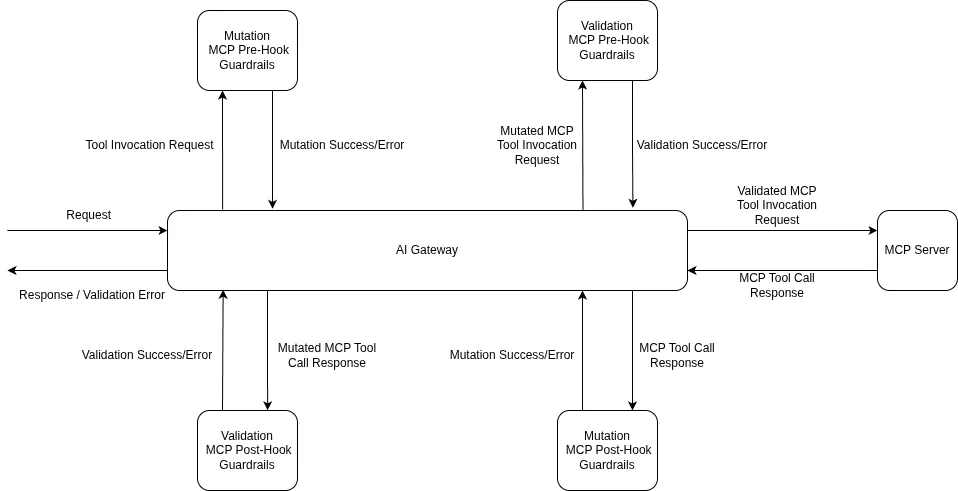
Auf TrueFoundry werden Leitplanken am Gateway auf dem agentischen Aufrufpfad durchgesetzt – der Kette von Benutzer → App → Agent → Sub-Agent → MCP-Werkzeugaufrufen. Jeder kontrollierte Schritt passiert einen Abfangpunkt mit einem Vor- und Nach- Hook.
Produktscreenshot – TrueFoundry-Dokumentation: Leitplanken werden bei LLM-Ein- und -Ausgaben sowie bei MCP-Pre-/Post-Tool-Hooks ausgeführt.
TrueFoundry AI Gateway bietet eine Latenz von ~3—4 ms, verarbeitet mehr als 350 RPS auf einer vCPU, skaliert problemlos horizontal und ist produktionsbereit, während LiteLM unter einer hohen Latenz leidet, mit moderaten RPS zu kämpfen hat, keine integrierte Skalierung hat und sich am besten für leichte Workloads oder Prototyp-Workloads eignet.
Auf Geschwindigkeit ausgelegt: ~ 10 ms Latenz, auch unter Last





.webp)





.png)
.png)
.png)
.png)
.png)
.png)