November 10, 2026
|
5 min read



Blazingly fast way to build, track and deploy your models!
Most teams discover they need an evaluation platform the same way: a prompt change that looked fine in a notebook quietly regresses in production, a customer screenshots a hallucinated answer, and nobody can say whether the new model version is actually better than the old one or just different. The question "is this LLM app good?" turns out to have no answer until you have built the machinery to measure it.
That machinery is what LLM evaluation platforms provide. But the category is noisy. Some tools are eval-first with tracing bolted on. Some are observability-first with evals bolted on. Some are open-source libraries you host; some are managed SaaS. And the newest wrinkle is agents: evaluating a single prompt-and-completion is one problem, evaluating a ten-step agent that calls tools, retrieves documents, and loops is a much harder one.
This guide does three things. It defines the eval lifecycle so you know what capabilities you actually need. It walks through the main platforms (Langfuse, Arize Phoenix, Braintrust, LangSmith, Comet Opik, Maxim, Helicone) with specifics on what each is good and bad at. And it explains where an AI gateway fits, because the traces and cost data a gateway produces are the raw material most eval platforms consume.
Want per-request traces, cost, and inline guardrails alongside your evals? Book a demo.
Evaluation is not a single step you run before launch. It is a loop with four stages, and a serious platform supports all of them.
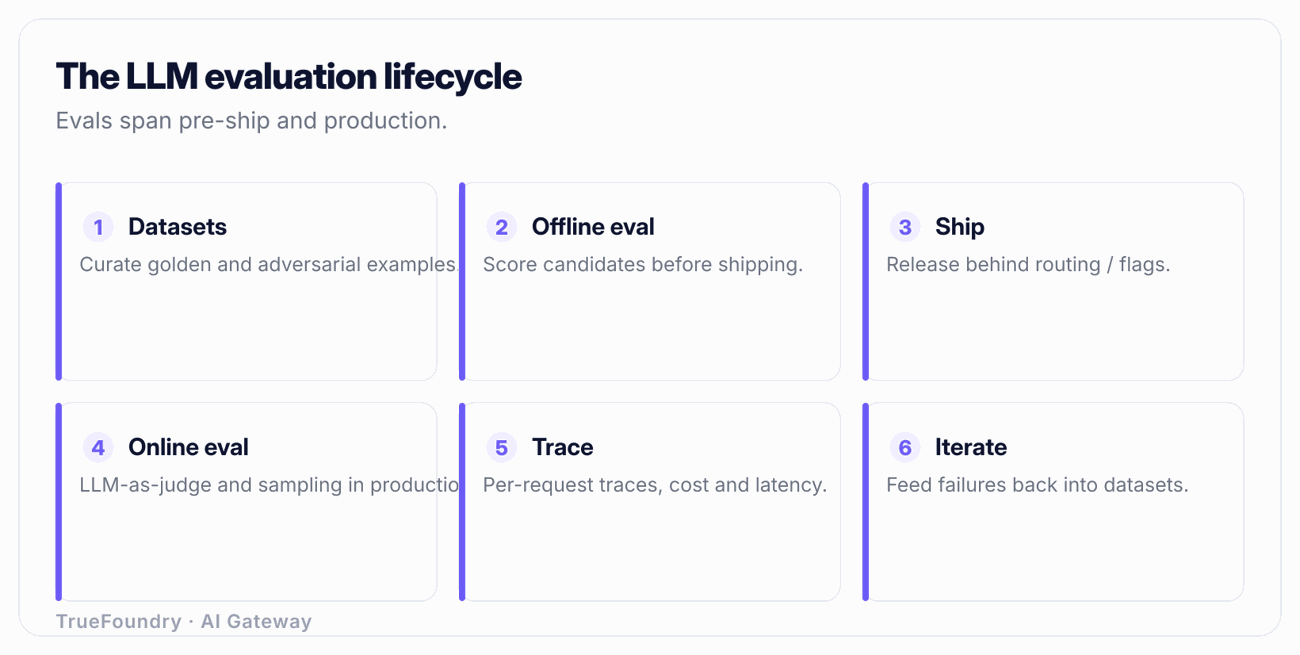
1. Datasets. Everything starts with examples. A dataset is a set of inputs, optionally with expected outputs or reference answers, that represents the work your app does. The best datasets are not synthetic, they are harvested from production: the real questions users asked, especially the ones that went wrong. A mature team continuously pulls failing or low-score production traces back into the dataset so the eval suite gets harder over time instead of staying frozen at launch-day difficulty.
2. Offline evaluation. Before you ship a prompt, model, or retrieval change, you run it against the dataset and score the outputs. Scoring methods range from deterministic (exact match, regex, JSON-schema validity, does the SQL execute) to model-graded (LLM-as-judge for correctness, relevance, tone). Offline eval is your pre-merge gate: it answers "did this change make things better or worse on cases I already know about?"
3. Online evaluation. Offline datasets never cover everything production throws at you. Online evaluation runs scorers against live traffic, usually on a sample, to catch regressions and emerging failure modes that your dataset missed. This is where you measure things like production hallucination rate, answer relevance, and guardrail violations on real user sessions.
4. Tracing and observation. Underpinning both is tracing: capturing every step of a run as structured spans. For a simple chatbot that is prompt in, completion out, plus token counts and latency. For an agent it is a tree: the planning step, each tool call with its arguments and result, each retrieval with the chunks returned, each model call with its prompt and output. Without this tree you can score an agent's final answer but you cannot tell why it was wrong, whether the retrieval missed, the tool errored, or the model ignored good context.
The loop closes when findings from stages 3 and 4 flow back into stage 1. A good platform makes that one click: see a bad production trace, add it to the dataset, re-run offline eval against it forever.
Agent evaluation adds two problems. First, trajectory matters, not just the final answer. An agent can reach a correct answer through a broken path (three redundant tool calls, a retrieval that returned garbage the model ignored by luck) and that fragility will bite you later. You have to score the steps, not only the result. Second, non-determinism compounds. A ten-step agent where each step has some variance produces wildly different runs from the same input, so you need multiple runs per case and aggregate scoring, not a single pass-or-fail.
For anything open-ended, summaries, chat answers, extracted fields with fuzzy correctness, you cannot write a regex. The practical scorer is another LLM prompted to grade the output: LLM-as-judge.
It works, but with caveats that separate teams who trust their evals from teams who get burned:
Every platform below offers LLM-as-judge. The differences are in how easy they make calibration, rubric definition, and keeping the judge versioned.
No single tool wins for everyone. Here is an honest rundown.
Langfuse. Open source (self-hostable or managed cloud), and the most complete OSS option. It combines tracing, evals, prompt management, and datasets in one system. Strong for teams that want to self-host for data-residency reasons and get observability plus evaluation without stitching three tools together. The tracing model is flexible and framework-agnostic. If you want one open-source platform that covers most of the lifecycle, this is usually the first to try. See our overview of LLM observability tools for how it sits in the broader observability landscape.
Arize Phoenix. Open source and OpenTelemetry-native, which is its defining trait. Phoenix speaks OTel semantic conventions for LLM spans, so traces slot into infrastructure you may already run, and you avoid lock-in to a proprietary trace format. Strong on retrieval and RAG debugging (embedding and chunk inspection). If your org has standardized on OpenTelemetry, Phoenix is the natural fit. Arize also sells a managed enterprise product above the OSS core.
Braintrust. Managed, eval-first. Its thesis is evals-as-CI: you wire evaluation into your development loop so every prompt or code change runs against datasets automatically, with scores diffed like test results. Strong experimentation UX for comparing prompt and model variants side by side. Best for teams whose main pain is "we change prompts constantly and have no regression gate." Lighter on the self-host and full-observability side than Langfuse.
LangSmith. Managed, built by the LangChain team and deeply integrated with LangChain and LangGraph. If your stack is already LangChain, tracing is nearly free, instrumentation comes along for the ride, and the agent-trajectory views are strong. The trade-off is that the tightest experience assumes the LangChain ecosystem; outside it, it is still usable but less of an obvious win.
Comet Opik. Open source, from the Comet (ML experiment tracking) lineage. Covers tracing, evals, and notably ships guardrail-style checks alongside evaluation. A good fit for teams that already use Comet for classical ML experiment tracking and want their LLM work in the same house, or that want an OSS eval tool with built-in moderation-type checks.
Maxim AI. An eval and observability platform that also ships Bifrost, an open-source AI gateway. The combined pitch is "evaluate, observe, and route in one vendor." The gap buyers hit is that evals and the gateway are effectively separate products rather than one control plane, gateway pricing is not public (request access), and it is a younger vendor whose benchmarks are largely self-reported. If you are specifically weighing Maxim or its Bifrost gateway, weigh the eval depth against the gateway and governance depth separately, because few tools are best-in-class at both.
Helicone. Open source, observability-and-proxy oriented. It sits as a lightweight proxy in front of your model calls and captures logs, latency, and cost with minimal integration (change a base URL). Evals are present but lighter than a dedicated eval platform's. Best when your priority is fast, cheap observability with low setup cost and you treat deep evaluation as secondary.
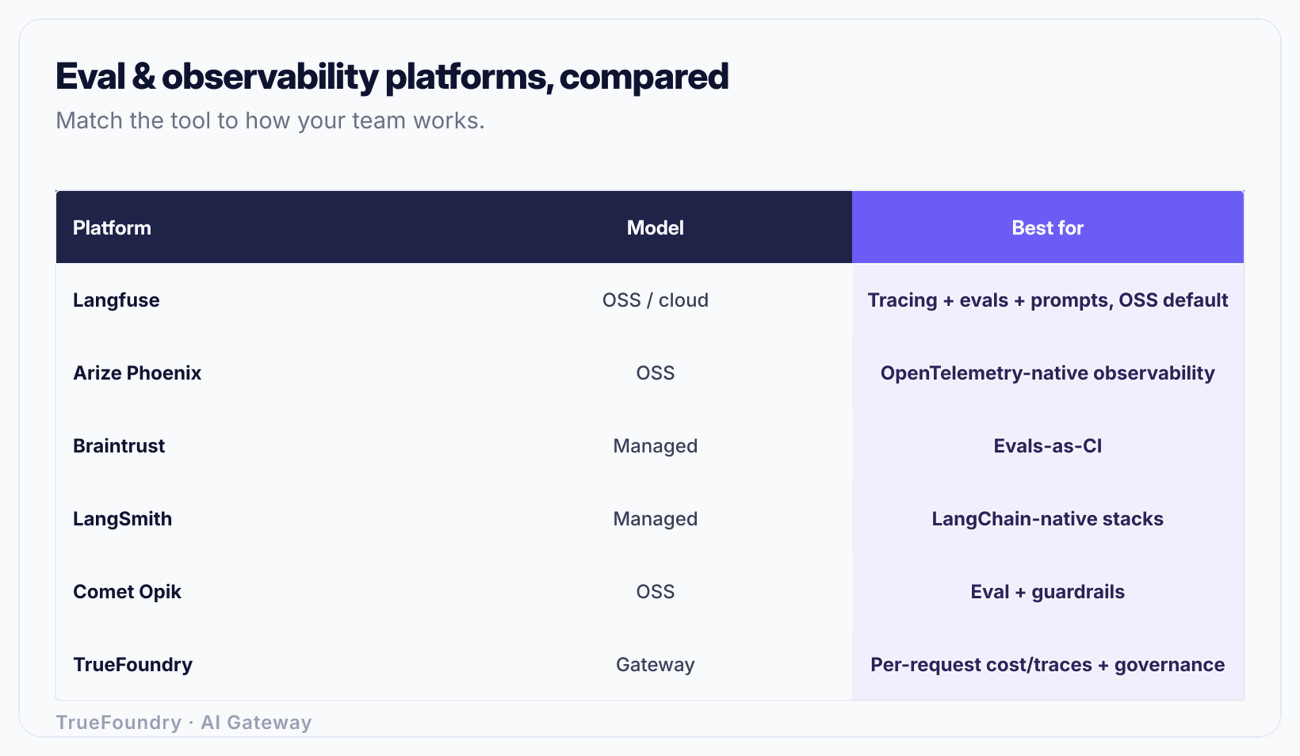
Here is the comparison condensed:
| Platform | OSS / Managed | Core strength | Best for |
|---|---|---|---|
| Langfuse | OSS + managed | All-in-one tracing, evals, prompts, datasets | Teams wanting one self-hostable platform |
| Arize Phoenix | OSS + managed | OpenTelemetry-native tracing, RAG debugging | OTel-standardized orgs; retrieval-heavy apps |
| Braintrust | Managed | Evals-as-CI, prompt/model experimentation | Teams needing a regression gate on prompt changes |
| LangSmith | Managed | LangChain/LangGraph-native tracing + eval | LangChain-based stacks |
| Comet Opik | OSS + managed | Evals plus built-in guardrail checks | Comet users; OSS eval with moderation |
| Maxim AI | Managed (+ OSS Bifrost gateway) | Eval + observability + a gateway product | Teams wanting eval and gateway from one vendor |
| Helicone | OSS + managed | Lightweight proxy-based observability | Fast, low-effort logging and cost capture |
See how TrueFoundry adds observability and governance to your eval stack. Book a demo.
Picking from the list above comes down to a handful of axes. Score candidates against these rather than against feature-count marketing.
| Criterion | What to look for |
|---|---|
| Eval types | Both deterministic (exact match, schema, code) and model-graded (LLM-as-judge, pairwise, rubric); human-review workflow for calibration |
| Tracing depth | Full span tree for agents (tool calls, retrievals, sub-steps), not just prompt-in/completion-out; OpenTelemetry support is a plus |
| Offline + online | Dataset-based pre-ship evals and production sampling, with one-click promotion of bad traces into datasets |
| OSS vs managed | Self-host for data residency and control, or managed for zero-ops; check whether OSS is full-featured or a stripped core |
| Governance | Access control, audit of who changed prompts and datasets, SSO; matters once more than a few people touch evals |
| Integrations | SDKs for your language, framework support, and a clean way to ingest traces from your gateway or proxy |
| Cost model | Usage-based pricing can spike with trace volume; understand retention limits and what sampling costs |
A concrete way to use the grid: if your hard constraint is "customer data cannot leave our VPC," you have immediately narrowed to the self-hostable OSS options (Langfuse, Phoenix, Opik) or an enterprise plan with in-VPC deployment, and the managed-only tools drop off regardless of how good their UX is. Start from your non-negotiable, then optimize within what remains.
An eval platform needs data to evaluate: traces, prompts, completions, token counts, latencies, and cost per call. Where does that come from? For a single app you instrument it directly. Across an organization running dozens of apps and agents against many model providers, the cleaner source is the layer every call already flows through: the AI gateway.
A gateway like TrueFoundry sits in front of all model and provider traffic behind a unified OpenAI-compatible API. Because every request passes through it, it emits per-request observability: tokens in and out, latency, the model and provider used, and cost, all tagged by user, team, and application. That is exactly the stream an eval platform wants to ingest, and it arrives without per-app instrumentation because the gateway produces it centrally.
The gateway also runs guardrails inline at call time, PII detection, prompt-injection checks, secret scanning, which is a different job from offline evaluation. Guardrails block or flag a bad request or response as it happens; evals score quality after the fact against datasets and production samples. You want both. The guardrail stops the obvious harm in the request path; the eval platform tells you whether answer quality is trending up or down over weeks.
The division of labor is clean: the gateway owns the request path (routing, fallback, caching, budgets, inline guardrails, and trace emission); the eval platform owns the measurement loop (datasets, offline and online scoring, LLM-as-judge, experiment comparison). TrueFoundry provides the gateway side and the observability feed; a dedicated eval platform from the list above consumes it. For teams standardizing cost and governance across many models, pairing the two beats trying to force either tool to do the other's job. Our guide to the best AI observability platforms for LLMs in 2026 goes deeper on the observability half specifically.
Treating LLM-as-judge as ground truth. The judge is a model with its own biases and failure modes. Teams that ship a judge without calibrating it against human labels end up optimizing their app to please a miscalibrated grader, which is worse than no eval because it feels rigorous while being wrong. Always measure judge-human agreement first.
Evaluating only the final answer of an agent. A correct answer from a broken trajectory is a latent bug. If you never score the intermediate steps, you will not notice that your agent reaches the right answer through three wasteful tool calls and a retrieval it ignored, until a small change tips it into failure and you have no idea why.
Freezing the dataset at launch. A static eval set measures launch-day difficulty forever while production drifts underneath it. Without a loop that continuously pulls failing production traces back into the dataset, your green eval dashboard slowly stops meaning anything.
Buying an eval tool for a problem a guardrail should solve. If your real need is "block PII and prompt injection in the request path," that is inline guardrails at the gateway, not an offline eval suite. Conversely, running offline datasets to catch real-time attacks is too slow. Match the tool to whether the check happens in-path or after-the-fact.
Ignoring data residency until procurement. Teams pick a managed eval tool on UX, then discover in security review that production prompts containing customer data cannot leave the VPC. Decide the OSS-vs-managed and deployment question first; it eliminates options faster than any feature does.
Evaluation is the discipline that turns "the AI feels better now" into a number you can defend. The platforms differ less in whether they do evals, they all do, than in how they handle the full lifecycle: dataset curation, offline gating, online monitoring, agent-trajectory tracing, and calibrated LLM-as-judge. Start from your hard constraints (data residency, existing framework, OSS vs managed), score the shortlist against the selection grid, and insist on the full loop rather than a one-shot test harness.
And remember that evaluation does not live alone. The gateway in front of your models already produces the traces and cost data your eval platform needs, and it enforces guardrails in the request path that offline evals cannot. Pair a strong eval platform with a gateway that gives you clean per-request observability and inline controls, and you get both the real-time safety net and the long-run quality signal that keep an LLM product honest.
Pair your evals with a governed gateway. Book a demo.
TrueFoundry AI Gateway delivers ~3–4 ms latency, handles 350+ RPS on 1 vCPU, scales horizontally with ease, and is production-ready, while LiteLLM suffers from high latency, struggles beyond moderate RPS, lacks built-in scaling, and is best for light or prototype workloads.




LLM evaluation is the practice of measuring the quality of a language model application's outputs, using curated datasets, scoring functions (deterministic checks and model-graded LLM-as-judge), and production monitoring. It answers whether a prompt, model, or retrieval change actually improved results rather than just changing them.
Offline evaluation runs your app against a fixed dataset before shipping, as a pre-merge regression gate. Online evaluation scores live production traffic (usually a sample) to catch regressions and new failure modes the dataset did not cover. Mature teams run both and feed online failures back into offline datasets.
It can be, if you calibrate it against human labels, use pairwise or rubric scoring instead of raw numeric scales, control for position and verbosity bias, and pin the judge model and prompt. Treated as unquestioned ground truth without calibration, it drifts and gives false confidence.
Yes, they do different jobs. The gateway produces per-request traces, cost data, and runs inline guardrails in the request path. The eval platform consumes those traces to score quality offline and online over time. The gateway is the data source and real-time control; the eval platform is the measurement loop.
Langfuse, Arize Phoenix, and Comet Opik are open source and self-hostable, which matters for data residency. Braintrust and LangSmith are managed-first. Helicone is open source and proxy-oriented with lighter evals. Choose based on whether you can let production data leave your network.



The latest news, articles, and resources sent to your inbox