November 8, 2026
|
5 min read



Blazingly fast way to build, track and deploy your models!
Maxim AI occupies an unusual spot in the tooling market. Most vendors pick a lane, they are an eval platform, or an observability platform, or a gateway. Maxim does eval and observability and also ships Bifrost, an open-source gateway written in Go that exposes an OpenAI-compatible API to many providers, with failover, semantic caching, an MCP gateway, virtual-key governance, and in-VPC deployment.
For some teams that breadth is the appeal: one vendor, one relationship, eval through to routing. For others it is exactly why they start looking at alternatives. Breadth across two product categories can mean neither is as deep as a specialist, and it raises the question of whether you are buying one integrated control plane or two products that share a logo.
This guide is not a hit piece. Maxim and Bifrost are credible tools. The goal is to help a buyer who is evaluating them understand where people look elsewhere, and to lay out the real alternatives grouped by what you actually need, deep evals, an enterprise gateway, or both in one place.
Want gateway, governance, and observability in one enterprise control plane? Book a demo.
Start with an honest description, because choosing an alternative requires knowing what you are replacing.
Maxim (the platform) is an AI evaluation and observability product. It supports the eval lifecycle, datasets, offline evaluation, LLM-as-judge scoring, production monitoring, and tracing for LLM and agent applications. If your problem is "we cannot measure whether our AI app is getting better or worse," that is the half of Maxim aimed at you.
Bifrost (the gateway) is a separate, open-source component: a gateway written in Go, which matters because Go avoids the concurrency ceiling that bites Python-based proxies under load. Bifrost speaks an OpenAI-compatible API to many providers, does automatic failover between them, supports semantic caching, includes an MCP gateway for tool access, offers virtual-key governance, and can run inside your VPC. As a routing-and-failover layer it is legitimately capable.
Where do buyers hesitate?
None of these makes Maxim a bad choice. They are simply the specific reasons a given team decides to evaluate the field, so let us map that field.
The alternatives split cleanly along the same line that runs through Maxim itself: eval/observability on one side, gateway/governance on the other. A few tools, including TrueFoundry, reach across.
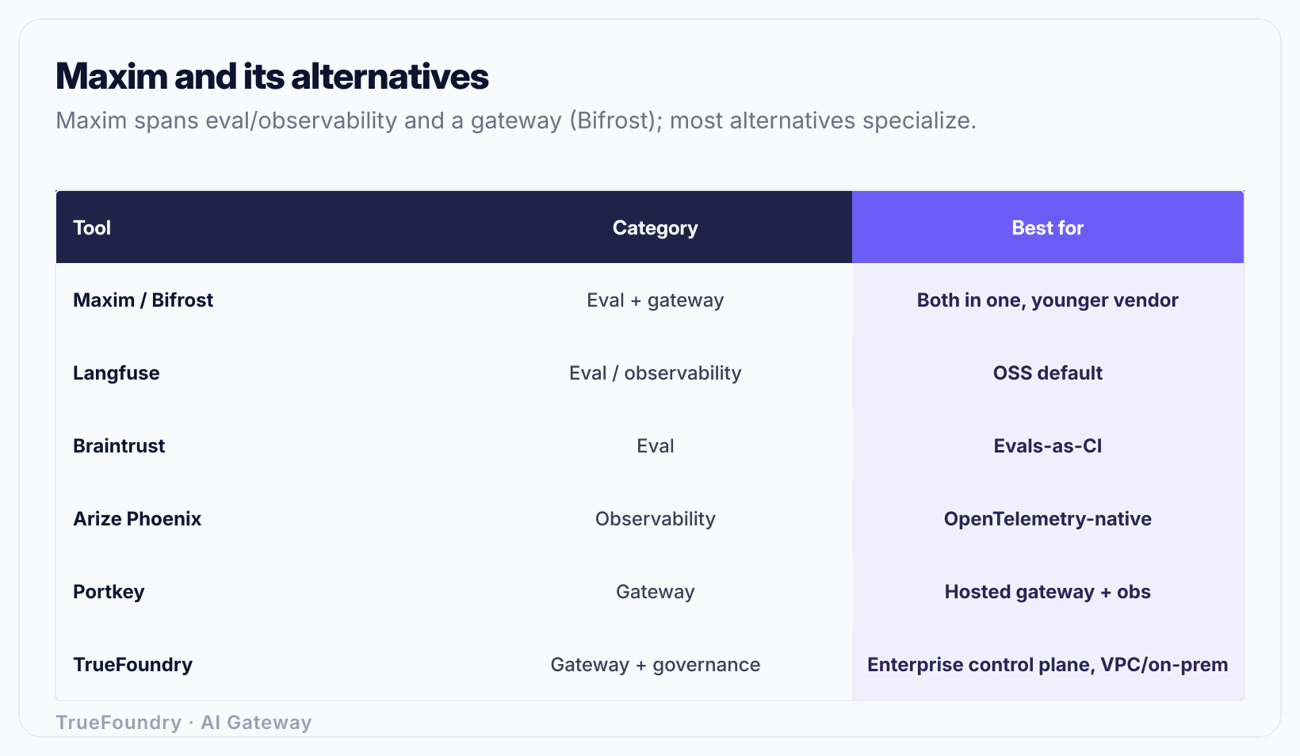
Understanding which side your real pain lives on is the whole decision. If you are losing sleep over "we cannot tell if answers are good," you need the eval side. If you are losing sleep over "we have no control over which teams spend what on which models, and secrets are scattered," you need the gateway-and-governance side. Many teams eventually need both, which is why the consolidation question matters.
If what drew you to Maxim was the eval and observability half, these are the specialists.
Langfuse. Open source, self-hostable or managed. The most complete OSS option, combining tracing, evals, prompt management, and datasets. The natural pick if you want Maxim's eval/observability capability but open source and under your own control, especially for data-residency reasons.
Arize Phoenix. Open source and OpenTelemetry-native. If your organization has standardized on OpenTelemetry, Phoenix's traces slot into existing infrastructure and you avoid a proprietary trace format. Strong at RAG and retrieval debugging.
Braintrust. Managed, eval-first, built around evals-as-CI: evaluation wired into the development loop so every change is scored and diffed like a test. Best when your main gap is a regression gate on constant prompt changes.
LangSmith. Managed, built by the LangChain team and tightly integrated with LangChain and LangGraph. If your stack is already LangChain, tracing and agent-trajectory views come almost for free.
Comet Opik. Open source, from the Comet ML-tooling lineage, covering tracing and evals with built-in guardrail-style checks. A fit for existing Comet users and for teams wanting an OSS eval tool with moderation checks included.
For the monitoring angle specifically, see our rundown of LLM observability tools and the best AI observability platforms for LLMs.
If what drew you to Maxim was Bifrost, the gateway, these are the alternatives, and they differ a lot in how much governance is native.
TrueFoundry. An enterprise AI gateway plus MCP gateway plus governance, with a unified OpenAI-compatible API. Routing (latency, weight, priority), fallback with in-request retries, exact and semantic caching, budgets and rate limits per user, team, and model, full per-request observability with cost attribution, and inline guardrails, all under one control plane with RBAC, SSO, SCIM, and audit. It deploys SaaS, in-VPC, on-prem, or air-gapped, with the data plane staying in your network. This is the Bifrost alternative for teams that want the gateway and the governance and the observability as one product rather than assembled parts. We cover the head-to-head framing in our Bifrost alternative piece.
Portkey. An AI gateway plus observability. Its open-source core does routing, fallback, and load balancing only, observability, virtual keys, caching, and prompt management live in the hosted product, and SSO, compliance, VPC, and PII anonymization are Enterprise-only. Capable, but the capability you need may sit behind a tier you have to pay up to. If you are weighing it, our Portkey vs LiteLLM comparison lays out the tiering.
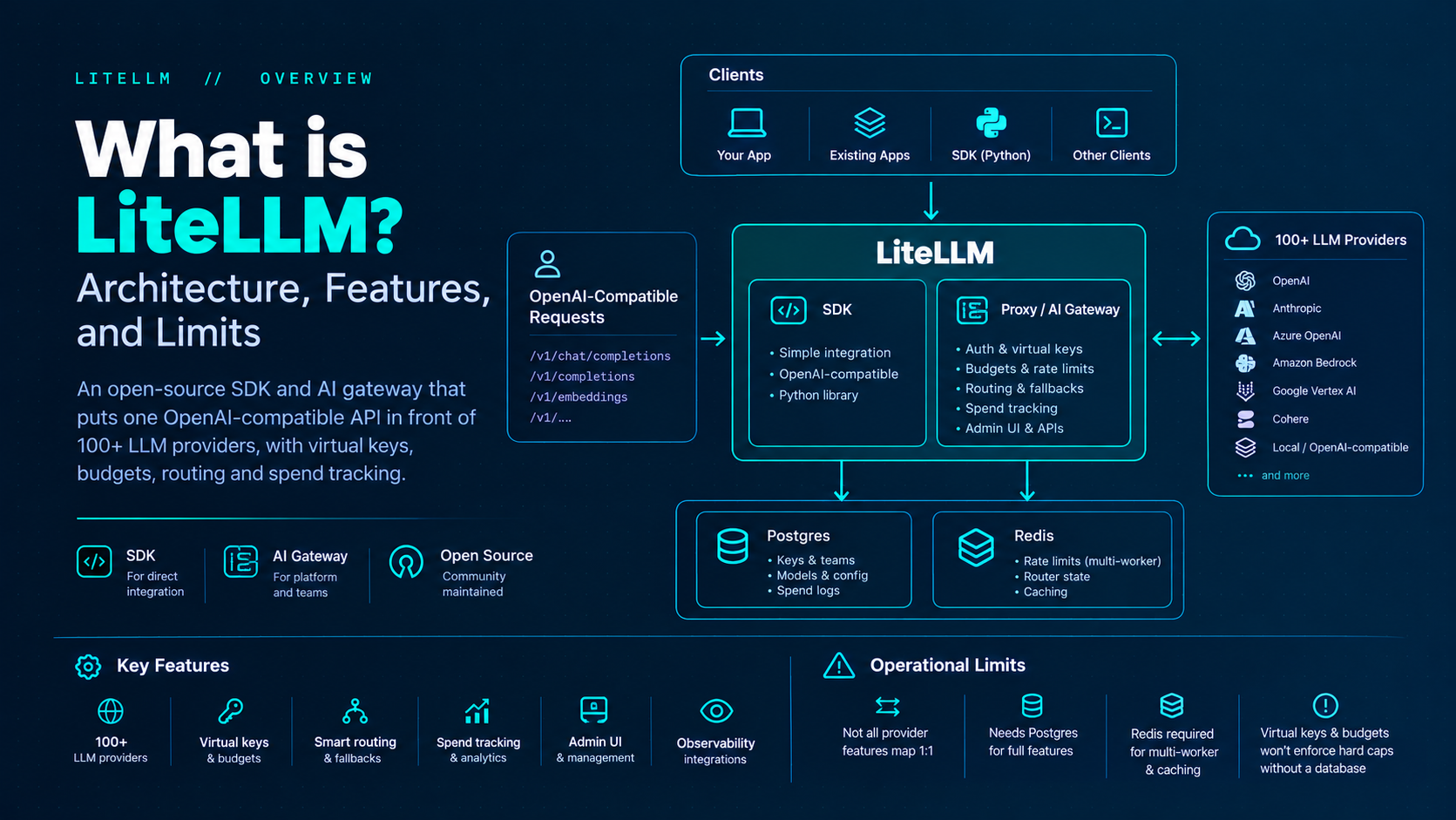
LiteLLM. Open source (MIT), a Python LLM proxy supporting 100+ providers, with an enterprise tier adding SSO, SCIM, budgets, rate limits, and audit. An excellent starting proxy. The reasons teams outgrow it are specific: the Python concurrency ceiling caps throughput and latency under high load, the proxy concentrates every provider secret in one place (a large blast radius), and self-hosted high availability is on you. See what is LiteLLM for the full picture.
Here is the comparison across both halves:
| Tool | Category | OSS / Managed | Deploy options | Best for |
|---|---|---|---|---|
| Maxim AI | Eval + observability + gateway (Bifrost) | Managed platform; Bifrost OSS | In-VPC (Bifrost); gateway pricing on request | Teams wanting eval and a gateway from one vendor |
| Langfuse | Eval + observability | OSS + managed | Self-host or cloud | Self-hostable all-in-one eval/observability |
| Arize Phoenix | Eval + observability | OSS + managed | Self-host or cloud | OTel-standardized, RAG-heavy teams |
| Braintrust | Eval | Managed | Cloud | Evals-as-CI regression gating |
| LangSmith | Eval + tracing | Managed | Cloud | LangChain/LangGraph stacks |
| Comet Opik | Eval + guardrail checks | OSS + managed | Self-host or cloud | Comet users; OSS eval + moderation |
| TrueFoundry | Gateway + MCP + governance + observability | Managed / self-managed | SaaS, VPC, on-prem, air-gapped | One enterprise control plane, data in your network |
| Portkey | Gateway + observability | OSS core + managed | Cloud; VPC on Enterprise | Routing with observability, if tiers fit |
| LiteLLM | Gateway / proxy | OSS (MIT) + enterprise | Self-host | Starter proxy, many providers, fast to adopt |
See how TrueFoundry compares for teams who need both gateway and governance. Book a demo.
Rather than comparing feature lists, decide which of three situations you are in.
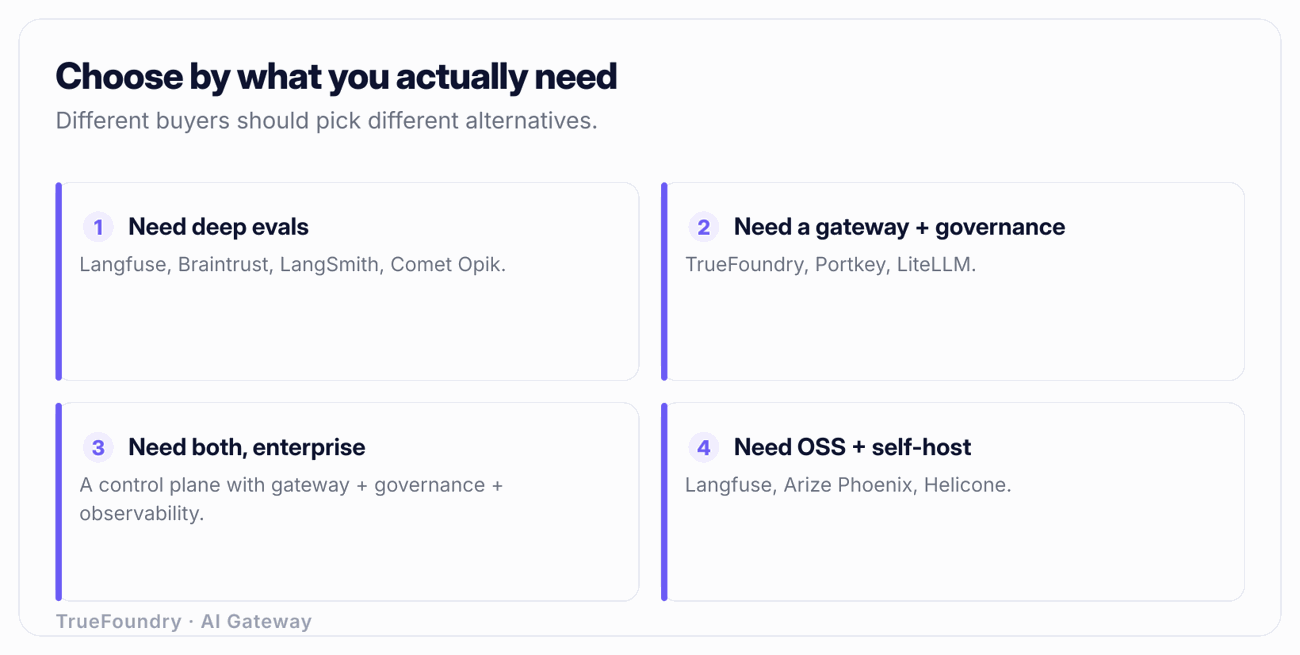
| Your need | Recommended alternative |
|---|---|
| Deep evals/observability, open source, self-hosted | Langfuse or Arize Phoenix |
| Evals wired into CI as a regression gate | Braintrust |
| Evals for a LangChain-based stack | LangSmith |
| Open-source gateway/failover, you own ops | Bifrost (Maxim) or LiteLLM |
| Gateway with governance but flexible on tiering | Portkey |
| Gateway + governance + observability + cost control in one plane, with VPC/on-prem/air-gapped | TrueFoundry |
The split that trips people up is treating "eval" and "gateway" as interchangeable because one vendor sells both. They are different jobs. An eval platform measures output quality against datasets over time. A gateway controls the request path: routing, fallback, caching, budgets, and inline guardrails. You can buy them separately from specialists, or you can consolidate, but you should decide which pain is primary before you let a bundled vendor set the frame.
For the buyer looking at Maxim because they want more than a point tool, routing and governance and observability and cost control, TrueFoundry is positioned as the single enterprise control plane rather than two adjacent products.
Concretely, that means: one unified OpenAI-compatible API in front of every provider; routing by latency, weight, and priority with cost- and quality-aware model selection; fallback with in-request retries; exact and semantic caching; budgets and rate limits enforced per user, team, and model; cost attribution tagged by team so FinOps actually works; inline guardrails for PII and prompt injection; and governance (RBAC, SSO, SCIM, audit) across both the LLM gateway and the MCP gateway. The deployment story is the other differentiator: SaaS, in-VPC, on-prem, or fully air-gapped, with the data plane staying inside your network, which is what regulated buyers need and what unpublished-pricing, request-access products make harder to evaluate.
The honest framing: if your only problem is evaluation, a specialist eval platform from the list above will serve you better than any gateway, and you should buy one. If your problem is enterprise control over a growing fleet of models and agents, and you would rather not stitch a gateway to a separate governance tool to a separate observability tool, that consolidation is the case for TrueFoundry. Our guide on how to choose an AI gateway walks the gateway-selection criteria in detail.
Buying a bundle to avoid integration, then integrating anyway. Choosing Maxim because "eval and gateway from one vendor" sounds simpler only pays off if the two halves are genuinely one plane. When they are separate products, you still integrate them, you have just limited your choice on each half. Check whether the bundle is one control plane or two logos.
Ignoring pricing opacity until late. An unpublished, request-access gateway price is fine to explore but risky to design around. Teams that build a rollout plan before they have a number sometimes discover the economics do not work after they have sunk integration effort. Get the number early.
Confusing a gateway's guardrails with an eval platform's scoring. A gateway blocks PII or injection in the request path, in real time. An eval platform scores answer quality after the fact against datasets. Picking one expecting it to do the other's job leaves a gap you find in production.
Over-weighting self-reported benchmarks. Every young vendor's benchmarks look great in their own charts. Treat throughput and latency claims as hypotheses to test on your workload, not as settled facts, whichever vendor publishes them.
Picking on features and failing security review on deployment. The feature grid rarely decides enterprise deals; the deployment and data-residency model does. If customer data cannot leave your network, VPC/on-prem/air-gapped support eliminates options faster than any capability, so weigh it first.
Maxim AI is a reasonable choice, and Bifrost is a capable gateway. Teams look at alternatives for concrete reasons: unpublished gateway pricing, the seam between the eval product and the gateway product, and a young vendor's self-reported benchmarks. The right alternative depends entirely on which half of Maxim you were buying it for.
If you need evaluation, buy an eval specialist, Langfuse, Phoenix, Braintrust, LangSmith, or Opik. If you need an enterprise gateway, decide whether you want routing-plus-governance-plus-observability as one control plane with VPC/on-prem/air-gapped deployment, which is the case for TrueFoundry, or a lighter starting point in LiteLLM or Portkey. Name your primary pain first, and the field narrows quickly.
Evaluate TrueFoundry alongside your shortlist. Book a demo.
TrueFoundry AI Gateway delivers ~3–4 ms latency, handles 350+ RPS on 1 vCPU, scales horizontally with ease, and is production-ready, while LiteLLM suffers from high latency, struggles beyond moderate RPS, lacks built-in scaling, and is best for light or prototype workloads.


Maxim AI is an AI evaluation and observability platform that also ships Bifrost, an open-source Go-based AI gateway. The platform covers datasets, offline and online evals, LLM-as-judge, and tracing; Bifrost provides an OpenAI-compatible gateway with failover, semantic caching, an MCP gateway, and virtual-key governance.
Bifrost is Maxim's open-source AI gateway, written in Go. It exposes an OpenAI-compatible API to many providers, does automatic failover, supports semantic caching and an MCP gateway, offers virtual-key governance, and can run in your VPC. Its commercial pricing is not published; you request access.
Langfuse and Arize Phoenix (both open source and self-hostable), Braintrust (evals-as-CI), LangSmith (LangChain-native), and Comet Opik (OSS eval with guardrail checks). Choose based on OSS vs managed, framework fit, and data-residency needs.
TrueFoundry if you want gateway, governance, observability, and cost control in one enterprise control plane with VPC/on-prem/air-gapped deployment; Portkey if you want a gateway with observability and the tiering fits; LiteLLM if you want an open-source starter proxy with broad provider support.
If your pain is clearly one side, buy the specialist, it will be deeper. If you genuinely need eval and gateway and governance together, consider whether the bundle is one unified control plane or two separate products sharing a brand, because that determines how much integration you still own.



The latest news, articles, and resources sent to your inbox