November 8, 2026
|
5 min read


Blazingly fast way to build, track and deploy your models!
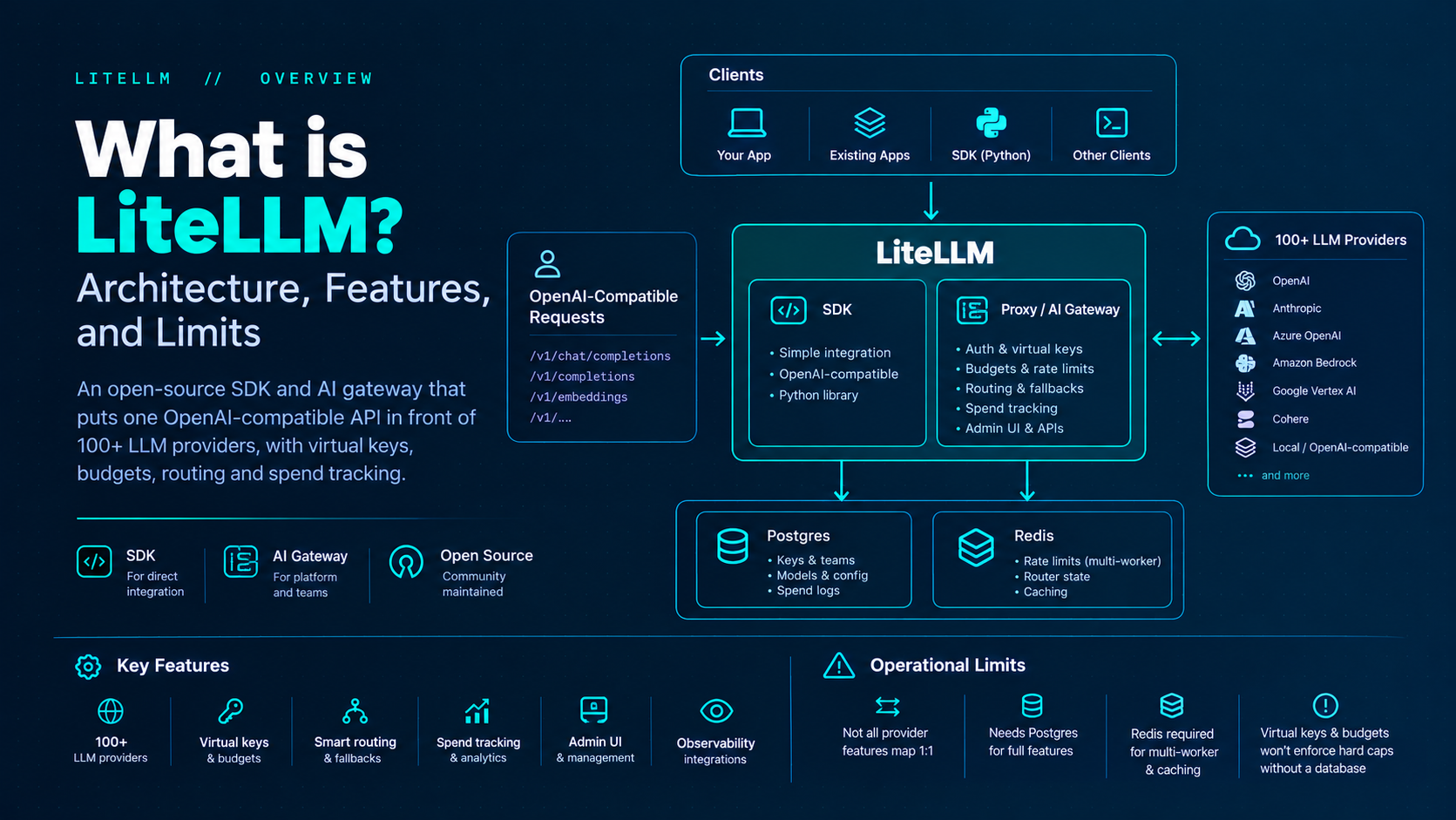
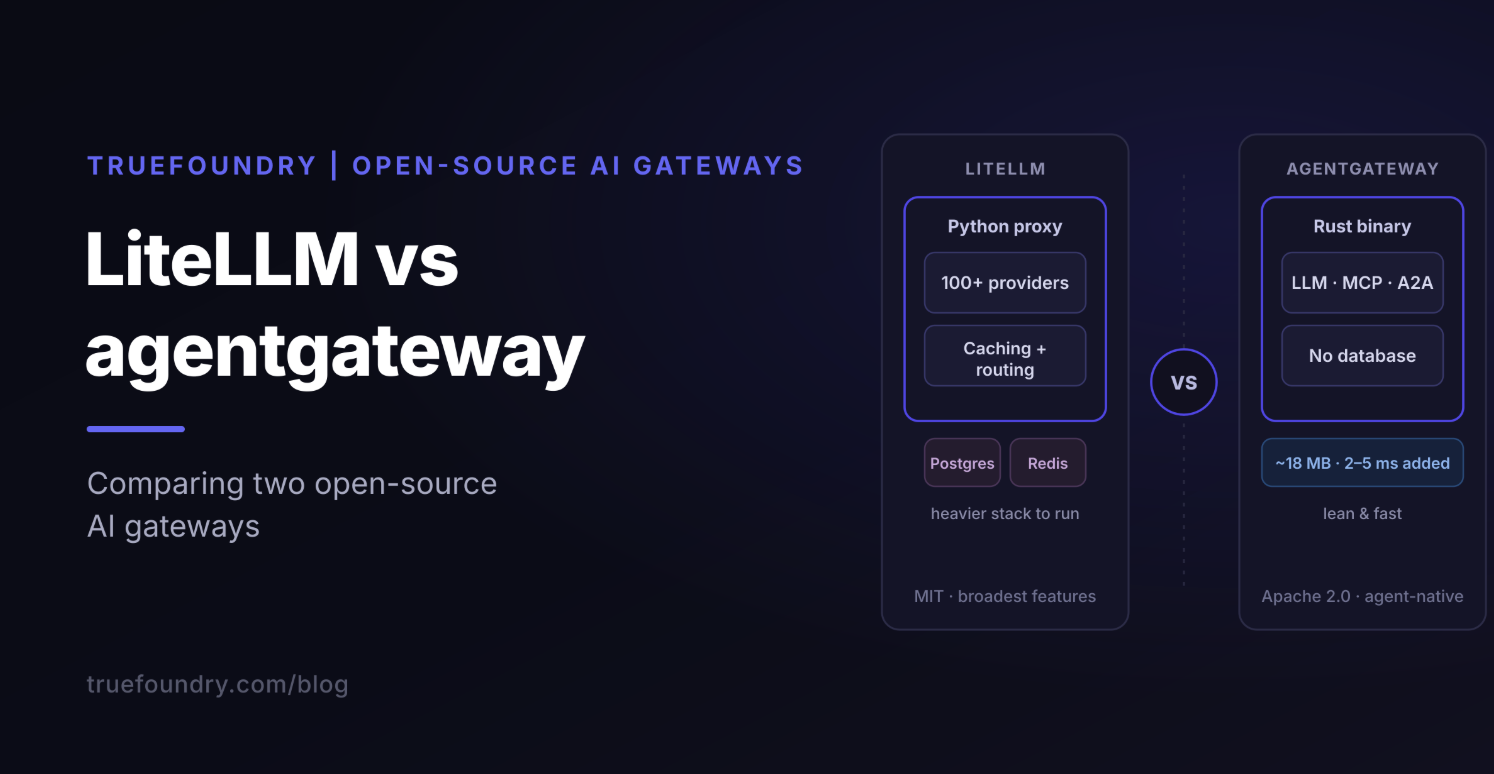
LiteLLM earned its popularity. It is MIT-licensed, supports over 100 providers behind one OpenAI-compatible API, installs in minutes, and gets a small team from "calling three providers with three SDKs" to "calling one endpoint" with almost no effort. For a lot of projects it is the right first choice, and nothing in this post argues otherwise.
The reasons teams migrate away from it are structural, and they show up at a predictable scale. When a dozen engineers become a hundred, when one app becomes thirty, when "we should probably track spend" becomes "finance needs cost per team" and "security needs an audit trail," a single-process Python proxy starts to strain against jobs it was never designed to own. Add the 2026 supply-chain incidents in the LiteLLM distribution chain, and the conversation shifts from "it works" to "who controls our model access, and how do we prove it?"
This is a migration playbook, not a teardown. It names the specific signals that you have outgrown LiteLLM, maps every LiteLLM concept to its governed-gateway equivalent, and lays out a step-by-step cutover that is low-risk precisely because both sides speak the OpenAI-compatible API. In most cases your application code changes by one line: the base URL.
Outgrowing LiteLLM? See how a base-URL swap moves you to a governed gateway. Book a demo.
Be precise about the triggers. Vague "it didn't scale" stories do not help you plan; specific failure modes do.
| Symptom you observe | Underlying cause |
|---|---|
| Latency climbs and throughput plateaus under concurrent load, even with more CPU | Python's Global Interpreter Lock serializes CPU-bound work in a single process; the proxy becomes the bottleneck |
| A single credential leak would expose every provider account | The proxy concentrates all provider secrets in one place, a large blast radius |
| Patching a vulnerability means chasing copies on laptops, CI runners, and prod | Deployment sprawl: the proxy runs in many places with no central version control |
| Keeping the proxy highly available (failover, zero-downtime upgrades) eats platform time | Self-hosted HA is entirely your responsibility; there is no managed control plane |
| Finance cannot get spend per team; security cannot get an audit trail | Governance (RBAC, cost attribution, audit) is not the core design center of a lightweight proxy |
The GIL throughput ceiling. LiteLLM's proxy is Python. Python's Global Interpreter Lock means one process executes Python bytecode on one thread at a time. For an I/O-bound proxy that mostly waits on provider responses this is tolerable at low concurrency, but as concurrent request volume rises, request handling, serialization, logging, policy checks contend for that single lock, and you see latency climb and throughput flatten no matter how much hardware you add. You can shard across many processes and instances, but now you own the orchestration and the shared-state problem that creates.
Secret concentration and blast radius. The proxy holds the API keys for every provider it fronts. That is the point of a proxy, but it means one compromised proxy, or one leaked config, exposes OpenAI, Anthropic, your cloud model endpoints, everything at once. Without centralized secret management, rotation, and scoped access, the blast radius of any incident is "all of it."
Deployment sprawl and patching. Because it is trivial to run, LiteLLM ends up running everywhere: a copy on each developer's laptop, one in CI, several in production. When a vulnerability drops, you have to find and patch every instance. There is no single control plane that says "every caller goes through this one governed endpoint," so "patch the proxy" becomes a scavenger hunt.
Self-hosted HA burden. Running one proxy is easy. Running it with failover, zero-downtime upgrades, health checking, and horizontal scale under SLA is platform work you now own in full. Many teams reach a point where that undifferentiated toil is not worth it.
Two events in 2026 turned these structural concerns into urgent ones, and they are worth stating plainly without alarm.
In March 2026, a CI compromise led to malicious LiteLLM releases (versions 1.82.7 and 1.82.8) being published to PyPI. The malicious packages stole credentials from systems that installed them. The official Docker image was not affected. In October 2026, a second incident saw a malicious release (1.107.0) pushed to both PyPI and Docker using stolen GitHub tokens. Separately, LiteLLM has had multiple CVEs, including one listed on CISA's Known Exploited Vulnerabilities catalog (a remote-code-execution path exploitable by holders of an API key) and an issue where an MCP session could be established with any bearer token.
The remediation pattern in each case was the same: pin versions, rebuild from a known-good release, and rotate all secrets. The lesson is not "LiteLLM is unsafe", open-source projects get targeted precisely because they are widely used. The lesson is that secret concentration plus version sprawl turns any single supply-chain event into a fleet-wide incident, and that is an argument for a governed control plane where version, secrets, and access are centrally managed and auditable. A compromised dependency is far easier to contain when every caller already routes through one governed endpoint with rotated, scoped credentials and a full audit trail.
A governed AI gateway keeps everything LiteLLM gave you, one OpenAI-compatible endpoint across many providers, and adds the layer a lightweight proxy does not center on:
TrueFoundry provides this as one control plane, and crucially it deploys SaaS, in-VPC, on-prem, or air-gapped, with the data plane staying inside your network, so "governed" does not mean "hand your traffic to a third party." For the selection criteria in general, see how to choose an AI gateway, and for the architectural framing, what an LLM proxy is and does.
See how TrueFoundry maps your LiteLLM keys, budgets, and models to governed policy. Book a demo.
The migration is deliberately incremental. You never flip the whole organization at once.
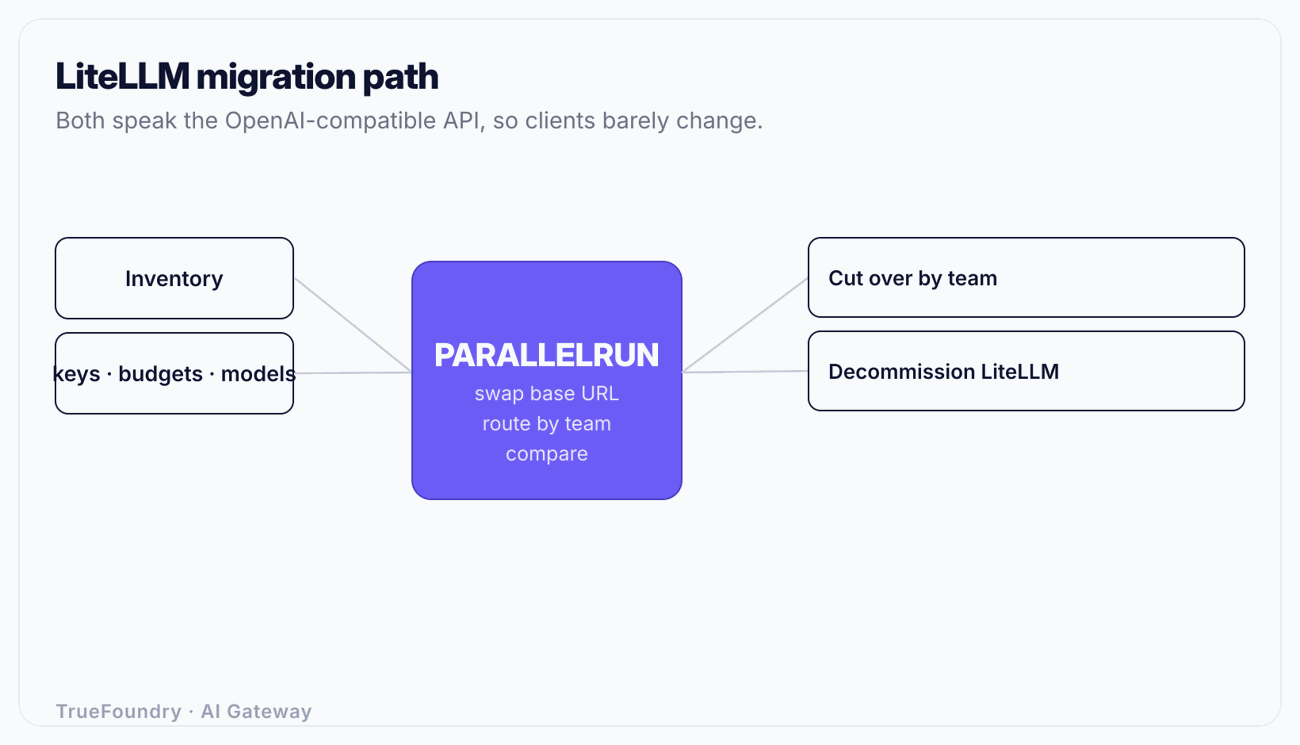
Before touching anything, catalog what LiteLLM is doing for you today:
The caller inventory is the one teams skip and regret. You cannot cut over traffic you did not know existed. Grep your codebases and infra for the proxy's hostname.
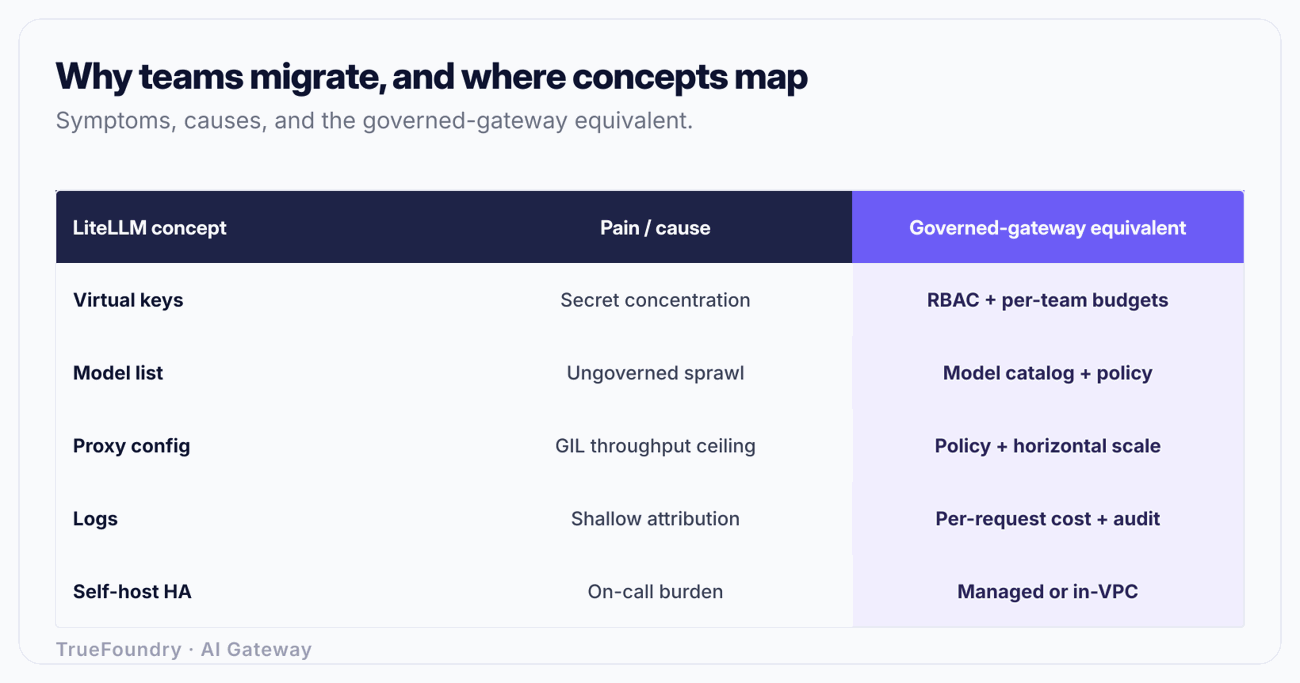
You are not rebuilding; you are translating. Every LiteLLM concept has a governed-gateway equivalent.
| LiteLLM concept | Governed-gateway equivalent |
|---|---|
| Virtual key (API key with limits) | Identity-tied access via RBAC + per-key/team budgets and rate limits |
| Model list / aliases | Governed model catalog, with access scoped per team |
Proxy config file (config.yaml) | Declarative policy (routing, fallback, caching, limits) under version control and audit |
| Scattered provider API keys | Centrally held, scoped, and rotated secrets |
| Request logs | Per-request observability: tokens, latency, cost, tagged by user/team/model |
| Fallback settings | Fallback with in-request retries and policy-driven routing |
| Manual key sharing | SSO + SCIM provisioning/deprovisioning |
The translation is mostly a mental reframe: LiteLLM thinks in keys and a config file; a governed gateway thinks in identities, teams, catalogs, and policy. The capabilities overlap heavily, which is why migration is low-risk.
This is the step that makes the whole thing safe. Both LiteLLM and the governed gateway expose an OpenAI-compatible API. That means the only change a client needs is the base URL, from the LiteLLM proxy's URL to the gateway's endpoint. No SDK swap, no request-shape rewrite, no response-parsing change.
Stand up the governed gateway alongside LiteLLM. Point a single low-risk service at the new base URL. Verify that responses are identical, that observability shows the traffic with correct cost attribution, and that budgets and guardrails behave as configured. Because both endpoints are live, you can compare them directly and roll a service back to the old base URL in seconds if anything looks off.
A concrete example: say your inference service reads OPENAI_API_BASE from an environment variable. Migration for that service is changing one environment variable and restarting, and reverting is changing it back. That is the entire client-side blast radius of this migration when both sides speak the same API.
Now migrate traffic in waves, organized by team or application, not all at once:
Cutting over by team gives you a clean rollback boundary and lets budgets and access be defined correctly per team as you go, rather than migrating a tangle of shared keys in one risky jump. It also spreads the review work: each team confirms its own traffic looks right before you move on.
Once every caller points at the gateway and has baked long enough that you trust it, decommission LiteLLM: stop the proxy instances, remove the provider secrets from its config, and, importantly, rotate those provider credentials so the old proxy's copies are dead. Remove the proxy from CI and developer setups so deployment sprawl does not quietly regrow. The migration is done when there is exactly one governed path to every model and no orphaned proxy holding live keys.
Migrating shared keys instead of redefining access by team. LiteLLM deployments accumulate shared virtual keys that several teams use. Porting those as-is recreates the exact ungoverned sprawl you are migrating to escape. Use the cutover to define access per team against your identity provider, that is half the point of moving.
Skipping the caller inventory. Teams migrate the apps they remember and leave a notebook, a cron job, or a CI step pointed at the old proxy. Then they decommission LiteLLM and something breaks in the dark. Grep everything for the old hostname before you turn the proxy off.
Forgetting to rotate secrets at decommission. If you shut down LiteLLM but leave the provider keys it held un-rotated, those credentials are still live and now sitting in a decommissioned, unmonitored system, exactly the stale-secret condition the 2026 incidents exploited. Rotate every credential the old proxy held.
Treating the base-URL swap as the whole migration. The base-URL swap is what makes the client side trivial, but governance, RBAC, budgets, catalog scoping, audit, is the reason you are migrating. Swapping URLs without actually configuring the governance leaves you with a new proxy and the old problems.
Big-bang cutover. Flipping the entire org in one change removes your rollback boundary. Parallel run and team-by-team cutover exist so that any problem is contained to one team and reversible with one base-URL revert. Skip them only if you enjoy incident calls.
Outgrowing LiteLLM is a sign of success, not a mistake in picking it. The triggers are specific and structural: a Python proxy's throughput ceiling under concurrency, every provider secret concentrated in one place, copies sprawling across environments, the full weight of self-hosted HA, and a 2026 supply-chain year that made secret concentration and version sprawl feel a lot less abstract.
The migration itself is low-risk because both sides speak the OpenAI-compatible API, so the client change is usually one base URL. Inventory what you have, map keys to RBAC and budgets, the model list to a catalog, config to policy, run both in parallel, cut over team by team, and decommission with a full secret rotation. Done that way, you trade a convenient proxy for a governed control plane without a rewrite, and you come out the other side with access, cost, and audit under control.
Migrate off LiteLLM with minimal application change. Book a demo.
TrueFoundry AI Gateway delivers ~3–4 ms latency, handles 350+ RPS on 1 vCPU, scales horizontally with ease, and is production-ready, while LiteLLM suffers from high latency, struggles beyond moderate RPS, lacks built-in scaling, and is best for light or prototype workloads.




No. LiteLLM is a strong, MIT-licensed starting proxy and the right choice for many teams. You migrate when you outgrow a single-process Python proxy, high-concurrency throughput limits, secret concentration, deployment sprawl, HA burden, or when compliance needs RBAC, cost attribution, and audit that a lightweight proxy does not center on.
Usually one line: the base URL. Both LiteLLM and a governed gateway like TrueFoundry expose an OpenAI-compatible API, so clients keep the same SDK, request shape, and response parsing. You point them at the new endpoint and the rest is unchanged.
In March 2026 a CI compromise led to malicious releases (1.82.7/1.82.8) on PyPI that stole credentials; the official Docker image was unaffected. In October 2026 a malicious release (1.107.0) was pushed to PyPI and Docker via stolen GitHub tokens. There have also been multiple CVEs, including one on CISA's KEV catalog. Remediation each time: pin versions, rebuild from a known-good release, rotate all secrets.
Yes, and you should. Running both in parallel is the core of a safe migration: stand up the gateway, swap one service's base URL, verify, then migrate team by team with the ability to revert any service in seconds. Decommission LiteLLM only after everything has baked.
They map onto the governed gateway's model: virtual keys become identity-tied RBAC access with per-team budgets and rate limits, the model list becomes a scoped catalog, and the config file becomes declarative policy under audit. You translate concepts rather than rebuilding, which is why the capabilities carry over cleanly.



The latest news, articles, and resources sent to your inbox