November 10, 2026
|
5 min read



Blazingly fast way to build, track and deploy your models!
Most teams do not have a flagship problem. They have a default problem. The model that answers the median request, the one that handles the long tail of chat, summarization, everyday coding, and retrieval-augmented answers, is where the bill actually accumulates, because that is where the volume is. Gemini 3.6 Flash is interesting precisely because it is built for that default slot: capable enough that users do not notice a downgrade from a flagship, cheap enough that you can point the firehose at it.
This post covers what Gemini 3.6 Flash is (as reported in November 2026), where it fits between rock-bottom small models and the flagships, when to pick it and when not to, and the gateway pattern that lets you make it your default while still escalating the requests that genuinely need more.
One accuracy note up front: apart from the Claude figures, the specs below come from third-party reporting and sources that sometimes conflict. Treat them as a starting point and verify against Google's official model and pricing pages before you build on them. Model specs change frequently.
Want to route most traffic to a Flash-class model and escalate only the hard requests? Book a demo.
Gemini 3.6 Flash is reported to have been released around July 2026 as the mid-tier, speed-optimized model in Google's Gemini 3.x line. The reported profile:
The one-line summary: a model that gives you most of a flagship's everyday usefulness, at a mid-tier price, with flagship-class context and strong throughput. That combination is exactly what a default model should be.
| Attribute | Reported value |
|---|---|
| Release | ~July 2026 |
| Input price | $1.50 / 1M tokens |
| Output price | $7.50 / 1M tokens |
| Context window | 1M tokens |
| Throughput | ~280 tokens/sec |
| Intelligence Index | ~50 (aggregate) |
| SWE-Bench Pro | ~58.7% |
| Positioning | High-capability, low-cost workhorse |
Pricing/benchmarks as reported as of November 2026; verify against each provider's official pricing page before relying on them — model specs change frequently.
If your account or region does not yet show 3.6 Flash, the safe, generally available fallback is Gemini 3.5 Flash. Treat 3.6 as the target and 3.5 GA as the backstop until you have confirmed 3.6 directly.
The useful way to think about Flash is as the middle rung of a three-rung ladder. Below it sits the rock-bottom tier. Above it sit the flagships. Each rung has a job.
Rock-bottom tier (roughly $0.10–$0.25 input). Claude Haiku 5.5 is confirmed from $0.10 / $0.50. The reported GPT-6 Luna sits at $0.10 / $0.50 and Gemini 3.1 Flash-Lite near $0.25 / $1.50. These are for classification, extraction, routing, and other short, unambiguous jobs. On input price, they are roughly 15x cheaper than Flash. They are not as capable, and they are not meant to be.
Flash-class workhorse (roughly $1–$2 input). Gemini 3.6 Flash at a reported $1.50 / $7.50, alongside peers like Claude Sonnet 5.5 (confirmed $2 / $10) and the reported GPT-6.1 Terra ($1 / $5). This is the default tier: chat, summarization, RAG answers, everyday coding, anything that needs real competence but not the deepest reasoning.
Flagship tier (roughly $2–$10 input, high output). Gemini 3.1 Pro (reported $2 / $12), Claude Opus 5.5 (confirmed $4 / $20), the reported GPT-6 Astra ($10 / $50). These earn their price only on the hard slice: long-horizon agentic coding, deep reasoning, difficult analysis.

The point of the ladder is that each rung is roughly an order of magnitude apart in either price or capability, so moving a request to the wrong rung is expensive in one direction and low-quality in the other. Flash is the rung most of your traffic belongs on.
Flash is the right default, not the right answer for everything. Here is the decision.
| Dimension | Rock-bottom (Haiku 5.5 / Luna) | Flash-class (3.6 Flash) | Flagship (3.1 Pro / Opus 5.5) |
|---|---|---|---|
| Reported input price | ~$0.10 | ~$1.50 | $2–$4+ |
| Reported output price | ~$0.50 | ~$7.50 | $12–$20+ |
| Best for | Classify, extract, route | Chat, RAG, everyday coding | Deep reasoning, agentic coding |
| Context need | Low | Up to 1M | Large, hard reasoning |
| Share of typical traffic | ~70–80% | ~15–20% | ~5% |
| When it is the wrong choice | Needs nuance or coding depth | Short trivial jobs; hardest reasoning | Simple or everyday work |
Pricing/benchmarks as reported as of November 2026; verify against each provider's official pricing page before relying on them — model specs change frequently. Claude figures are first-party confirmed.
See how TrueFoundry defaults to cheap models and falls back automatically. Book a demo.
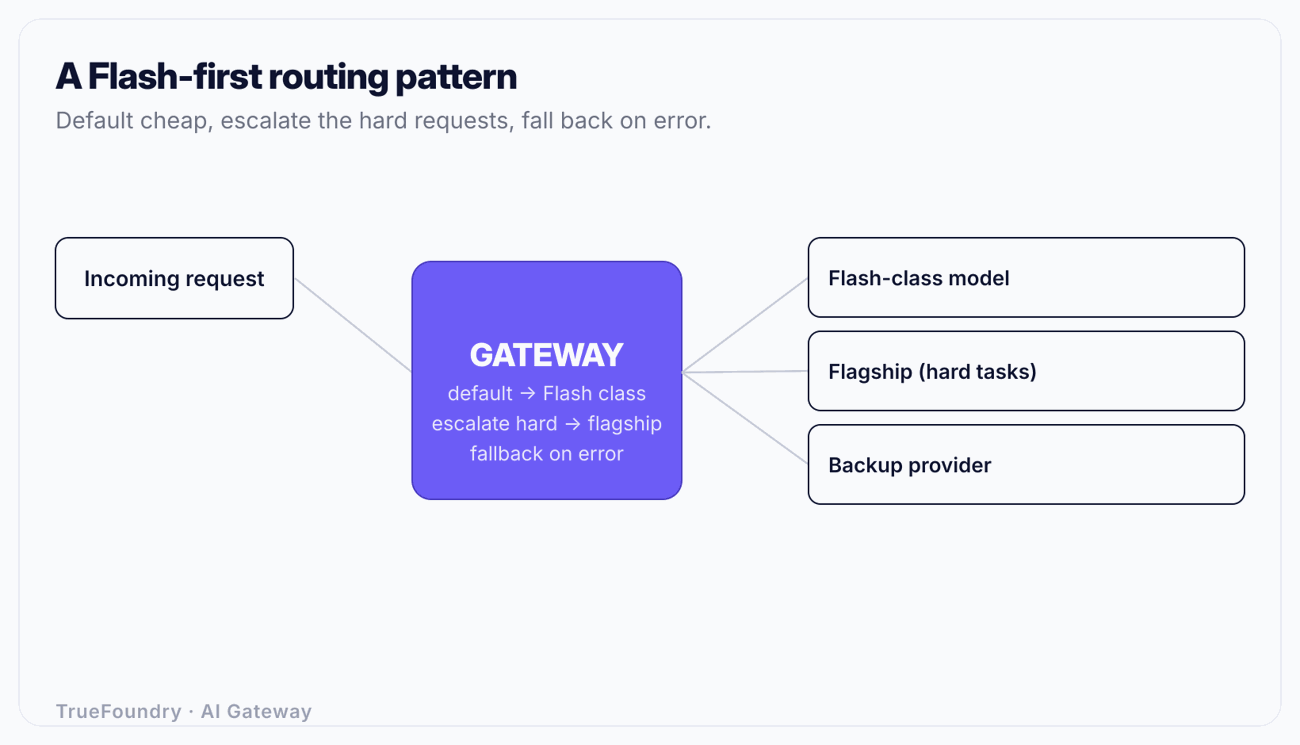
Knowing Flash should be your default is not enough. You need a mechanism that sends the bulk of traffic to Flash, recognizes the requests that need more, escalates only those, and does not fail when Google has a bad five minutes. That mechanism is an AI gateway with a unified, OpenAI-compatible API.
Here is the pattern in four moves.
1. Make Flash the default route. Point a model alias (say, default-chat) at Gemini 3.6 Flash in gateway config. Your application calls default-chat; it never hard-codes "gemini-3.6-flash." When you want to test Sonnet 5.5 or Terra as the default instead, you change one line of config and shift a percentage of traffic, with no application deploy. This is cost- and quality-aware model selection in practice, and the underlying idea is what an LLM router does.
2. Escalate hard requests. Tag requests that need more (a complexity signal from your app, a specific endpoint, a retry after a low-confidence answer) so the gateway routes them to a flagship alias instead. Most traffic stays on Flash; only the thin hard slice pays flagship rates. The gate is a routing rule, not a code branch scattered through your services.
3. Fall back on error. Configure Flash to fall back to a second provider when Google returns an error or times out. A Flash-class request can fall back to Claude Sonnet 5.5 or GPT-6.1 Terra. In-request retries and provider fallback mean a provider incident becomes a latency bump, not an outage. See what is LLM fallback.
4. Cache and measure. Exact and semantic caching stop you from paying Flash to answer the same question twice; see semantic caching. And every call is recorded with tokens, latency, and cost tagged by user, team, and model, so you can prove Flash is carrying the volume and the flagship is only touching the hard slice. See LLM observability tools.
Take a product doing 5M requests a month, mostly chat and RAG, with a hard tail of complex reasoning. Suppose the split is 75% everyday (Flash-appropriate), 20% trivial (rock-bottom-appropriate), 5% hard (flagship-appropriate), averaging 800 input and 400 output tokens.
If everything runs on a flagship at $2 / $12, you pay the flagship output rate on all 5M requests, including the 3.75M that Flash would have answered the same way and the 1M that a $0.10 model would have answered identically.
Route by tier instead:
The 20% trivial slice drops roughly 15x in input cost by leaving Flash for the rock-bottom tier. The 75% everyday slice drops from flagship output ($12) to Flash output ($7.50), nearly 40% off the dominant cost component. The 5% hard slice keeps the flagship. The net effect in most real token mixes is a bill cut of well over a third, with no quality loss on any tier, because every request still lands on a model sized for it. You can only confirm the number by measuring per-tier cost, which is why the observability and cost attribution pieces matter as much as the routing.
To keep the hard tier from quietly blowing the budget, put a ceiling on it with token rate limiting and budgets: the gateway returns HTTP 429 when a team or model crosses its cap, so an escalation path cannot run away with your spend.
Gemini 3.6 Flash is built for the slot where most of your spend actually lives: the median request. Reported at $1.50 / $7.50 with a 1M context window and strong throughput, it gives you most of a flagship's everyday usefulness without the flagship price, and it is clearly a step above the rock-bottom tier that should still handle your trivial jobs. The right mental model is a ladder, and Flash is the rung most traffic belongs on.
Make it your default at a gateway, escalate only the hard requests to a flagship, fall back to a second provider when Google stumbles, and measure cost per model so you can prove the split is working. Do that, and "use Gemini 3.6 Flash" stops being a one-off decision and becomes a routing policy you can tune the moment the next model or the next price cut lands.
Route to the cheapest model that is good enough. Book a demo.
TrueFoundry AI Gateway delivers ~3–4 ms latency, handles 350+ RPS on 1 vCPU, scales horizontally with ease, and is production-ready, while LiteLLM suffers from high latency, struggles beyond moderate RPS, lacks built-in scaling, and is best for light or prototype workloads.




It is reported at $1.50 per 1M input tokens and $7.50 per 1M output tokens as of November 2026. That is a mid-tier price: well above rock-bottom models near $0.10 input, well below flagships. These figures are from third-party reporting; verify against Google's official pricing page before you depend on them, because model prices change frequently.
Reported benchmarks put it around 58.7% on SWE-Bench Pro, which is strong for a mid-tier model and makes it a reasonable everyday coding workhorse. For long-horizon agentic coding, a flagship such as Claude Opus 5.5 (confirmed) is a safer default. Evaluate Flash on your own codebase before committing, since benchmark scores do not transfer cleanly.
Use Flash as your default for chat, RAG, and everyday coding, and Pro for the hard reasoning slice. Pro is reported at $2 / $12 against Flash's $1.50 / $7.50, so Pro costs more and earns it only on genuinely difficult requests. The best setup routes the bulk to Flash and escalates hard requests to Pro at the gateway.
Use the generally available Gemini 3.5 Flash as the fallback target until you confirm 3.6 directly with Google. Because this is configured as a gateway alias, swapping 3.5 for 3.6 later is a config change, not a code change.
Point a model alias at Flash in an AI gateway and have your app call the alias, not the model name. You get a unified OpenAI-compatible API, automatic fallback to a second provider on error, caching, and per-model cost tracking, and you can shift the default to another model later by editing config.



The latest news, articles, and resources sent to your inbox