November 9, 2026
|
5 min read



Blazingly fast way to build, track and deploy your models!
"We could just build this" is the most expensive sentence in platform engineering, and an MCP gateway invites it, because the first version really is easy. A reverse proxy that forwards MCP traffic to a backend server is an afternoon. It works in the demo. It forwards the calls. And it is roughly 10% of a gateway, which is the problem, because the demo makes the other 90% invisible until you are committed.
This post is the honest build-versus-buy analysis. Not "buying is always right", that is not true, and there are real cases where building is correct. The goal is to make the full scope of "build" visible before you commit to it, to name the maintenance tax that outlives the build, and to give you the criteria for which side of the line your situation falls on. If you have not yet settled whether to self-host an open-source gateway or buy a managed one, that is a related fork; this piece is specifically about building from scratch versus buying, and a survey of what is out there lives in best MCP gateways compared.
Before you build an MCP gateway, see what buying one saves you. Book a demo.
The reason "we could build this" is seductive is that the visible part is genuinely simple, and the submerged part is genuinely large.

Above the waterline is the proxy: accept a connection from a client, forward the MCP request to the right backend server, return the response. That is the part you can build in an afternoon and show in a demo. Below the waterline is everything that makes it a gateway instead of a forwarder, and each item below the line is a project, not a function.
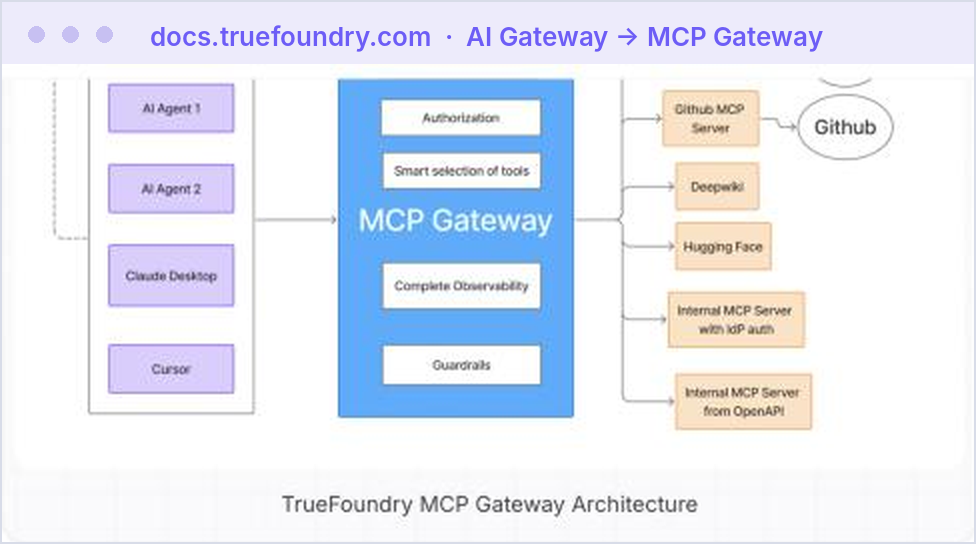
OAuth, both two-legged (service-to-service) and three-legged (on behalf of a user), per backend server, with token management, refresh, and the issuer-validation hardening the current spec requires. A registry of which servers exist, with lifecycle: adding, versioning, deprecating. Access control that decides which users and teams may reach which servers and tools, wired to your identity provider. Tool discovery, so clients can enumerate what is available dynamically rather than hardcoding it. Observability that records cost, tokens, latency, and usage per request, tagged by caller. An audit trail that can answer "who called what, when" across every call. Guardrails for PII, prompt injection, and secret leakage. And underneath all of it, the on-call rotation, because a gateway in the request path of every agent is tier-one infrastructure the day it ships.
That is the honest scope. The proxy was the easy tenth. The other nine-tenths is what the word "gateway" actually denotes.
Spelled out as a table, because the aggregate is the point.
| Component | What it actually involves | Rough effort |
|---|---|---|
| Reverse proxy | Forward MCP requests to backends; the visible part | Days |
| OAuth 2LO/3LO per server | Service and on-behalf-of flows, token refresh, issuer validation | Weeks |
| Registry | Server catalog with add/version/deprecate lifecycle | Weeks |
| Access control (RBAC) | Per-user/team/tool authorization, wired to your IdP (SSO, SCIM) | Weeks |
| Tool discovery | Dynamic enumeration of available tools from the registry | Weeks |
| Observability | Per-request cost, tokens, latency, usage, tagged by caller | Weeks |
| Audit | Centralized, queryable "who called what, when" across all calls | Weeks |
| Guardrails | PII, prompt-injection, secret detection in the request path | Weeks to months |
| HA + scaling | Redundancy, failover, load testing, capacity planning | Weeks, then ongoing |
| Spec compliance | Tracking and implementing protocol revisions as they ship | Ongoing, forever |
Sum the "weeks" honestly and you are at one to two engineer-quarters to reach parity with what a bought gateway gives you on day one, and that is the optimistic path where nothing goes wrong and the team has done this before. The last row has no end date on purpose, which brings us to the part that is easy to miss during planning: the build has a finish line and the maintenance does not. The components themselves are described from the user's side in what an MCP gateway is and what an MCP registry is; building them means owning the parts those posts describe as features.
The cost that sinks most build decisions is not the build. It is that the Model Context Protocol is young and revising fast, and whatever you build, you maintain against a target that moves.
Look at the 2026-07-28 revision as the concrete example. It deprecated Dynamic Client Registration in favor of Client ID Metadata Documents, which means a gateway that implemented DCR now has a migration ahead of it and a server-side metadata fetch to build, with the SSRF handling that implies. It made Streamable HTTP stateless, retiring the initialize handshake and Mcp-Session-Id, which changes how a gateway terminates transport and handles in-flight requests. It moved routing into Mcp-Method and Mcp-Name headers, with a rule that headers and body must agree and mismatches be rejected, which is new logic in the request path. That is one revision. The protocol will revise again, and each time, your in-house gateway needs an engineer to read the changelog, understand the operational implications, implement them, and roll them out without breaking the agents that depend on it. The mechanics of the auth model you would be chasing are covered in MCP authentication, and the security implications of getting those changes wrong in MCP security risks and best practices.
This is the difference between a bought gateway and a built one that does not show up in the initial estimate. When you buy, spec churn is the vendor's problem: the clients pointed at the gateway do not change, the gateway does, and the vendor does the reading, implementing, and testing. When you build, spec churn is a standing claim on your team's time, indefinitely, for a component that is not your product. It is the tax you pay for the rest of the gateway's life, and it is the reason "we built it in a quarter" so often becomes "we have a person and a half permanently assigned to keeping it current."
Security patching rides along with this. A gateway sits in the trust boundary and processes untrusted input, including the tool-poisoning class of attacks covered in MCP tool poisoning and gateway defense. When a vulnerability in a dependency or in the protocol handling surfaces, a built gateway needs a fast-turnaround patch from the team that built it, who are also the only people who understand it. That is on-call plus security response, forever, for plumbing.
See how TrueFoundry delivers the gateway you would otherwise spend eng-months building. Book a demo.
Building is not always wrong. There is a real band where it is correct, and it is worth naming precisely so the decision is made on the right grounds.
Build when your requirements are genuinely unique, meaning no product meets them and the gap is central to how you operate, not a preference you could adjust. This is rarer than teams think, because most "unique" requirements turn out to be standard ones phrased locally, but it does happen, and when it does, a product that cannot meet the requirement is not an option regardless of its other merits.
Build when you are an infrastructure company and this is core to what you do. If your product is AI infrastructure, a gateway may be something you need to own end-to-end because it is part of your own differentiation, and the maintenance tax is not a tax, it is your business. The same logic applies if you intend to ship the gateway itself as a product: then building is not overhead, it is the thing you are selling.
Build when you have deliberately decided to own this capability and staffed it, with eyes open about the one-to-two-quarter build and the standing maintenance, because owning it has strategic value to you that exceeds the cost. The key word is deliberately. The failure mode is not choosing to build; it is drifting into building because the proxy was easy, without ever pricing the submerged nine-tenths or the forever-tax.
For almost everyone else, buying wins, and the test is a single question: is an MCP gateway your differentiator or your dependency?
If your team's job is to ship agents, internal copilots, customer-facing AI features, automation, then the gateway is infrastructure those agents depend on, not the thing you are trying to build. Every engineer-quarter spent building it and every standing fraction spent maintaining it is time not spent on the agents, which are the actual product. Buying converts that time back into product work, and converts spec churn from your problem into the vendor's.
Buying also wins on the features that are expensive to build well and dangerous to build badly: the security and compliance surface. SSO, SCIM, a defensible audit trail, and guardrails are table stakes a bought gateway ships and a built one must construct and then keep audit-ready. The deployment flexibility question, often the reason teams think they must build, is answered without building: a gateway available as managed SaaS plus in-VPC, on-prem, and air-gapped keeps the data plane in your network while still being a product someone else maintains, so "we need it in our environment" is not a reason to build it yourself. That deployment model is exactly what TrueFoundry provides, and the data-control reasoning behind it is covered in enterprise MCP governance.
Put the decision on two axes and it resolves quickly.

High on the differentiation axis means owning the gateway gives you a competitive advantage, you are an infra company, or you are selling it. Low means it is plumbing that supports your real product. The horizontal axis is what building costs you in time and ongoing maintenance versus buying. The recommendation zone is clear: build only when differentiation is high enough to justify the cost; buy everywhere else, which is most of the plane.
As a scorecard you can fill in:
| Factor | Points toward build | Points toward buy |
|---|---|---|
| Differentiation | Gateway is core to your product or business | Gateway supports your product; it is not the product |
| Time-to-value | You can wait one to two quarters for parity | You need production-grade capability in days |
| Maintenance | You will staff spec churn and on-call indefinitely | You want spec churn to be someone else's standing job |
| Security / compliance | You will build and keep SSO, SCIM, audit, guardrails current | You need these shipped and audit-ready on day one |
| Cost | Engineer time is cheaper to you than a subscription | Total cost, time included, favors a subscription |
| Deployment | You need something no product's deployment model offers | In-VPC/on-prem/air-gapped managed meets your boundary |
If most of your marks land in the right column, and for teams whose product is agents rather than infrastructure they will, buying is the answer, and the build instinct is the easy-proxy illusion talking. If they land left, build deliberately and staff it properly.
They estimate the proxy and call it the gateway. The afternoon-long forwarder becomes "we can build this," and the one-to-two quarters of auth, registry, access control, discovery, observability, audit, and guardrails are never scoped. The estimate is for the tenth that is visible.
They forget the spec moves. The build gets a finish line in the plan; the maintenance does not get a line at all. Then the 2026-07-28-style revision lands, and the team discovers that keeping the gateway current is a permanent assignment, not a one-time effort.
They build to solve "it must run in our environment." This is the most avoidable one. Deployment flexibility is a reason to choose a gateway that runs in-VPC, on-prem, or air-gapped, not a reason to build from scratch. Teams build a gateway to keep data in their network and never learn that a bought one could have done the same.
They build the proxy well and the security poorly. The visible parts get attention; the submerged security surface, prompt-injection and tool-poisoning defenses, secret detection, a real audit trail, gets whatever is left. A gateway with a solid proxy and weak guardrails is a false sense of control in the request path of every agent.
They never ask if it is their differentiator. The decision gets made on "can we" rather than "should we." The team can build it; the question that matters is whether building it advances the product, and for most teams shipping agents, it actively diverts from it.
The build instinct for an MCP gateway comes from a true observation, the proxy is easy, and a false inference, therefore the gateway is easy. The gateway is the nine-tenths below the waterline: auth per server, a registry, access control, discovery, observability, audit, and guardrails, built to parity in a quarter or two and then maintained forever against a protocol that will not hold still. The maintenance tax, not the build, is what the estimate misses, and it is the cost that runs for the life of the system.
Build when the gateway is genuinely your differentiator: unique requirements, an infrastructure business, or a product you intend to sell. Buy when it is your dependency, which for teams whose product is agents is almost always the case, because every quarter spent on plumbing is a quarter not spent on the thing that actually differentiates you. And if the reason you want to build is that the gateway must run in your environment, that is a deployment choice a bought gateway can meet in-VPC, on-prem, or air-gapped, not a reason to take on the build and the tax. Make the call deliberately, on differentiation and total cost, not on how easy the proxy looked.
Ship agents, not protocol plumbing. Book a demo.
TrueFoundry AI Gateway delivers ~3–4 ms latency, handles 350+ RPS on 1 vCPU, scales horizontally with ease, and is production-ready, while LiteLLM suffers from high latency, struggles beyond moderate RPS, lacks built-in scaling, and is best for light or prototype workloads.




The proxy is an afternoon. A production gateway, with OAuth 2LO/3LO per server, a registry, RBAC wired to your IdP, tool discovery, observability, audit, and guardrails, is one to two engineer-quarters to parity, plus standing maintenance to track protocol revisions and run it as tier-one infrastructure. The easy part is a small fraction of the whole.
The protocol revises. The 2026-07-28 spec alone deprecated DCR for CIMD, made Streamable HTTP stateless, and moved routing into headers, each requiring implementation and rollout without breaking dependent agents. A built gateway needs an engineer tracking and implementing those changes indefinitely, plus on-call and security patching, for a component that is usually not your product.
When your requirements are genuinely unique and no product meets them, when you are an infrastructure company and the gateway is core to your business, or when you intend to ship it as a product. Outside that band, where the gateway is a dependency rather than a differentiator, buying wins on time and total cost.
A reverse proxy forwards requests, which is the visible tenth of a gateway. It does not authenticate per server, maintain a registry, enforce access control, discover tools, record observability and audit, or apply guardrails. Those are what distinguish a gateway from a forwarder, and they are the work.
No. A gateway available as managed SaaS plus in-VPC, on-prem, and air-gapped keeps the data plane in your network while the vendor maintains the software and tracks the spec. "It must run in our environment" is a deployment-model requirement, which buying can satisfy, not a reason to build from scratch.



The latest news, articles, and resources sent to your inbox