November 8, 2026
|
5 min read


Blazingly fast way to build, track and deploy your models!
Once a team decides it needs an MCP gateway, the next fork is immediate: run an open-source one yourself, or buy a managed one. The debate usually gets framed as "free versus paid," which is the wrong frame, because it compares a license fee against a subscription and ignores the largest cost on the open-source side, which does not appear on any invoice. That cost is the engineering time to run the thing in production, and it is the number that actually decides most of these.
This is not an argument that managed always wins. It does not. There are real situations where self-hosting an open-source gateway is the correct call, and pretending otherwise is vendor noise. The goal here is to lay out the dimensions that genuinely decide it, put honest numbers and trade-offs against each, and give you decision rules you can apply to your own situation. If you are still deciding whether you need a gateway at all, what an MCP gateway is is the prior question; this piece assumes you have answered yes.
Want managed MCP gateway convenience without giving up data control? Book a demo.
"Open source versus managed" sounds like two options. It is really a spectrum with two axes: how much data control you keep, and how much operational burden you carry. The two are usually assumed to move together, more control means more burden, but the interesting deployment models break that assumption.
At the left end, pure open-source self-hosting: maximum control, maximum burden. You hold the source, the data, and every operational responsibility. At the right end, managed SaaS: minimum burden, and the data plane runs in the vendor's environment. The middle is where the assumption breaks. A gateway deployed in-VPC or on-prem, but managed by the vendor's control plane, gives you data that never leaves your network and software you do not have to operate alone. That combination is the reason the binary framing misleads people: it lets you keep the data-control benefit that usually drives teams toward open source while shedding the operational burden that is the main cost of open source. The distinction between the part that must run in your network and the part that does not is the control plane versus data plane split, and it is the key to reading this whole decision correctly.
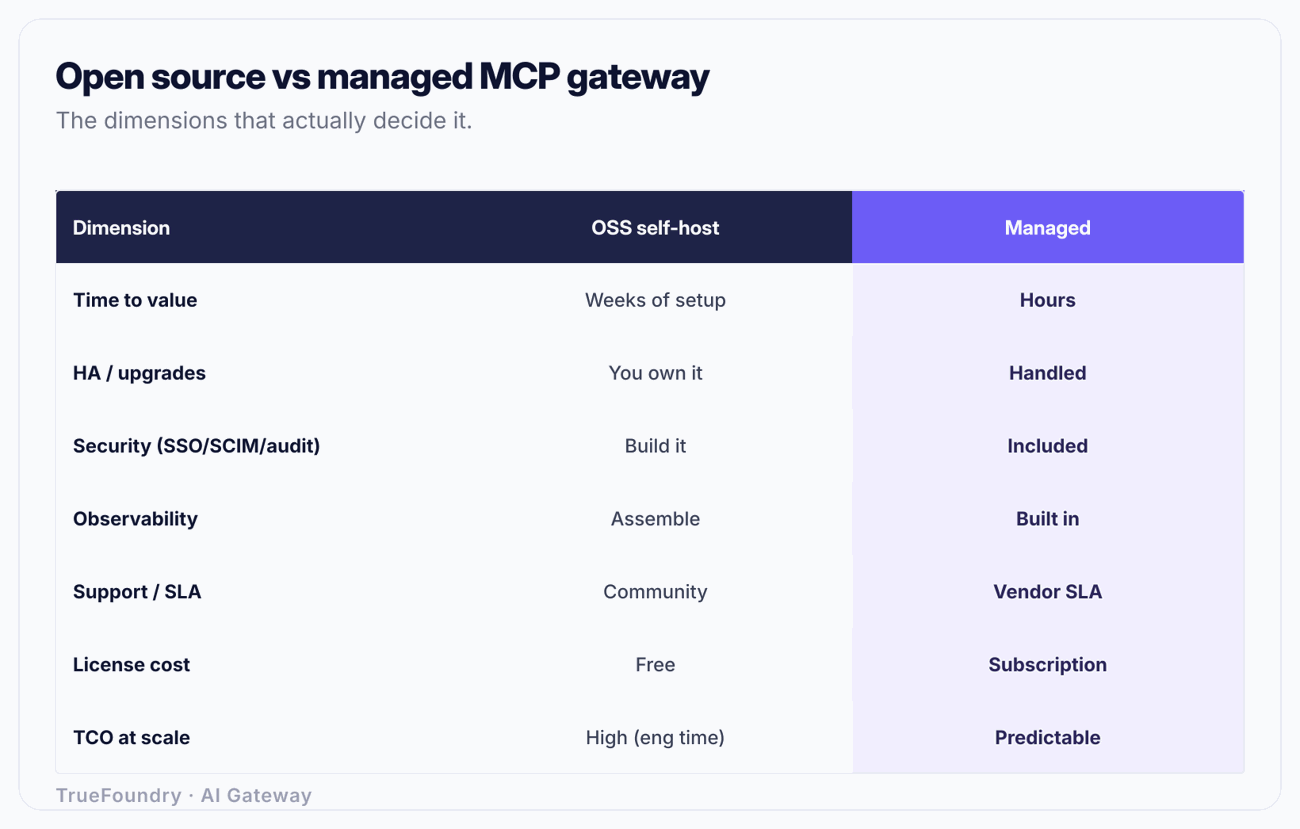
Here is the honest comparison. Neither column is all green.
| Dimension | Open-source self-hosted | Managed |
|---|---|---|
| Time-to-value | Weeks to months: deploy, harden, integrate SSO/audit, build HA | Days: provision, connect identity, register servers |
| License cost | Zero | Subscription |
| Who runs HA | You: redundancy, failover, load testing | Vendor, to an SLA |
| Who patches | You, including fast turnaround on security CVEs | Vendor, continuously |
| Security features | What the project ships, plus what you build (SSO, SCIM, audit) | Built in: SSO, SCIM, RBAC, audit, guardrails |
| Observability depth | Basic unless you integrate your own stack | Per-request cost, tokens, latency, usage, out of the box |
| Support / SLA | Community, issues, your own expertise | Contractual support with response targets |
| Total cost of ownership | Low license, high and ongoing engineer time | Subscription, low marginal operational cost |
The pattern is that open source shifts cost from the invoice to the headcount, and managed does the reverse. Whether that is a good trade depends entirely on what your engineers' time is worth and whether you want them running protocol plumbing or building the agents the gateway exists to support.
The first dimension people underestimate is time-to-value, and the second is on-call.
Standing up an open-source gateway so that it serves a request is a day. Standing one up so that it is production-grade is not. Production-grade means highly available, so a single node failing does not take down every agent in the company; it means SSO and SCIM wired to your identity provider, so access is managed where the rest of your access is managed; it means an audit trail that satisfies your security team; and it means someone is paged when it breaks. Each of those is real work, and the SSO, audit, and HA pieces are the ones that routinely turn a "we'll have it up this sprint" into a quarter.
The pager is the cost that keeps coming. A gateway is in the request path of every agent that depends on it, which makes it tier-one infrastructure the moment it is adopted. Self-hosting means owning that pager: the 2 a.m. page when the gateway falls over, the scramble when a dependency ships a CVE, the capacity planning when usage triples. Managed means the vendor owns it to an SLA. This is not a small line item dressed up; for many teams the honest statement is that they do not want to add a tier-one service to their on-call rotation to support a capability that is not their product. The best MCP gateway for production AI systems discussion goes deeper on what "production-grade" actually demands.
The security column is where the gap is widest, because security features are exactly the things that are expensive to build well and easy to get subtly wrong.
A managed gateway ships SSO, SCIM 2.0 provisioning, RBAC, a centralized audit trail, and guardrails for PII, prompt injection, and secrets, because those are table stakes for the enterprises it sells to. An open-source gateway ships whatever the project chose to ship, and the enterprise-grade identity and audit features are frequently the parts that are thin, behind a paywall even in "open-core" projects, or absent. If your organization requires SCIM-based provisioning and deprovisioning tied to your IdP, and most regulated ones do, you are either getting it in the managed product or building and maintaining the integration yourself on top of the open-source one.
Compliance compounds this. A gateway that is the control point for AI access is in scope for whatever regime you operate under, and the audit, access-control, and data-handling evidence an auditor wants is far easier to produce from a product built to generate it than from a self-hosted deployment where you assembled the logging yourself. The governance surface is detailed in enterprise MCP governance, and the security-tooling angle in best MCP security tools. The short version: if compliance is a requirement rather than an aspiration, the build cost on the open-source side is not a one-time integration, it is a standing obligation to keep that integration audit-ready as both the gateway and the regulations change.
See how TrueFoundry runs managed in your own VPC, on-prem, or air-gapped. Book a demo.
Here is the calculation that the "free versus paid" frame hides.
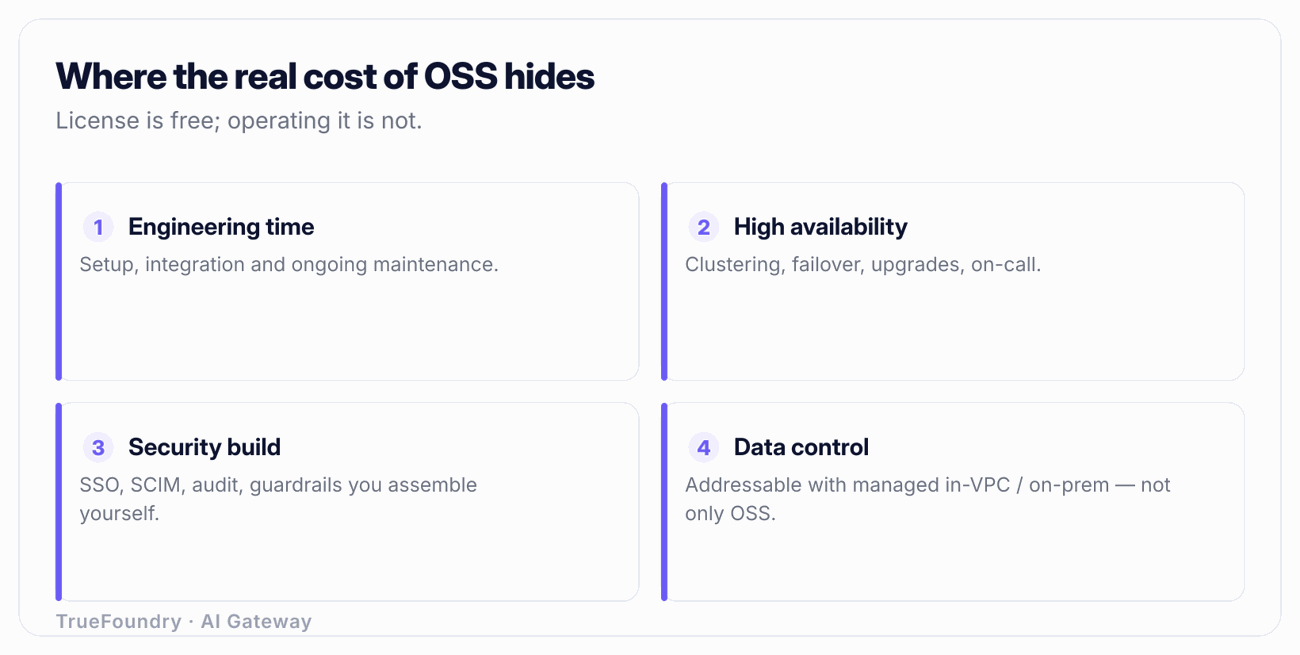
Price out the open-source option properly. Take the engineer-weeks to get to production-grade: deployment and hardening, HA, SSO and SCIM integration, audit, observability wiring, and guardrails. Call it a conservative one to two engineer-months to parity with what a managed product gives you on day one, and that is if the features exist to integrate rather than build. Then add the standing cost: the fraction of an engineer's time, and on-call load, to patch, upgrade, keep the identity integration current, and respond when it breaks. At a fully loaded cost for a senior platform engineer, the "free" gateway's first-year cost is dominated entirely by that time, and the subscription you were comparing against is often smaller than the build phase alone, before you count a single day of operations.
This is why the TCO row flips with scale. At tiny scale, with one engineer who enjoys running it and no compliance requirement, the open-source option's time cost is low enough that "free license" genuinely wins. At enterprise scale, with HA, compliance, and real usage, the time cost dominates and managed wins on TCO, not despite being paid but because the alternative's unpriced engineer time is larger than the subscription. The license fee was never the variable that mattered.
None of this means open source is a trap. It means the comparison has to be time-adjusted. If your organization has engineers whose time is genuinely cheaper than the subscription, or who would otherwise be idle, or if running this infrastructure is itself something you want to build expertise in, the math can favor self-hosting. Just do the math with the time in it.
The strongest argument for self-hosting open source is not cost. It is data control: the conviction, often a hard requirement, that prompts, tool calls, and responses must never leave the organization's network, and that a managed vendor's SaaS therefore cannot be used. This objection is correct about SaaS and wrong about "managed," and the distinction is the whole game.
A managed gateway that only runs as multi-tenant SaaS does send the data plane through the vendor. But a gateway that also deploys in-VPC, on-prem, and air-gapped does not. TrueFoundry's model is exactly this: the gateway can run inside your own VPC, in your on-prem environment, or fully air-gapped, so the data plane, every prompt and every tool call, stays in your network, while the software is still a supported product rather than a thing you assembled and now maintain alone. That is the configuration the data-control objection should actually be weighed against, not multi-tenant SaaS. The underlying principle is the control-plane/data-plane split: the vendor can manage the control plane while the data plane never crosses your boundary, and for teams with data residency requirements that is often the deciding realization.
Once you see that, the objection narrows. "We can't use managed because our data can't leave" becomes "we can't use multi-tenant SaaS," which is a much smaller statement, and one that an in-VPC or on-prem managed deployment answers directly. The choice stops being "control xor convenience" and becomes "which managed deployment model fits our boundary," with self-hosting open source reserved for the cases where you also need to read and modify the source itself.
Strip it to rules you can apply.
| Choose open-source self-hosted if… | Choose managed if… |
|---|---|
| You have engineers with time to run tier-one infra | You want your engineers building agents, not plumbing |
| You must read and modify the source itself | You need SSO, SCIM, audit, and guardrails on day one |
| Scale is small and compliance is light | Scale is real and compliance is a hard requirement |
| Running this is itself a capability you want to own | You want an SLA and someone else holding the pager |
| License cost is the binding constraint | Total cost of ownership, time included, is the real constraint |
| Your requirements are genuinely unique to you | Your requirements are standard enterprise ones |
The two rows that decide it most often are the first and the third. If you have the headcount and either small scale or a true need to own the source, open source is defensible. If scale is real and compliance is required, managed almost always wins on time-adjusted TCO, and the data-control concern that would otherwise push you back to open source is answered by an in-VPC or on-prem managed deployment. For the broader selection framework, how to choose an AI gateway applies the same reasoning to the LLM side.
They compare license to subscription and stop there. The license is zero and the subscription is not, so open source "wins," and the one-to-two engineer-months of build plus standing operational cost are never priced. The decision is made on the one number that does not matter.
They treat SSO, SCIM, and audit as checkboxes rather than projects. On a managed product they are configuration. On a self-hosted open-source gateway they are integration work that then has to be maintained as both sides change. Underestimating this is the single most common way the "we'll have it running this sprint" plan slips a quarter.
They assume managed means their data leaves. It can, if it is multi-tenant SaaS. It does not have to. An in-VPC, on-prem, or air-gapped managed deployment keeps the data plane in your network, and teams that reflexively rule out managed on data-control grounds often never learn that the option they actually wanted exists.
They forget the gateway becomes tier-one infrastructure. The moment agents depend on it, a self-hosted gateway is in the critical path and needs HA, on-call, and capacity planning like any other tier-one service. Teams that stood it up as a side project discover this during the first outage.
They pick open source for control and then never exercise it. The control argument, reading and modifying the source, only pays off if you actually do. Many teams take on the full operational burden for a flexibility they never use, which is the worst of both columns: the cost of open source without its benefit.
The open-source-versus-managed choice is not a morality test and not a free-versus-paid comparison. It is a question of where you want the cost to sit, on an invoice or in your engineers' calendars, and of how unique your requirements really are. Open source genuinely wins when you have the headcount to run tier-one infrastructure, when scale is small, or when you must own the source itself. Managed wins when scale is real, when compliance is a hard requirement, and when you would rather your engineers build agents than operate protocol plumbing and carry its pager.
The piece that dissolves the hardest part of the debate is deployment flexibility. The data-control objection that usually pushes teams toward self-hosting is answered by a managed gateway that runs in-VPC, on-prem, or air-gapped, keeping the data plane in your network without making you the sole operator. Price the decision with engineer time in it, weigh it on scale, security, operational capacity, and uniqueness, and the right column usually becomes obvious.
Get a managed MCP gateway that keeps your data in your network. Book a demo.
TrueFoundry AI Gateway delivers ~3–4 ms latency, handles 350+ RPS on 1 vCPU, scales horizontally with ease, and is production-ready, while LiteLLM suffers from high latency, struggles beyond moderate RPS, lacks built-in scaling, and is best for light or prototype workloads.





Only on the invoice. The open-source option has no license fee but carries engineer time for deployment, HA, patching, and building security features, which at enterprise scale usually exceeds the subscription. The right comparison is total cost of ownership with time included, not license versus subscription.
Not necessarily. Multi-tenant SaaS does route the data plane through the vendor, but managed gateways that deploy in-VPC, on-prem, or air-gapped keep every prompt and tool call inside your network while the vendor still runs the software. That model answers the usual data-control objection to managed.
When you have engineers with the time to run tier-one infrastructure, when your scale is small or your compliance needs are light, or when you have a genuine requirement to read and modify the source. It also makes sense when running this infrastructure is itself a capability you want to own.
Typically SSO, SCIM 2.0 provisioning, RBAC, a centralized audit trail, and guardrails for PII, prompt injection, and secrets, built in rather than assembled. Open-source projects ship these unevenly, often behind an open-core paywall or not at all, leaving you to build and maintain the integrations.
Yes, and many teams do, usually when scale, compliance, or on-call load makes self-hosting unattractive. Because both expose MCP through the same protocol, the clients pointing at the gateway do not care which is behind the endpoint, so a migration is mostly re-pointing the gateway's backends and cutting over, not re-wiring every client.



The latest news, articles, and resources sent to your inbox