November 10, 2026
|
5 min read



Blazingly fast way to build, track and deploy your models!
Most AI-gateway security incidents are not exotic. They are a departed contractor's API key still working three weeks later, a shared "team key" pasted into a dozen notebooks that nobody can rotate without breaking everyone, and a model-access policy that lives in one engineer's memory. Enterprise AI access fails in boring, preventable ways, and the fix is the same identity plumbing every other serious enterprise system already uses: single sign-on for authentication and SCIM for lifecycle provisioning.
This post explains why AI access must run through SSO and SCIM rather than static keys, what each protocol does, how they map onto the specifics of an AI gateway (console login, model access, MCP server access, budgets), and how to set them up conceptually against any major identity provider. It is written for the platform or security engineer who has been handed "get the AI gateway under SSO" and needs to understand the mechanism, not just click through a wizard.
Want SSO and SCIM wired into every model and MCP server your teams use? Book a demo.
Start with the thing most teams actually do: a long-lived API key, often one per team, sometimes one for the whole company, handed around to call the gateway. It has four structural problems, and all four are solved by identity-based access.
SSO and SCIM replace this with a model where access is a function of who you are in the identity provider and what groups you belong to. Authentication proves identity at login. Provisioning keeps the gateway's picture of who exists, and who belongs to which group, in sync with the IdP automatically. When the IdP disables an account, access ends everywhere the account reached, with no manual step. That single property, automatic deprovisioning, is the reason this is not optional for enterprise AI.
They are routinely conflated, and conflating them is how orphaned access happens. SSO logs people in. SCIM manages whether their account and group memberships exist in the first place. SSO is an authentication event; SCIM is a lifecycle sync.
| Dimension | SSO (SAML / OIDC) | SCIM 2.0 |
|---|---|---|
| Purpose | Authenticate a user at login | Provision, update, and deprovision accounts and group memberships |
| When it runs | Every login, interactively | Continuously, driven by changes in the IdP, no user present |
| Protocol | SAML 2.0 assertions or OpenID Connect (OAuth 2.0) ID tokens | SCIM 2.0 (RFC 7643 schema, RFC 7644 protocol) over REST/JSON |
| What it carries | Who the user is, right now, plus claims (email, groups) in the assertion | The full user record and group memberships, pushed as they change |
| What breaks without it | Users manage separate passwords; no central login; weak MFA story | Accounts and access linger after offboarding; group changes never propagate; manual deprovisioning |
| Analogy | The doorman who checks your badge each time you enter | The HR process that issues and revokes the badge |
The trap is to configure SSO, see people logging in with their corporate identity, and declare victory. SSO alone means that when someone is offboarded in the IdP, their ability to log in is gone, but if the gateway provisioned their account and access out of band, or if they still hold a token or key, the account and its entitlements can persist. SCIM is what reaches into the gateway and removes the account and its group memberships when the IdP says the person is gone. You want both: SSO so login is centralized and MFA-backed, SCIM so existence and access track the source of truth.
An AI gateway has specific things to protect, and identity plugs into each of them. The chain runs from the identity provider to a concrete policy on models, MCP servers, and budgets.

Walk the chain left to right:
The result is that access to your most expensive frontier model, or to a sensitive internal MCP server, is a property of IdP group membership. Grant it by adding someone to a group in the IdP; revoke it by removing them. The gateway's RBAC is covered in more depth alongside fine-grained authorization, and the broader "how do I even choose this" framing is in how to choose an AI gateway.
Here is an illustrative mapping to make the abstraction concrete. Adjust the role names and entitlements to your own policy.
| IdP group | Gateway role | Models allowed | MCP servers allowed | Budget / limits |
|---|---|---|---|---|
ml-platform | platform-admin | All, including frontier reasoning models | All, including admin tooling | High monthly budget; high RPS |
product-eng | app-developer | Mid-tier chat + embedding models | Read-only internal data servers | Moderate budget; 429 on breach |
finance-analysts | analyst | Cheap chat model only | Finance data server only | Low budget; strict rate limit |
contractors | restricted | One sandboxed model | No internal servers | Minimal budget; short token cap |
| (offboarded: removed from all groups) | none | none | none | none — access revoked |
The last row is the whole point. Removal from the IdP groups, which SCIM propagates automatically, collapses a person's entitlements to nothing. No ticket, no manual key rotation, no "did we remember to remove their access everywhere."
See how TrueFoundry maps IdP groups to RBAC roles across the gateway. Book a demo.
The exact screens differ by identity provider, but the conceptual sequence is the same for Okta, Entra ID, Google Workspace, or any SAML/OIDC and SCIM 2.0 IdP. Do not invent provider-specific labels from memory; follow each IdP's own documentation for the field names. The shape is this:
Step 1: Create the application in the IdP. In the identity provider, register the gateway as an enterprise application. This is the object that will hold both the SSO configuration and, later, the SCIM configuration. Decide now which users and groups will be assigned to this application, because only assigned users will be provisioned.
Step 2: Configure SSO (metadata and claims). Choose SAML or OIDC. For SAML, exchange metadata: the IdP provides its entity ID, sign-in URL, and signing certificate; the gateway provides its assertion consumer service (ACS) URL and entity ID. For OIDC, you register a client and exchange issuer URL, client ID, and secret, and set redirect URIs. Either way, configure the claims: at minimum the user's email or unique identifier, and crucially the user's group memberships, because groups are what you will map to roles. Confirm the group claim is actually included in the assertion or token; a missing group claim is the most common reason role mapping silently fails.
Step 3: Enable SCIM (token and endpoint). Turn on provisioning. The gateway exposes a SCIM 2.0 base endpoint (a URL) and you generate a bearer token that authorizes the IdP to call it. Paste the endpoint and token into the IdP's provisioning configuration. The IdP will test the connection by calling the SCIM endpoint; a successful test means the IdP can create, read, update, and deactivate users and groups in the gateway.
Step 4: Map attributes and groups to roles. Configure attribute mappings so the IdP's user fields (email, display name, external ID) populate the gateway's user record, and SCIM group pushes land as gateway groups. Then, in the gateway, map each group to an RBAC role with its model, MCP server, and budget entitlements, as in the table above. This mapping is the policy; get it reviewed by whoever owns access governance.
Step 5: Test the full lifecycle. Do not ship on a login test alone. Test all three lifecycle events:
The entire value proposition is in three events over an employee's or contractor's lifetime, and SCIM handles all three without a human touching the gateway.
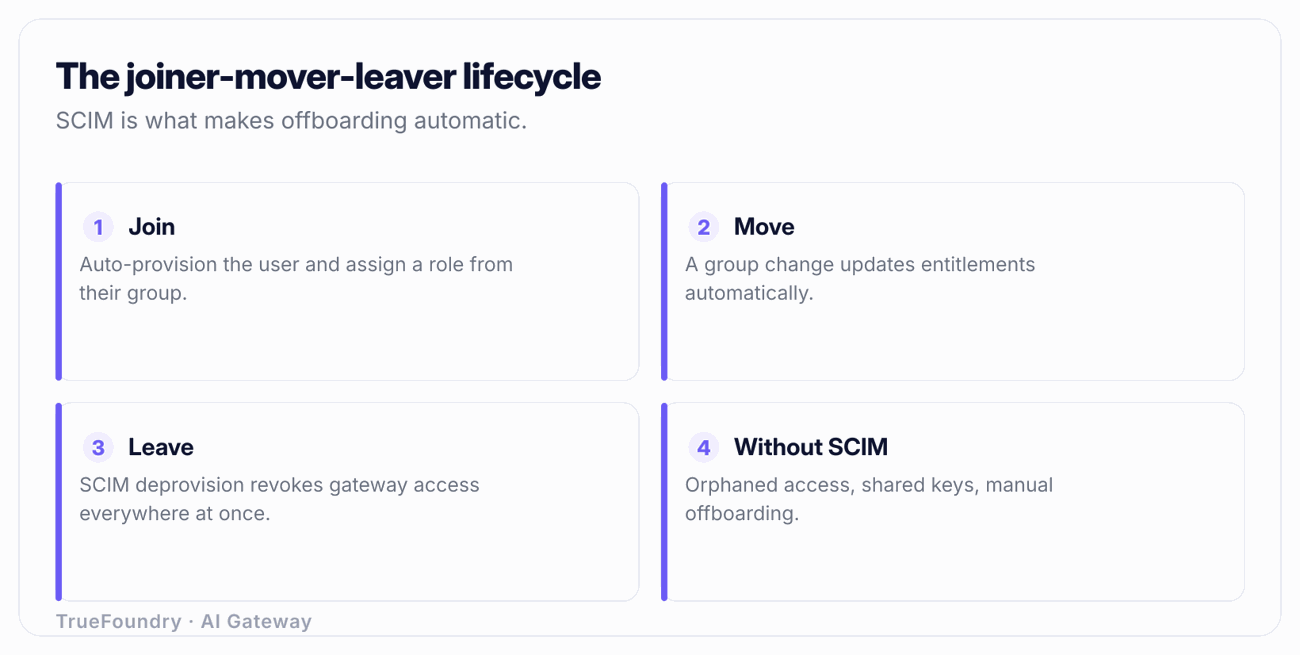
Compare that to the shared-key world: onboarding means finding and sharing the right key, moves mean nothing changes automatically, and leaving means someone has to remember to rotate a key that breaks everyone else when rotated, so it does not happen. The lifecycle gap is exactly where breaches live.
Human identity through SSO and SCIM is the foundation, but enterprise AI access has two dimensions humans do not fully cover.
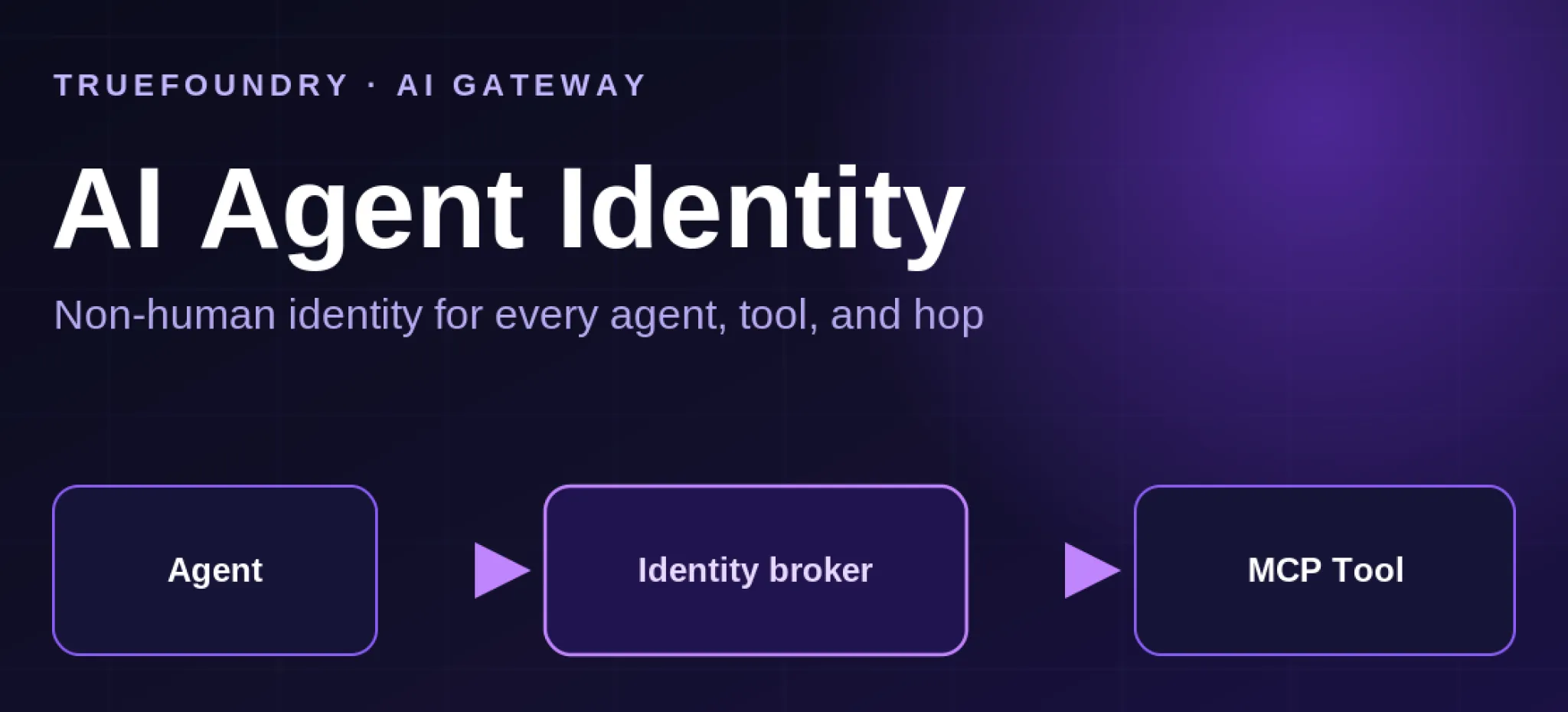
First, agents are callers too. An autonomous agent that invokes models and MCP servers needs its own identity, its own role, and its own budget, not a borrowed human key. The same RBAC machinery that maps human groups to roles extends to agent identities, so an agent gets least-privilege access to specific tools and a capped budget. This is the natural continuation of the identity work; see AI agent identity and the MCP-specific controls in enterprise MCP governance.
Second, where identity and data live matters. Authentication and provisioning decide who may call what; deployment decides where the requests and their data physically go. TrueFoundry deploys as SaaS, in-VPC, on-prem, or air-gapped, so the data plane stays inside your network while identity integrates with your IdP. For regulated workloads this separation is the difference between a usable gateway and a compliance blocker; data residency and the control plane vs data plane split cover how that works.
They configure SSO and skip SCIM. Login is centralized, everyone is happy, and offboarding still leaves accounts and entitlements behind because nothing syncs deprovisioning. SSO without SCIM solves authentication and ignores lifecycle. Configure both.
They never test deprovisioning. The provision path gets tested because new users need access on day one. The deprovision path, the one that actually protects you, gets assumed. Disable a test account and confirm a previously working call now fails, every time you change the configuration.
They forget the group claim. SSO works, users log in, and then everyone lands in a default or empty role because the IdP assertion did not include group memberships. Role mapping depends entirely on the group claim being present and correctly named. Verify it in an actual assertion or token.
They keep a shared key as a "backup." A single admin or break-glass key left active defeats the whole model, because it is unattributable and never deprovisioned. If you need break-glass access, make it a named, audited, short-lived path, not a permanent shared secret.
They map everyone to one broad role. Provisioning through SCIM into a single "all users" role gives you attribution but not least privilege; everyone can call the frontier model and every MCP server. The point of group-to-role mapping is granularity. Model real teams and real entitlements.
Enterprise AI access does not fail in clever ways. It fails because a shared key outlived the person who used it, because offboarding was a manual step someone forgot, because nobody could say who spent the token budget. SSO and SCIM close those gaps by making access a function of identity: SSO authenticates every login through your identity provider, and SCIM keeps the gateway's picture of who exists, and who belongs to which group, in automatic sync with the source of truth.
Set up both, map groups to roles with real least-privilege entitlements, and test the deprovision path until you trust it. Do that, and access to your most expensive models and most sensitive MCP servers becomes something you grant by adding someone to a group and revoke by removing them, instantly and everywhere. That same identity foundation then carries forward to agent identity, fine-grained per-tool authorization, and the data-residency controls that regulated AI requires.
Automate joiner-mover-leaver access for your AI stack. Book a demo.
TrueFoundry AI Gateway delivers ~3–4 ms latency, handles 350+ RPS on 1 vCPU, scales horizontally with ease, and is production-ready, while LiteLLM suffers from high latency, struggles beyond moderate RPS, lacks built-in scaling, and is best for light or prototype workloads.






SSO (via SAML or OIDC) authenticates a user at the moment of login, proving who they are and passing claims like email and group membership. SCIM 2.0 is a continuous provisioning protocol that creates, updates, and deactivates user accounts and group memberships in the target system as they change in the identity provider, with no user present. SSO handles login; SCIM handles the account's whole lifecycle, including the automatic deprovisioning that SSO alone does not provide.
Without SCIM, offboarding in the identity provider stops a person from logging in but does not necessarily remove the account or its entitlements from the gateway, and any token or key they hold can persist. SCIM reaches into the gateway and deactivates the account and strips group memberships automatically when the IdP disables the user, which is what actually revokes access to models, MCP servers, and budgets. That automatic deprovisioning is the specific gap that causes orphaned-access incidents.
SCIM syncs each user's identity-provider group memberships into the gateway. You map each group to an RBAC role, and each role carries entitlements: which models it may call, which MCP servers it may reach, and what budgets and rate limits apply (with HTTP 429 on breach). Access then becomes a property of group membership, so you grant or revoke a person's model and server access by changing their groups in the IdP.
SCIM 2.0 is defined by two RFCs: RFC 7643 specifies the core schema for users and groups (the JSON representation of a user record, its attributes, and group memberships), and RFC 7644 specifies the protocol, a REST/JSON API with create, read, update, delete, and search operations. The identity provider acts as the client, calling the target system's SCIM endpoint, authorized by a bearer token, to keep user and group state in sync.
The authentication part (SSO) is about human login, but the authorization machinery it feeds, roles mapped from groups to entitlements, extends to agents. An autonomous agent should have its own identity, role, and budget rather than borrowing a human's key, so it gets least-privilege access to specific tools and a capped spend. Treating agents as first-class identities within the same RBAC model is the natural extension of human SSO and SCIM.



The latest news, articles, and resources sent to your inbox