


October 26, 2026
|
5 min read


.webp)
Blazingly fast way to build, track and deploy your models!
Applications using large language models depend on AI model providers for every inference request. OpenAI, Anthropic, and Google offer services, yet no LLM provider eliminates rate limits, outages, or latency spikes. A provider issue can therefore disrupt LLM applications and workflows.
Without a fallback path, a request may fail, exceed response objectives, or create an inconsistent user experience. The pattern sends affected requests through another model or provider when the initial route misses defined requirements. It preserves service continuity without exposing infrastructure failures to application users.
Reliable implementation matters whenever production systems use multiple models, regions, or providers. An LLM Gateway can centralize routing, resilience, and policy enforcement behind one interface. This architecture helps production teams avoid embedding provider-specific recovery logic throughout every app.
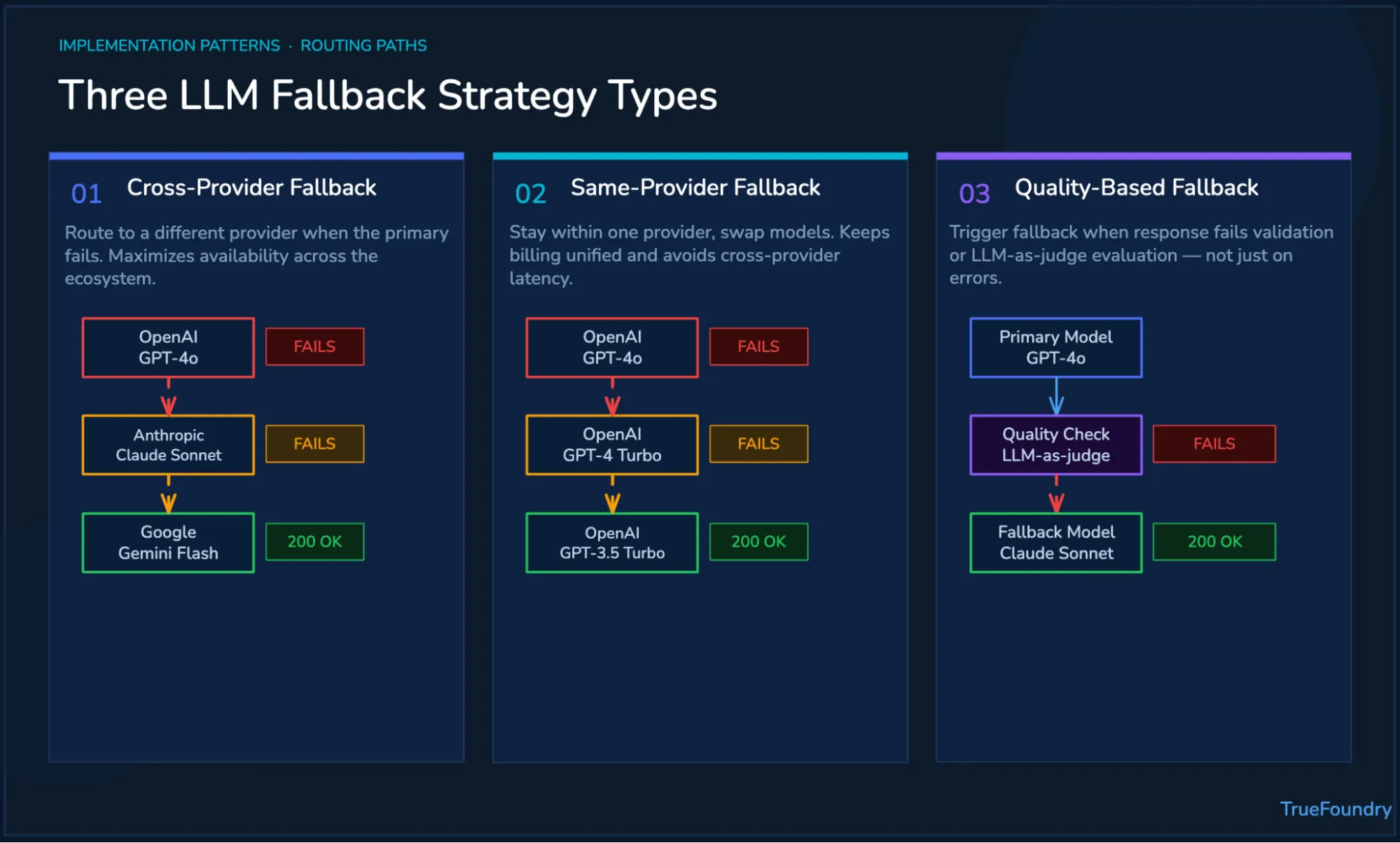
This reliability pattern automatically forwards a request when the primary model fails to meet the defined availability, latency, or quality requirements. Triggers may include an HTTP 429 response, a server error, a network error, or a configured timeout. The request then moves toward a suitable fallback model through an alternative route.
The LLM fallback meaning extends beyond isolated error recovery. It represents a resilience layer within the model access architecture. The approach reduces dependency on a single LLM provider while helping applications remain available during provider instability.
Fallbacks can operate across providers, models, regions, or quality thresholds. A single model may also fall back toward another deployment within the same provider. The selected design should preserve compatibility across prompts, tokens, context windows, LLM tool support, and response formats.
The LLM fallback mechanism follows a controlled sequence after request failure. Its router evaluates the trigger, reads the configured fallback chain, and selects the next eligible target. The original prompt, context, and generation settings then travel through the chosen fallback route.
Retries should address transient failures before changing providers. Bounded policies use exponential backoff, jitter, and response guidance before rerouting. OpenAI recommends randomized backoff, while Anthropic documents rate limits, timeouts, and overloaded responses.
.webp)
Fallback, failover, and retries solve related problems across different operating scopes. Fallback handles individual request failures, while failover redirects broader traffic during sustained degradation. Retries repeat a request against the same endpoint before another target receives it.
These common patterns usually work together within resilient architectures. Limited retries can resolve short-lived errors without changing providers. LLM load balancing distributes normal traffic, while failover protects continuity during sustained outages. Fallback handles remaining failures at the request level.
Different fallback strategies support availability, quality, cost, and provider independence. Each strategy requires clear trigger conditions and compatible model capabilities. Teams should compare expected latency, output quality, context limits, and tool support before defining route priorities.
Effective rate limiting should coordinate with each strategy rather than trigger uncontrolled rerouting. Central rate-limit controls can apply quotas across users, models, applications, and environments. Google documents HTTP 429 responses when Gemini workloads exceed applicable quotas.
Building fallback logic inside application code appears manageable during early development. Complexity rises when the setup spans several providers, model versions, and environments. Every SDK exposes different errors, defaults, response structures, and retry behavior.
Teams may evaluate Portkey, Bifrost, or Vercel when comparing gateway options. Whatever platform they select, best practices require bounded retries, health-aware routing, secure credentials, and measurable recovery. Strong LLM observability should show latency, errors, fallback frequency, and the final success rate.
The TrueFoundry AI Gateway centralizes model access, routing, reliability controls, and observability. Its global routing configuration supports load balancing, fallback, and retry rules from a single governing layer. Applications can use one API without rebuilding recovery logic for each provider.
The platform supports chains across a primary provider and alternative targets. Automatic retries handle temporary provider errors before rerouting. Continuous health monitoring reduces delayed recovery during disruptions.
For AI agents, the Agent Gateway governs multi-step execution. The MCP Gateway controls access across connected enterprise tools. Together, they protect the entire system when one model route becomes unavailable.
Build resilient AI applications with TrueFoundry’s AI Gateway. Centralize routing, retries, observability, and LLM fallback across providers. Book a free demo today to get started.
LLM fallback is an architectural requirement for dependable applications using external models. Providers may impose restrictions or experience temporary failures during operations. Applications should absorb those conditions without passing every disruption toward users.
Application-level implementation remains possible, yet complexity grows across multi-model environments. A gateway can centralize retry rules, fallback order, health checks, credentials, and monitoring. This approach improves resilience while keeping application code independent from provider-specific behavior.
Teams should define triggers, validate model compatibility, and monitor every route after deployment. They should also test exhausted chains and recovery behavior before production traffic expands. TrueFoundry provides a single control plane for governing model access decisions.
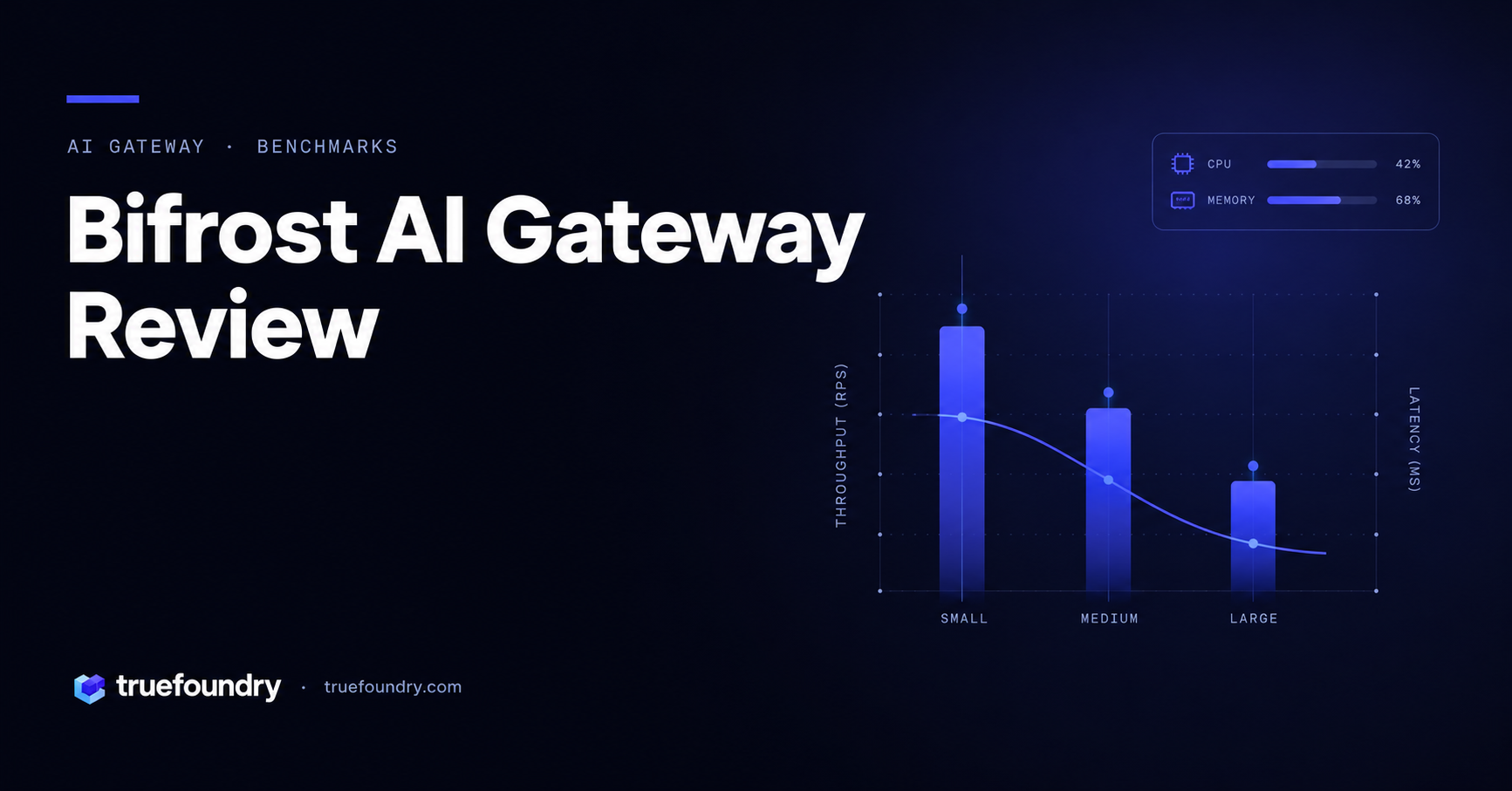
TrueFoundry AI Gateway delivers ~3–4 ms latency, handles 350+ RPS on 1 vCPU, scales horizontally with ease, and is production-ready, while LiteLLM suffers from high latency, struggles beyond moderate RPS, lacks built-in scaling, and is best for light or prototype workloads.




A fallback in an LLM system redirects failed requests toward another model or provider. It activates after errors, timeouts, capacity limits, or quality failures. The process preserves availability without exposing recovery steps to users. Teams should define compatible targets, bounded retries, and clear exhaustion behavior before production deployment.
This mechanism detects a qualifying failure, selects the next approved target, forwards the request, and monitors its result. Routing may continue until one target returns an acceptable response. Health checks, timeout policies, retry limits, and circuit breakers prevent repeated requests toward unhealthy endpoints.
LLM fallback begins when a request fails to meet an availability, latency, or quality requirement. The gateway checks its configured chain and routes the request toward another target. This continues until a valid response is received or no options remain. Logs should record every attempt, selected provider, latency, and outcome.
Failover shifts broader traffic away from a degraded provider or region. Fallback handles individual request failures and returns toward the preferred route after recovery. Retry logic first repeats the same request against one endpoint. Mature architectures combine these mechanisms while defining separate triggers, scopes, and recovery conditions.
An AI gateway sits between applications and model providers. Teams configure routing rules, fallback order, retry limits, and timeout policies within that shared layer. The gateway applies these controls to every request without changing each integration. This simplifies maintenance, provider switching, monitoring, and policy enforcement across production workloads.



The latest news, articles, and resources sent to your inbox
.webp)
.webp)

.png)
.png)
.png)
.png)
.png)
.png)
.png)
.png)
.png)
.png)
.png)


