November 9, 2026
|
5 min read



Blazingly fast way to build, track and deploy your models!
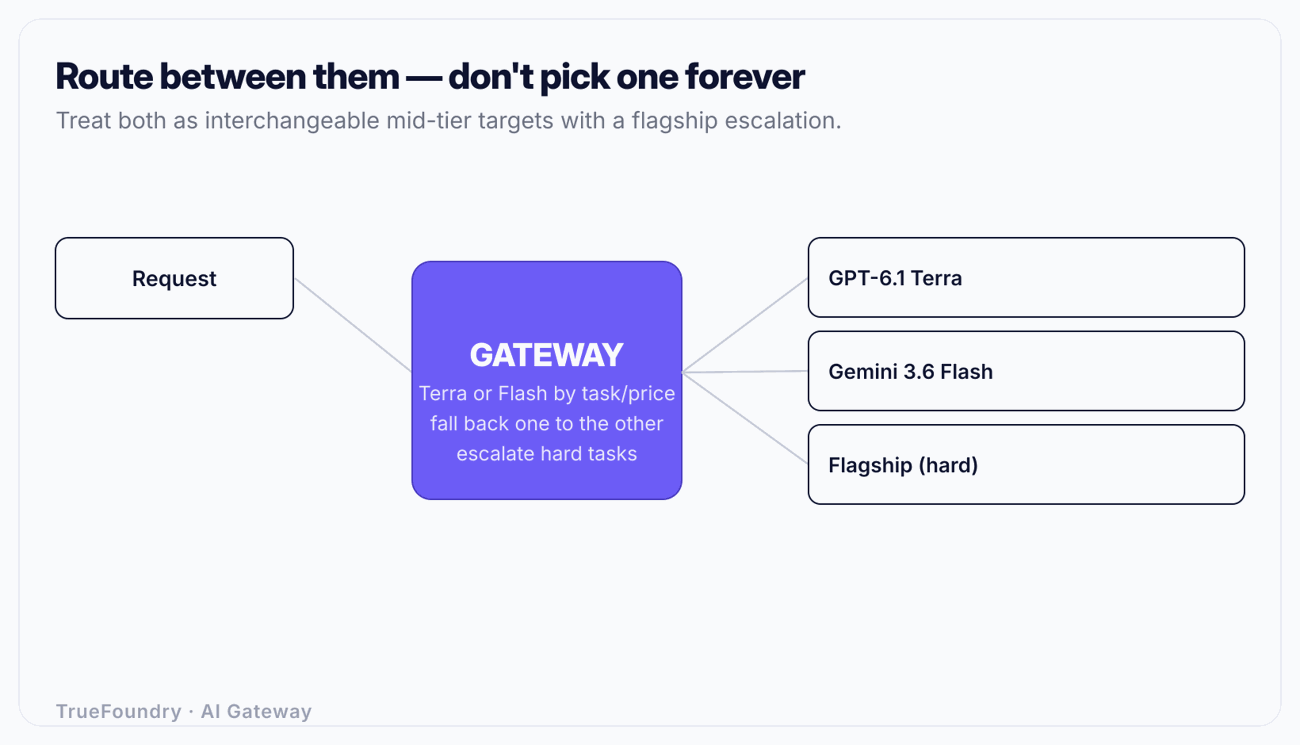
Head-to-head model comparisons usually ask the wrong question. "Terra or Flash?" implies you must marry one. But GPT-6.1 Terra and Gemini 3.6 Flash occupy the same rung of the ladder: mid-tier, large-context, strong-but-not-flagship coding models priced within shouting distance of each other. When two models are that close and that substitutable, the expensive mistake is picking one and hard-coding it. The cheap, resilient move is to route between them, use each where it is better or cheaper, and fall back one to the other when a provider has a bad moment.
This post compares the two on the dimensions that matter (price, context, coding, speed), all reported and hedged, and then makes the real argument: treat them as interchangeable targets in a routing policy, with a flagship above them for the hard slice.
Accuracy note: apart from the Claude figures used for reference, every spec below comes from third-party reporting as of November 2026, and some sources conflict. Verify against OpenAI's and Google's official pages before you build on these numbers.
Want to route between mid-tier models by task and price, with automatic fallback? Book a demo.
GPT-6.1 Terra is reported to have been released around October 26, 2026, as the mid-tier member of OpenAI's GPT-6.1 line. Reported profile: $1 per 1M input tokens, $5 per 1M output tokens, roughly 1.05M context window, and a Coding Index around 48. Its notable feature is price: at a reported $1 / $5 it lands at about half the per-token cost of GPT-6.1 Sol (reported $2 / $10) while reportedly retaining a large share of Sol's coding ability.
Gemini 3.6 Flash is reported to have been released around July 2026 as Google's mid-tier, speed-optimized model. Reported profile: $1.50 per 1M input tokens, $7.50 per 1M output tokens, a 1M context window, throughput near 280 tokens per second, an Intelligence Index near 50, and SWE-Bench Pro around 58.7%. Its notable feature is the coding-plus-speed combination at a mid-tier price.

| Dimension | GPT-6.1 Terra (reported) | Gemini 3.6 Flash (reported) |
|---|---|---|
| Released | ~Oct 26, 2026 | ~July 2026 |
| Input price | $1 / 1M | $1.50 / 1M |
| Output price | $5 / 1M | $7.50 / 1M |
| Context window | ~1.05M | 1M |
| Coding signal | Coding Index ~48 | SWE-Bench Pro ~58.7% |
| Throughput | not confirmed | ~280 tokens/sec |
| Intelligence Index | not confirmed | ~50 |
| Standout trait | Lower price (~half of Sol) | Reported coding/speed combo |
Pricing/benchmarks as reported as of November 2026; verify against each provider's official pricing page before relying on them — model specs change frequently. Claude figures, where referenced elsewhere, are the only first-party-confirmed numbers.
A few honest caveats about reading this table:
The conclusion the table pushes toward is not "Terra wins" or "Flash wins." It is that these two are close enough to be substitutes, and substitutes are exactly what you want to route between.
When two models are substitutable, committing to one buys you nothing and costs you two things: you lose the ability to use the better-fit model per task, and you take on single-provider outage risk. Routing between them fixes both.
Terra's lower reported price makes it the default for output-heavy, cost-sensitive traffic: bulk generation, long chat, high-volume everyday coding. Flash's reported coding and speed edge makes it the preferred target for coding-heavy requests or latency-sensitive paths where ~280 tokens/sec matters. You do not have to choose globally; you choose per task class. This is cost- and quality-aware model selection, and the mechanism behind it is an LLM router.
Because they are substitutable, each is a natural fallback for the other. Configure Terra as primary with Flash as fallback (or the reverse) and a provider error, timeout, or rate-limit on one is absorbed by the other. The user sees a slightly slower response, not a failure. This is the core value of LLM fallback: two interchangeable mid-tier models give you provider redundancy almost for free, because you were going to run one of them anyway.
Neither is a flagship. For long-horizon agentic coding or deep reasoning, both should escalate to a flagship tier (Claude Opus 5.5 is a confirmed strong default; GPT-6.1 Sol and Gemini 3.1 Pro are reported peers). The mid-tier pair handles the bulk; the flagship catches the hard slice. The gate is a routing rule.
See how TrueFoundry treats interchangeable models as one routing policy. Book a demo.
| Task | Route to | Why |
|---|---|---|
| High-volume everyday coding | Terra (primary), Flash (fallback) | Terra's lower reported price wins on volume; Flash backs it up |
| Coding-heavy or complex refactor | Flash (primary), Terra (fallback) | Flash's reported coding/SWE-Bench edge; Terra backs it up |
| Latency-sensitive chat | Flash (primary), Terra (fallback) | Flash's reported ~280 tok/s throughput |
| Output-heavy bulk generation | Terra (primary), Flash (fallback) | Terra's lower reported $5 output price |
| Long-context summarization | Either (both ~1M) | Context is a tie; pick by current price/latency |
| Long-horizon agentic coding | Flagship (Opus 5.5 / Sol) | Neither mid-tier model is the right tool; escalate |
| Deep reasoning / hard analysis | Flagship (3.1 Pro / Astra) | Beyond mid-tier capability; escalate and gate |
Pricing/benchmarks as reported as of November 2026; verify against each provider's official pricing page before relying on them — model specs change frequently.
Notice that most rows pair the two models as primary and fallback rather than picking one exclusively. That is the design intent: you are not choosing a winner, you are assigning roles that can swap.
The policy above is only useful if it is cheap to express and cheap to change. An AI gateway with a unified, OpenAI-compatible API gives you that. Your application calls a stable alias; the gateway decides whether the request lands on Terra, on Flash, or on a flagship, and what to do on error.
Because both models are aliased, the arrival of GPT-6.2 or Gemini 3.7, or a price cut on either, is a config edit. Your routing policy adapts; your application does not change.
Take a developer-tooling product sending 4M mid-tier coding requests a month, output-heavy at roughly 600 input and 1,500 output tokens per request (code generation produces a lot of tokens).
Output dominates here, so the output price is the lever. At Terra's reported $5 / 1M output, 1,500 output tokens per request costs about $0.0075 per request on output. At Flash's reported $7.50 / 1M, the same request costs about $0.01125 on output, roughly 50% more. Across 4M requests that difference is substantial.
But Flash reportedly codes a bit better and runs faster. So the policy is not "all Terra." It is: route the bulk of routine generation to Terra for the output-price advantage, route the harder or latency-sensitive coding requests to Flash, and fall back each to the other on error. You then watch per-model cost and per-model quality in observability and tune the split. If Terra's quality holds on your traffic, you lean harder on it; if Flash's coding edge shows up in fewer retries, that changes the math. The only way to know is to measure, which is why the routing and the observability are one system, not two.
Retries change this math in a way raw price tables hide. If Terra's output is 33% cheaper but produces a wrong answer that forces a second call 5% more often than Flash, that retry rate eats part of the price advantage, because a retried request pays twice. This is why a flat price comparison is misleading and why you have to measure effective cost per successful response, not cost per call. A model that is nominally cheaper but needs more retries can end up more expensive on real traffic, and the only way to see it is per-model observability tracking both cost and failure rate on your own requests.
To keep an escalation path from quietly overspending, cap the flagship tier with token rate limiting and budgets so a runaway escalation returns HTTP 429 instead of a surprise invoice.
GPT-6.1 Terra and Gemini 3.6 Flash are not a duel with a winner. They are two interchangeable mid-tier workhorses, priced within a third of each other, both carrying ~1M context, each with a small reported edge the other lacks: Terra on price, Flash on coding and speed. When models are that close, the question is not which to crown but how to use both.
Route between them by task and cost, fall back one to the other for nearly free provider redundancy, and escalate to a flagship only for the hard slice. Express all of it as policy at a gateway behind a single OpenAI-compatible API, and the next release or price cut from either provider becomes a config change instead of a migration. That is how you get the best of both without betting your architecture on either.
Route between Terra and Flash instead of picking one. Book a demo.
TrueFoundry AI Gateway delivers ~3–4 ms latency, handles 350+ RPS on 1 vCPU, scales horizontally with ease, and is production-ready, while LiteLLM suffers from high latency, struggles beyond moderate RPS, lacks built-in scaling, and is best for light or prototype workloads.




As reported in November 2026, yes: Terra at $1 / $5 versus Flash at $1.50 / $7.50 per 1M tokens, roughly 33% cheaper on both input and output. Whether that translates to a lower bill depends on your token mix and on how often each model's quality forces a retry. Verify both prices against the providers' official pages, and measure on your own traffic.
Reported signals give Flash a slight edge (SWE-Bench Pro ~58.7%) and put Terra's Coding Index near 48, but these are different benchmarks and not directly comparable. In practice, route coding-heavy or complex requests to Flash and high-volume routine generation to Terra, with each as the other's fallback, and let your own eval and retry rates settle the split.
No, and you probably should not. They are substitutable mid-tier models, so the resilient setup runs both behind one gateway API, routes each request to whichever fits better or costs less, and falls back one to the other on error. "Choose one forever" is the expensive option.
Both are reported around 1M tokens (Terra ~1.05M, Flash 1M), so context is effectively a tie and should not drive your choice for most workloads. Decide on price, coding fit, and latency instead.
For long-horizon agentic coding and deep reasoning, escalate to a flagship: Claude Opus 5.5 is a confirmed strong default, with GPT-6.1 Sol and Gemini 3.1 Pro as reported peers. Keep the mid-tier pair for the bulk of traffic and gate the flagship so only hard requests reach it and your budget stays bounded.



The latest news, articles, and resources sent to your inbox