In this blog, we will explore the importance of LLMOps and how it tackles the challenges associated with LLMs, such as iteration, prompt management and testing complexities. We also go a step further and suggest how you can get started on your LLMOps journey.
AI generated image of a fantasy world- Etsy UK
Large language models (LLMs) have caused a seismic shift in the world of artificial intelligence (AI) and machine learning (ML), reshaping the landscape of natural language processing (NLP) and pushing the boundaries of what is possible in language understanding and generation.
Even the business world has taken a note of the revolutionary capabilities of LLMs which make man-power in functions like customer support, content generation, code debugging and more redundant. Large language models have the potential to revolutionise industries and redefine how organisations conduct business by providing intelligent and context-aware chatbots, analysing vast amounts of unstructured data to provide actionable insights for decision makers, and more.
However, as LLMs become more prevalent in various industries, the need for efficient and effective operational practices while productionising them has arisen. This is where LLMOps, or LLM Operations, come into play. LLMOps refers to the specialised practices and techniques employed to manage and deploy LLMs at scale, ensuring their reliability, security, and optimal performance.
💡
Some of our top Open-source LLM recommedations & their applications are as follows,
Falcon-40B: Helps with tasks like sentiment analysis, text classification and Q&A. This model is available under permissive Apache 2.0 software license.
Llama-2-70B: This is a model built for text completion. This model is licensed under the Llama 2 license agreement and is available for free for research & commercial use.
MPT-7B: Some of the most interesting use-cases of this model are financial forecasting and predictive maintenance in industrial settings. This model is available under permissive Apache 2.0 software license.
Dolly.20 by Databricks: Best suited for Q&A systems. This model is available under permissive Apache 2.0 software license.
What is LLMOps?
Definition of LLMOps and its significance in the AI/ML landscape
The recent progress in large language models (LLMs), underlined by the introduction of OpenAI's GPT API, Google's Bard, and a many other open source LLMs, has spurred remarkable growth in enterprises that are developing and implementing LLMs. As a result, there is a growing need to build best practices around how to operationalise these models. LLMOps, which encompasses the efficient deployment, monitoring, and maintenance of large language models, plays a pivotal role in this regard. Similar to the conventional concept of Machine Learning Ops (MLOps), LLMOps entails a collaborative effort involving data scientists, DevOps engineers, and IT professionals.
LLMOps recognises all the aspects of building and deploying LLMs from continuous integration and continuous delivery (CI/CD), quality assurance, to enabling you to enhance delivery time, reduce defects, and enhance the productivity of data science teams. In short, LLMOps is a methodology that applies DevOps practices specifically to the management of large language models (LLMs) and machine learning workloads.
Why LLMOps are Essential?
As enterprises transition from experimenting with LLMs to leveraging LLM based projects at scale to transform your business, the discipline of LLMOps will become more and more essential to their AI and ML initiatives.
Now while LLMs like ChatGPT, Bard and Dolly have revolutionised the way we interact with technology. They cannot be put to direct business use. The use of LLMs for business applications calls for fine-tuning for your specific use case by teaching it with domain-specific data. For example, customer support use cases might require training on your internal company data to better answer to your customer queries.
This fine-tuning adds another layer of work which needs to be carried out, evaluated and monitored before LLMs can be shipped into production. All of this makes LLMOps a crucial discipline that has emerged alongside the rise of large language models (LLMs) and their commercial use. Some reasons why LLMOps is so crucial are as follows,
Here are some 9 reasons why LLMOps are needed:
Computational Resources: LLMs can have billions or even trillions of parameters, which makes them difficult to train and deploy. This size and complexity of LLMs can pose challenges, particularly in resource-constrained environments or edge devices. Hence, strategies for efficient resource allocation, fine-tuning models, optimising storage, and managing computational demands, ensuring effective deployment and operation of LLMs becomes key.
Model Fine-tuning: Pre-trained LLMs may require fine-tuning on specific tasks or datasets to achieve optimal performance in real-world applications. Additionally LLMs can be complex and time-consuming to train. Their fine-tuning LLMs, includes multiple activities such as data preprocessing, feature engineering, and hyper-parameter optimization and more.
Ethical Concerns: LLMs can be used to generate harmful or offensive content. This gives rise to a need for measures monitor and control the output of LLMs to minimise ethical concerns and uphold ethical standards.
Hallucinations: Hallucinations, in this context, signify instances when the LLM “imagines” or “fabricates” information that does not directly correspond to the provided input. This makes it important to have systems and frameworks to monitor the precision and the accuracy of an LLM's output on a continuous basis.
Interpretability and Explainability: LLMs are highly complex models, making it challenging to understand their internal workings and decision-making processes. Hence, there is a need for techniques and measure to make LLMs more transparent and interpretable, enabling stakeholders to understand and trust the decisions made by these models.
Testing LLMs is hard: Testing LLMs poses unique challenge due to many reasons, such as lack of training data, difference in distribution of training and real world data, lack of well-suited evaluation metrics, lack of model interpretability and explainability techniques, need for human judgment and subjective evaluation of the qualitative aspects of the output and more.
Latency and Inference Time: The computational demands of LLMs can result in increased latency, affecting real-time applications and user experiences. This raises concerns over the applicability of LLMs in areas where timely responses is important.
Limitations of Traditional MLOps in handling Language Models: Traditional MLOps methodologies, designed for conventional machine learning models, may not be well-suited to handle the intricacies of language models. Language models have distinct characteristics, such as unknown training data used by API providers and differences between production and training distributions. Additionally, metrics for evaluating language models are often less straightforward, and the diverse behaviors of the models may not be captured effectively. LLMOps fills these gaps by introducing specialized techniques and frameworks tailored to LLMs.
Lack of structure & frameworks around Prompt Management: Prompt engineering, a crucial aspect of LLM usage, often lacks structured tools and workflows. This includes lack of tracking mechanisms for prompts & chains, lack of iterative prompt management strategies and lack of engineering-like experimentation methodologies.
Need for specialised tooling to ensure efficient deployment of LLMs: Just like traditional MLOps methodologies are inadequate for handling LLMs even MLOps tools are insufficient when it comes to managing LLM pipelines. The following are the reasons why LLMOps tooling differ from MLOps tooling,
Unlike MLOps tooling, LLMOps tooling needs to be able to support the compute resources required deploy LLMs with billions of parameters.
Traditional ML models can be trained on noisy data, but large language models are more sensitive to data quality. This means that LLMOps tooling needs to be able to ensure that the data used to train and deploy large language models is of high quality
Traditional ML models can be deployed to a variety of environments, but large language models are more challenging to deploy. This is because large language models require specialised hardware and infrastructure. LLMOps tooling needs to be able to automate the deployment of large language models to a variety of environments.
These reasons make it necessary to build an LLMOps practice which combines the principles of DevOps and MLOps with the uniqueness of LLM project management.
Learn about the best practices for productionising LLMs:
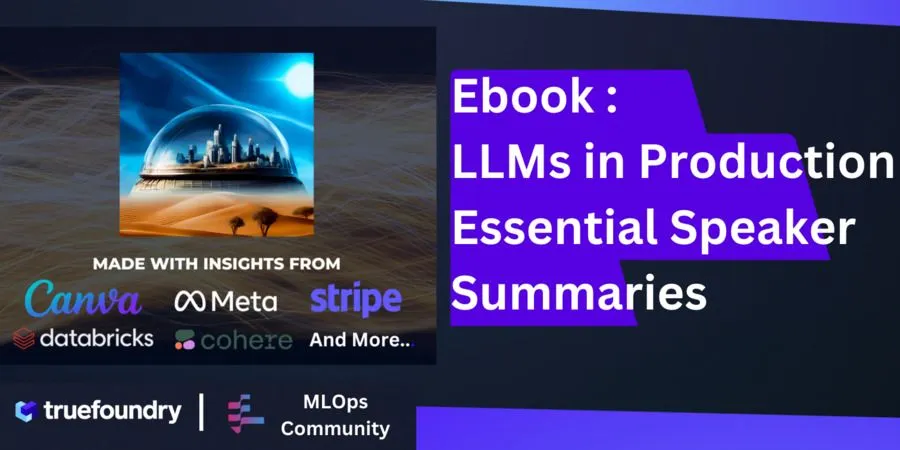
Ebook summarising LLMs in Production conference
LLMOps Center of Excellence: A Budget-Friendly and Effective Approach
However, due to a scarcity in engineering talent & resources, and the ever-evolving nature of this field, it makes the most sense to pool an organisation's resources to address the above mentioned challenges. This is where an LLMOps Center of Excellence (CoE) comes in. An LLMOps CoE, is a centralised unit or team within an an organisation's AI and ML practice which focuses on establishing best practices, processes, and frameworks for implementing and managing LLMOps within an organisation. While we're sure that this sort of a centralised team for championing and productionising LLMs will be called by different names- GenAI CoE, LLM CoE etc. it will be for companies that have AI CoE, this will become an important constituent.
The primary goal of an LLMOps CoE is to enable secure, efficient and scalable deployment of large language models while ensuring reliable and high-quality operations.
Here are 10 key areas in which an an LLMOps CoE adds value to an organisation's AI and ML practice:
Strategy and Governance: The LLMOps CoE defines the strategic vision and objectives for LLM operations within the organisation. It establishes governance frameworks, policies, and standards to ensure compliance, security, and ethical use of LLMs.
Process Design and Automation: The CoE designs and documents end-to-end processes for LLM operations, encompassing tasks such as data preprocessing, model training, deployment, monitoring, and maintenance. It focuses on streamlining and automating these processes to improve efficiency and reproducibility.
Tooling and Infrastructure: The CoE identifies, evaluates, and implements appropriate tools, technologies, and infrastructure to support LLM operations. This includes selecting frameworks for model development, deployment pipelines, version control systems, prompt pipeline tools,autonomous agents, monitoring tools, and vector databases.
Fine-tuning: Unlike shipping traditional machine learning applications, LLM projects necessitate fine-tuning- adjusting the parameters of an already trained LLM using smaller, domain-specific dataset. An LLMOps CoE adds value to this new aspect of AI engineering by sharing best practices, preventing common pitfalls, offering relevant datasets, pre-trained models, and more to facilitate an effective fine-tuning process.
Prompt Engineering: The emergence of LLMs has seen the birth of prompt engineering. While this field is relatively new, it is quickly evolving and plays a crucial role in ensuring LLMs deliver the right output on a consistent basis. Hence a key role that an LLMOps CoE plays is establishing standardised guidelines, frameworks, tools and streamlining the development process and research to stay up-to-date with the fast evolving field of prompt engineering.
Collaboration and Knowledge Sharing: The LLMOps CoE fosters collaboration and knowledge sharing among teams involved in LLM operations. It promotes cross-functional communication, establishes communities of practice, and provides training programs to ensure the expertise is shared effectively across the organization.
Performance Monitoring and Optimization: The CoE defines key performance indicators (KPIs) and establishes monitoring practices to track the performance and health of deployed LLMs. It develops mechanisms for automated monitoring, anomaly detection, and performance optimization to ensure reliable and efficient LLM operations.
Security and Compliance: The LLMOps CoE ensures the security and compliance of LLM operations. It develops policies and practices for data privacy, access controls, encryption, and regulatory compliance. The CoE collaborates with security and legal teams to address potential risks and vulnerabilities.
Change Management: The CoE guides the organization through the cultural and operational changes associated with adopting LLMOps. It develops change management strategies, communication plans, and training programs to facilitate smooth transitions, gain buy-in from stakeholders, and maximize the value of LLMOps practices.
Enabling business Use-cases: Last but not the least, a very essential function of an LLMOps CoE is enabling business use-cases. By providing expertise, best practices, tools, resources, and training and support an LLMOps CoE helps companies develop and deploy LLMs for a variety of business goals.
Some LLM business use-cases which we believe CoEs can help with are as follows,
Automated customer support: An LLMOps CoE can develop and deploy LLMs to automate customer support tasks, such as answering FAQs and resolving simple issues. This can free up human customer support agents to focus on more complex tasks.
Personalised marketing: They can develop and deploy LLMs to personalize marketing campaigns for each individual customer. This can help companies to increase sales and improve customer satisfaction.
Content creation: They can develop and deploy LLMs to create content, such as blog posts, articles, and social media posts. This can help companies to save time and money on content creation.
Compliance: They can develop and deploy LLMs to help companies comply with regulations, such as GDPR and CCPA. This can help companies to avoid costly fines and penalties.
A recent, remarkable language model which offers a wide range of applications in the field of NLP is Falcon 40B . This model can helps with tasks like sentiment analysis, text classification, question answering and more.
To learn how to deploy Falcon 40B read this blog by TrueFoundry
However, like every successful function in a company, the life blood of an LLMOps CoE is its man-power. An LLMOps CoE typically includes a mix of the following 6 roles and expertise:
TrueFoundry AI Gateway delivers ~3–4 ms latency, handles 350+ RPS on 1 vCPU, scales horizontally with ease, and is production-ready, while LiteLLM suffers from high latency, struggles beyond moderate RPS, lacks built-in scaling, and is best for light or prototype workloads.










.png)


.png)
.png)
.png)
.png)
.png)
.png)
.png)
.png)
.png)
.png)





