



October 26, 2026
|
5 min read


Blazingly fast way to build, track and deploy your models!
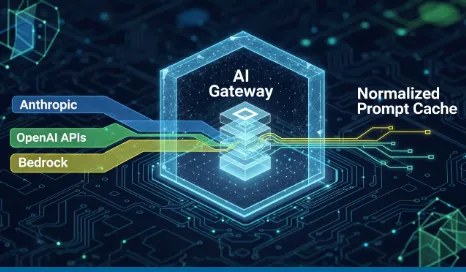
Every major LLM provider implements prompt caching differently. Here's how the TrueFoundry AI Gateway translates cache directives across providers, handles fallback when a target doesn't support caching, and exposes unified hit metrics — with token savings benchmarks.

Prompt caching is the single highest-leverage cost optimization for any LLM workload built on a long, stable prefix — a 10K-token system prompt, a tool registry, a retrieval bundle. The discount is roughly 90% off cached input tokens, large enough to change the unit economics of an agent product.

The catch is that the three major LLM provider APIs — Anthropic native, OpenAI, AWS Bedrock Converse — each model caching differently in ways that aren't cosmetic: directive shape, response shape, TTL options, and even when caching is invoked at all.
Anthropic's prompt caching is the most expressive of the three. You explicitly mark which portion of the request should be cached using the cache_control attribute on a system or message block:
anthropic request · json
{
  "model": "claude-sonnet-4-6",
  "system": [{
    "type": "text",
    "text": "<10,000 token system prompt>",
    "cache_control": {"type": "ephemeral"}
  }],
  "messages": [{"role": "user", "content": "<query>"}]
}
Three rules govern when this actually caches. The prefix must clear a model-specific minimum: 1,024 tokens for Sonnet-class and 2,048 tokens for Opus-class. Below the threshold the directive is silently dropped. The default TTL is 5 minutes, refreshed on each hit. And the prefix must be byte-identical — a stray timestamp before the cached block kills the hit (we return to this in §08).
Pricing has two non-obvious components. Cache reads are billed at 10% of the base input rate — the 90% discount you came for. Cache writes carry a 25% premium over base input pricing. The cache must pay for itself across enough subsequent hits to recover the write surcharge; for a 10K-token prefix on Sonnet 4.6, breakeven is two follow-up hits.
The response surfaces caching in three usage fields: cache_read_input_tokens (served from cache), cache_creation_input_tokens (written this turn), and input_tokens (everything else). Since extended-TTL caching now lets you opt into a 1-hour retention at a 2× write premium, Anthropic also surfaces a per-TTL breakdown under cache_creation.ephemeral_5m_input_tokens and cache_creation.ephemeral_1h_input_tokens. That breakdown matters more than it looks — we'll come back to it in §04.
OpenAI's prompt caching takes the opposite philosophy. There is no directive. The cache turns on automatically once the prompt prefix exceeds 1,024 tokens, and OpenAI's infrastructure caches the KV activations server-side. Subsequent requests with the same prefix get the cached state automatically.
The developer-facing surface is two optional parameters that influence — but don't trigger — caching. prompt_cache_key is a string combined with the prefix hash to influence backend routing: same key, same backend, higher hit rate. prompt_cache_retention accepts "in_memory" (default, 5–10 minutes) or "24h" for extended retention. Both are documented in OpenAI's prompt caching guide.
The asymmetry with Anthropic is sharp: you cannot choose which prefix is cached. OpenAI's caching layer picks the longest repeated prefix it observes on a given backend. If your system prompt is followed by a frequently-changing tool registry, the cache may land on the system prompt alone or on a different boundary, with no visibility into which. The response surfaces only one cache field — cached_tokens nested under usage.prompt_tokens_details — and no write-side counter, because OpenAI doesn't bill for cache writes.
The practical implication: OpenAI caching is well-suited to workloads where the stable prefix is one block. Anthropic's explicit breakpoints give you fine-grained control over multi-region prefixes; OpenAI doesn't.
Bedrock's prompt caching sits in the Converse API and uses a cachePoint marker block placed after the content it caches:
bedrock converse · json
{
  "modelId": "anthropic.claude-sonnet-4-6-v1:0",
  "system": [
    {"text": "<long system prompt>"},
    {"cachePoint": {"type": "default", "ttl": "1h"}}
  ],
  "messages": [/* ... */]
}
Three things make this trickier than it looks. First, the marker placement is the opposite of Anthropic's — the directive comes after the content it caches, not on it. Implementations that lift Anthropic's pattern directly silently disable caching. Second, this is the Converse API specifically; Bedrock's native InvokeModel endpoint accepts the Anthropic-style format verbatim for Claude models, but Converse is the path most newer integrations use.
Third, TTL support shifted recently. Before January 26, 2026, Bedrock Converse only supported a 5-minute TTL. On that date AWS shipped 1-hour TTL support for the Claude 4.5+ family and Amazon Nova; the new ttl: "1h" field on the cachePoint opts in. Older models reject the field — no graceful downgrade.
The response uses camelCase: cacheReadInputTokens, cacheWriteInputTokens, and inputTokens. Unlike Anthropic, Bedrock Converse does not expose a per-TTL breakdown on writes. The gateway that translated the request knows which TTL was requested; the response alone doesn't tell you.
The translation problem the gateway has to solve is: a client sends a single canonical request with Anthropic-style cache_control, and the gateway routes to whichever provider the policy selects. Three strategies are possible — strip the directive when the target doesn't understand it, translate to the target's native cache primitive, or error and refuse to route.
TrueFoundryのゲートウェイは、 可能な場合は翻訳し、そうでない場合は削除してログに記録します。AnthropicとBedrock Converseには完全な翻訳が適用されます — cache_control というTTLを持つものは cachePoint と、それと同等の ttl フィールドになります。OpenAIでは意図が翻訳されます。ディレクティブ自体は破棄されますが、 prompt_cache_retention は "24h" に設定され、1時間の正規TTLの場合、 prompt_cache_key は正規の cache_keyから転送されます。ダウングレードが強制された場合 — 拡張TTLをサポートしないモデルに1時間のTTLがルーティングされる場合 — ゲートウェイは警告スパン属性 (gen_ai.tfy.cache_ttl_downgrade=5m) を出力し、回帰が観測可能になります。
レスポンス側でのより巧妙な落とし穴の1つは、混合TTLコスト計算バグです。
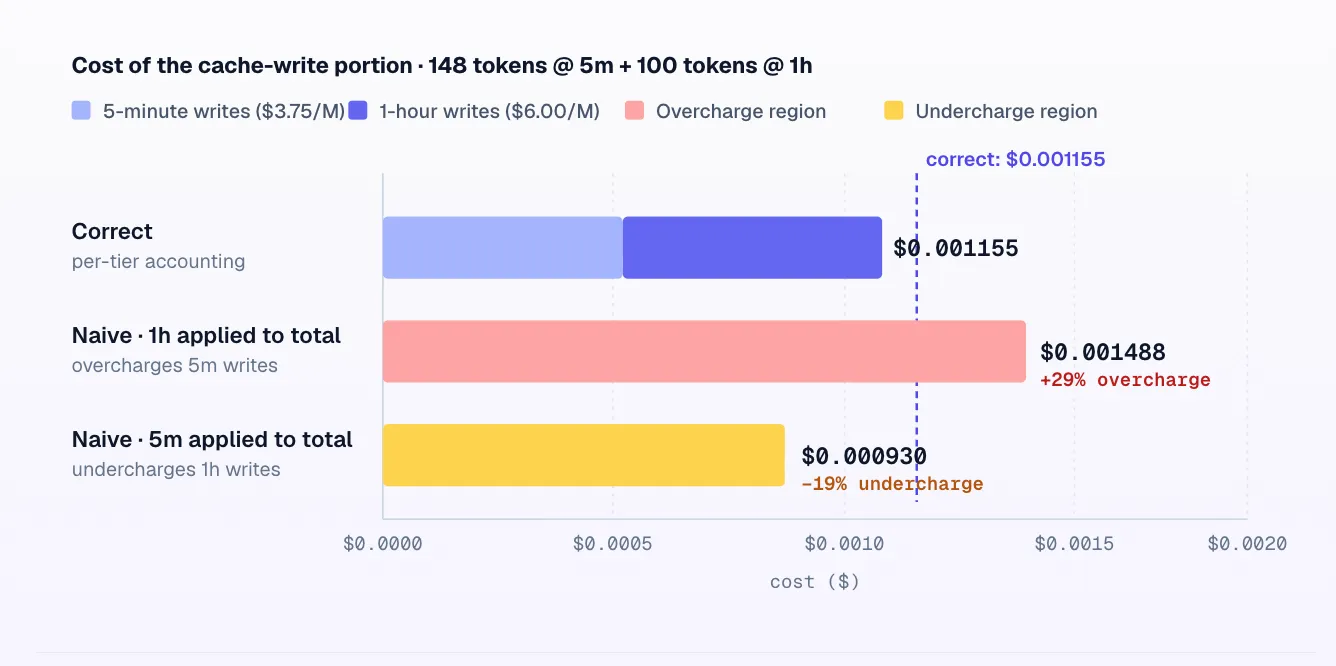
したがって、ゲートウェイがダウンストリームに公開する統合使用量オブジェクトには、4つではなく5つのトークンフィールドがあります。 cache_hit_tokens、 cache_miss_tokens、 cache_write_5m_tokens、 cache_write_1h_tokens、および。
複数のプロバイダーに対応するゲートウェイにとって興味深い障害モードは、プライマリターゲットがレート制限されたりダウンしたりして、リクエストがセカンダリにフォールバックする場合に何が起こるかです。キャッシングに関しては、 キャッシュはプロバイダー間でトラフィックを追跡しません。 過去15分間Anthropicのキャッシュでホットだった1万トークンのシステムプロンプトを持つリクエストは、Azure OpenAIへのフォールバック時に、完全にコールドなプレフィックスキャッシュにヒットします。フォールバックは成功しますが、プレフィックスに対しては入力トークンの全コストを支払い、トレースは正しくキャッシュミスを報告します。
Sonnet 4.6で1万トークンのプレフィックスの場合、これはリクエストあたり0.003ドル(キャッシュ読み取り)と0.030ドル(フル入力)の差となり、フェイルオーバー期間中にコストが10倍に跳ね上がります。セカンダリがウォームアップした後でも、ウォームアップは無料ではありません。コールドターゲットへの新しいリクエストごとに、書き込みプレミアムが発生します。
この緩和策には2つの部分があります。 セカンダリをウォームアップ状態に保つ — インシデント時だけでなく、継続的にトラフィックの1%をフォールバックプロバイダーに送信します。 フォールバックキャッシュヒット率を別途監視する役立つアラートは「フォールバック率が5%を超過しました」ではなく、「フォールバック率が5%を超過し、かつフォールバックキャッシュヒット率が50%未満です」というものです。前者はルーティングイベントであり、後者は測定可能なコストペナルティを伴うルーティングイベントです。
正規化レイヤーの利点は、どのプロバイダーがリクエストを処理したかに関わらず、すべてのトレーススパンが同じキャッシュ属性を持つことです。
otel span attributes · gateway-emitted
gen_ai.provider.name              = anthropic
gen_ai.request.model              = claude-sonnet-4-6
gen_ai.usage.cache_hit_tokens     = 9800
gen_ai.usage.cache_miss_tokens    = 248
gen_ai.usage.cache_write_tokens   = 0
gen_ai.usage.output_tokens        = 503
gen_ai.cache.hit_rate             = 0.975
gen_ai.cache.ttl_tier             = 1h
gen_ai.tfy.virtual_account        = tenant-123
どのダッシュボードクエリ、コストアトリビューションジョブ、ルーティング調整分析も、プロバイダーごとに分岐することなくこれらのフィールドを読み取ることができます。それらから計算されたキャッシュヒット率は、Anthropic、OpenAI、Bedrockのトラフィック間で比較可能であり、これにより、3つの異なるSQLテンプレートを使用することなく、1つのダッシュボードパネルで「このワークロードでどのプロバイダーが最高のキャッシュ経済性を提供しているか」という問いに答えることができます。
2つの注意点があります。キャッシュ固有の属性はOTelの gen_ai.* 名前空間パターンに従いますが、公式のセマンティック規約仕様の一部ではありません(現時点では)。そして hit_rate は運用上役立つ要約であり、正確な効率性指標ではありません。フォレンジックなコスト照合のためには、基となるトークンフィールドを直接読み取ってください。
ほとんどのエージェントアプリケーションが実際に実行するワークロードは、安定した1万トークンのシステムプロンプト、リクエストごとに変化する200トークンのユーザークエリ、500トークンのモデル応答、そしてセッションウィンドウ全体で1,000リクエストです。現実的な95%のキャッシュヒット率(アイドル期間中のTTL期限切れによる950ヒット、50ミス)を仮定します。すべての数値は、2026年5月の定価に対する米ドル建てです。

2つの点が際立っています。両プロバイダーは大きく、ほぼ同等の節約を提供しており、キャッシュなしの場合との差に比べて、両者間の差は小さいです。そして、キャッシュが有効になると、出力トークンが主要なコスト項目になります(Anthropicの総コストの約58%、OpenAIの総コストの約65%)。これにより、次にどの最適化が重要になるかが変わります。キャッシュが有効になると、次のコスト削減は出力長の制御から得られ、より深い入力最適化からではありません。
キャッシュキーは、上記の工夫が適用される前はバイト単位で完全一致します。いくつかの一般的なパターンが、気づかれないうちにヒット率を低下させますが、それらはすべて同じ形をしています。 不安定なものが、安定しているはずのプレフィックスの前や内部に連結されてしまうことです。
ゲートウェイは、仮想アカウントごとのキャッシュヒット率を監視することで、これらのほとんどを自動的に検出できます。10Kトークンのシステムプロンプトでヒット率が常に40%を下回る場合、それはほぼ間違いなくコンテンツの揮発性に関する問題であり、トレースのタイムラインは通常、どのセグメントが変化しているかを示します。TrueFoundryのダッシュボードでは、これを「低キャッシュヒット率」アラートとして、プレフィックスの差分情報とともに表示するため、修正は通常5分程度のプロンプト編集で済みます。
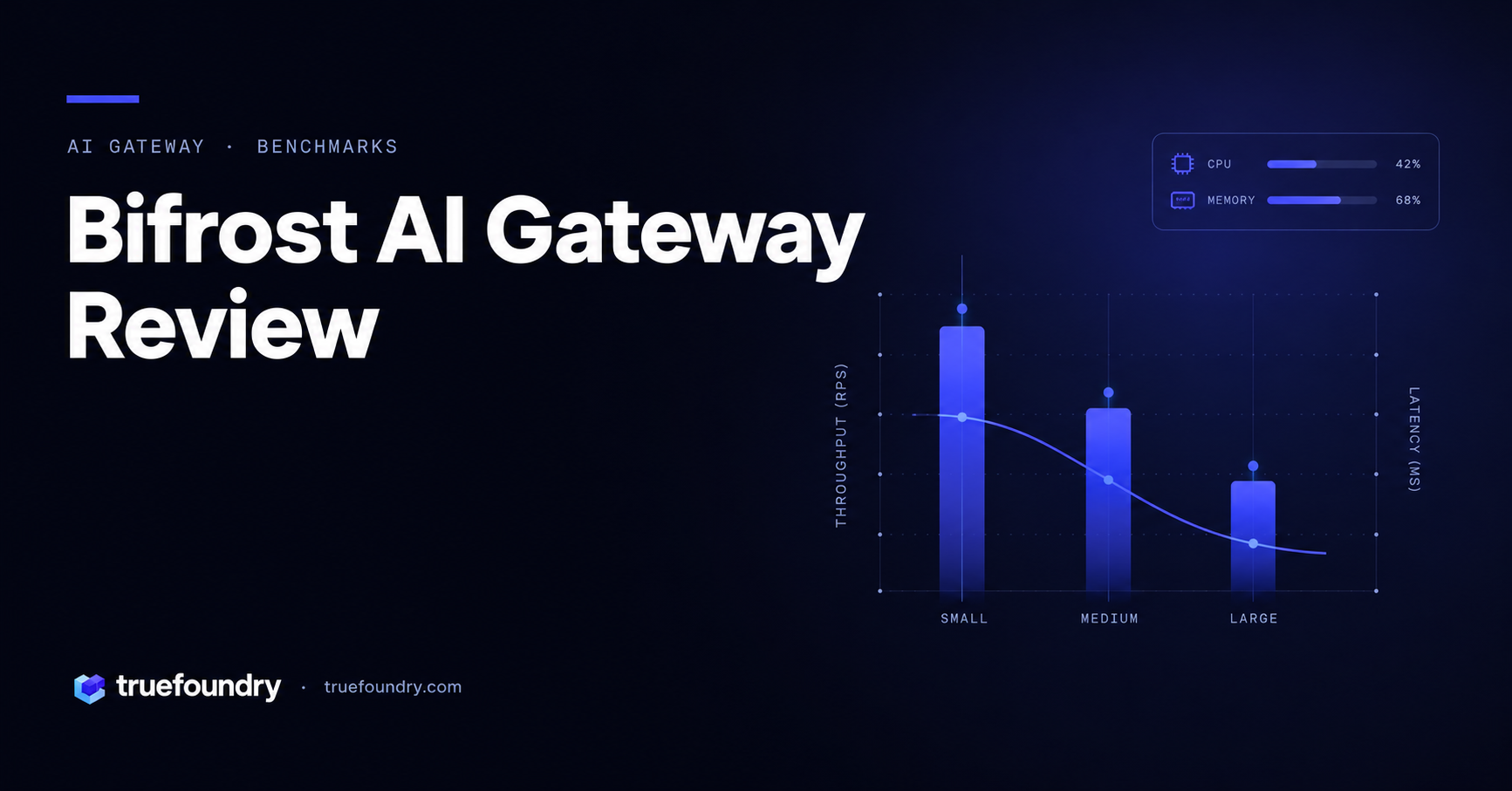
TrueFoundry AI Gateway delivers ~3–4 ms latency, handles 350+ RPS on 1 vCPU, scales horizontally with ease, and is production-ready, while LiteLLM suffers from high latency, struggles beyond moderate RPS, lacks built-in scaling, and is best for light or prototype workloads.




.webp)
.webp)

.png)
.png)
.png)
.png)
.png)
.png)
.png)
.png)
.png)

.png)
.png)





