Blank white background with no objects or features visible.

TrueForgeのご紹介:オープンソースでベンダーフリーなエージェントハーネス。コストを50%削減します。今すぐ試す→

LiteLLM vs Vercel AI Gateway: Which Platform Fits AI Engineering Teams Better?

By アシシュ・ドゥベイ

Published: September 10, 2026

TrueFoundry compares LiteLLM and Vercel AI Gateway governance
TL;DR:

LiteLLM and Vercel AI Gateway both handle model access well; the real difference between them lies in ownership rather than capability. LiteLLM hands you a proxy to run. Vercel runs one for you. Both charge for governance, just in different currencies.

Which areas should enterprise teams prioritize:
  • Decide who operates the gateway first: Every other difference follows from that answer.
  • Find the governance paywall on each side:LiteLLM gates SSO and audit logs, Vercel meters team-wide controls.
  • Budget for Postgres, not just the binary:LiteLLM's control features need a database you run.
  • Credit LiteLLM's MCP support: Its registries and per-tool spend tracking are real and up to date.
  • Separate tool access from workflow limits:Governing which tool runs differs from capping a loop.
  • TrueFoundry owns the layer above:Models, MCP tools, agents, budgets, and audit logs in one plane.

Engineering teams compare LiteLLM vs Vercel AI when direct provider integrations become difficult to manage. Both simplify access to multiple LLM providers and reduce model-specific integration work. They also provide a standardized interface for AI applications switching models without repeated code changes.

The key difference concerns operating ownership across both platforms. LiteLLM is an open source, self-hosted AI gateway and proxy server. Vercel AI Gateway is a hosted managed service focused on developer experience. LiteLLM runs in your own infrastructure, while Vercel operates the gateway.

TrueFoundry becomes relevant when enterprises need broader governance across models, tools, agents, and budgets.

Govern LLM Traffic Before AI Applications Reach Production Risk

TrueFoundry controls model access, MCP tools, budgets, and audit logs inside your cloud securely

Start With Ownership: Self-Hosted Proxy or Hosted Gateway?

The most useful way to compare LiteLLM and Vercel AI is ownership. LiteLLM gives teams a LiteLLM proxy they run and customize. Platform teams control routing, rate limits, budgets, provider credentials, and deployment. The LiteLLM proxy server also supports a Python SDK. API calls can carry metadata through HTTP headers.

Vercel AI Gateway takes the hosted approach. Product teams get one API key, BYOK, OIDC tokens, routing, and observability. OpenAI-compatible integrations can be migrated via a base URL swap. The Vercel AI SDK also connects without gateway maintenance.

Ownership creates different operating costs. LiteLLM uses Postgres for team management, virtual keys, budgets, and access control. Vercel operates the service while teams configure routing and providers.

Buyer Question LiteLLM Vercel AI Gateway
Primary model Self-hosted gateway and proxy Hosted gateway service
Best buyer Platform and backend teams Product and frontend teams
Core value Flexibility and infrastructure control Fast hosted model access
Setup responsibility Higher internal ownership Lower infrastructure ownership
Main concern Operating and scaling the gateway Hosted ecosystem dependency
LiteLLM and Vercel AI Gateway ownership models compared

Where LiteLLM is a Good Option

LiteLLM suits teams wanting self-hosted routing and cost control. Its MIT core supports 140+ providers through a unified interface. Teams can connect internal models, Google Vertex, Amazon Bedrock, AWS Bedrock, and other upstream providers.

The free tier includes virtual keys, budgets, rate limiting, fallbacks, and Prometheus metrics. LiteLLM supports load balancing across providers, regions, and keys. Lowest-cost and Auto Routing can choose model providers by cost or complexity. TrueFoundry’s LLM load balancing guide explains these traffic routes across production workloads.  

LiteLLM now extends beyond a basic proxy with LLM, MCP, and agent capabilities. Usage tracks key, user, team, tool, agent, and MCP server across broader use cases.

The tradeoff remains the operational ownership required from engineering teams. Teams manage deployment, upgrades, storage, security, and reliability. Enterprise adds SSO, SCIM, audit logs, secret management, multi-region controls, and support. Pricing is quote-based and depends on annual gateway capacity and deployment requirements.

Choose LiteLLM when:

  • Self-hosted control is important for enterprise requirements.
  • Backend teams can operate gateway infrastructure reliably.
  • Multi-provider routing needs detailed configuration control.
  • Virtual keys and token usage tracking matter.
  • Open source extensibility outweighs hosted operational simplicity.

Where Vercel AI Gateway is a Good Choice

Vercel AI Gateway is strongest for small teams already building on Vercel. A single endpoint serves many models with a single credential and no token markup. Teams can use system credentials or their own keys, while existing OpenAI integrations can migrate by changing the base URL.

The practical advantage comes from faster setup and lower operational work. Developers can switch providers, review usage analytics, and set budgets without having to operate a gateway. Vercel’s AI gateway documentation covers AI SDK, OpenAI Chat Completions, Responses, and Anthropic Messages through a unified interface.

Vercel provides automatic failover across providers serving the same AI model. Teams can A/B test prompts through controlled routing. Teams can rank each supported provider by cost, time to first token, or throughput. BYOK can use provider timeouts, while fallback logic moves failed traffic onward.

Team-wide zero data retention restricts requests to providers covered by Vercel agreements. Provider allowlists constrain team traffic. Provider-level data retention still needs review for regulated workloads.

Choose Vercel AI Gateway when:

  • The Vercel platform already hosts the application delivery layer.
  • Developer experience matters more than gateway ownership.
  • Teams want fast access to LLMs through a single endpoint.
  • BYOK and no token markup are important.
  • Product teams need built-in visibility into usage and spend.

How Do LiteLLM and Vercel AI Compare on Routing, Observability, and Monitoring?

The Vercel AI vs LiteLLM decision becomes clearer around routing and monitoring. LiteLLM controls rate limiting, fallbacks, provider routing, and logging. The proxy exposes a single API across deployments.

Vercel provides built-in monitoring through the Vercel dashboard. Teams can review requests, cost, latency, token usage, and provider behavior. Routing can prioritize cost, throughput, or low latency without operating the data plane. Tail latency still depends on upstream providers and selected models.

For enterprises, AI gateway observability should connect routing with failures, cost, and policy activity. A dedicated LLM Gateway can centralize provider access across production traffic.

Requirement LiteLLM Vercel AI Gateway TrueFoundry Angle
Provider routing Configurable proxy and router Hosted routing and fallback Unified LLM Gateway
Developer setup Proxy deployment required Fast hosted setup Central AI Gateway API
Observability Callbacks and integrations Dashboard and reporting Gateway-wide observability
Budgets Key, user, team, org caps Team, project, key, user Team and workflow budgets
Private deployment Self-hosted and air-gapped Hosted service VPC, on-prem, air-gapped
Agent coverage MCP and agent capabilities Requires added architecture Agent workflow controls

LiteLLM now covers MCP and agents deeply than older comparisons suggest. Buyers should still separate tool access from workflow limits. Governing a tool call differs from controlling a complete sequence of agent calls.

LiteLLM Vercel AI and TrueFoundry routing matrix

How Should Enterprises Compare Pricing and Operations of LiteLLM vs Vercel AI?

Pricing should reflect the total ownership required by each operating model. LiteLLM’s open-source gateway has no license fee, while Enterprise pricing is custom. Enterprise is sized by annual request capacity, deployment architecture, and support needs. Teams still fund the supporting infrastructure and ongoing operations themselves.

Enterprise adds SSO, SCIM, audit logs, secret management, multi-region capabilities, and support. This replaces the older public-price assumption in the draft. TrueFoundry’s LiteLLM enterprise pricing analysis provides detailed information on operational cost drivers.  

Vercel uses prepaid credits and charges the provider list price without token markup. Its free tier includes $5 every 30 days until payment begins. Card purchases can incur payment processing fees, while invoicing is available without them.

Some governance controls also carry separate usage-based meters for teams. Team-wide ZDR costs $0.10 per 1,000 requests. Custom Reporting charges $0.075 per 1,000 values written and $5 per 1,000 queries. These additional costs matter as production traffic scales across teams.

Enterprises should compare software, infrastructure, operations, and cost control together once private deployment and broader governance become requirements.

What Gaps Do LiteLLM and Vercel AI Leave for Enterprise AI Teams

LiteLLM vs Vercel AI is no longer a simple proxy-versus-hosted comparison. LiteLLM covers models, MCP, agents, and governance. Vercel has stronger budgets and provider controls. Remaining gaps concern complete agent workflows.

Production AI can start as an LLM call, continue through Model Context Protocol tools, and trigger more actions. Enterprises may need identity, budgets, and audit evidence across that chain. TrueFoundry’s MCP Gateway governs tool access, while the Agent Gateway governs agent execution.

Common areas to evaluate include:

  • Tool-level permissions across enterprise MCP servers.
  • Workflow limits and circuit breakers for agents.
  • Identity propagation across models and enterprise tools.
  • Audit trails tied to users, tools, and costs.
  • Private deployment for prompts and execution traces.
  • Budget enforcement across complete agent workflows.

The decision between Vercel AI or LiteLLM should reflect current governance requirements. Teams comparing another managed option, such as Kong AI Gateway, should apply the same ownership test

Move From Model Routing to Governed Enterprise AI Execution

Get started with TrueFoundry to govern models, tools, agents, costs, and audit logs centrally

Where TrueFoundry Fits in the LiteLLM vs Vercel AI Gateway Decision

TrueFoundry is a good fit when enterprises want a single governance layer across models, tools, and agents. Its AI Gateway centralizes routing, budgets, guardrails, observability, and provider access across SaaS and private deployments.

LiteLLM gives teams a gateway they operate, while Vercel provides a hosted model gateway. TrueFoundry packages model, MCP, and agent governance with private deployment options.

Enforcement is declarative and lives in version control. Rules evaluate in order, and the first match wins:

name: ratelimiting-config
type: gateway-rate-limiting-config
rules:
  # Cap one contractor account on a specific model
  - id: "contractor-gpt4-daily"
    when:
      subjects: ["user:contractor@example.com"]
      models: ["openai-main/gpt4"]
    limit_to: 1000
    unit: requests_per_day

  # Give every user an independent daily token budget
  - id: "user-daily-limit"
    when: {}
    limit_to: 1000000
    unit: tokens_per_day
    rate_limit_applies_per: ['user']

The `rate_limit_applies_per` field creates a separate counter per entity, so a single rule covers all users without generating a rule per identity. A request over its limit returns HTTP 429, naming the rule that fired, alongside an `x-tfy-applied-rules` header:

{
  "status": "failure",
  "message": "Rate limit exceeded for model: openai-main/gpt4 with rule: contractor-gpt4-daily",
  "error": {
    "type": "RateLimitError",
    "code": "429"
  },
  "error_origin_level": "rate_limit_budget"
}

TrueFoundry is most relevant when:

  • Enterprise governance matters beyond gateway setup.
  • VPC, on-premises, or air-gapped deployment is required.
  • MCP tools require centralized policy and credential control.
  • Agents need budget limits and execution safeguards.
  • Compliance teams need audit-ready execution evidence.
  • Multiple providers need one consistent control layer

Final Verdict: LiteLLM or Vercel AI Gateway?

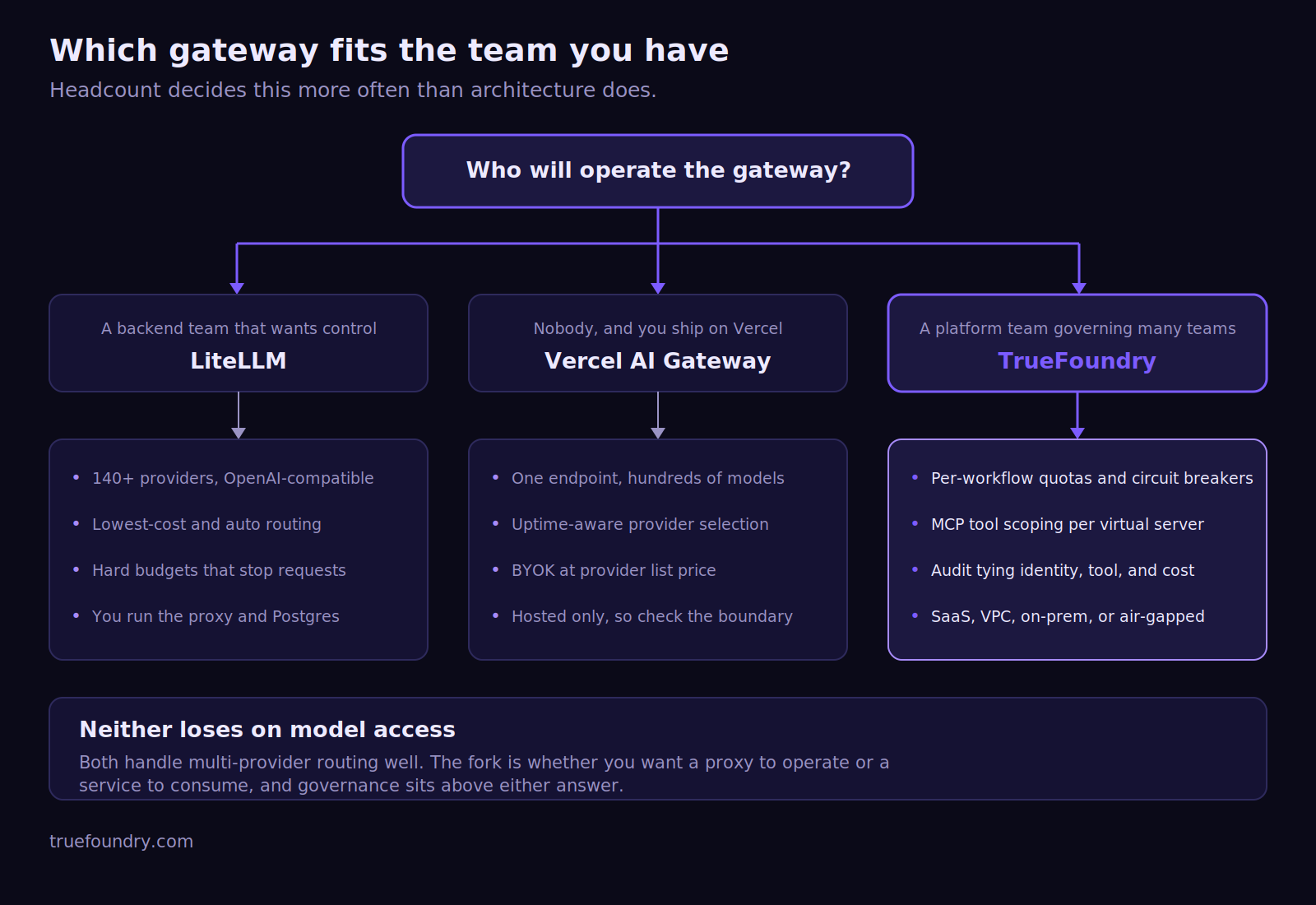
Decision flow for LiteLLM, Vercel AI Gateway, and TrueFoundry

Choose LiteLLM when your team wants self-hosted control, open-source flexibility, virtual keys, budgets, and custom operations. Its platform now covers models, MCP, and agents, making it strongest when platform teams can own operations.

Choose Vercel AI Gateway when your team uses Vercel and wants fast model access, BYOK, and hosted reliability. It is strongest when delivery speed matters more than private gateway ownership.

Choose TrueFoundry when governed execution must span models, MCP tools, agents, and budgets. It also fits private or managed production environments requiring audit evidence.

The LiteLLM or Vercel AI decision comes down to ownership first. LiteLLM provides infrastructure control, while Vercel provides a hosted service. TrueFoundry fits when broader AI governance becomes the primary focus.

Book a Demo with TrueFoundry to evaluate your gateway, MCP, agent, deployment, and governance requirements.

Try now.

One gateway for all your models, MCP servers, and agents.
No credit card needed.

Start free
Table of Contents

One Gateway for Every LLM, Agent and MCP Server

Book a 30-min with our AI expert

Book a Demo

The fastest way to build, govern and scale your AI

Book Demo
Summarize with
ChatGPT logo by OpenAI
Perplexity AI logo
Blurry red snowflake on white background, symmetrical frosty design with soft edges and abstract shape.

Discover More

No items found.
TrueFoundry compares LiteLLM and Vercel AI Gateway governance
September 10, 2026
|
5 min read

LiteLLM vs Vercel AI Gateway: Which Platform Fits AI Engineering Teams Better?

No items found.
TrueFoundry governs multi-agent orchestration workflows in enterprise production
July 4, 2026
|
5 min read

マルチエージェントオーケストレーションとは?エンタープライズチームのための実践ガイド

No items found.
July 4, 2026
|
5 min read

セキュリティログにAIを導入する前に、EUのSOCチームが問うべきこと

LLM・生成AI
September 10, 2026
|
5 min read

TrueFoundryとSmallest AIの統合

No items found.
No items found.

Recent Blogs

Black left pointing arrow symbol on white background, directional indicator.
Take a quick product tour
Start Product Tour
Product Tour