


October 1, 2026
|
5 min read


Published: September 11, 2026

Blazingly fast way to build, track and deploy your models!
As enterprises scale their AI initiatives, a new challenge is emerging: uncontrolled costs, inconsistent governance, and fragmented integrations across models and providers. The Gartner® Market Guide for AI Gateways (October 2025) identifies this shift clearly, projecting that by 2028, 70% of software engineering teams building multimodel applications will use AI gateways to improve reliability and optimize costs, compared to 25% in 2025.
Gartner recognizes TrueFoundry as a representative vendor for our product, the TrueFoundry AI Gateway. Built as a unified control layer for AI workloads, it brings observability, cost control, and governance to enterprise-scale AI environments.
Understanding the AI Gateway Layer
Gartner defines an AI Gateway as middleware that sits between applications and AI services or models, managing security, observability, and cost optimization.
At a technical level, an AI Gateway performs four foundational tasks:
This transforms the Gateway into a programmable policy and governance plane sitting between the application layer and the model ecosystem — similar to what Kubernetes did for containers.
At TrueFoundry, we view this layer as the AI Control Plane — the layer that brings together reliability, accountability, and operational excellence for multimodel and multi-agent systems.
The Gartner® report identifies several forces accelerating AI Gateway adoption:
In essence, Gateways are shifting from simple traffic routers to intelligent governance engines that define how enterprise AI operates.
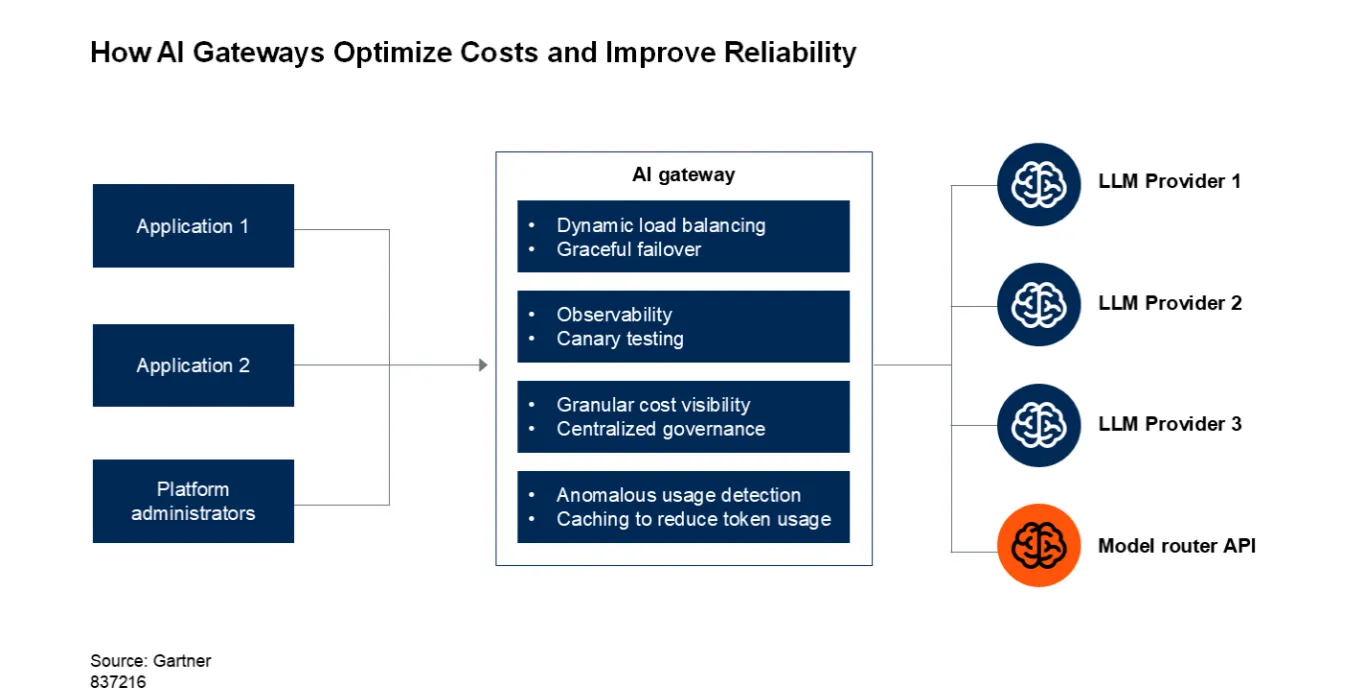
Based on the evaluation framework in the Market Guide for AI Gateways, enterprises should assess AI Gateway solutions on the following dimensions:
These considerations reflect a fundamental change in how organizations evaluate AI infrastructure: not only by accuracy or performance but by reliability, safety, and cost predictability.
As enterprises operationalize AI Gateways, several deployment patterns are emerging across the market—each balancing central control with distributed performance.
Aggregator: A single gateway aggregates providers behind it, enforcing global policy and cross-model orchestration.
Proxy: Fronts individual providers for fast rollout of authentication and logging without re-architecture.
Composite / Hybrid: Regional gateways feed a global control layer for low-latency access under central governance.
These reflect the architectural flexibility Gartner emphasizes—supporting multi-cloud, hybrid, and on-prem models while maintaining unified governance and observability.
TrueFoundry AI Gateway supports all three: defaulting to Aggregator mode, scaling into Composite topologies for global rollouts, and offering Proxy setups for selective control.
The routing layer dynamically directs traffic based on performance, reliability, or cost criteria. It supports multiple AI providers such as OpenAI, Anthropic, Mistral, and Cohere, and automatically fails over when a model or endpoint becomes unstable.
TrueFoundry’s adaptive cost engine tracks token consumption by application, user, and model. Semantic caching reduces redundant LLM requests by up to 40 percent without sacrificing response quality, lowering spend and improving responsiveness.
Centralized key rotation eliminates credential sprawl. Input and output validation guardrails block unsafe prompts, redact sensitive data, and enforce compliance standards such as HIPAA and GDPR. Role-based and policy-based access control uses OAuth 2.x and OIDC for secure authentication.
Real-time tracing, latency analytics, and usage dashboards provide visibility into every AI interaction. Integrations with Grafana, Datadog, and OpenTelemetry allow unified monitoring across environments.
TrueFoundry’s AI Gateway natively supports the Model Context Protocol, allowing AI agents to access enterprise systems through a secure, auditable control plane. This creates a seamless bridge between AI model governance and multi-agent orchestration.
Gartner notes a rapid convergence between API management and AI control systems. Traditional API vendors are adding AI-specific extensions, while AI platform providers like TrueFoundry deliver gateways that are natively optimized for token management, semantic caching, and latency analytics.
The total addressable market for AI Gateways is estimated at 50 to 100 million dollars in 2025, and it is expected to grow sharply as enterprises adopt multimodel and hybrid AI architectures. Gartner predicts increasing vendor consolidation, expansion into edge deployments, and deeper integration with AI observability tools.
Going Beyond the Gartner Checklist
The Gartner Market Guide lays out what enterprises should evaluate before adopting AI Gateways. To our, TrueFoundry AI Gateway not only meets those criteria—it extends them with multi-provider routing, agent-aware governance, and deep observability.
Here’s a snapshot of how we believe TrueFoundry aligns with and goes beyond the report’s recommended capabilities.
This architecture enables platform and DevOps teams to operate AI systems with the same rigor they apply to production software; measurable, secure, and compliant.
To see the full enterprise checklist—including advanced criteria like multi-region deployments and MCP integration, download the AI Gateway Evaluation Checklist.
Month 1: Centralize keys, activate token dashboards, and audit credentials for shadow usage.
Outcome: コストの可視化と認証情報のセキュリティ。
2ヶ月目: IDプロバイダー(Okta、Azure AD)を接続し、クォータと予算を有効化し、ガバナンスポリシーを展開します。
成果: 予測可能な支出とポリシー適用範囲。
3ヶ月目: ルーティング、フェイルオーバー、セマンティックキャッシュを有効化し、アップタイムとコスト最適化を確保します。
成果: 高い回復性と完全な監査可能性。
経営層向けKPI: 支出の予測可能性 • プロバイダーの回復性 • コンプライアンスの追跡可能性
AIゲートウェイは、複雑なモデルエコシステムを管理するために必要なガバナンスと可視性を提供し、エンタープライズAIの基盤となりつつあります。Gartner 2025 Market Guideは、この変化を裏付けており、TrueFoundryのようなベンダーがこの不可欠なインフラ層を進化させていることを評価しています。
組織がマルチモデルおよびマルチエージェントAIシステムへと進化するにつれて、TrueFoundryは、ルーティング、セキュリティ、コスト管理が集約される基盤となるコントロールプレーンの構築に注力しています。
“AIイノベーションの次の段階は、いかにインテリジェントにガバナンスされるかにかかっています。AIゲートウェイは、そのガバナンスを可能にします。.”
について詳しくはこちら TrueFoundry AIゲートウェイ そして、あらゆるモデルや環境において、安全で、可観測性があり、費用対効果の高いAI運用をどのように実現するか。
ガートナー AIゲートウェイ市場ガイド、Andrew Humphreys 他、2025年10月13日
GARTNERは、Gartner, Inc.および/またはその米国および国際的な関連会社の登録商標およびサービスマークであり、本書では許可を得て使用されています。全ての権利は留保されています。ガートナーは、その調査出版物に掲載されているいかなるベンダー、製品、サービスも推奨するものではなく、テクノロジーユーザーに対し、最高の評価またはその他の指定を受けたベンダーのみを選択するよう助言するものではありません。ガートナーの調査出版物は、ガートナーの調査組織の意見で構成されており、事実の記述と解釈されるべきではありません。ガートナーは、本調査に関して、商品性または特定目的への適合性の保証を含む、明示的または黙示的な一切の保証を否認します。
この図は、Gartner, Inc.がより大規模な調査文書の一部として発行したものであり、文書全体との関連において評価されるべきです。ガートナーの文書は、TrueFoundryに請求すれば入手可能です。
TrueFoundry AI Gateway delivers ~3–4 ms latency, handles 350+ RPS on 1 vCPU, scales horizontally with ease, and is production-ready, while LiteLLM suffers from high latency, struggles beyond moderate RPS, lacks built-in scaling, and is best for light or prototype workloads.



.png)
.png)
.png)
.png)
.png)
.png)
.png)
.png)
.png)
.png)
.png)





