


.webp)
October 24, 2026
|
5 min de lecture


Accédez instantanément à un environnement TrueFoundry en direct. Déployez des modèles, acheminez le trafic LLM et explorez la plateforme complète : votre sandbox est prête en quelques secondes, aucune carte de crédit n'est requise.



.webp)
Une méthode incroyablement rapide pour créer, suivre et déployer vos modèles !
Les équipes en entreprise comparent Kong AI et Vercel AI lorsque le trafic IA commence à dépasser les appels directs aux fournisseurs. Les deux plateformes connectent les applications aux fournisseurs de LLM, réduisent le travail d'intégration et placent une passerelle IA entre les applications et les modèles. Cela devient crucial à mesure que le volume de requêtes en entreprise augmente.
La différence principale réside dans le point de départ de chaque plateforme. Kong est issu de la gestion d'API et étend Kong Gateway aux charges de travail IA. Son Kong AI Gateway actuel fournit également un plan de contrôle dédié pour les modèles, les agents et les serveurs MCP. Vercel AI Gateway reste axé sur les développeurs, offrant aux équipes produit un accès à de nombreux modèles via un point de terminaison unique.
TrueFoundry ajoute une troisième perspective d'entreprise axée sur les modèles gouvernés, les outils MCP, les flux de travail des agents, les budgets, les garde-fous et les preuves d'audit.
Comparer Kong AI et Vercel AI selon le modèle opérationnel est plus utile que de compter les fonctionnalités. Kong convient aux entreprises utilisant déjà Kong Gateway pour le trafic API. Les modèles de sécurité et de routage existants peuvent être étendus au trafic LLM. Les équipes peuvent réutiliser les politiques, les pratiques d'observabilitéet le contrôle d'accès.
Kong AI Gateway 2.0 ajoute un plan de contrôle IA dédié avec des modèles, des agents, des serveurs MCP et des fournisseurs de premier ordre. Les équipes peuvent toujours utiliser les déploiements Kong Gateway, y compris les modèles auto-hébergés et hybrides. Ce modèle convient aux équipes de plateforme API qui souhaitent une propriété directe des politiques et un contrôle plus approfondi sur le plan de données.
Vercel AI Gateway résout un problème différent pour les équipes produit. Il fournit une clé API unique, la prise en charge du SDK IA, le BYOK (Bring Your Own Key), le routage, les budgets et l'analyse d'utilisation. Un nouveau projet peut appeler des modèles de fondation via une URL de base unique avec un minimum de modifications de code, y compris pour les complétions de chat OpenAI.
L'expérience développeur de Vercel convient aux équipes utilisant déjà la plateforme cloud plus large pour les sites statiques, les applications et les fonctionnalités IA. La passerelle peut utiliser des clés de fournisseur ou des identifiants système Vercel, tandis que les jetons OIDC éliminent le besoin d'identifiants à longue durée de vie dans les déploiements Vercel pris en charge.
Aucun choix n'est mauvais si le modèle opérationnel est adapté. Vercel AI et Kong AI servent des acheteurs différents ; la propriété de l'infrastructure détermine donc souvent le choix avant même de regarder une grille de fonctionnalités.
.webp)
Kong AI Gateway est idéal lorsque le trafic IA doit suivre des pratiques matures de passerelle API. Ses capacités principales incluent le routage proxy IA, les contrôles de prompt, la mise en cache sémantique, l'observabilité et la limitation de débit basée sur les jetons. AI Proxy Advanced prend en charge l'équilibrage de charge LLM entre les fournisseurs en amont tout en conservant les requêtes dans des formats standard compatibles avec OpenAI.
Kong AI Gateway 2.0 réduit l'assemblage de plugins pour les nouveaux déploiements. Les modèles, les fournisseurs, les agents et les ressources MCP apparaissent désormais comme des entités IA de premier ordre. Les plugins IA restent disponibles pour Kong Gateway et les déploiements sur site.
Les contrôles basés sur les jetons deviennent plus importants à mesure que l'utilisation des modèles augmente. Kong peut appliquer des limites de débit au niveau du modèle, de l'agent, du serveur MCP, du consommateur ou du groupe. Les fonctionnalités IA payantes incluent des contrôles de coûts et des garde-fous pour les prompts. L'offre Plus inclut cinq modèles LLM uniques, tandis que l'offre Enterprise utilise des limites personnalisées.
Choisissez Kong AI lorsque :
Vercel AI Gateway est la solution idéale pour les équipes qui développent des produits IA avec Vercel ou le SDK IA open source. Les développeurs accèdent à de nombreux fournisseurs de modèles via un point de terminaison unique et une seule identification. Le catalogue inclut des options telles qu'AWS Bedrock. Les équipes peuvent utiliser leurs propres clés, tandis que les identifiants de la passerelle simplifient l'adoption initiale de l'IA.
La fiabilité demeure un atout majeur de Vercel AI Gateway. Le routage s'appuie sur les données récentes de disponibilité et de latence des fournisseurs d'IA. Le basculement automatique permet de rediriger les modèles entre les fournisseurs, tandis que les listes de secours gèrent les pannes plus larges. Les règles de routage peuvent également réécrire ou refuser des requêtes, aidant ainsi les équipes à effectuer des tests A/B sur leurs choix de modèles.
Vercel prend également en charge des contrôles de non-rétention des données et garantit l'absence d'entraînement au niveau de la couche passerelle. La rétention des données au niveau du fournisseur reste distincte, ce qui permet aux équipes de limiter le trafic aux fournisseurs couverts par des accords ZDR (Zero Data Retention). Les listes d'autorisation des fournisseurs ajoutent une couche de politique supplémentaire pour répondre aux exigences de sécurité des entreprises.
Des budgets peuvent être appliqués au niveau de l'équipe, du projet, de la clé API et de l'utilisateur pour l'ensemble des appels LLM. L'utilisation est visible en temps réel via le tableau de bord, et des rapports personnalisés permettent une attribution plus précise. Vercel propose également AI Gateway via AWS Marketplace pour les organisations utilisant des accords d'approvisionnement cloud existants.
Choisissez Vercel AI Gateway lorsque :
C'est sur le plan de la sécurité que Vercel AI et Kong AI se distinguent le plus nettement. Kong applique des contrôles de passerelle éprouvés au trafic IA, notamment l'authentification, l'autorisation, les politiques de prompt, les limites de débit et le routage au niveau du modèle. Ses capacités MCP pour l'IA permettent de servir de proxy aux serveurs MCP existants. Ils peuvent également exposer des services REST en tant qu'outils MCP via le Model Context Protocol.
Kong propose également des contrôles au niveau des outils grâce à ses capacités MCP. Cela s'avère crucial lorsqu'une entreprise souhaite utiliser une seule couche de passerelle pour ses API, ses modèles et ses outils. Les clés virtuelles ou les identifiants de consommateur délimités peuvent réduire la nécessité de distribuer les identifiants des fournisseurs en amont à chaque application.
Vercel se concentre sur l'accès aux modèles, le routage, les budgets, l'observabilité et les contrôles de rétention. Les règles de routage permettent de refuser les modèles non approuvés ou de réécrire le trafic de manière transparente. L'absence de rétention des données, les listes d'autorisation des fournisseurs et l'authentification basée sur OIDC améliorent la gouvernance sans nécessiter de modifications au niveau des applications.
La limite du produit reste un facteur important pour les décisions de gouvernance en entreprise. Vercel AI Gateway ne se positionne pas comme une passerelle MCP pour la gouvernance des outils en entreprise. Kong va plus loin dans le domaine du MCP, bien qu'aucune des deux plateformes ne centre son produit sur la gouvernance de bout en bout des flux de travail des agents à travers les modèles et les outils. TrueFoundry guide de contrôle d'accès MCP explique pourquoi l'autorisation des outils devient une limite de production distincte.
.webp)
Considérez le prix comme un coût total de possession plutôt que comme un simple coût logiciel. Kong Konnect Plus inclut jusqu'à cinq modèles LLM uniques. Le prix catalogue actuel affiche le proxy de modèle IA à 100 $ par mois et par modèle, tandis que l'offre Entreprise fait l'objet de conditions personnalisées. Kong Gateway auto-hébergé reste disponible via une licence entreprise distincte.
Vercel facture au prix catalogue du fournisseur, sans majoration sur les jetons ni frais de plateforme, y compris pour le BYOK. Les équipes reçoivent des crédits de passerelle mensuels, tandis que l'offre gratuite est soumise à des limites de débit plus strictes. La facturation entreprise est disponible sans frais de traitement de paiement.
Certaines fonctionnalités de gouvernance font l'objet d'une tarification distincte en cas d'utilisation intensive. La rétention zéro des données (ZDR) à l'échelle de l'équipe et les listes d'autorisation des fournisseurs coûtent 0,10 $ pour 1 000 requêtes réussies sur les plans éligibles. Les rapports personnalisés coûtent actuellement 0,075 $ pour 1 000 écritures et 5 $ pour 1 000 requêtes. Ces frais sont minimes, bien qu'ils augmentent avec le trafic de production.
TrueFoundry devient pertinent lorsque la gouvernance des coûts s'étend aux équipes, aux modèles, aux outils et aux agents. Son coût de la passerelle IA modèle utilise une tarification basée sur des plans plutôt qu'une majoration sur les jetons des fournisseurs. Les plans publiés commencent avec l'offre Developer à 0 $ et l'offre Pro à 499 $ par mois. L'offre Pro Plus coûte 2 999 $ par mois, tandis que l'offre Entreprise fait l'objet de conditions personnalisées.
La question pratique du coût se concentre sur la propriété opérationnelle à long terme. Kong peut être efficace pour les équipes exploitant déjà l'infrastructure Kong. Vercel supprime la plupart des opérations de passerelle pour les équipes produit. TrueFoundry réduit le travail d'assemblage lorsque les équipes d'entreprise ont besoin d'une couche de contrôle unique sur une infrastructure IA plus large.
Kong AI et Vercel AI couvrent des exigences substantielles en matière de routage de modèles et de sécurité. Kong va plus loin dans la gouvernance des API et du MCP. Vercel offre un accès robuste aux modèles hébergés, ainsi que des contrôles de budget, de routage et de rétention. La question qui subsiste est de savoir si l'une ou l'autre de ces plateformes peut devenir la couche de gouvernance pour des flux de travail d'IA agentique complets.
Les agents en production peuvent appeler des modèles, utiliser des outils MCP, déclencher des flux de travail, consommer des budgets et créer des preuves de conformité. Ces actions peuvent s'étendre sur plusieurs passerelles LLM et fournisseurs d'IA. Les équipes d'entreprise ont toujours besoin d'une politique cohérente en matière d'identité, d'outils, d'accès aux modèles, de coûts et d'historique d'exécution.
Que votre sélection finale se porte sur Vercel AI ou Kong AI, évaluez ces lacunes :
Ces contrôles au niveau du flux de travail sont là où une Agent Gateway devient pertinente à mesure que les agents gagnent en autonomie.
TrueFoundry est la solution adaptée lorsque les besoins dépassent la simple politique de passerelle API ou l'accès à des modèles hébergés. La passerelle IA de TrueFoundry offre un plan de contrôle unique pour le routage, l'accès aux fournisseurs, les budgets, les garde-fous et l'observabilité. Le déploiement privé étend ces mêmes contrôles à l'ensemble des charges de travail IA de l'entreprise.
Sa LLM Gateway centralise l'accès aux modèles, les solutions de secours, le routage, le suivi de l'utilisation et la visibilité des coûts. La passerelle MCP régit les autorisations d'outils via une authentification et un contrôle d'accès entrants et sortants. L'Agent Gateway ajoute des contrôles de flux de travail, des disjoncteurs et une exécution traçable pour les systèmes agents.
L'application est déclarative et réside dans le contrôle de version. Les règles sont évaluées dans l'ordre, et la première correspondance l'emporte :
name: ratelimiting-config
type: gateway-rate-limiting-config
rules:
  # Cap one contractor account on a specific model
  - id: "contractor-gpt4-daily"
    when:
      subjects: ["user:contractor@example.com"]
      models: ["openai-main/gpt4"]
    limit_to: 1000
    unit: requests_per_day

  # Give every user an independent daily token budget
  - id: "user-daily-limit"
    when: {}
    limit_to: 1000000
    unit: tokens_per_day
    rate_limit_applies_per: ['user']
Le champ `rate_limit_applies_per` crée un compteur distinct par entité, de sorte qu'une règle unique couvre tous les utilisateurs sans avoir à générer une règle par identité. Une requête dépassant sa limite renvoie une erreur HTTP 429, en nommant la règle déclenchée, accompagnée d'un en-tête `x-tfy-applied-rules` :
{
  "status": "failure",
  "message": "Rate limit exceeded for model: openai-main/gpt4 with rule: contractor-gpt4-daily",
  "error": {
    "type": "RateLimitError",
    "code": "429"
  },
  "error_origin_level": "rate_limit_budget"
}
Choisissez TrueFoundry lorsque :
Choisissez Kong AI si votre entreprise utilise déjà Kong Gateway et souhaite gérer le trafic IA via des contrôles d'API familiers. Cette solution est idéale pour les équipes qui privilégient le déploiement privé, une configuration avancée des politiques, la prise en charge du protocole MCP et un contrôle direct sur le comportement de la passerelle.
Choisissez Vercel AI Gateway si la rapidité, l'expérience développeur, l'accès aux modèles hébergés, le BYOK (Bring Your Own Key) et le basculement automatique sont vos priorités. Cette solution convient aux équipes produit qui recherchent un accès rapide aux fournisseurs de modèles avec un minimum d'opérations de passerelle et une expérience utilisateur cohérente.
Choisissez TrueFoundry lorsque l'exécution gouvernée doit couvrir les modèles, les outils MCP, les agents, les budgets et les preuves d'audit. Cette option est plus pertinente lorsque l'adoption de l'IA en entreprise nécessite une couche de gouvernance dédiée plutôt que des contrôles de routage et de sécurité distincts.
Le choix final dépend de qui détient la responsabilité de cette couche. Kong s'adresse principalement aux équipes plateformes API qui gèrent déjà des passerelles. Vercel cible les équipes produit privilégiant la rapidité de développement. TrueFoundry accompagne les organisations qui souhaitent standardiser la gouvernance sur l'ensemble de leurs charges de travail IA en production.
Réserver une démo pour comparer ces contrôles avec votre architecture de production.
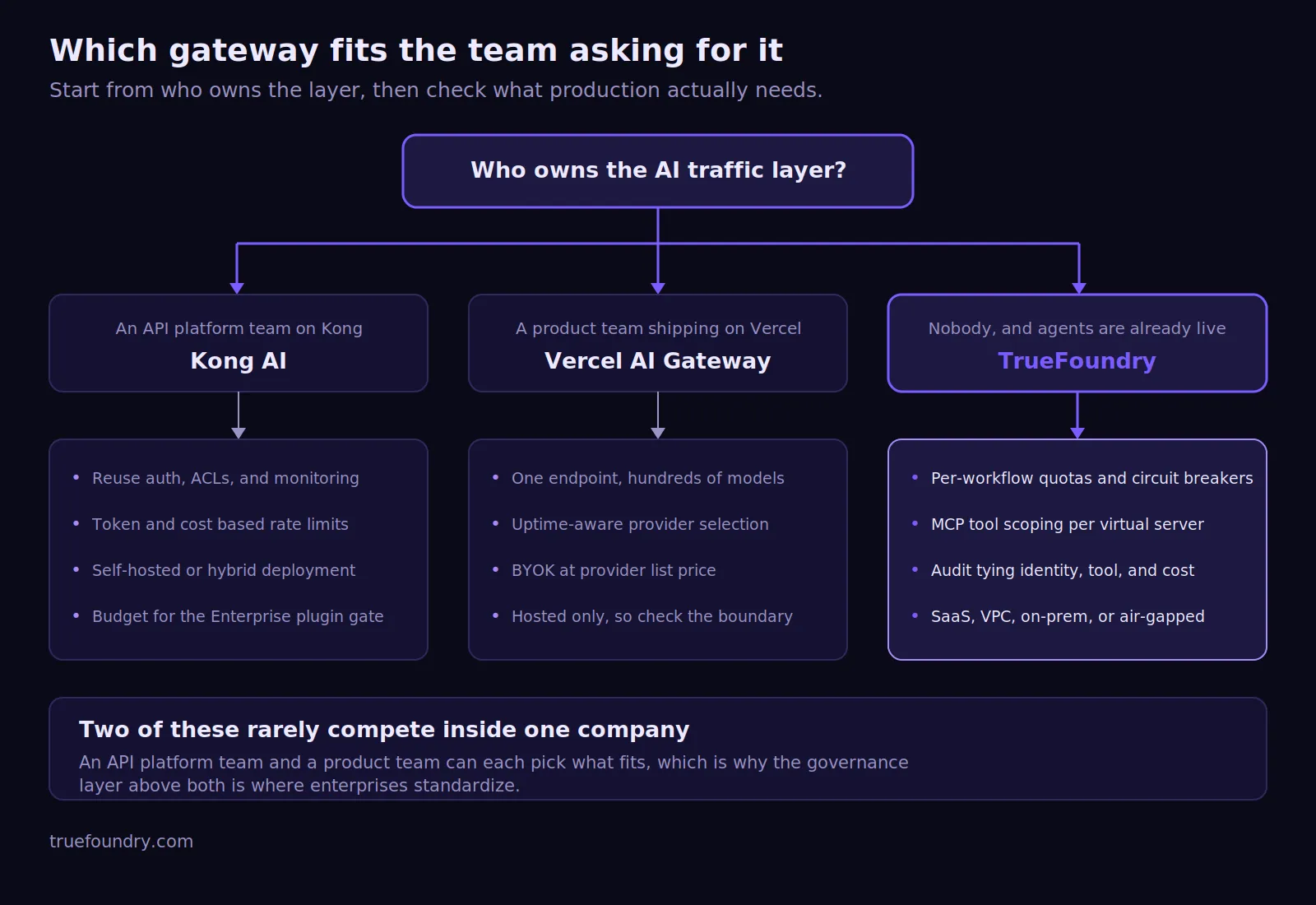
Texte alternatif: Flux de décision pour Kong AI, Vercel AI et TrueFoundry
TrueFoundry AI Gateway offre une latence d'environ 3 à 4 ms, gère plus de 350 RPS sur 1 processeur virtuel, évolue horizontalement facilement et est prête pour la production, tandis que LiteLM souffre d'une latence élevée, peine à dépasser un RPS modéré, ne dispose pas d'une mise à l'échelle intégrée et convient parfaitement aux charges de travail légères ou aux prototypes.





Les dernières nouvelles, articles et ressources envoyés dans votre boîte de réception


.png)
.png)
.png)
.png)
.png)
.png)
.png)
.png)
.png)
.png)
.png)


