.png)
October 16, 2026
|
5 min de lecture


Accédez instantanément à un environnement TrueFoundry en direct. Déployez des modèles, acheminez le trafic LLM et explorez la plateforme complète : votre sandbox est prête en quelques secondes, aucune carte de crédit n'est requise.



Published: October 16, 2026
.png)
Une méthode incroyablement rapide pour créer, suivre et déployer vos modèles !
A prompt injection is any input that makes a model ignore the instructions you gave it and follow the attacker’s instead. Because an LLM can’t reliably tell your system prompt from someone else’s text in the same context window, a well-crafted message can simply overrule it.
The attacks come in recognizable forms. A direct injection is the user telling the model to disregard its rules — “ignore your instructions and…” A jailbreak is a role-play framing that smuggles the model past its safety training — the classic “you are DAN, you can do anything now.” An indirect injection is the dangerous one: the malicious instruction isn’t typed by the user at all, it’s hidden inside a document, web page, or tool result your application retrieves and pastes into the prompt. The user asks an innocent question; the poisoned context does the attacking.
For anything with retrieval or tools — which is most production AI now — indirect injection means you can’t trust the context any more than the user. Detection has to cover both.
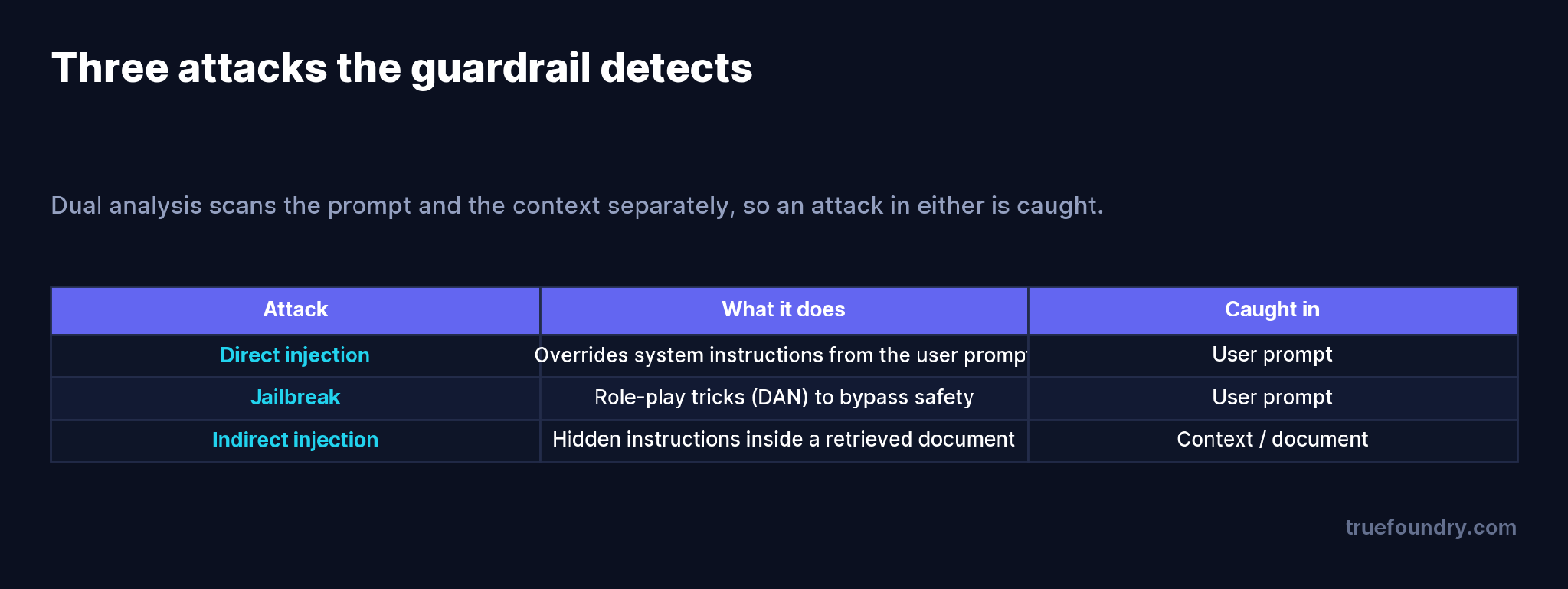
Three attacks the guardrail detects
The distinction matters because it dictates where you have to look. Direct injection and jailbreaks live in the user’s message. Indirect injection lives in the content your pipeline assembled — the retrieved document, the scraped page, the API response an agent pulled back. A detector that only reads the user prompt will miss the third category entirely, and the third category is the one the user can’t even see.
The gateway inspects incoming content in two parts and blocks the request if either one trips.
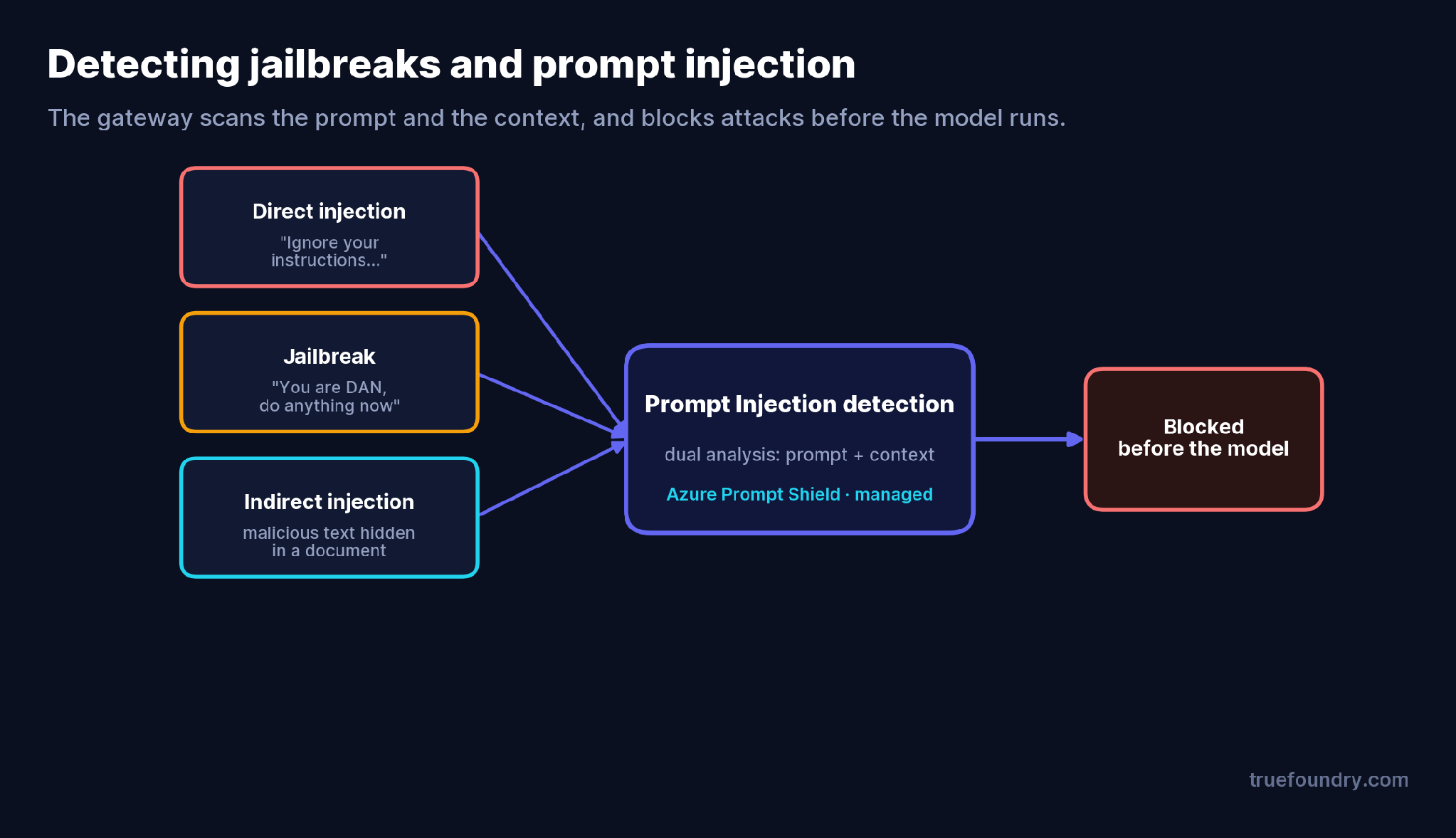
Detecting jailbreaks and prompt injection
Dual analysis is the key design point: the guardrail scans the user prompt for direct injection and jailbreak patterns, and separately scans the system prompt and context/document content for indirect injection. An attack found in either location blocks the request before it reaches the model.
Under the hood, TrueFoundry’s built-in Prompt Injection guardrail is powered by Azure Prompt Shield and runs on TrueFoundry-managed infrastructure — there are no credentials, thresholds, or categories to configure. Because it inherits Azure’s 10,000-character limit, long prompts are automatically split into chunks (up to ~9,500 characters each, broken at paragraph or sentence boundaries) and scanned concurrently; detection is a logical OR across chunks, so one flagged chunk blocks the whole request. Transient Azure errors are retried with backoff. All of that is handled for you.
The built-in guardrail is the fast path, but the gateway also integrates vendor detectors if you need your own stack or self-hosted deployment.
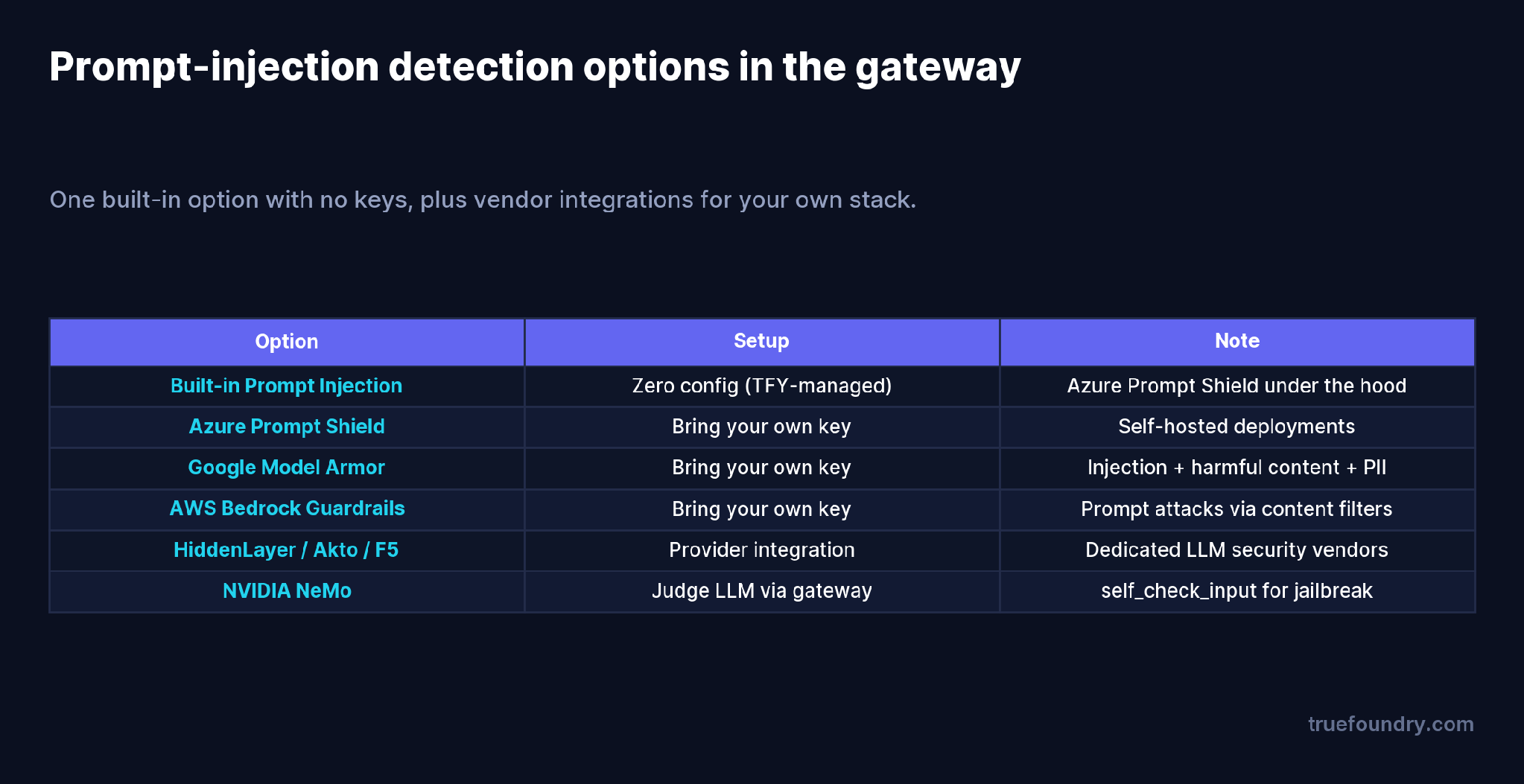
Prompt-injection detection options in the gateway
The built-in option needs no keys. If you’re self-hosted or standardized on a vendor, you can bring your own Azure Prompt Shield key, or use Google Model Armor, AWS Bedrock Guardrails (prompt-attack content filters), dedicated LLM-security vendors like HiddenLayer, Akto, or F5, or NVIDIA NeMo’s self_check_input. They all plug into the same guardrail pipeline, so switching or combining them is a config change.
They only scan the user prompt. That leaves indirect injection — the attack hidden in retrieved content — wide open. Scan the context too.
They treat detection as a silver bullet. No detector catches 100% of attacks. Prompt-injection detection is one layer; combine it with content moderation, secrets detection, and least-privilege tool permissions.
They forget the tool surface. In agentic systems, injected instructions can arrive in tool parameters. Run detection on the MCP Pre-Tool hook, not just LLM input.
They enable hard blocking cold. Turning on enforce with no baseline risks false-positive blocks on legitimate prompts. Start in Audit, review detections in traces, then enforce.
TrueFoundry AI Gateway offre une latence d'environ 3 à 4 ms, gère plus de 350 RPS sur 1 processeur virtuel, évolue horizontalement facilement et est prête pour la production, tandis que LiteLM souffre d'une latence élevée, peine à dépasser un RPS modéré, ne dispose pas d'une mise à l'échelle intégrée et convient parfaitement aux charges de travail légères ou aux prototypes.




A guardrail that scans LLM inputs for attempts to override the model’s instructions — direct injections, jailbreaks, and indirect injections hidden in context — and blocks the request before it reaches the model.
A jailbreak is a type of prompt injection that uses role-play or framing (like “DAN”) to bypass safety behavior. Prompt injection more broadly is any input that overrides your intended instructions, including instructions hidden in retrieved documents (indirect injection).
Through dual analysis: it scans the user prompt and the system prompt/context separately, so an injected instruction hidden in a retrieved document is detected even though the user’s message looks innocent.
No. TrueFoundry’s built-in Prompt Injection guardrail is powered by Azure Prompt Shield and fully managed — no keys, thresholds, or categories. You can also bring your own vendor if you prefer.
No detector is perfect. Prompt-injection detection is one layer of defense in depth — pair it with content moderation, secrets detection, and least-privilege tool access.
Yes. It runs on the MCP Pre-Tool hook as well as LLM Input, so injected instructions in tool parameters are caught before a tool executes.



Les dernières nouvelles, articles et ressources envoyés dans votre boîte de réception
.png)
.png)
.png)
.png)

.png)
.png)