



October 5, 2023
|
5 min de lecture


Accédez instantanément à un environnement TrueFoundry en direct. Déployez des modèles, acheminez le trafic LLM et explorez la plateforme complète : votre sandbox est prête en quelques secondes, aucune carte de crédit n'est requise.




Une méthode incroyablement rapide pour créer, suivre et déployer vos modèles !
With the June 9, 2026 launch of Claude Fable 5, Anthropic now offers two tiers of frontier model to developers: the new Mythos-class Fable 5 and the established Opus 4.8. They're closely related, Fable 5's safeguards actually fall back to Opus 4.8, but they're priced and positioned very differently. Here's how to choose, and how to use both without rewriting your stack.
Short answer: Fable 5 is meaningfully more capable on long, complex, autonomous tasks, and about 2x the price. Opus 4.8 is the better default for most everyday work on cost and latency. The smart move is to route by task: Fable 5 for the hard jobs, Opus 4.8 for the rest.
On the benchmarks Anthropic published, Fable 5's lead is largest on hard, long-horizon coding and reasoning:
Anthropic's framing: "the longer and more complex the task, the larger Fable 5's lead." On shorter, well-scoped tasks the two are much closer, which is exactly why Opus 4.8 remains a sensible default for a lot of production traffic.
Customer signals reinforce this. Replit reported Fable 5 is the highest-performer on its end-to-end "vibe-coding" benchmark; a finance customer said Fable 5 was the first model to break 90% on its core analytics benchmark, a 10-point jump over Opus; and a spreadsheet-automation customer found Fable 5 beats Opus 4.8 at every effort level while finishing 25-30% faster on their suite.
Two cost nuances matter:
Still, for high-volume, simple, or latency-sensitive workloads, Opus 4.8 at half the price is usually the rational default.
This is the part that's easy to miss: Fable 5 and Opus 4.8 are directly linked. Fable 5 ships with safeguard classifiers for cybersecurity, biology/chemistry, and distillation. When a request trips one, Fable 5 hands it to Opus 4.8 and the user is notified. Anthropic says this happens in under 5% of sessions.
Practical implications:
Reach for Fable 5 when:
Stick with Opus 4.8 when:
You rarely have to pick one model for everything. With the TrueFoundry AI Gateway, both Fable 5 and Opus 4.8 sit behind one OpenAI-compatible endpoint, so you can:
Setting it up takes two steps in the gateway.
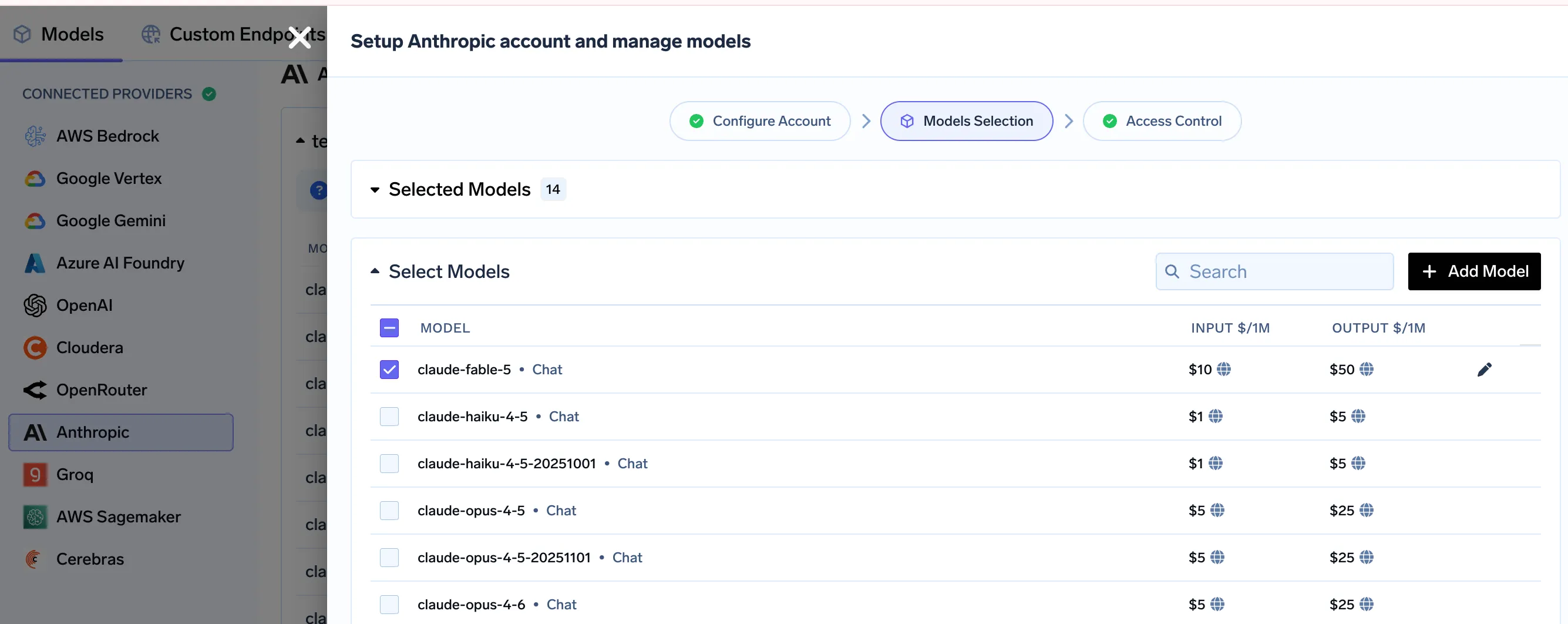
Step 1: Add both models. In your connected Anthropic provider, enable claude-fable-5 and claude-opus-4-8 on the Models Selection screen (their pricing shows inline), then use Access Control to set who can call each one.
Step 2: Invoke either model from one endpoint. From the Playground, pick a model and copy its usage snippet. Both Fable 5 and Opus 4.8 are reached through the same gateway base URL, so routing a request to one or the other is just a change of the model ID.
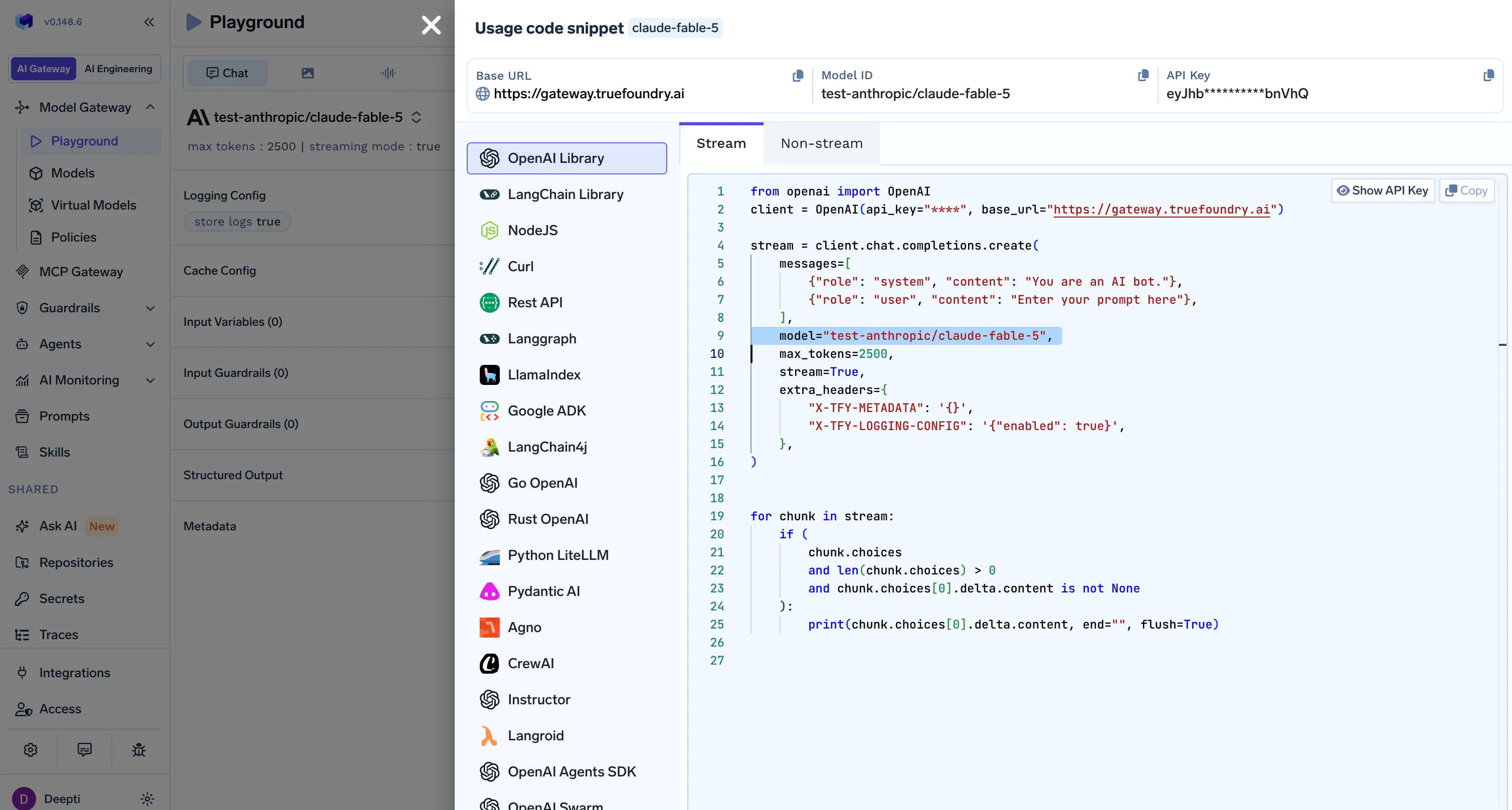
Because both models sit behind the same endpoint, you can send the hard, long-horizon jobs to Fable 5 and default routine traffic to Opus 4.8 without maintaining two integrations or rewriting any application code.
Is Claude Fable 5 better than Opus 4.8?On the benchmarks Anthropic published, yes, notably +11 points on SWE-Bench Pro and roughly double on FrontierCode, with the biggest gains on long, complex tasks. On short, routine work the gap narrows.
How much more expensive is Fable 5?About 2x: $10/$50 per million input/output tokens vs $5/$25 for Opus 4.8.
Why would a Fable 5 request return an Opus 4.8 answer?Fable 5's safeguards route flagged cyber/bio-chem/distillation queries to Opus 4.8 (under 5% of sessions), and you aren't billed Fable rates for them.
Can I use both without two integrations?Yes, through a gateway like TrueFoundry, both models share one endpoint and you switch with a single string.
Route between Claude Fable 5 and Opus 4.8 on the TrueFoundry AI Gateway →
TrueFoundry AI Gateway offre une latence d'environ 3 à 4 ms, gère plus de 350 RPS sur 1 processeur virtuel, évolue horizontalement facilement et est prête pour la production, tandis que LiteLM souffre d'une latence élevée, peine à dépasser un RPS modéré, ne dispose pas d'une mise à l'échelle intégrée et convient parfaitement aux charges de travail légères ou aux prototypes.





Les dernières nouvelles, articles et ressources envoyés dans votre boîte de réception




.webp)

.png)
.png)

.png)
.png)
.png)
.png)
.png)
.png)
.png)

.png)
.png)


