October 19, 2026
|
5 min de lecture


Accédez instantanément à un environnement TrueFoundry en direct. Déployez des modèles, acheminez le trafic LLM et explorez la plateforme complète : votre sandbox est prête en quelques secondes, aucune carte de crédit n'est requise.



Published: October 19, 2026
Une méthode incroyablement rapide pour créer, suivre et déployer vos modèles !
Prompt caching is the highest-leverage cost lever on Claude, and also the one teams most often get subtly wrong — paying the write premium on every request and never collecting the read discount. It is not a feature you switch on; it is a pricing trade you have to set up correctly. The good news is the trade is governed by two numbers, and once you know them the decision is arithmetic.
This post is the arithmetic: what a cache write and a cache read actually cost relative to a normal token, where the break-even sits, when it does not pay off, and how to run it so the savings are measured rather than assumed. All the multipliers below are from Anthropic’s prompt caching documentation, as of October 2026.
Caching reuses a previously processed prompt prefix so Claude does not re-read it. You pay a premium to write a prefix into the cache, then a deep discount to read it on later requests.
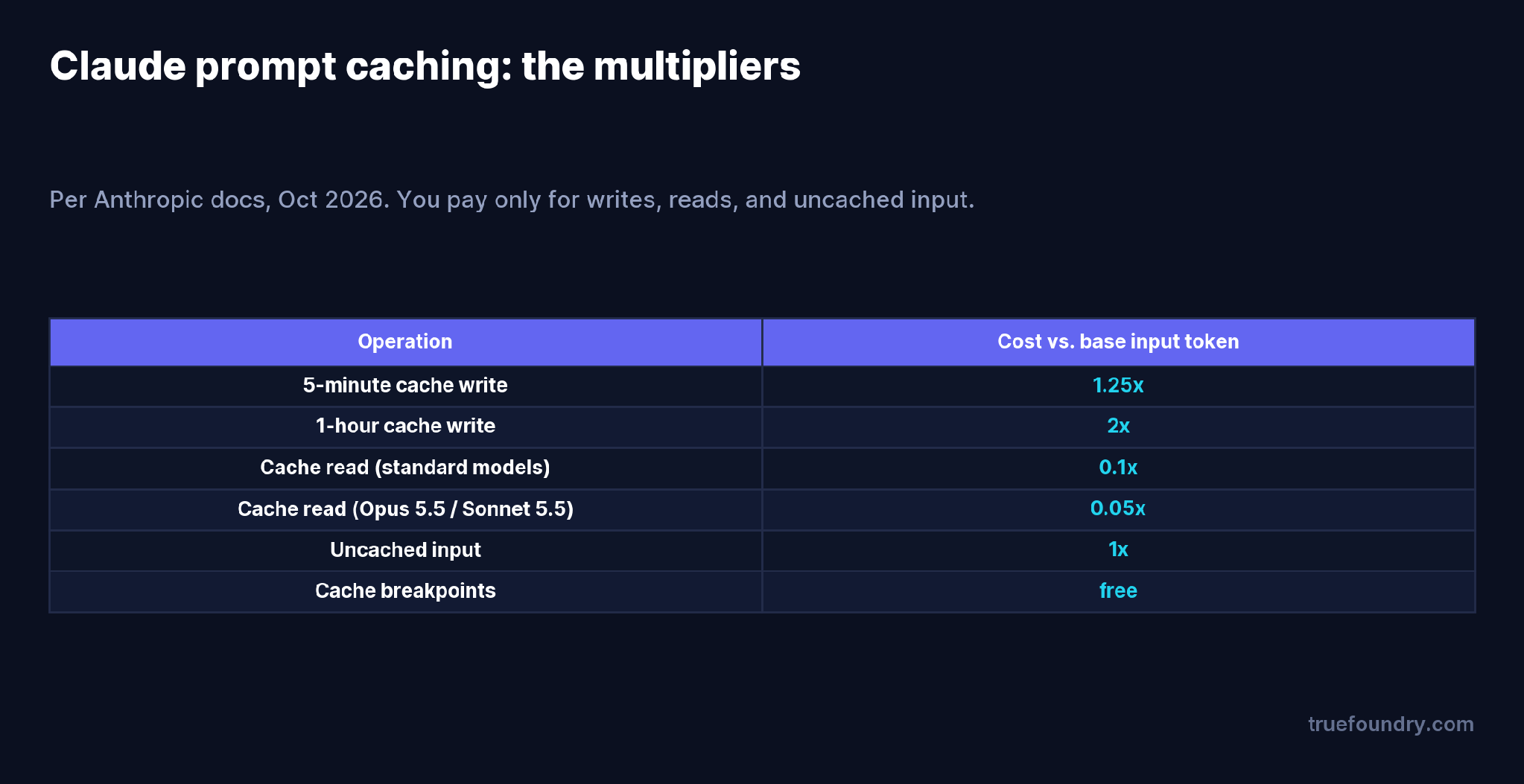
The cost multipliers for a Claude cache write and cache read
A 5-minute cache write costs 1.25x a normal input token. The 1-hour write costs 2x. A cache read costs 0.1x on standard models, and only 0.05x on Opus 5.5 and Sonnet 5.5 (0.025x on Fable 5.1 and Mythos 5.1). Cache breakpoints themselves are free — you pay only for writes, reads, and ordinary uncached input. Concretely, on Opus 5.5 (base input $4 per million tokens) a 5-minute write is $5, a 1-hour write is $8, and a cache hit is $0.20 per million.
TrueFoundry AI Gateway offre une latence d'environ 3 à 4 ms, gère plus de 350 RPS sur 1 processeur virtuel, évolue horizontalement facilement et est prête pour la production, tandis que LiteLM souffre d'une latence élevée, peine à dépasser un RPS modéré, ne dispose pas d'une mise à l'échelle intégrée et convient parfaitement aux charges de travail légères ou aux prototypes.



A 5-minute cache write costs 1.25x a normal input token, a 1-hour write 2x, and a cache read 0.1x — or 0.05x on Opus 5.5 and Sonnet 5.5. Breakpoints are free; you pay only for writes, reads, and uncached input.
As soon as a cached prefix is reused once within its TTL. The write adds a 25% premium on the first request, and the first read saves ~90%, so from the second hit you are ahead. It does not help a prefix used only once.
512 tokens on Opus 5.5, Sonnet 5.5, Haiku 5.5, and Fable 5.1; 1,024 or more on older models. Below the minimum the prompt is processed without caching and no error is returned.
Almost always because the breakpoint sits on a block that changes every request. A hit needs a 100% identical prefix; put the breakpoint on the stable system or context block and keep the variable user input after it.
Provider caches are provider-specific, but routing through the TrueFoundry AI Gateway lets you add exact and semantic caching uniformly and see hit rate and savings per model in one place.



Les dernières nouvelles, articles et ressources envoyés dans votre boîte de réception