|
5 min de lecture


Accédez instantanément à un environnement TrueFoundry en direct. Déployez des modèles, acheminez le trafic LLM et explorez la plateforme complète : votre sandbox est prête en quelques secondes, aucune carte de crédit n'est requise.



Published: novembre 25, 2026
Une méthode incroyablement rapide pour créer, suivre et déployer vos modèles !
Bifrost vs Vercel AI Gateway is not a fight between two products of the same kind. Bifrost is an open-source gateway you run yourself. Vercel AI Gateway is a hosted router you call over the internet. Both put one OpenAI-compatible endpoint in front of many model providers, and both let you set budgets and fall back between providers. The real decision is whether your team wants to operate a gateway in exchange for control and free governance features, or pay a vendor to run it and accept where it runs and how it is billed.
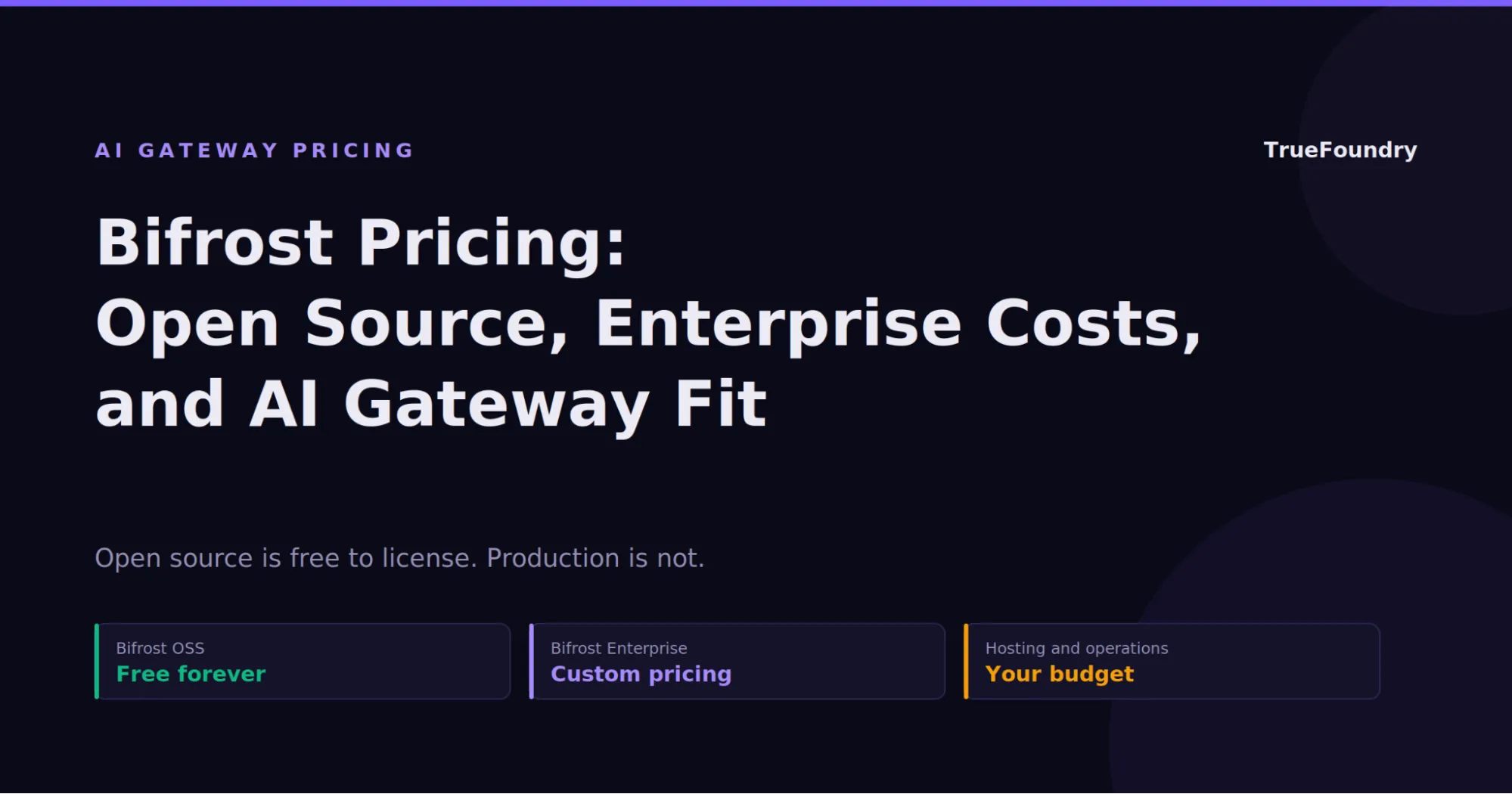
Bifrost's free tier is a complete gateway rather than a trial. It covers weighted routing and CEL routing rules, fallbacks and retries, virtual keys with budgets and rate limits, semantic caching, an MCP gateway, Prometheus metrics, OpenTelemetry traces and a built-in dashboard. It runs as a Docker container, a binary or a Helm chart, inside your VPC, on-prem or air-gapped, and you bring your own provider keys with no markup.
The costs are operational. Multi-node OSS deployments don't share state, so config changes need a restart on every replica, and budgets and counters are kept per pod. SSO, RBAC, audit logs, external secret managers, guardrails and live clustering are Enterprise features, priced by quote. In our own testing, a default install also starts with no authentication on the gateway or the admin API, so hardening is on you from day one. For the full picture of that split, see our Bifrost pricing breakdown.
Vercel AI Gateway is a hosted service with nothing to deploy or scale. It has been generally available since August 2025 and lists hundreds of models; the models endpoint returned 377 when our team checked in September. It charges no markup on tokens, including when you bring your own provider keys, and it can also call providers on Vercel's credentials so you don't need your own accounts. Logs keep metadata rather than prompt and response bodies by default, which is a reasonable privacy default.
Governance is where it gets more nuanced. Budgets can be set per team, project, API key or user, but they are soft caps: the request that crosses the limit finishes, and later ones get a 402. Bringing your own keys needs purchased credits, and our team's test of a key on the free tier was rejected with byok_requires_paid_credits. Several controls are paid add-ons rather than built in, which we cover under pricing below. There is no self-hosted, BYOC or air-gapped version of the gateway itself; Vercel's BYOC beta covers apps and functions, not AI Gateway.
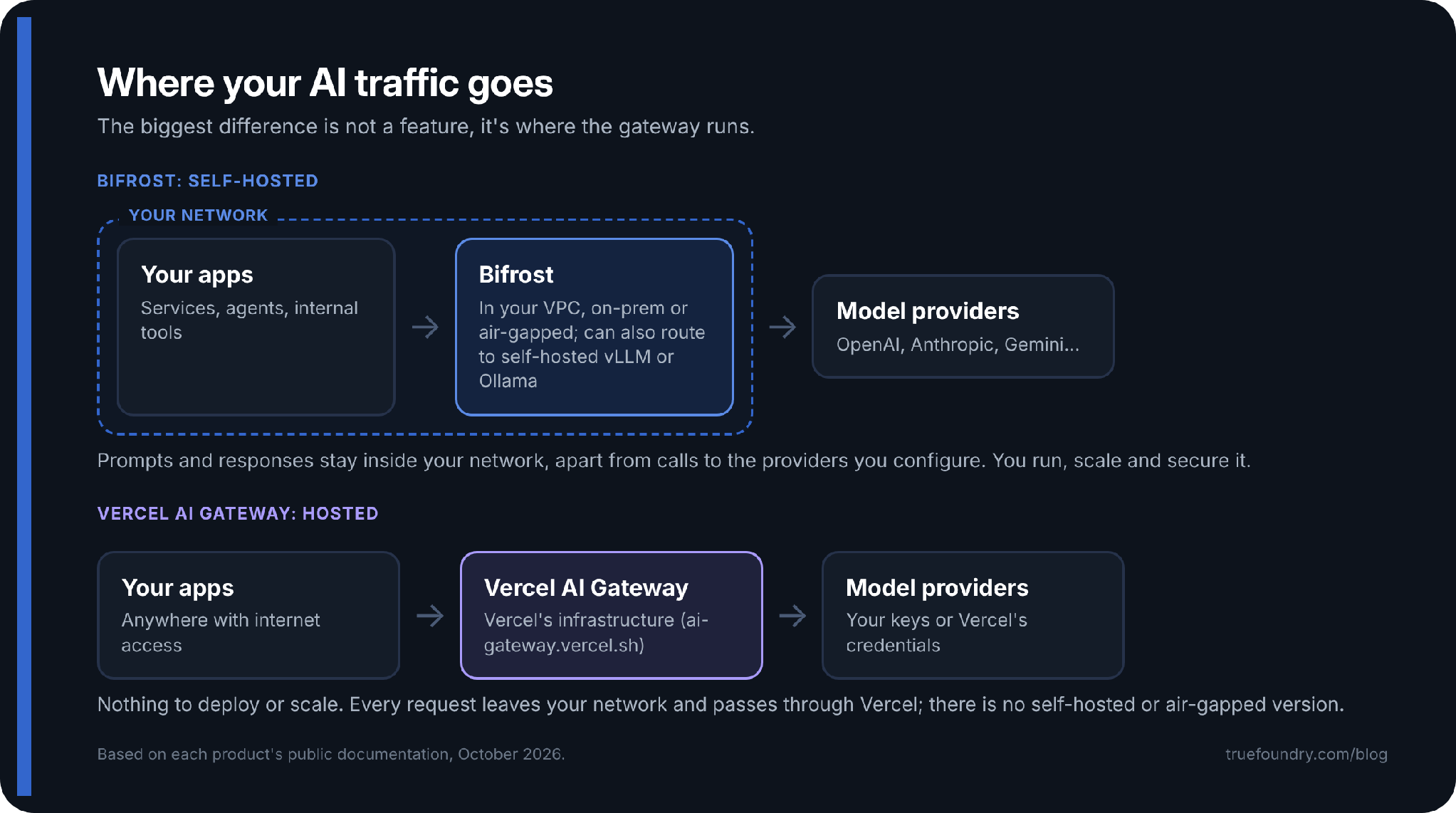
Bifrost reflects its public documentation and our testing of OSS v2.0.0. Vercel reflects its public documentation and our team's hands-on account, with pricing re-checked in October 2026.
Both products take no cut of your token spend, so the comparison comes down to licenses, add-ons, infrastructure and people. We use the three team sizes from our gateway comparison series.
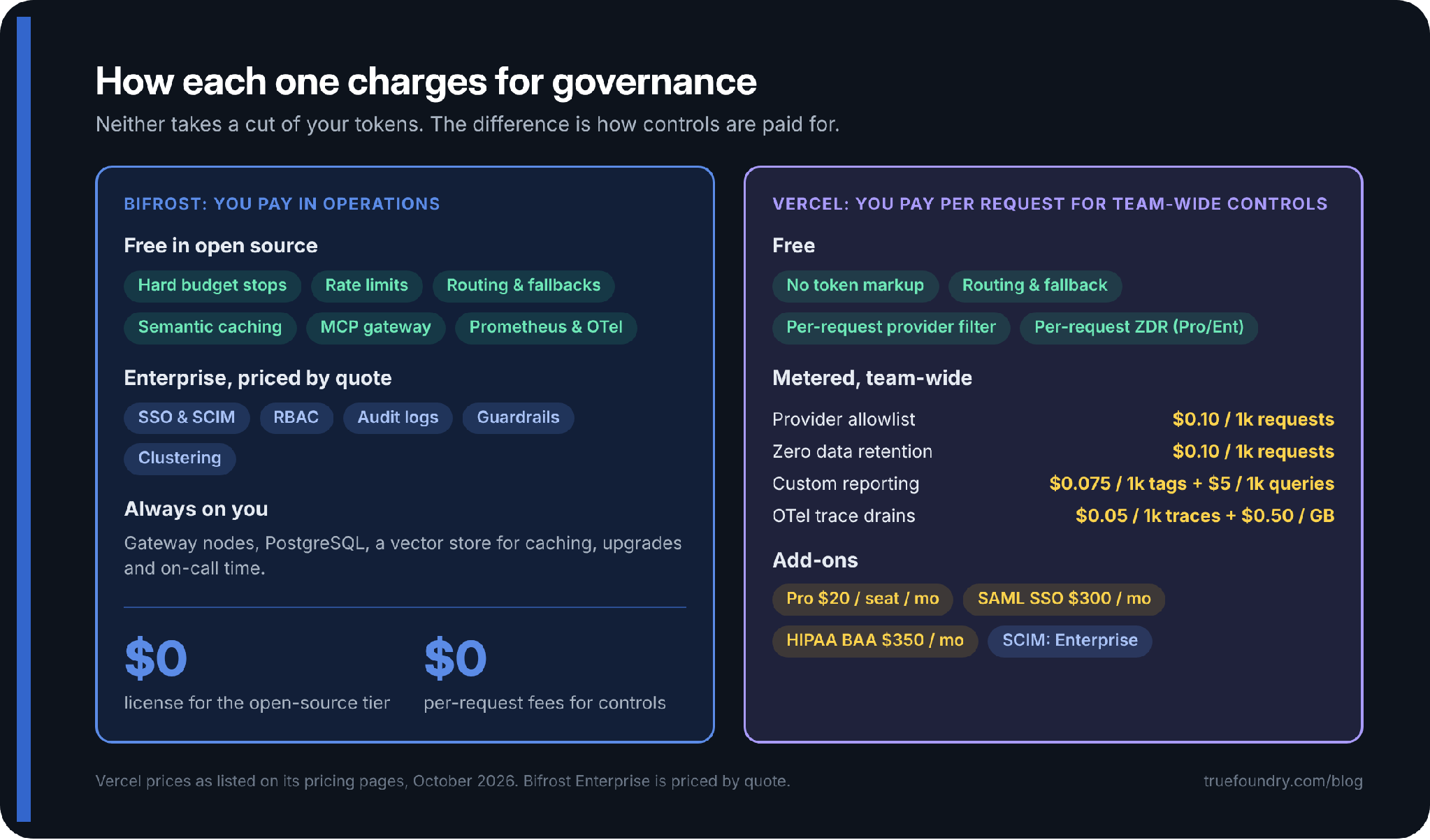
Bifrost charges you in operations time; Vercel meters its team-wide controls. Vercel prices as listed in October 2026.
Vercel's routing is cheap; its organization-wide controls are metered. From its pricing pages in October 2026:
The per-request options keep costs down if every application sets them correctly. The team-wide settings are the ones a security team can actually enforce, and those are the metered ones.
Bifrost's budgets, rate limits, allowlists, caching and observability cost nothing in license. What they cost is the infrastructure (gateway nodes, PostgreSQL for multi-node or production use, a vector store if you use semantic caching, a load balancer) and someone's time to run, upgrade and back it up. Once you need SSO, RBAC, audit logs or a live cluster, Bifrost Enterprise is a quote rather than a price list.
The two products can't be benchmarked the same way. Bifrost is a container we can pin to one vCPU and test against a mock provider; our Bifrost performance review covers that. Vercel is a hosted service with nothing to size, so our team measured it from a client instead. In our paced free-tier test, Vercel AI Gateway added about 211 ms at p50 compared with calling OpenAI directly (non-streaming, single client, San Jose). That number includes the network path to Vercel and is not comparable with an in-cluster gateway figure. The free tier's account-level rate limiter, not added latency, is what stopped us running a standard load test; buying credits moves a team to the paid tier, which Vercel says has higher limits.
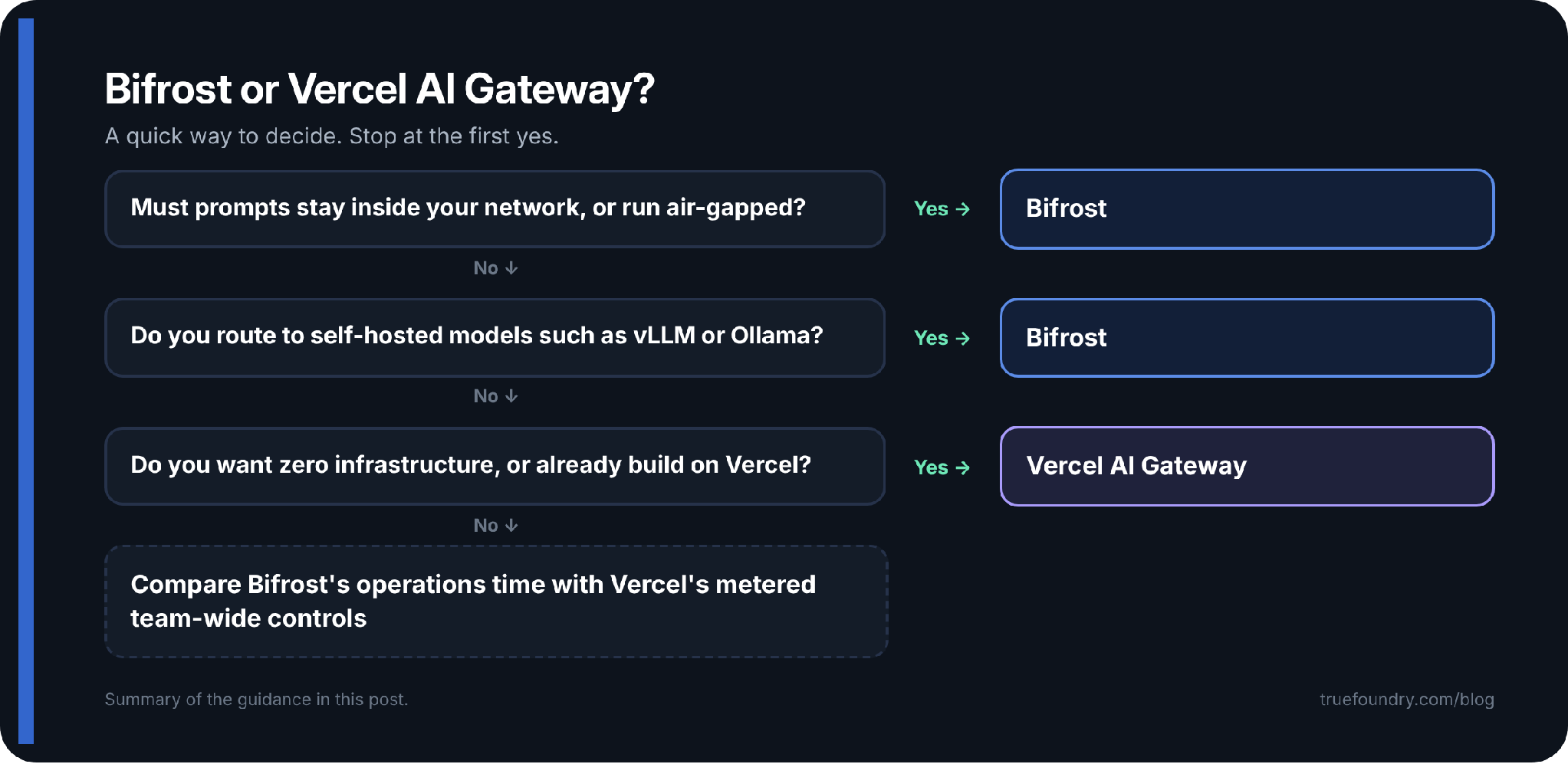
A quick way to decide between the two.
Bifrost and Vercel force the build-or-buy choice up front. The TrueFoundry AI Gateway doesn't. Start on the managed SaaS gateway, move the gateway plane into your own cluster when data policy demands it, or self-host everything, including air-gapped, without changing the product your applications call. Gateway pods receive config, access rules and limits from the control plane in real time, so multi-node consistency isn't a separate tier. SSO with SAML or OIDC, SCIM, RBAC, audit logs, guardrails and per-application virtual accounts with token rotation are part of the product rather than add-ons.
If your shortlist is Bifrost or Vercel and neither shape quite fits, see how the TrueFoundry AI Gateway works or book a demo.
Bifrost vs Vercel AI Gateway comes down to who should run the gateway. Pick Bifrost when traffic has to stay in your network and you have the people to operate it; pick Vercel when a hosted router fits your data policy and per-request governance fees are acceptable. If you want the option to do either without switching products, book a TrueFoundry demo.
TrueFoundry AI Gateway offre une latence d'environ 3 à 4 ms, gère plus de 350 RPS sur 1 processeur virtuel, évolue horizontalement facilement et est prête pour la production, tandis que LiteLM souffre d'une latence élevée, peine à dépasser un RPS modéré, ne dispose pas d'une mise à l'échelle intégrée et convient parfaitement aux charges de travail légères ou aux prototypes.


Oui. TrueFoundry s'exécute dans votre VPC, sur site, en environnement isolé (air-gapped) ou hybride, et aucune donnée ne quitte votre domaine. C'est une raison essentielle pour laquelle les équipes réglementées le choisissent plutôt que des passerelles uniquement SaaS.
TrueFoundry atteste de sa conformité SOC 2 Type II, HIPAA et GDPR pour son infrastructure gérée, intégrant nativement le RBAC, le SSO et les journaux d'audit. Les attestations à jour sont disponibles sur le Trust Center à l'adresse trust.truefoundry.com. Pour les déploiements auto-hébergés, la conformité de votre propre environnement reste sous votre responsabilité, comme pour tout logiciel auto-hébergé.



Les dernières nouvelles, articles et ressources envoyés dans votre boîte de réception