


October 14, 2026
|
5 minutos de lectura


Obtenga acceso instantáneo a un entorno TrueFoundry en vivo. Implemente modelos, dirija el tráfico de LLM y explore la plataforma completa: su sandbox estará listo en segundos, sin necesidad de tarjeta de crédito.


Published: October 7, 2026
¡Una forma increíblemente rápida de crear, rastrear e implementar sus modelos!
Boston Consulting Group publicó este verano dos documentos que deberían estar sobre la misma mesa. En junio de 2026, la cuarta edición de su AI at Work encuesta —a unos 11 749 trabajadores en 14 mercados— informó de una asociación sustancialmente mayor entre la claridad estratégica y el impacto medible de la IA que entre el acceso a herramientas y dicho impacto: +25 puntos porcentuales sobre la base de estrategia limitada para una estrategia sólida con herramientas limitadas, frente a +5 para herramientas sólidas con estrategia limitada; una comparación observacional, no una estimación causal controlada (bcg.com). Luego, a principios de julio de 2026, BCG publicó The Agentic Leadership Playbook: A Scaling Strategy for CTOs and CIOs —una entrevista estructurada con dos de sus líderes en IA agente, Mark Abraham y Neveen Awad—, cuyos hallazgos convierten la encuesta en una tarea ejecutiva: solo alrededor del 5% de las empresas son lo que BCG denomina verdaderamente centradas en agentes, la mayoría del resto se sitúa por debajo del 30% de adopción, y aproximadamente el 60% de las decisiones sobre la pila tecnológica y el despliegue de agentes recaen ahora en el CIO o el CTO (bcg.com). Leídas en conjunto, ambas publicaciones dicen algo preciso: la cuestión estratégica se ha convertido en una cuestión de liderazgo tecnológico, y la pregunta del líder tecnológico es arquitectónica: ¿dónde, concretamente, se aplica una estrategia? La Parte 1 toma los hallazgos principales de la encuesta y las conclusiones de liderazgo del manual y asigna cada uno a un control de puerta de enlace de IA documentado que puede operacionalizar parte de ellos. La Parte 2 continúa con los hallazgos de BCG sobre agentes mediante el uso de MCP Gateway y Agent Harness. BCG diagnostica la brecha; esta serie traza una arquitectura de plano de control que puede operacionalizar partes de la respuesta, ofrecida como síntesis editorial de TrueFoundry, no como una recomendación de BCG.
Boston Consulting Group es una de las firmas de consultoría de gestión más grandes del mundo; su investigación sobre IA se lee al nivel donde se establecen los presupuestos. Los dos documentos en los que se basa esta serie son instrumentos diferentes. AI at Work 2026 (junio) es una encuesta —aproximadamente 11 749 empleados, gerentes y líderes en 14 mercados— que es lo que le permite hablar de tendencias en lugar de anécdotas; su tesis se encuentra en su subtítulo, por qué la estrategia importa más que las herramientas, y su contraste principal sostiene que una claridad estratégica sólida se asocia con un impacto empresarial mucho más medible que el simple acceso a herramientas potentes, tal como se indica en la comparación de cuatro cuadrantes del informe: el 55% de los encuestados con estrategia limitada y herramientas limitadas reportaron un impacto medible; las herramientas potentes con estrategia limitada elevaron esa cifra al 60% (+5 puntos); una estrategia sólida con herramientas limitadas alcanzó el 80% (+25 puntos); y ambos factores juntos, el 83%. Se trata de una asociación sustancialmente mayor para la estrategia, y es una comparación observacional, no una estimación causal controlada (el informe; resumen de prensa). El manual de liderazgo agéntico (principios de julio de 2026) es el instrumento opuesto: no es una encuesta, sino una entrevista estructurada con dos profesionales de BCG que implementan programas agénticos en grandes empresas —Mark Abraham y Neveen Awad—, publicada explícitamente para CIO y CTO (el manual). Sus hallazgos son observaciones de profesionales más que estadísticas de encuestas, y esta publicación los trata como tales: atribuidos, no universalizados. Cada uno aporta lo que al otro le falta: la encuesta establece que la estrategia marca la diferencia a escala poblacional; el manual describe quién debe ejecutarla y qué obstáculos encuentra dicha ejecución. Todo lo que sigue está organizado en torno a ese traspaso.
La cifra más contundente del manual es una distribución: la IA agéntica está dividiendo a las empresas en un pequeño grupo de líderes con enfoque agéntico —alrededor del 5%— y el resto, mayoritariamente estancado por debajo del 30% de adopción. Si combinamos esto con el contraste entre estrategia y herramientas de la encuesta, la pregunta arquitectónica surge por sí sola: si el plan influye más en el resultado que el equipo, ¿dónde se ejecuta físicamente ese plan? En la arquitectura de IA moderna, ese lugar tiene nombre. TrueFoundry describe su AI Gateway como una capa de proxy entre las aplicaciones, los proveedores de LLM y los servidores MCP: una interfaz unificada para más de 1000 modelos, con observabilidad y gobernanza gestionadas en el mismo salto (documentación de la puerta de enlace). Lo que convierte a esto en un ejecución una capa de procesamiento, más que una capa de informes, se basa en su ubicación: dependiendo de las políticas configuradas, una solicitud que atraviesa la puerta de enlace puede ser autenticada frente al proveedor de identidad empresarial, autorizada bajo RBAC, filtrada por barreras de seguridad, enrutada según políticas y verificada contra presupuestos y límites de tasa antes de ser enviada; en el camino de vuelta, se valora, se atribuye y se rastrea. Las intenciones técnicas —quién puede acceder a qué modelos, cómo se enrutan las solicitudes, qué filtros de seguridad se aplican, qué puede gastar cada solicitud— se convierten en controles evaluados en la solicitud en tiempo real, en lugar de ser un panel que las describe a posteriori; los resultados de negocio aún deben medirse en los sistemas operativos y financieros de la organización. Una interpretación arquitectónica —la nuestra, no el diagnóstico declarado de BCG— es que las organizaciones pierden impulso cuando cada nuevo caso de uso debe restablecer los controles de acceso, seguridad, enrutamiento y costes; una puerta de enlace puede convertir parte de ese trabajo repetitivo en una configuración compartida, el tipo de ventaja que apunta el contraste entre estrategia y herramientas del estudio.
El hallazgo sobre gobernanza del manual es organizativo: aproximadamente el 60% de las decisiones sobre la pila tecnológica y el despliegue de agentes recaen ahora en el CIO o el CTO; un cambio real, señalan los profesionales, respecto al ciclo anterior de IA, donde el negocio tenía tanto o más peso. Señalan el riesgo que esto conlleva con una franqueza inusual: el peligro es que sea un programa liderado por la tecnología en lugar de una asociación entre negocio y tecnología, y los CIOs con visión de futuro que observan establecen primero los objetivos, estrategias y prioridades de sus contrapartes de negocio, para luego trabajar hacia atrás hasta llegar a los requisitos tecnológicos. Para un líder técnico, "trabajar hacia atrás desde las prioridades de negocio" tiene una traducción exacta en sistemas: las prioridades deben poder expresarse como políticas, y la política debe poder cambiarse sin necesidad de cambiar la plataforma. Eso es política como configuración, y es una propiedad documentada del plano de la puerta de enlace: presupuestos con alcance por inquilino y equipo cuyas reglas pueden coincidir con usuarios, modelos y metadatos; límites de tasa entre usuarios, equipos, modelos y aplicaciones; RBAC y claves con alcance para usuarios, equipos y aplicaciones; conjuntos de barreras de seguridad adjuntos por ruta, con dimensiones de aplicación y entorno representables a través de metadatos gobernados (descripción general de la plataforma). Dos detalles tienen peso ejecutivo. Los presupuestos admiten modos de solo advertencia y de aplicación estricta con alertas de hitos (documentación de presupuestos) — el descubrimiento se ejecuta de forma flexible, la producción de forma estricta, todo con un mismo mecanismo. Y debido a que los controles residen en la puerta de enlace en lugar de dentro de cada aplicación, una revisión de la política técnica puede propagarse de forma centralizada en lugar de reimplementarse dentro de cada aplicación; a la escala de una cartera con un 60% de responsabilidad, es la diferencia entre dirigir la gobernanza y reconstruirla. Y para las organizaciones cuyos reguladores están presentes cuando se toman estas decisiones, el plano se despliega dentro del perímetro del comprador: VPC, local o aislado (air-gapped) (postura de despliegue).
El hallazgo más práctico del estudio es que la adopción ya no es el problema, sino la conversión: la adopción por parte de los usuarios habituales de primera línea alcanzó el 74%, un aumento de aproximadamente 23 puntos interanuales; el 42% de los usuarios habituales ahorra el equivalente a una jornada laboral completa o más cada semana; y la mayoría recibe poca orientación sobre cómo reinvertir ese tiempo, y más de la mitad afirma que no se redirige a trabajos de mayor valor (resumen de prensa). El manual añade la perspectiva económica de los líderes: las empresas más audaces están reduciendo entre un 15 y un 20% del gasto funcional total, según los profesionales, mientras que, de forma reveladora, ordenan sus prioridades: primero velocidad, segundo crecimiento, tercero costes. Ambos hallazgos hacen de la atribución fiable un insumo técnico importante. No se puede gestionar la conversión del tiempo ahorrado en valor, ni priorizar la velocidad mientras se logra un resultado de reducción de costes del 15-20%, si no se puede ver —por equipo, por caso de uso, por solicitud— cuánto cuesta el uso de la IA, cómo funciona y qué dimensiones organizativas lo generaron, y luego unir esa telemetría con los KPI de negocio y los datos de resultados que residen en los sistemas operativos. La telemetría de la puerta de enlace proporciona parte de ese insumo, y sus mecanismos de atribución están documentados: etiquetado de metadatos en la ingesta junto con la valoración de costes en la salida, de modo que las llamadas puedan llevar metadatos gobernados de equipo, proyecto, aplicación y entorno, permitiendo que la telemetría de gasto y rendimiento se consolide en una responsabilidad estructurada (documentación; mecanismos). Una idea del manual le da a la atribución su forma ejecutiva: los profesionales describen que cada empresa tiene una teoría del negocio — los KPI que sigue, cómo se vinculan, la microsegmentación que importa (su ejemplo minorista abarca siete segmentos de clientes y focos de demanda microgeográficos). La atribución basada en metadatos es la forma en que el gasto en IA se une a ese árbol de KPI en lugar de flotar a su lado: un esquema de metadatos gobernado puede codificar las dimensiones organizativas necesarias para unir los datos de uso y costes de la IA a ese modelo de KPI, y las decisiones de redirigir y retirar que el estudio encuentra ausentes se convierten en consultas sobre datos unidos en lugar de conjeturas. La visibilidad sin control es solo contabilidad (como se ha argumentado en este blog); la atribución dentro de un plano de cumplimiento es gestión.
El pasaje más técnico del manual es su doctrina de datos, y merece un párrafo atento aquí antes de que la Parte 2 lo trate en profundidad. En la formulación de Awad —la única cita directa de este artículo del manual—: "Lo que los agentes necesitan no son datos perfectos, sino datos honestos": datos en los que la organización confía, a diferencia de datos que están completos. Al respecto, los profesionales sostienen que los riesgos aumentan porque los agentes actúan en lugar de recomendar; que los líderes deben construir agentes sobre un núcleo de confianza, observar sus ejecuciones y ampliar el alcance a medida que crece la confianza; y que los agentes funcionan notablemente mejor cuando se reduce su contexto. Cada cláusula es territorio de gobernanza de agentes —acceso a herramientas y datos con alcance definido, seguimiento de ejecuciones, expansión por etapas—, que es exactamente donde esta serie hace la transición: Parte 2 desarrolla cada punto a través de MCP Gateway y Agent Harness (Autenticación y seguridad de MCP Gateway; Documentación de Agent Harness).
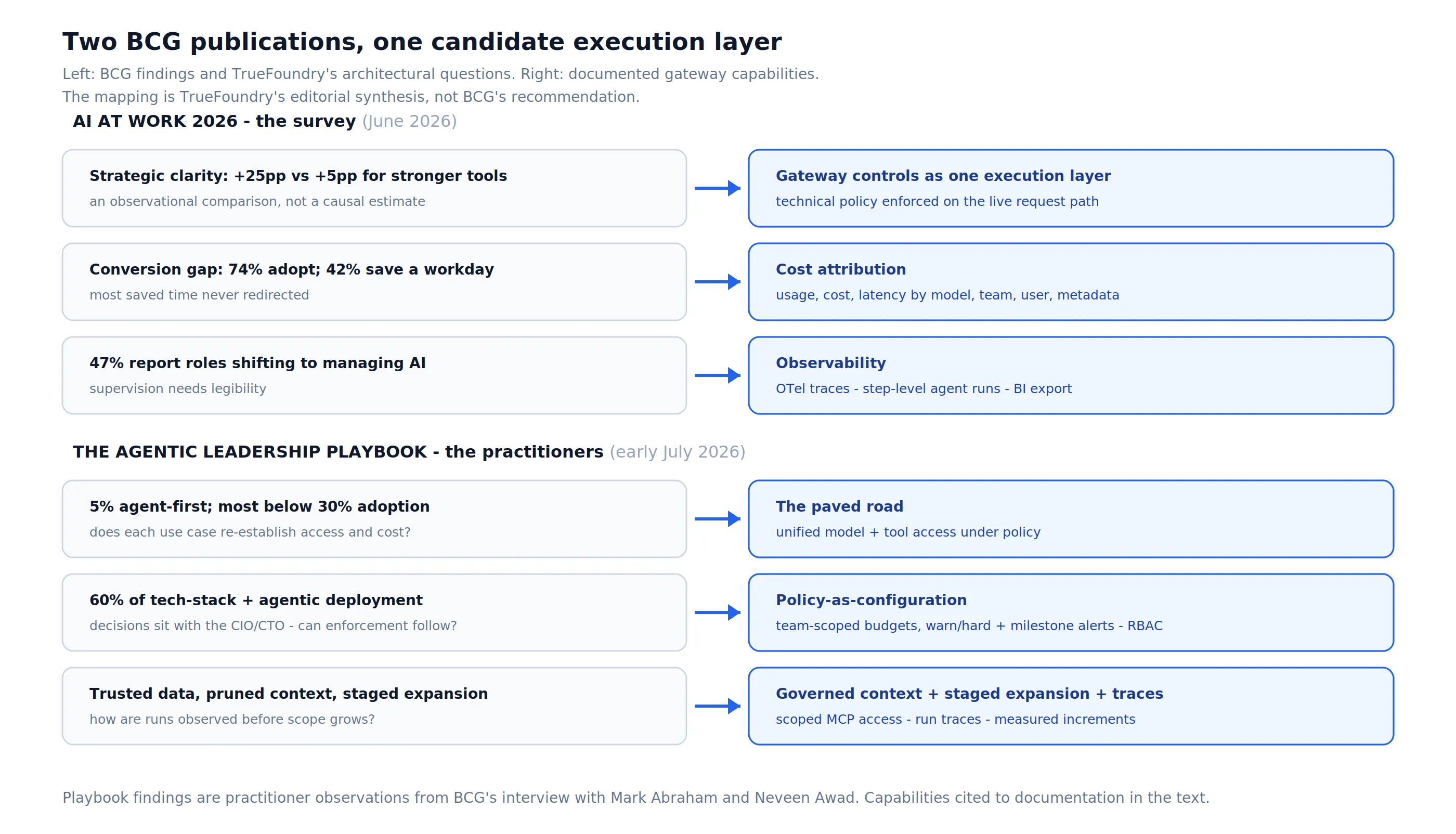
Un hallazgo de la encuesta apunta directamente a la infraestructura: el 47% de los encuestados afirma que sus funciones han cambiado hacia la gestión y dirección de la IA —un cambio que la cobertura de BCG denominó revolución gerencial—, mientras que la mayoría de los encuestados informa que el nivel de exigencia para un trabajo aceptable ha aumentado (resumen de prensa). El hallazgo del manual sobre las personas lo agrava: el éxito en la implementación de agentes depende en un 70% de las personas y la gestión del cambio, y las empresas más avanzadas han formado a más de la mitad de su plantilla. La supervisión a esa escala crea una necesidad de herramientas junto con una necesidad de personas, procesos y responsabilidad; la creciente cuota de supervisión necesita legibilidad: qué hizo el sistema, cuánto costó, qué evidencia respalda su corrección —los seguimientos muestran la ejecución; las evaluaciones y los resultados comerciales juzgan la calidad— y, para el trabajo con agentes, qué secuencia de pasos y llamadas a herramientas produjo el resultado. Esa es la superficie de observabilidad de la puerta de enlace, expresada técnicamente: métricas, seguimientos y registros de solicitudes compatibles con OpenTelemetry; inspección a nivel de solicitud que muestra el prompt y la respuesta completos, así como la aplicación de enrutamiento, alternativas y barreras de seguridad; seguimientos a nivel de paso para las ejecuciones de los agentes; exportación a Prometheus, Grafana, Datadog o Elastic con costos calculados y atribuidos automáticamente (documentación; notas de campo). Aquí es donde el hallazgo del 70% de personas se convierte en un requisito para la infraestructura en lugar de una crítica a la misma: la formación se traduce en una delegación segura solo cuando el usuario puede ver lo que hizo el sistema. La observabilidad hace que la cuota de supervisión sea manejable y auditable, algo que al ejecutivo responsable de la Sección 3 se le pedirá eventualmente que demuestre.
La agenda de liderazgo de la encuesta incluye gobernar la IA como un objetivo móvil —una gobernanza permanente y adaptativa en lugar de un programa puntual— y la premisa del manual (modelos, agentes y adopción cambiando dentro de un mismo ciclo presupuestario) explica el porqué. El requisito de ejecución es que la gobernanza se exprese como algo que la organización cambia continuamente sin necesidad de cambiar de plataforma. Dos capacidades documentadas lo cumplen. Barandillas: detección de PII, filtrado de inyección de prompts, moderación de contenido y políticas personalizadas aplicadas a las solicitudes y respuestas en la ruta de servicio (documentación). Y políticas como configuración: las reglas —quién puede llamar a qué modelos y herramientas, con qué presupuesto, bajo qué conjunto de barandillas y con qué cadena de respaldo— residen como configuración en la puerta de enlace, de modo que una revisión de la gobernanza es un cambio de configuración que se propaga una sola vez, no un redespliegue de cada aplicación (visión general de la plataforma). Para el CIO de la Sección 3, este es el mecanismo que hace que el "objetivo móvil" sea sostenible: el objetivo se mueve, la política se mueve con él, sin requerir que cada aplicación redespliegue su propia implementación de políticas.
Ahora, la advertencia que mantiene la credibilidad de esta serie. Una plataforma no es una estrategia; para los fines de este análisis, la puerta de enlace pertenece al lado de la tecnología y las herramientas de la comparación de BCG, y el contraste entre estrategia y herramientas va en contra de cualquiera que afirme que una plataforma sustituye a la estrategia o al cambio organizacional. El manual es aún más directo: si el éxito depende en un 70% de las personas y la gestión del cambio, entonces ninguna puerta de enlace, por bien situada que esté, capacita a una fuerza laboral, rediseña un modelo operativo o proporciona la secuenciación centrada en el negocio que practican sus CIOs con visión de futuro. Los hallazgos de BCG son resultados de encuestas y observaciones de profesionales, no promesas, y el mapeo en esta publicación es la lectura editorial de TrueFoundry, ofrecida con enlaces para que pueda ser verificada. La afirmación que sobrevive a todas esas calificaciones es estrecha y, creemos, duradera: la estrategia necesita un lugar donde ejecutarse. Las intenciones técnicas sobre costos, acceso, seguridad y medición se convierten en controles en la ruta de solicitud en vivo o permanecen como presentaciones teóricas, y los controles de puerta de enlace reducen la brecha entre la política declarada y la aplicación en la ruta de solicitud. El 5% no llegó allí comprando un proxy, y muchas arquitecturas maduras utilizan una puerta de enlace compartida o un plano de control equivalente, aunque BCG no prescribe una implementación en particular.
La observación más profunda del manual —los agentes actúan en lugar de recomendar— es donde la historia de la encuesta da paso a la infraestructura específica para agentes. La Parte 2 lleva los hallazgos sobre agentes de BCG a ese punto: gobernar lo que los agentes pueden llamar (la puerta de enlace MCP: registro, RBAC, delegación por usuario, rastreo y atribución de solicitudes), gobernar cómo se ejecutan los agentes (el entorno de ejecución de agentes: sandboxing, aprobaciones, rastros de ejecución y expansión por etapas basada en resultados medidos), y supervisar la ola de agentes con observabilidad a nivel de paso —la disciplina de "expandir a medida que crece la confianza" de la Sección 5, construida como un patrón operativo.
¿Qué significa "agente primero" en el manual de BCG? BCG lo utiliza para el pequeño grupo —alrededor del 5% de las empresas en 2026— que ha pasado de probar agentes a repensar cómo opera el negocio en torno a ellos, frente a la mayoría que aún está por debajo del 30% de adopción. El manual atribuye la diferencia principalmente al liderazgo, la secuenciación y la gestión del cambio, más que a la elección del modelo.
¿Dónde cambia técnicamente el hallazgo de que el 60% de las decisiones recaen en el CIO/CTO? La responsabilidad se concentra, por lo que la capacidad de ejecución también debe hacerlo. Un líder que posee la decisión de despliegue necesita que la política se exprese como configuración (modificable sin cambiar de plataforma), que el gasto se aplique en la ruta con modos de solo advertencia y modos estrictos, y que existan rastros y registros de solicitudes paso a paso: las capacidades específicas que las Secciones 3 y 6 citan en la documentación.
¿Está TrueFoundry afirmando que BCG respalda las puertas de enlace? No. Las publicaciones de BCG no evalúan ni recomiendan a TrueFoundry ni a ningún producto de puerta de enlace; el mapeo de hallazgos a capacidades aquí es una síntesis editorial de TrueFoundry, con cada cifra de BCG vinculada a su fuente y cada capacidad citada en la documentación.
Serie: Parte 1 de 2 · Siguiente → Parte 2: De la adopción de agentes a herramientas y entornos de ejecución gobernados
Todas las cifras de BCG son paráfrasis de las publicaciones y materiales de prensa enlazados; las conclusiones del manual son observaciones de profesionales obtenidas mediante una entrevista estructurada, presentadas como tales, con un único fragmento citado de menos de quince palabras atribuido a Neveen Awad. El mapeo de conclusiones a capacidades es una síntesis editorial de TrueFoundry; BCG no evalúa ni respalda a TrueFoundry ni a ningún proveedor mencionado en los materiales citados, y TrueFoundry no tiene ninguna afiliación con Boston Consulting Group. Las capacidades de TrueFoundry son paráfrasis de la documentación pública vigente en el momento de la redacción; verifique la información con la documentación actualizada.
TrueFoundry AI Gateway ofrece una latencia de entre 3 y 4 ms, gestiona más de 350 RPS en una vCPU, se escala horizontalmente con facilidad y está listo para la producción, mientras que LitellM presenta una latencia alta, tiene dificultades para superar un RPS moderado, carece de escalado integrado y es ideal para cargas de trabajo ligeras o de prototipos.





Las últimas noticias, artículos y recursos enviados a tu bandeja de entrada



.png)
.png)
.png)
.png)
.png)
.png)


