


.webp)
October 21, 2026
|
Lesedauer: 5 Minuten


Erhalten Sie sofortigen Zugriff auf eine TrueFoundry-Live-Umgebung. Stellen Sie Modelle bereit, leiten Sie den LLM-Verkehr weiter und erkunden Sie die gesamte Plattform — Ihre Sandbox ist in Sekundenschnelle einsatzbereit, ohne dass eine Kreditkarte erforderlich ist.


Unglaublich schnelle Methode zum Erstellen, Verfolgen und Bereitstellen Ihrer Modelle!
AGENT ECONOMICS · No. 2 IN AN OPEN SERIES · ← No. 1: what is the agent economy?
No. 1 in this series defined the agent economy and read two complementary sources side by side: MIT Sloan's July 2026 report on Ramesh Raskar's vision of an agent economy needing identity, trust, service, and payment infrastructure (mitsloan.mit.edu), and the Google DeepMind preprint Virtual Agent Economies, whose sandbox-economy framework argues that an agent economy's origins and its permeability with the human economy should be design decisions (arXiv:2509.10147). This entry does what No. 1 merely previewed: it takes each institution that research calls for and asks the engineer's question — does a firm-scale version of this exist as documented capability today? The setting makes the question fair. An enterprise running selected agent operations through governed gateways offers a bounded test case resembling aspects of an intentionally designed sandbox — a resemblance that is analytical rather than literal, applying only to the activity the participating controls mediate, and governed enough to measure that traffic in unusual detail. What follows is the institution-by-institution mapping: two comparatively strong firm-scale analogs, several useful but limited control analogies, one architectural boundary, and clear gaps in reputation, settlement, insurance, and mission design — stated as plainly as the matches. The mapping itself is our editorial synthesis; neither source evaluates TrueFoundry, and firm scale is not economy scale — a boundary Section 8 makes precise.
Recall the DeepMind framework's two axes — origins (emergent vs. intentional) and permeability with the human economy — and its diagnosis that the macro trajectory points to the risky quadrant: emergent and highly permeable. The enterprise deployment differs on both coordinates, with care about how far that goes. A gateway-governed agent estate is intentional by construction for its participating operations — nothing joins the gateway plane without configuration. Its broader boundary is not thereby impermeable: permeability is a collective property, and agents may also touch the world through channels the gateways do not mediate. Enterprise deployments can provide an early source of comparatively high-resolution evidence about governed, gateway-mediated agent activity — checking parts of the research wishlist against running configurations is this post's method. For each institution: what the research calls for, what the documented instrument is, and how far the analogy legitimately stretches.
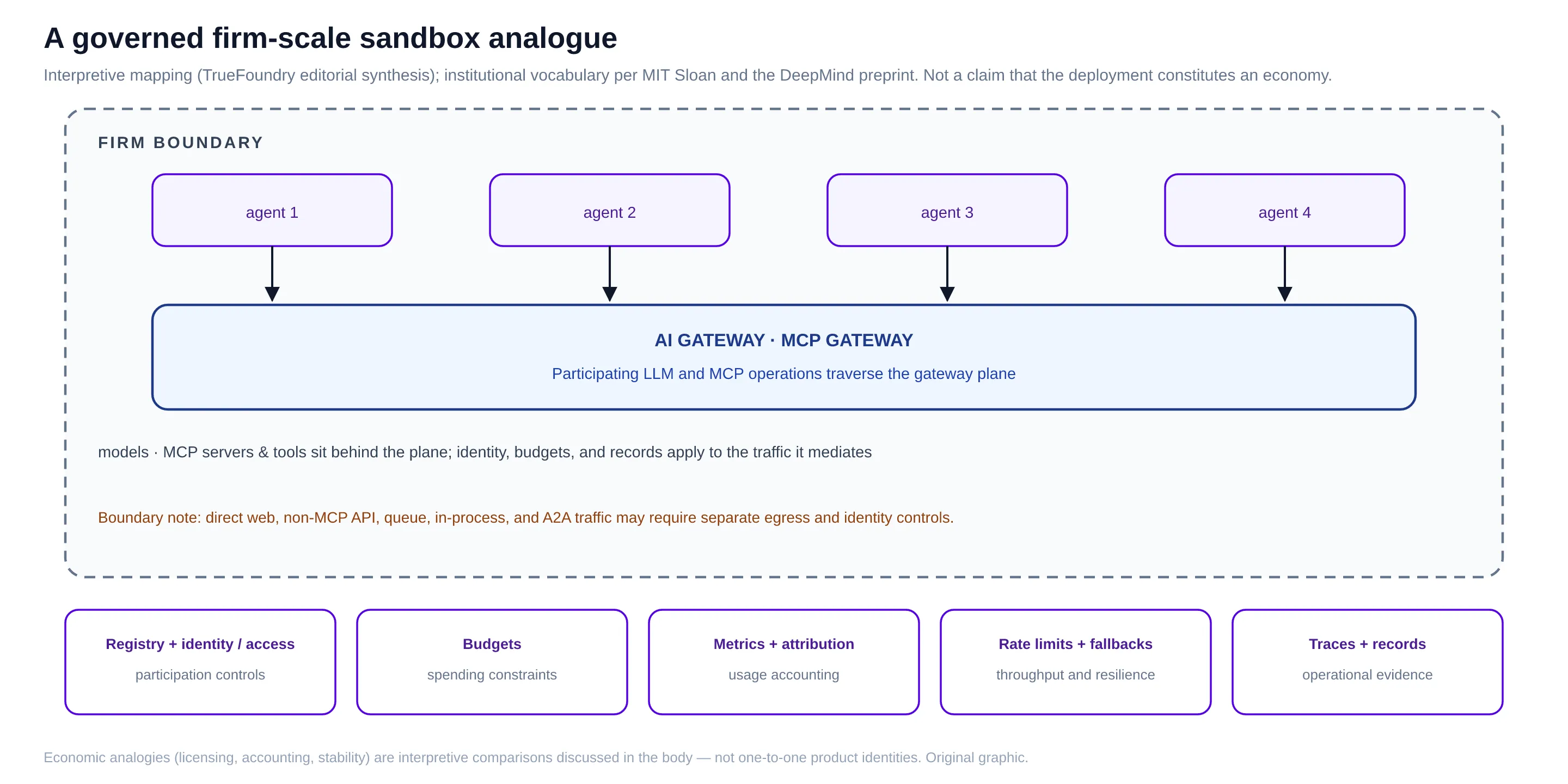
Raskar's first two categories — agent identity and discovery systems ("ICANN for agents") and trust services (passports for agents) — answer the question every market answers before its first trade: who is allowed in, and how do counterparties know who they're dealing with? The firm-scale instrument is the registry stack. MCP servers are hosted, published, and discovered through the MCP registry (registry docs); depending on configuration, the MCP Gateway can resolve the caller as a user, team, virtual account, or service identity and apply server- or tool-level access rules; per-user OAuth can delegate an individual user's downstream permissions where that mode is configured (auth & security docs) — the deployment mechanics of which this blog documented end to end for Google Drive (MCP in Practice, Part 1). Tool-level restrictions narrow what a licensed participant may do; in gateway-managed authentication modes, downstream provider credentials are centralized rather than distributed to each agent, though clients still authenticate to the gateway and some modes allow client-supplied downstream credentials. The analogy's true extent: this is licensing and identity within one jurisdiction. Raskar's categories are about identity that travels between jurisdictions — the inter-firm, open-web version — which no single vendor's registry provides and which is precisely what his Project NANDA and the IETF's agent-identity work are contesting.
The DeepMind abstract's defining anxiety is speed — agents transacting and coordinating at scales and speeds beyond direct human oversight. The classical answer to an economy that outruns its observers is measurement infrastructure, and here the firm-scale instrument is unusually complete. For gateway-mediated activity, the dashboard provides high-resolution usage and cost accounting — model cost and token metrics are attributed, and MCP server and tool volumes and failures are measured (measurement, not necessarily an economic price); the documented Metrics Dashboard pivots cost, token, latency, and failure charts by model, virtual model, user, virtual account, team, or custom metadata keys — the organizational dimensions a business actually budgets on — and extends the same treatment to MCP traffic down to per-server and per-tool call volumes, latencies, and failure breakdowns (Metrics Dashboard docs). Telemetry exports over OpenTelemetry to the enterprise's existing observability stack (gateway docs). In the series' vocabulary, and strictly as analogy: for its gateway-mediated activity, the firm has usage accounting at the individual-request grain, continuously — an operational ledger the macro agent economy conspicuously lacks, and the reason ledger question 6 from No. 1 (what does firm-scale evidence reveal?) is answerable at all.
The sandbox paper's systemic-risk concern — instability propagating through and out of agent markets — is at firm scale a pair of documented mechanisms. Spend governance: tenant- and team-scoped budgets whose rules match users, models, and metadata, with warn-only and hard enforcement modes and budget milestone alerts — a graduated response rather than the binary of an outage (budget docs). Stability mechanics: rate limits per user, model, and application; load balancing across models by weight, latency, or priority; automatic retries and fallback chains configured as virtual models (rate limiting docs; virtual model docs). The analogy is functional rather than exact: a runaway agent loop resembles a demand shock and a provider outage a supply shock, while budgets constrain permitted spend, rate limits constrain request throughput, and virtual-model retries or fallbacks can improve resilience for participating model traffic — none of which regulates a currency, interest rate, money supply, or inter-agent credit market. These controls can constrain selected spending and throughput failure modes before additional requests are admitted; they do not regulate an economy or prevent every form of cascading failure. In that limited sense they dampen propagation — enforced before spend accrues, which is the property month-end reconciliation can never have.
The DeepMind framework's most original contribution is treating permeability as a designed variable, and at firm scale that variable has a physical location: egress — the boundary where internal agents reach the public web. That boundary is acquiring, on the outside, institutions adjacent to Raskar's list: cryptographically signed automated-client authentication through Web Bot Auth at the IETF — a narrow operator-authentication analogue within Raskar's broader passport category, not a reputation system or proof of the end user behind the agent, and machine micropayments through HTTP 402 and the x402 ecosystem (his stablecoin-micropayments category) — developments whose plumbing this blog analyzed in depth (agent loops on the metered web). The precision note from that post carries over verbatim in spirit: TrueFoundry's documentation describes neither x402 nor Web Bot Auth, and this post claims neither. The mapping claim is architectural and bounded: the LLM and MCP gateways are two possible enforcement points within a broader permeability architecture — direct browser access, general network egress, non-MCP APIs, queues, payment rails, and agent-to-agent communication may require controls outside the AI Gateway. TrueFoundry can govern and observe participating LLM and MCP operations routed through its gateways. General web egress, direct APIs, non-MCP tools, queues, in-process calls, and agent-to-agent traffic may require separate identity, network, policy, and accounting controls. The bespoke-currency idea from the preprint has no firm-scale counterpart here: a cost allowance is not a transferable currency, medium of exchange, settlement asset, or store of value.
Trust and reputation — in both source frameworks, reputation arises from contribution quality and histories of interaction that travel between parties. At firm scale, logs and metrics can provide evidence about behavior, but nothing computes a reputation score or transports it across administrative domains; the IETF Web Bot Auth charter explicitly excludes reputation assignment. Gap, on the record.
Payment and settlement — Raskar's stablecoin-micropayments category and the DeepMind bespoke-currency lever both presuppose transferable value. TrueFoundry documents no transferable currency, inter-agent settlement rail, x402 implementation, or payment-market mechanism; the emerging rails (HTTP 402, x402) are evolving outside the platform. Gap, on the record.
A mapping that only reports matches is marketing, so here are the misses. Insurance, repair, and legal services — Raskar's third category — has at best a partial analog: step-level run traces and request records can provide operational evidence for incident investigation — not underwriting, legal adjudication, or a complete liability framework (Agent Harness docs), and approval gates on configured sensitive tool calls are loss prevention, but nothing at firm scale prices agent risk, underwrites it, or adjudicates it. Responsibility and loss allocation depend on contracts, insurance, organizational policy, and applicable law; the platform does not price or allocate that risk — ledger question 5 from No. 1, still open. Mission economies — the DeepMind lever for orienting agent markets around collective goals — is an organizational and governance choice no platform supplies; the nearest documented machinery (approval gates, staged expansion based on measured outcomes) constrains how agents pursue objectives, not which objectives the estate is pointed at. Those two additional gaps are worth keeping visible: they mark where the agent economy's institutions will have to come from outside the infrastructure layer.
The links of documentations could be found in References below.
Four bounds. The mapping is TrueFoundry's editorial synthesis: neither MIT Sloan nor the DeepMind authors evaluate, mention, or endorse TrueFoundry, and Virtual Agent Economies remains a preprint. Firm scale is not economy scale — a sandbox with one owner, one budget authority, and one administrative policy domain sidesteps exactly the coordination problems (openness, inter-jurisdiction identity, consolidation) that make the macro question hard, so nothing here answers Raskar's ownership question; it only shows what the institutions look like when someone can simply decide to have them. Analogy strengths in the table are our judgments, made to be argued with. And capabilities are paraphrased from public documentation current at the time of writing — the durable content is the mapping's structure, not any snapshot of a docs page. Firm-scale deployments can contribute comparatively high-resolution evidence to the series going forward: attribution data, budget events, and trace records from governed, gateway-mediated deployments — which is where a future entry in this series will pick up ledger question 6.
Serie: Agentenökonomie, Nr. 2 · ← Nr. 1: Was ist die Agentenökonomie – und wer darf sie gestalten?
Zweiter Beitrag einer offenen Serie zur Agentenökonomie. In diesem Beitrag werden keine direkten Zitate aus den Primärquellen verwendet; alle Inhalte sind paraphrasiert und mit Links versehen. Die Zuordnung von Institutionen zu Instrumenten sowie die Einschätzungen zur Stärke der Analogien sind redaktionelle Synthesen von TrueFoundry. Die Plattformfunktionen wurden auf Basis der zum Zeitpunkt der Erstellung öffentlichen Dokumentation zusammengefasst.
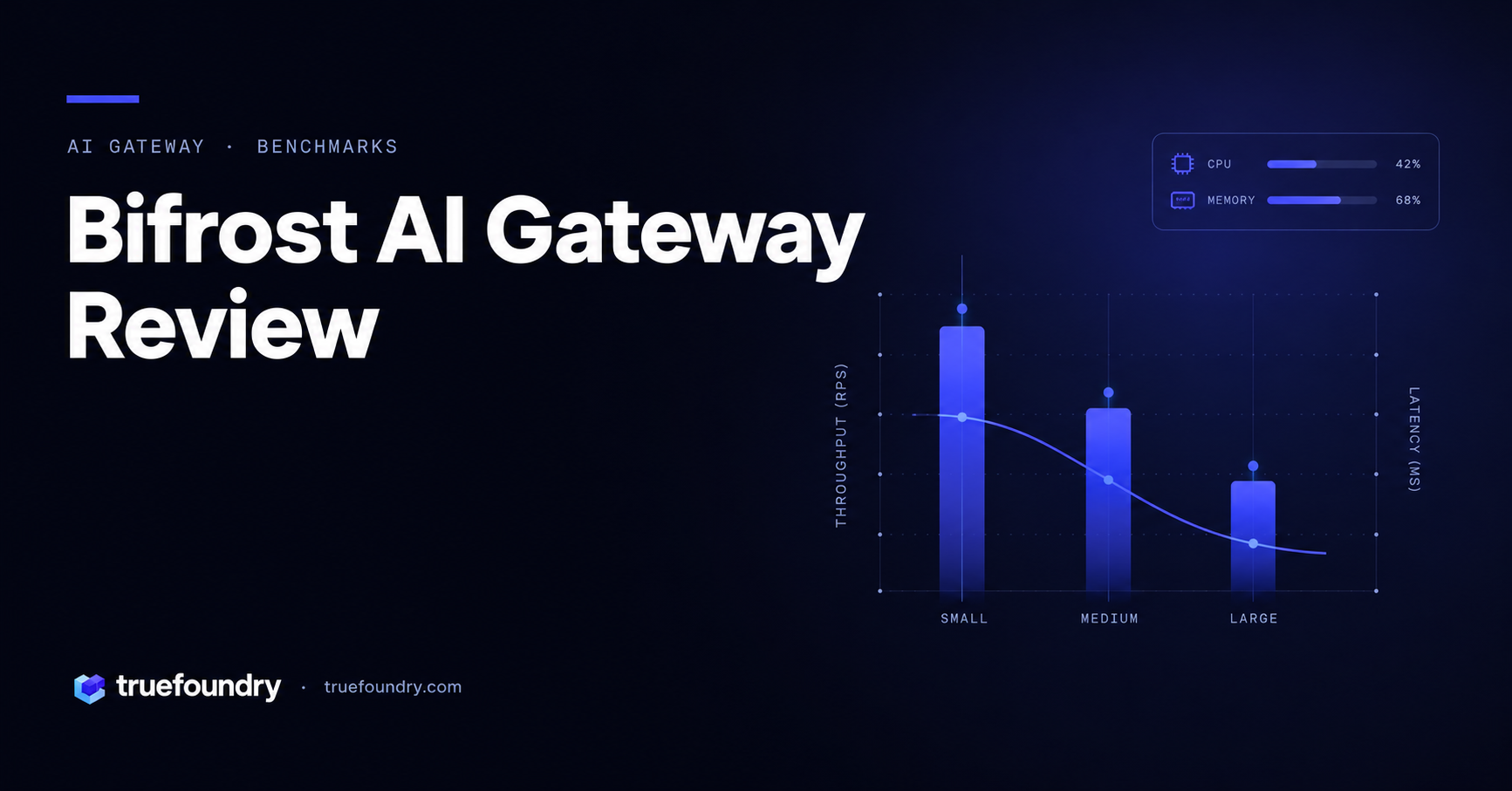
TrueFoundry AI Gateway bietet eine Latenz von ~3—4 ms, verarbeitet mehr als 350 RPS auf einer vCPU, skaliert problemlos horizontal und ist produktionsbereit, während LiteLM unter einer hohen Latenz leidet, mit moderaten RPS zu kämpfen hat, keine integrierte Skalierung hat und sich am besten für leichte Workloads oder Prototyp-Workloads eignet.





Die neuesten Nachrichten, Artikel und Ressourcen werden in Ihren Posteingang gesendet


.png)
.png)
.png)
.png)
.png)
.png)
.png)
.png)
.png)
.png)
.png)


