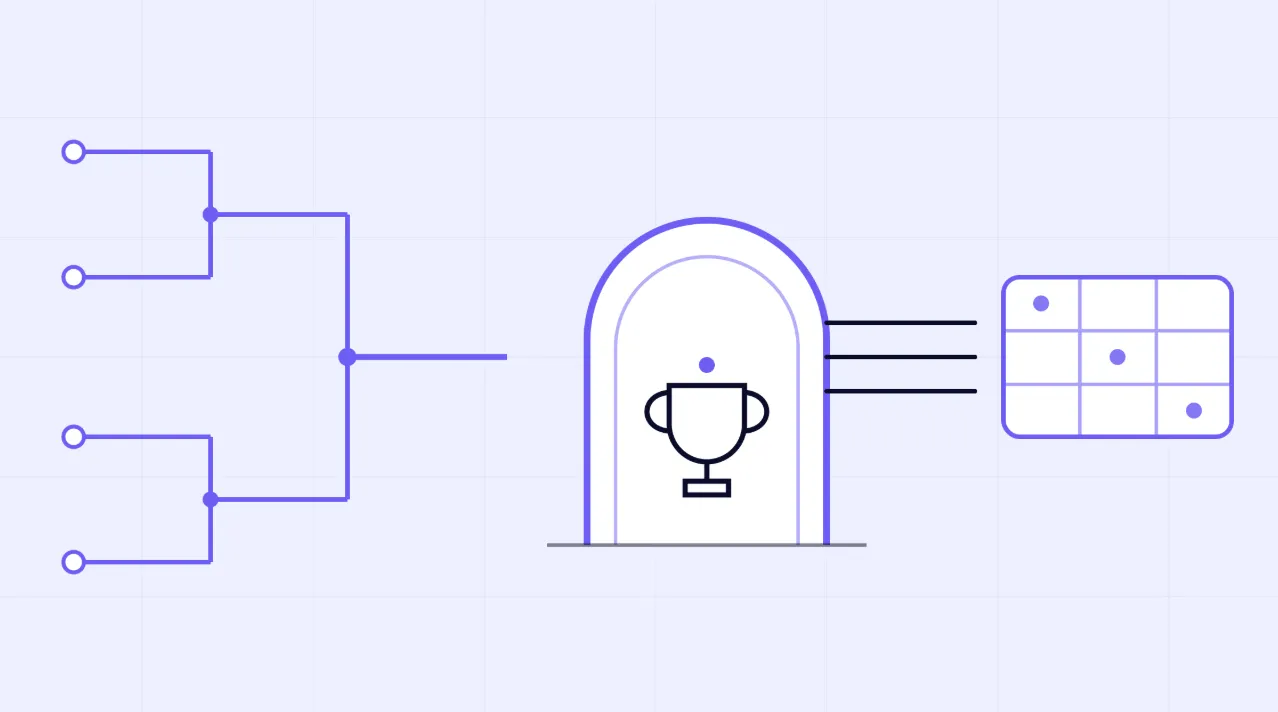
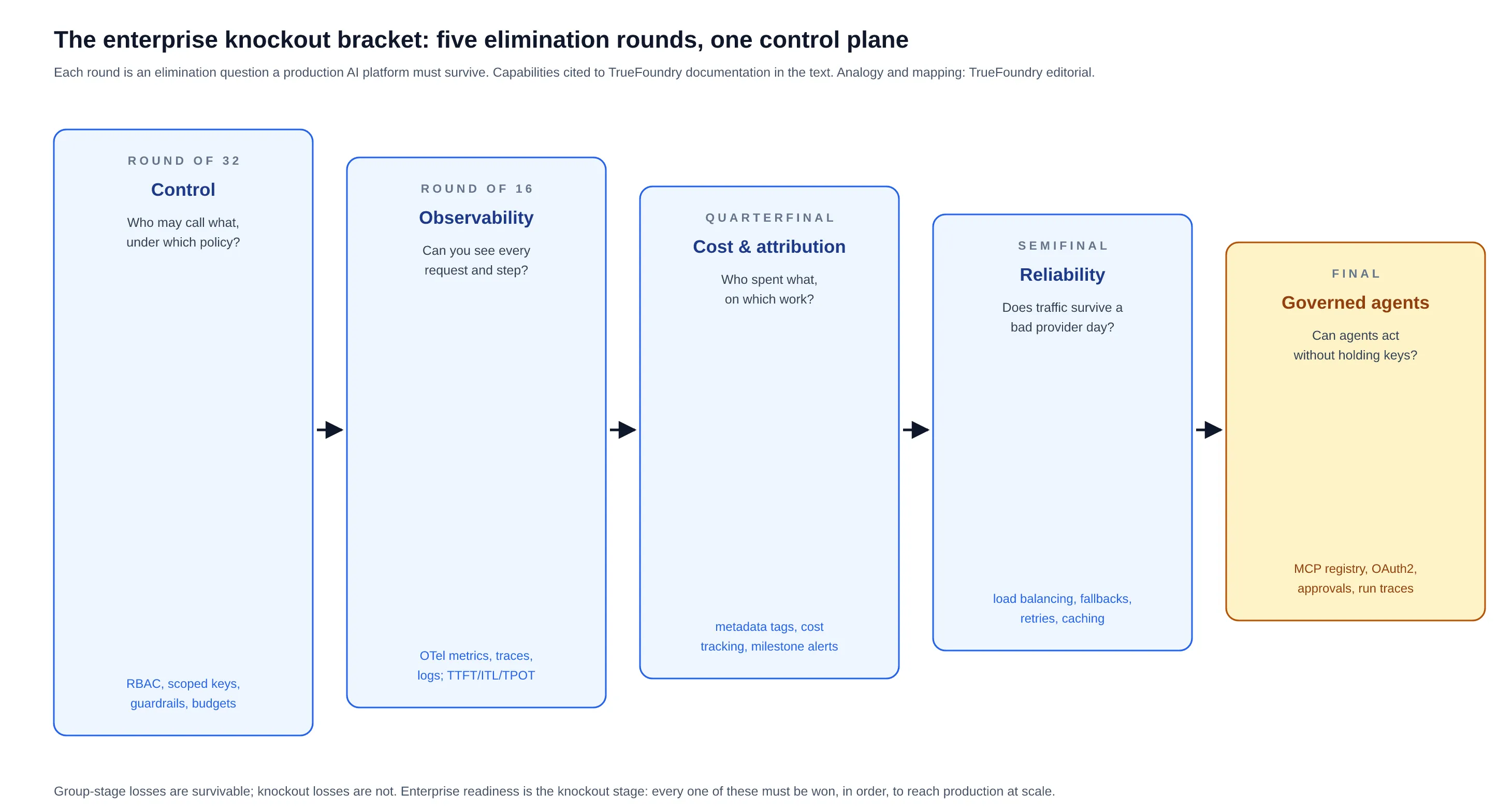
The group stage of enterprise AI — pilots, experiments, tolerated failures — is over; enterprise readiness behaves like a knockout bracket where each unanswered question (who can call what, what did it cost, what did the agent do) eliminates a platform from production, whatever its model quality.
Round of 32 — control: RBAC and scoped keys for users, teams, and applications; rate limits per user, model, and application; tenant- and team-scoped budgets with warn-only and hard modes plus milestone alerts; and guardrails (PII, prompt injection, moderation, custom policies) applied in the serving path — all documented gateway configuration.
Round of 16 — observability: the documented Metrics Dashboard covers LLM and MCP traffic in one place — request latency, time to first token, inter-token latency, and time per output token with P50/P75/P90/P99 selectors; failure-rate breakdowns by error type; guardrail outcomes (blocked, flagged, mutated); and per-tool MCP metrics — with OpenTelemetry export to the stack the enterprise already runs.
Quarterfinal — cost: the same dashboard pivots every chart by model, virtual model, user, virtual account, team, or custom metadata, which is what turns raw spend into attribution — cost of inference over time, by the dimension the CFO actually budgets on — backed by semantic caching and batch APIs for the spend that shouldn't exist at all.
Semifinal — reliability: load balancing across models by weight, latency, or priority with automatic retries and fallbacks, per the gateway documentation — the difference between a provider's bad day and your product's bad day.
Final — governed agents: an MCP registry with centralized authentication, per-user delegation, tool restrictions, and approval gates; agents can reference tools by name without embedding downstream service credentials in agent code, and runs produce step-level traces — the newest and most operationally demanding round in this framework.
Where the analogy breaks, we say so: production is a season, not a final, and a platform is not a strategy. But the bracket's core property transfers — in the knockout phase, strengths don't offset gaps. A brilliant model does not compensate for unattributed spend or an unobservable agent.
TrueFoundry AI Gateway delivers ~3–4 ms latency, handles 350+ RPS on 1 vCPU, scales horizontally with ease, and is production-ready, while LiteLLM suffers from high latency, struggles beyond moderate RPS, lacks built-in scaling, and is best for light or prototype workloads.


.webp)







.png)

.png)
.png)


.png)
.png)
.png)
.png)
.png)