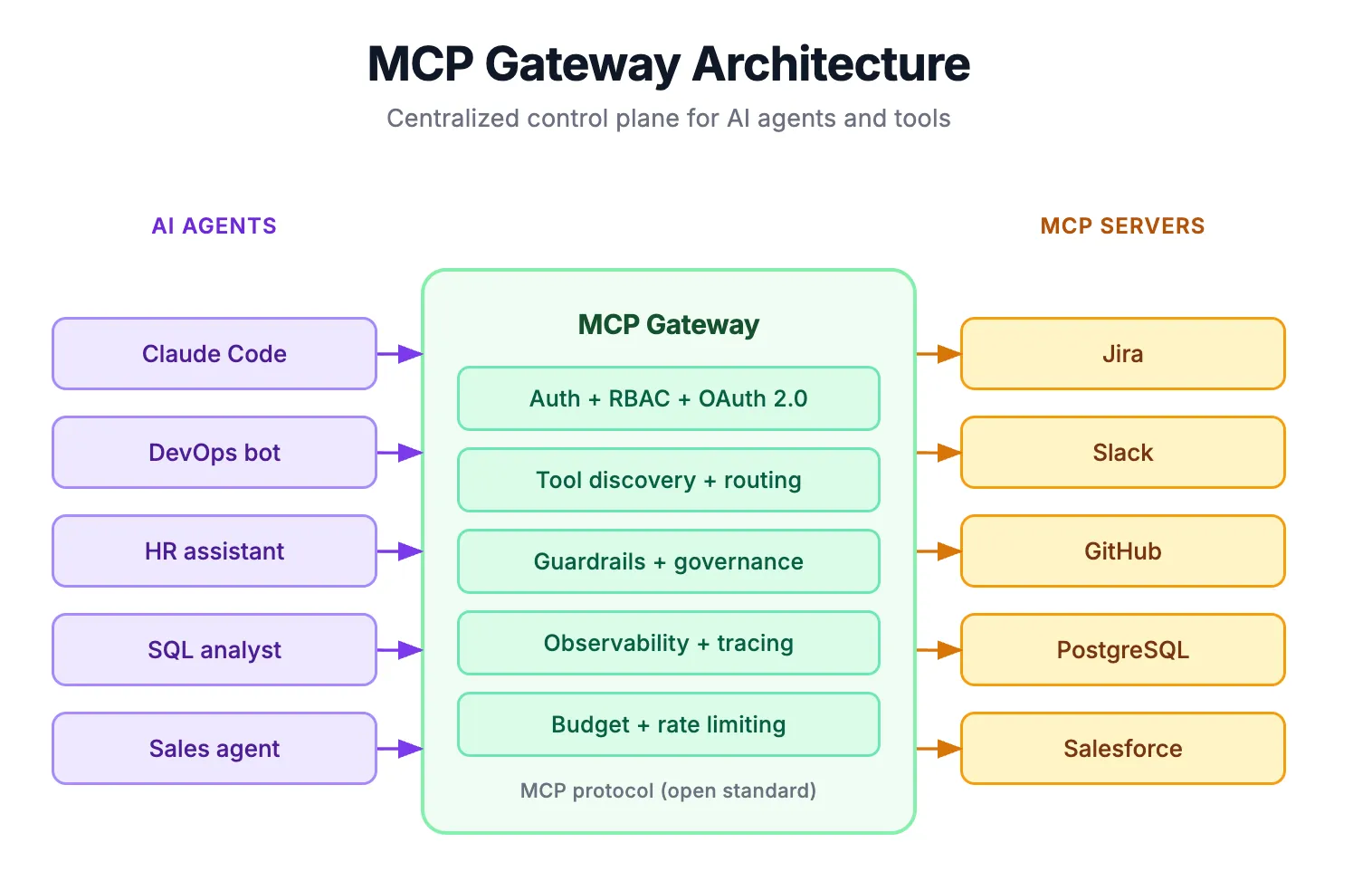
Bifrost is an open-source AI gateway that was built in Go by Maxim AI (H3 Labs). It provides teams with a centralized interface that works with multiple LLM providers through the same OpenAI-compatible endpoint, as well as allows teams to perform tasks with their own MCP Tools.
The Bifrost Gateway is completely self-hosted and available for both Docker and NPX deployment and uses an Apache 2.0 open source license. Additionally, Bifrost provides complete native MCP capability, serving as both an MCP Client and Server; this centralisation of authentication, authorisation, and tool discovery gives Teams a single Control Layer for managing all of their LLM workloads.
Bifrost has also incorporated Maxim AI’s observability platform for its production environment monitoring.
Why teams look for alternatives
Many organizations that use Bifrost to serve as their Managed Control Point (MCP) gateway are considering other options because of some limitations that Bifrost has, including:
Enterprise Governance: Advanced features that are typically included with higher-tier solutions; for example, have the ability to create guardrails, cluster instances of applications, use adaptive load balancing, create federated authentication models, etc., are often excluded from Bifrost’s service.
Operational Burden: There is no managed cloud option for teams to use; therefore, your team must manage the entire infrastructure lifecycle–deploying infrastructure, scaling it, upgrading it, maintaining it, etc.
Lack of AI Lifecycle: Bifrost only covers a portion of the full AI Lifecycle–only the gateway layer. It does not include capabilities for deploying and/or fine-tuning models or managing prompts.
Observability Lock-In: Bifrost’s deeper observability capabilities come with Maxim AI’s proprietary platform and, as a result, cannot be used with an open observability tool.
Complexity of Orchestrating Multi-Agent Workflows: As an organization’s systems grow in complexity, the number of agents on their system and how they interact require significant custom engineering. Most of this custom engineering must go beyond simply routing tools.
In this document, we will be exploring the best alternatives to Bifrost in 2026 with respect to solving the problems that Bifrost has in regards to MCP Routing, Governance, Observability and full-stack AI Infrastructure.
How Did We Evaluate Maxim AI MCP Gateway (Bifrost) Alternatives
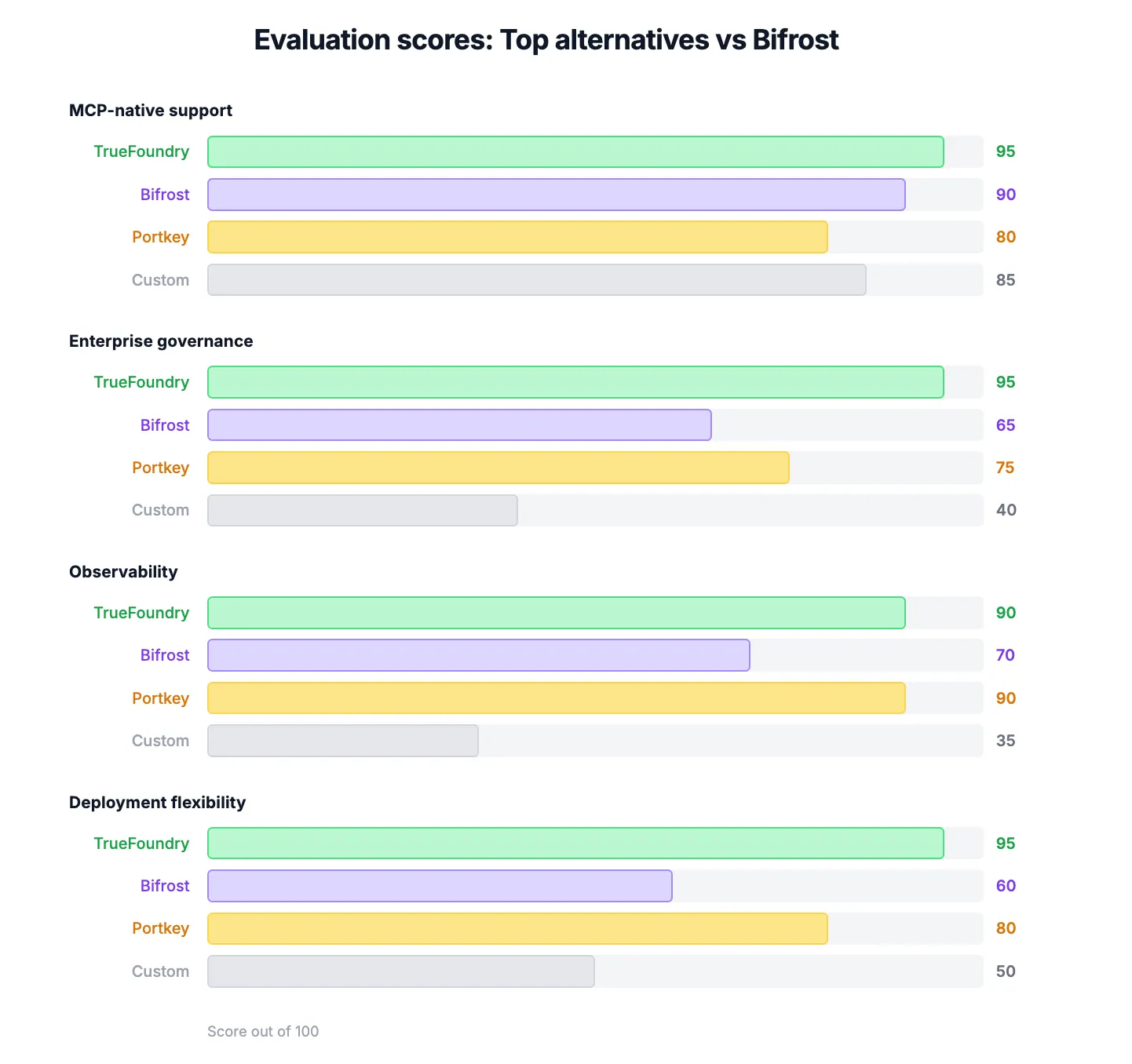
We assessed Maxim-AI MCP Gateway alternatives to determine which represented production ready solutions, based upon 4 major factors.
1. MCP-native vs. MCP-compatible
MCP protocol support varies by platform. During our analysis, we identified two distinct categories:
MCP-native: All standard tools can be discovered through the MCP standard. Tools can be invoked during execution and work in a seamless manner with MCP clients (e.g., Claude Desktop, Cursor, VS Code).
MCP-compatible: Tools will either employ proprietary mechanisms to call and/or invoke (e.g., OpenAI function calling or AWS actions), or will provide adapters/bridges to MCP; however, no native implementation of the MCP exists.
Overall, during our evaluation of platforms, native implementations scored higher than non-natives. Native implementations lower latencies, remove unnecessary translation layers, and eliminate proprietary middleware from/for tools/agents resulting in faster, easier and more reliable tool invocation.
2. Enterprise capabilities (Authorization, Oversight, and Audit Processes)
Routing alone does not work for a production environment. Therefore, we evaluated four main areas that represent a gauge of how capable the platform is at supporting enterprise-level governance:
Identity and access management: Role-based access control and support for third-party identity providers, such as Okta and Azure AD.
Tool permissions: Detailed permissions so users can access and manage individual MCP tools.
Budget controls: The controller enforces the budget limit for the user, team, or application.
Auditing: All model and tool invocations are logged for compliance with standards like SOC2, HIPAA, and EU AI Act.
3. Observability and debugging
An MCP Gateway is a black box without visibility. Therefore, we evaluated the observability of our platforms on:
Distributed Tracing: Correlating LLM decisions with Tool invocations.
Structured Telemetry: With dashboards providing insight into request latency, token usage, errors, and request volume.
Debugging capabilities: Quickly resolving failures through multi-step agent workflows.
4. Deployment flexibility and developer experience
To finish our assessment, we evaluated how easily teams can deploy and scale these platforms to use in real-life situations:
Deployment Options: Managed, Self-Hosted, and Hybrid Deployment Options
Multi-Cloud Support: Support for the vendor lock-in, multi-cloud compatibility with AWS, GCP, and Azure
Developer Experience: Ease of setup, documentation support level, and time it takes to go from a nonexistent to a working (up-and-running) implementation.
The platforms with the most flexible types of deployment and the shortest amount of time to be raised from an existing situation made it have the highest cumulative scores in this category.
Quick Comparison Table - Top 6 Maxim AI MCP Gateway (Bifrost) Alternatives for 2026
Before diving into each platform, here is a quick comparison table to help you understand how the leading Bifrost gateway alternatives differ in focus and capabilities.
Tool
MCP Support
Core Strength
Governance
Best For
TrueFoundry MCP Gateway
Native
Full-stack AI platform + MCP
RBAC, OAuth 2.0, audit, secrets
Enterprise teams needing unified AI infra
Portkey
Native (Gateway 2.0)
LLM gateway + observability
Virtual keys, budgets, RBAC
Observability-first teams
LangChain + LangGraph
DIY (custom)
Agent orchestration framework
Manual
Full control over agent logic
Anthropic MCP Ecosystem
Native (protocol creator)
Deep Claude integration
Basic
Claude-based agent workflows
AWS Bedrock Agents
Proprietary
AWS-native agent framework
IAM, CloudTrail
AWS-invested enterprises
Custom-Built MCP Gateway
Native (self-built)
Full flexibility
Custom
Strong infra engineering teams
1. TrueFoundry MCP Gateway
TrueFoundry, which is recognized as a vendor on the 2025 Gartner Market Guide for AI Gateways, provides an all-inclusive infrastructure platform that includes LLM Routing combined with the ability to manage multiple different MCP Tools, deploy models, manage prompts, and maintain observability through a single control plane.
Key Feature:
Unified LLM + MCP Gateway: Next-gen routing across 1,000+ LLM models from multiple providers, central control of MCP Tool connectivity and central management of Agent workflows from a single dashboard.
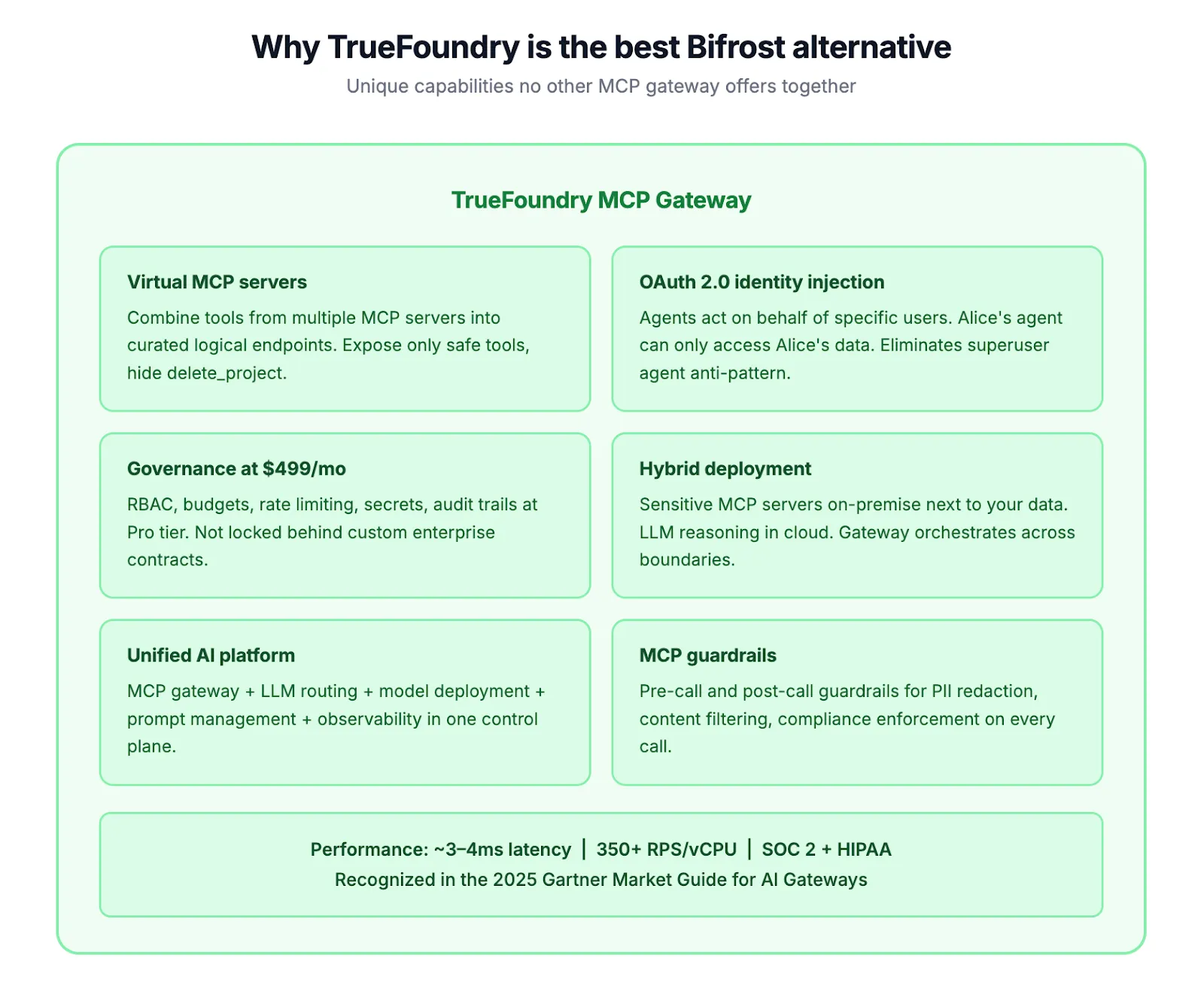
Virtual MCP Servers: Create a curated list of logical endpoints allowing users to combine tools from multiple MCP servers; only expose approved tools for that particular logical endpoint; hide dangerous operations from view.
OAuth 2.0 Identity Injection: Authorize any agent to act on behalf of the user with user permission; removes the "superuser agent" anti-pattern (where all agents use the same set of privileged credentials).
Enterprise Governance at Pro Tier: Included all Enterprise Governance components (RBAC (Role-Based Access Control), Budget Control (spending limits for customers), Rate-Limiting, Secret Management and Audit Trail); no requirement for custom enterprise contracts).
MCP Guardrails: Pre-call and post-call enforcement of PII Redaction, Content Filtering, and Compliance Policies
Deep Observability: Complete support of all OpenTelemetry compliant distributed tracing, latency tracking, Token Analytics and integration with Datadog.
Hybrid Deployment: Maintain sensitive MCP servers locally while handling LLM reasoning in the cloud, with the Gateway managing these interests. Deploy to multiple clouds, utilize Air-gaps, or create Virtual Private Clouds (VPCs).
Performance: Minimally 3 - 4ms Latency (Gateway) to ~350 RPS/vCPU; supports horizontal scaling via in-memory Authentication and Rate Limiting.
Best for:
Enterprise/marketing platform teams want a single solution to control the full lifecycle (from modeling to governing) of all tools; useful for companies subject to regulatory scrutiny (ex. - banking, healthcare & insurance) as there is no leeway to negotiate compliance with SOC 2; HIPAA; and EU AI regulations. Also, teams want to use a managed deployment model while maintaining the option of self-hosting.
Why is TrueFoundry a Better Alternative than Bifrost?
Bifrost may excel in routing but it only provides basic functionality, whereas TrueFoundry offers complete, end-to-end support for the full lifecycle (including deployment, fine-tuning, MCP Governance, prompt management & observability). This eliminates the need to glue together many disparate tools in order to support your models' lifecycle.
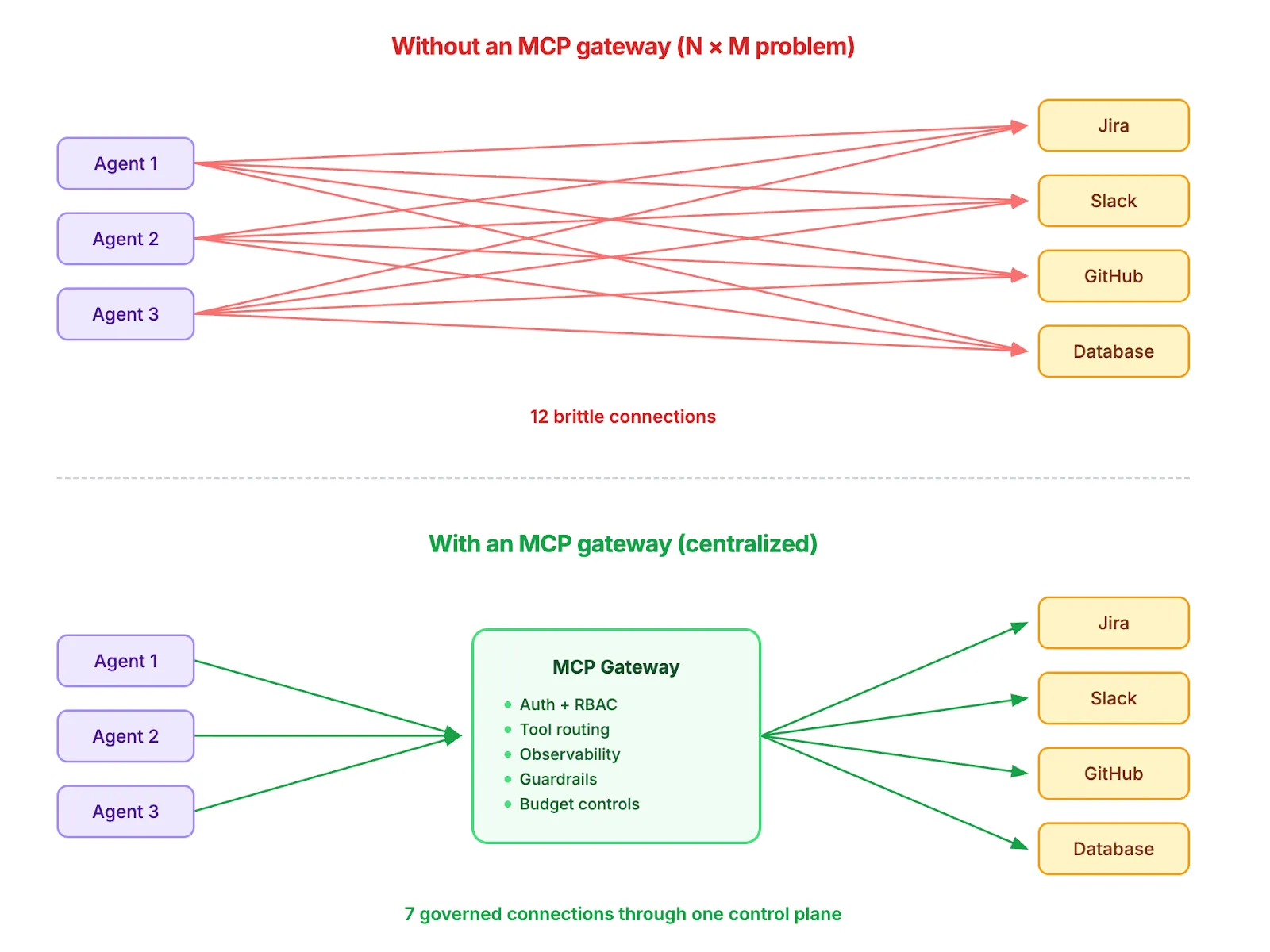
One area where virtual MCP servers are unique is solving the N×M architectural dilemma (i.e., how to route requests through multiple virtual machines). With virtual MCP servers, each of your agents can only connect to the appropriate endpoint(s), which gives them more security than protocols-only connections, and thus allows you to restrict the types of credentials that your agents can use (something that no other gateway we've compared provides).
In addition, Bifrost's guardrails (such as clustered or federated authentication) necessitate you to have a “contract” with them in place, such that you would not know how much those contracts would cost you upfront.
2. Portkey
The Port Key gateway enables a unified API interface to over 1,600 LLMs with production-oriented enablement, integrated observability, and a fully open-source API (MCP) Gateway for centralized governance of all production enablement tools.
Key Features:
Open-source MCP Gateway: the MCP Gateway allows for centralized authentication layers via OAuth 2.1, API tokens, and header authentication, with an immediately inspectable codebase.
Fast Core Gateway: processes more than one trillion tokens in production with sub-1ms latency and 122KB of total footprint each day.
Pros:
Excellent Developer Experience with a three-line SDK for integration, a two-minute installation time, and the ability to work with existing OpenAI-compatible APIs.
Strong Observability: active open-source development community (over 10K GitHub stars) and an observability dashboard with comprehensive functionality.
Compliant with SOC2 and HIPAA: the application can be utilized as a SaaS offering, private cloud, or completely self-hosted.
Cons:
Newer MCP Gateway: the maturity of features in the new MCP Gateway are continuing to catch-up with the existing core LLM Gateway.
No Virtual MCP Server abstractions allow the end-user to determine subsets of tools to be accessed through logical endpoints.
Log retention is limited to thirty days on the Pro tier of the Port Key application.
Best for:
The optimal solution for observability first teams searching for fast, low weight gateway to LLM and MCP routing combined. Startups/mid-market that have already used Portkey to manage LLMs and would like to also manage MCPs under the same governance but don't want to utilize another tool.
3. LangChain + LangGraph
LangChain + LangGraph (the top LLM Application Framework) includes LangGraph, a stateful way to manage multiple agents in a choreographed environment. Use LangChain and LangGraph to create custom workflows that adhere to MCP specifications but are not hosted services.
Key Features:
Flexible agent orchestration - allow full control over the routing decisions you make when composing your workflow.
LangGraph - utilizes stateful execution graphs to allow for coordination between multiple agents while preserving the state of the agent across turns.
LangSmith - provides monitoring, evaluation, and tracing functionality built specifically for agent pipelines.
Pros:
Maximum flexibility - allows you to build your workflow topology to fit your use case.
No vendor lock-in, through the means of a large variety of end-users contributing to the element of assurance.
LangSmith has built-in tools to facilitate development and debugging, allowing for rapid iteration.
Cons:
Not a gateway - routing through MCP, authorization and governance can only be accomplished via custom builds and subsequent management by you alone.
No built-in role based access control, audit trails or enterprise identity management capabilities.
Significant engineering resources needed for building a reliable and secure system for production use.
Best for:
Teams looking to establish complete control over the agent orchestration process, with sufficient engineering resources, and interested in creative, unique uses of multi-agent systems that other LLM gateways will not support.
4. Anthropic MCP Ecosystem Tools
Late last year, Anthropic released their initial MCP (Model Context Protocol) to establish the common standard (open) framework for agent-to-tool connection. Claude Desktop / Code and the SDK all have native support for MCP, representing the initial step in building agents using MCP.
Key Features:
Native Support for MCP: The native integration into each of the three primary products (Claude Desktop / Claude Code / SDK) provides the best integration of all suppliers into the MCP standard.
Open Specification: All of the reference implementations and protocol documentation for MCP is publicly available, allowing for others to build upon.
Growing Ecosystem: There are currently thousands of community created MCP servers supporting databases, API's, development tools, and enterprise level systems.
Claude Code: This supports agentic development via the use of the command line and provides the same direct access to your tool uses through MCP.
Pros:
Protocol Creator: They have the deepest native connection to the MCP standard of any suppliers.
Claude Models have been specifically designed for workflow of tool use and structured data.
MCP is an open standard and does not lock consumers into any vendor at the protocol level.
Cons:
There is no single entry point for accessing all your MCP connections as each instance of Claude is responsible for managing their own connections.
There is no enterprise oriented governance layer (RBAC, Audit Trails, Budget Control).
Limited only to using Claude Models out of the box and require additional tooling to connect multiple vendor usage.
Best for:
Development of Claude First Agent Workflows. Individual Developers and Small Teams currently not focused on Enterprise Oriented governance.
The natural starting for developing new MCP-based agents using Claude will be through the existing Claude tools.
5. AWS Bedrock Agents
An entirely managed agent framework that is hosted in AWS, provides capabilities to orchestrate multi-step tasks to connect foundation models to enterprise data sources through the inherent services of AWS.
Key Features:
Fully managed agent orchestration - automatic multi-step planning and execution with no infrastructure to provision.
Action groups - the ability to connect agents to Lambda function and external APIs to execute real-world tasks.
Observability - default integration of CloudWatch metrics and CloudTrail audit logs.
Pros:
Fully managed - there is no infrastructure to deploy or maintain and a fully scalable environment.
Enterprise compliance is built-in (SOC 2, HIPAA, FedRAMP certifications).
Cons:
AWS-locked - cannot be migrated to other clouds and not supported in on-premise environments.
Complex consumption-based pricing that may be unpredictable at scale.
Best For:
AWS invested enterprises who desire fully managed agent infrastructure within existing AWS ecosystems, IAM policies, and compliance frameworks. Teams that place a premium on operational simplicity over the ability to migrate between cloud offers.
6. Custom-Built MCP Gateway
A custom gateway gives you the most control over how data is routed, how it is secured, and what tools are used; however, you will incur a significant investment in terms of both building and maintaining a custom-built MCP Gateway.
Key Features:
Complete Protocol Control — implement your own specifications to the handling of both the client and server sides of the MCP protocol
Customized Authentication Logic — design authentication and authorization flows that are tailored to meet your application's identity infrastructure
Purpose-Built Architecture — every aspect of the architectural design has been created for the specific workloads and scalability of your application
Pros:
No Licensing Fees — as you will have used only open-source components to create your gateway
TrueFoundry AI Gateway delivers ~3–4 ms latency, handles 350+ RPS on 1 vCPU, scales horizontally with ease, and is production-ready, while LiteLLM suffers from high latency, struggles beyond moderate RPS, lacks built-in scaling, and is best for light or prototype workloads.
BifrostのMCPゲートウェイおよびLLMプロキシの主要な代替製品には、エンタープライズ向けのガバナンス、予算管理、MCPルーティング機能を追加できるTrueFoundryのAI Gateway、マルチプロバイダー対応のルーティングで人気のあるオープンソースのLiteLLM、信頼性と可観測性に重点を置いたPortkey、そしてすでにKongのAPI管理プラットフォームを利用しているチーム向けのKong AI Gatewayなどがあります。




.webp)



.png)
.png)
.png)
.png)
.png)
.png)
.png)
.png)
.png)
.png)
.png)





